Inspiration
Developers spend a significant amount of time writing repetitive code, creating test cases, debugging errors, and repeatedly running programs to verify their solutions. We wanted to build an AI coding assistant that does more than generate code—it should write, test, understand failures, and improve its own solution.
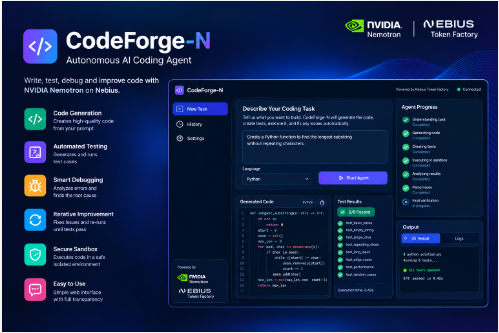
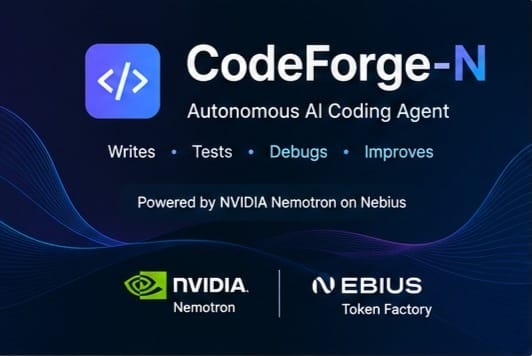
This inspired us to create CodeForge-N, an autonomous AI coding and testing agent powered by NVIDIA Nemotron through Nebius Token Factory.
What We Built
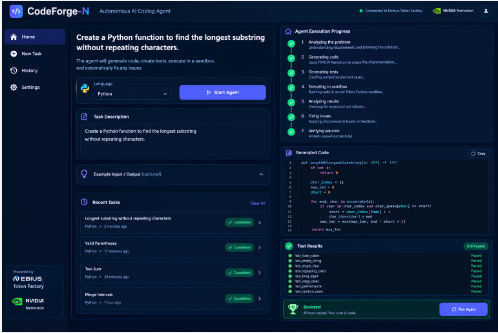
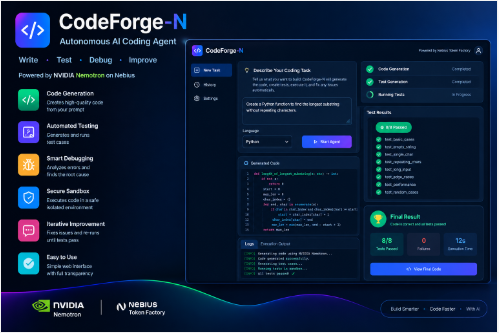
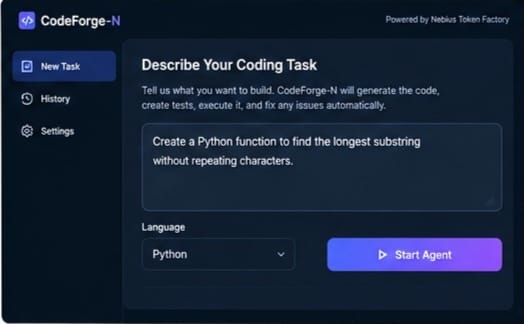
CodeForge-N takes a programming task from the user and manages the development workflow automatically.
The agent:
- Understands the user's coding requirement.
- Generates an initial solution using NVIDIA Nemotron.
- Creates relevant test cases.
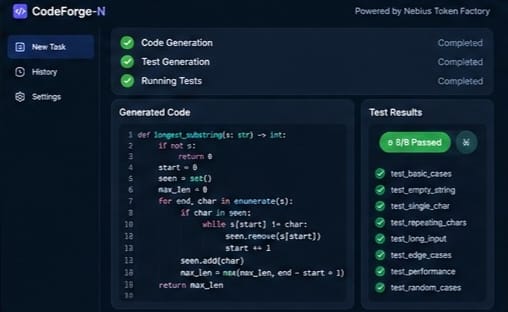
- Executes the generated code.
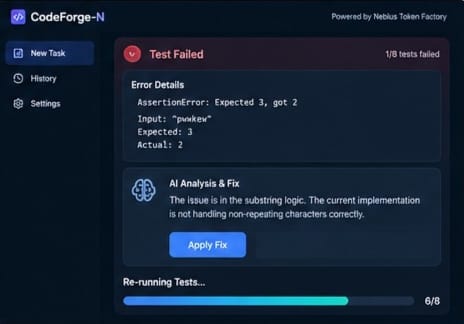
- Detects compilation, runtime, and test failures.
- Analyzes the failure using Nemotron.
- Generates a corrected solution.
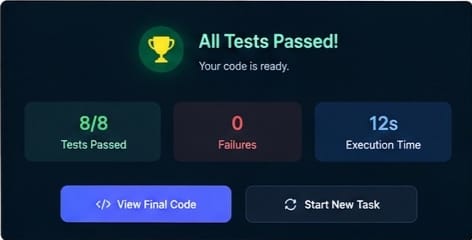
- Runs the tests again and verifies the result.
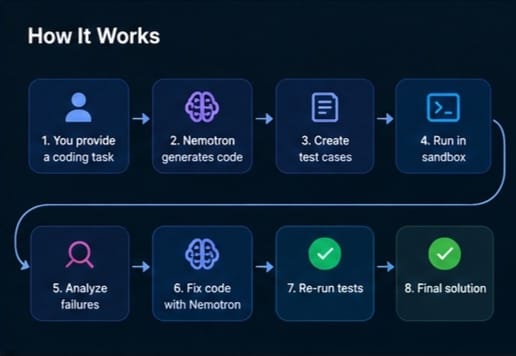
The core workflow is:
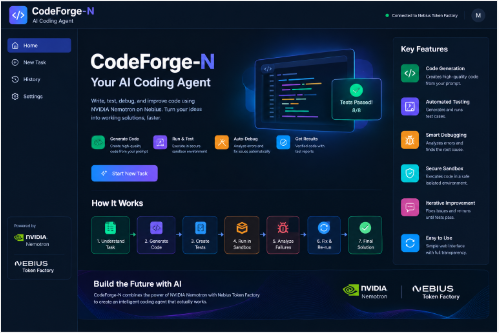
Coding Task ↓ Nemotron ↓ Code Generation ↓ Test Generation ↓ Code Execution ↓ Failure Analysis ↓ Automatic Fix ↓ Re-test ↓ Verified Solution
How We Built It
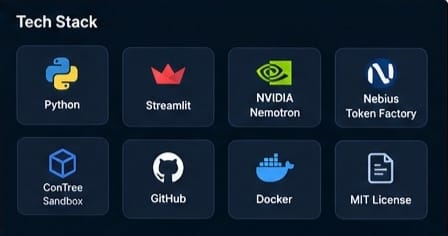
We built the application using Python with a simple web interface and an agent-based architecture.
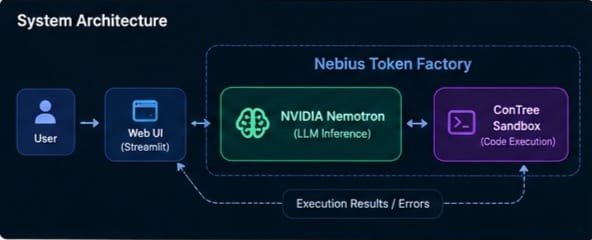
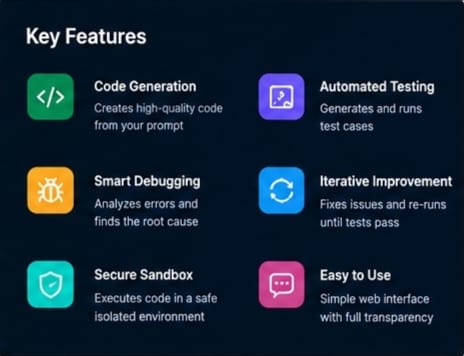
Nebius Token Factory is used for runtime inference with NVIDIA Nemotron. Nemotron handles code generation, reasoning, test generation, and debugging. The generated code is executed in a controlled sandbox environment so that the agent can receive real execution results instead of relying only on the model's assumptions.
The system is divided into components for planning, coding, test generation, execution, debugging, and evaluation. This makes the workflow easier to test and allows each part of the agent to be improved independently.
What We Learned
One of our biggest learnings was that effective AI coding requires more than generating a good first response. A coding agent becomes much more useful when it can observe execution results and use them to improve its solution.
We learned how to design an iterative agent workflow, structure prompts for different software-engineering tasks, process test and runtime feedback, and integrate an open-source NVIDIA model through Nebius Token Factory.
We also learned the importance of verification. Instead of assuming that generated code is correct, CodeForge-N uses testing as part of the generation process.
Challenges
The main challenge was dealing with incorrect or incomplete AI-generated code. Generated solutions can contain syntax errors, incorrect logic, or fail on edge cases even when they appear correct.
We addressed this by building a feedback loop:
Generate → Execute → Analyze → Fix → Execute Again
Another challenge was connecting model reasoning with actual program execution. We needed to provide structured test results and error information to Nemotron so that it could identify the cause of a failure and generate a targeted correction.
We also considered the security and reliability of executing AI-generated code and designed the project around controlled execution rather than running arbitrary generated code directly on the host system.
Why It Matters
CodeForge-N demonstrates how AI can move from simple code generation toward an agentic software-development workflow.
By combining NVIDIA Nemotron's reasoning capabilities with Nebius Token Factory and sandboxed execution, the project creates a continuous feedback loop between AI-generated code and real execution results.
Our vision is to evolve CodeForge-N into a development agent capable of handling larger software tasks, repository-level changes, automated testing, debugging, and pull-request generation.

Log in or sign up for Devpost to join the conversation.