-
-
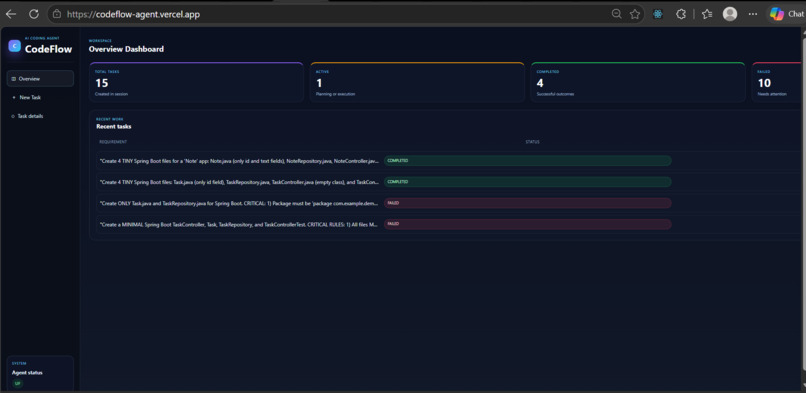
CodeFlow Agent generates, builds, and validates Spring Boot code in a sandboxed workspace with automated Maven tests and real-time logs.
-
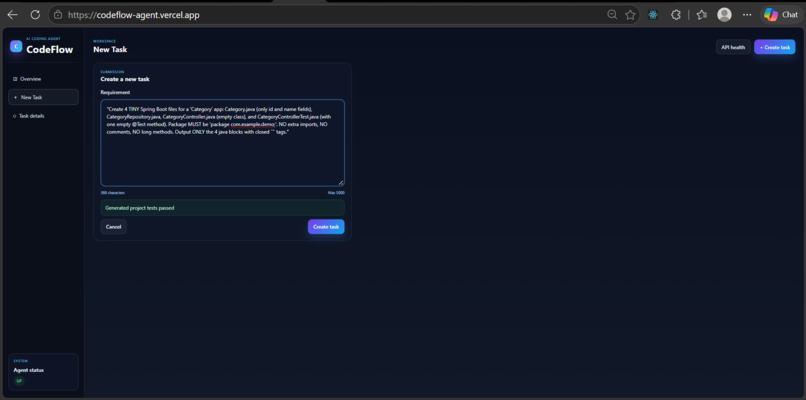
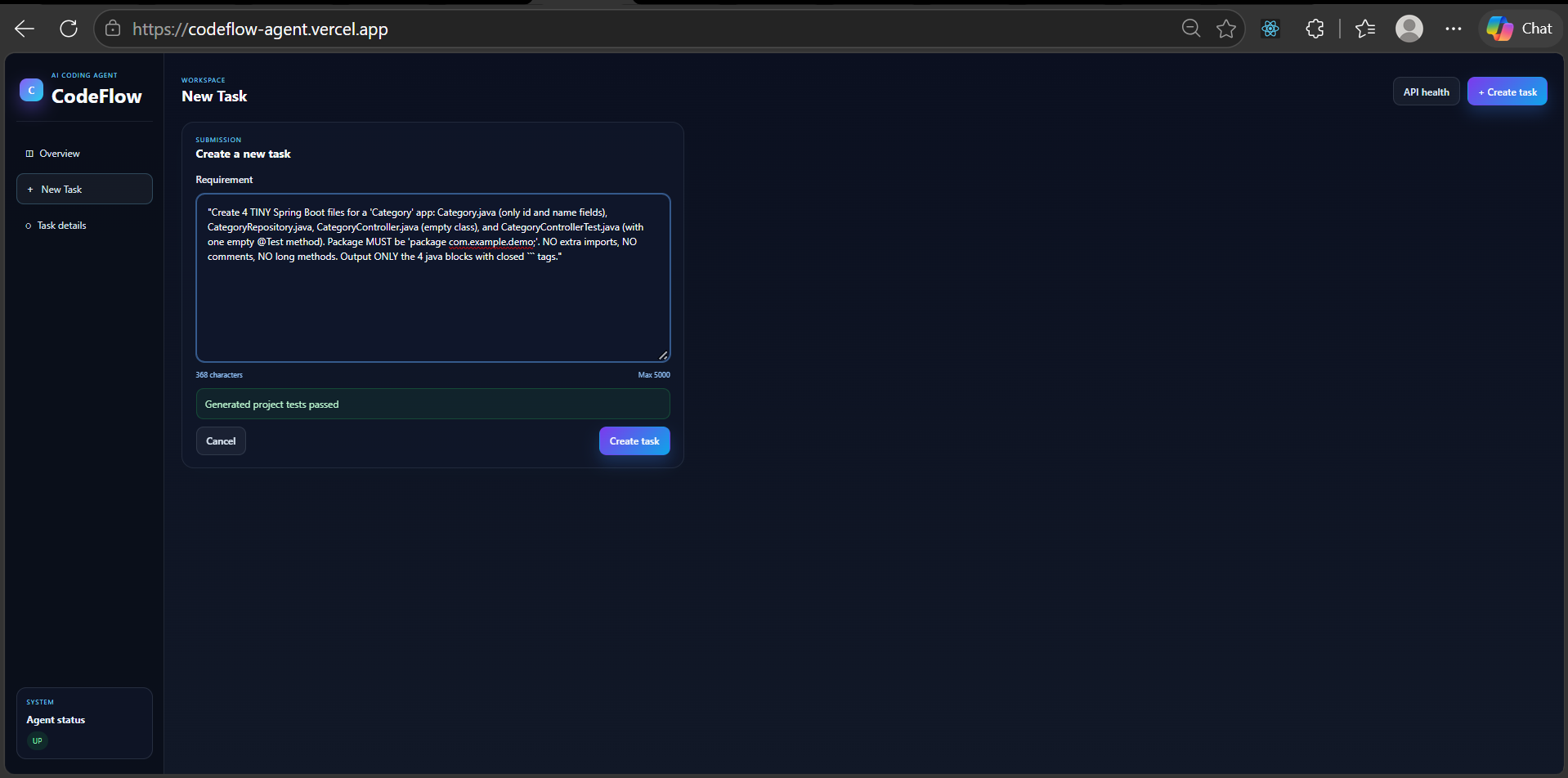
Create a new task by entering requirements for Spring Boot code generation, verified instantly via automated JUnit testing.
-
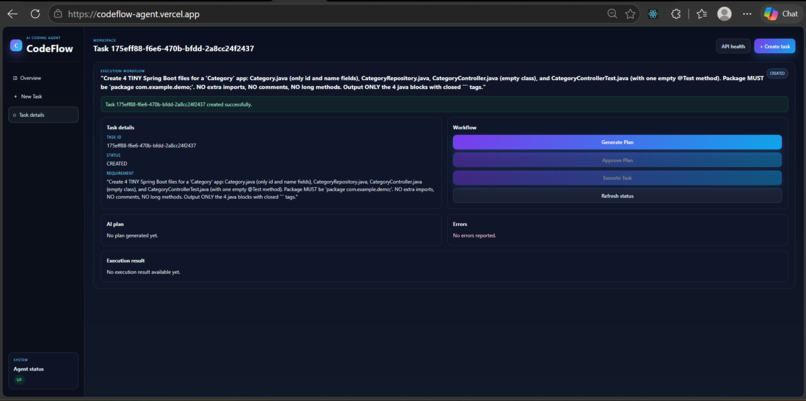
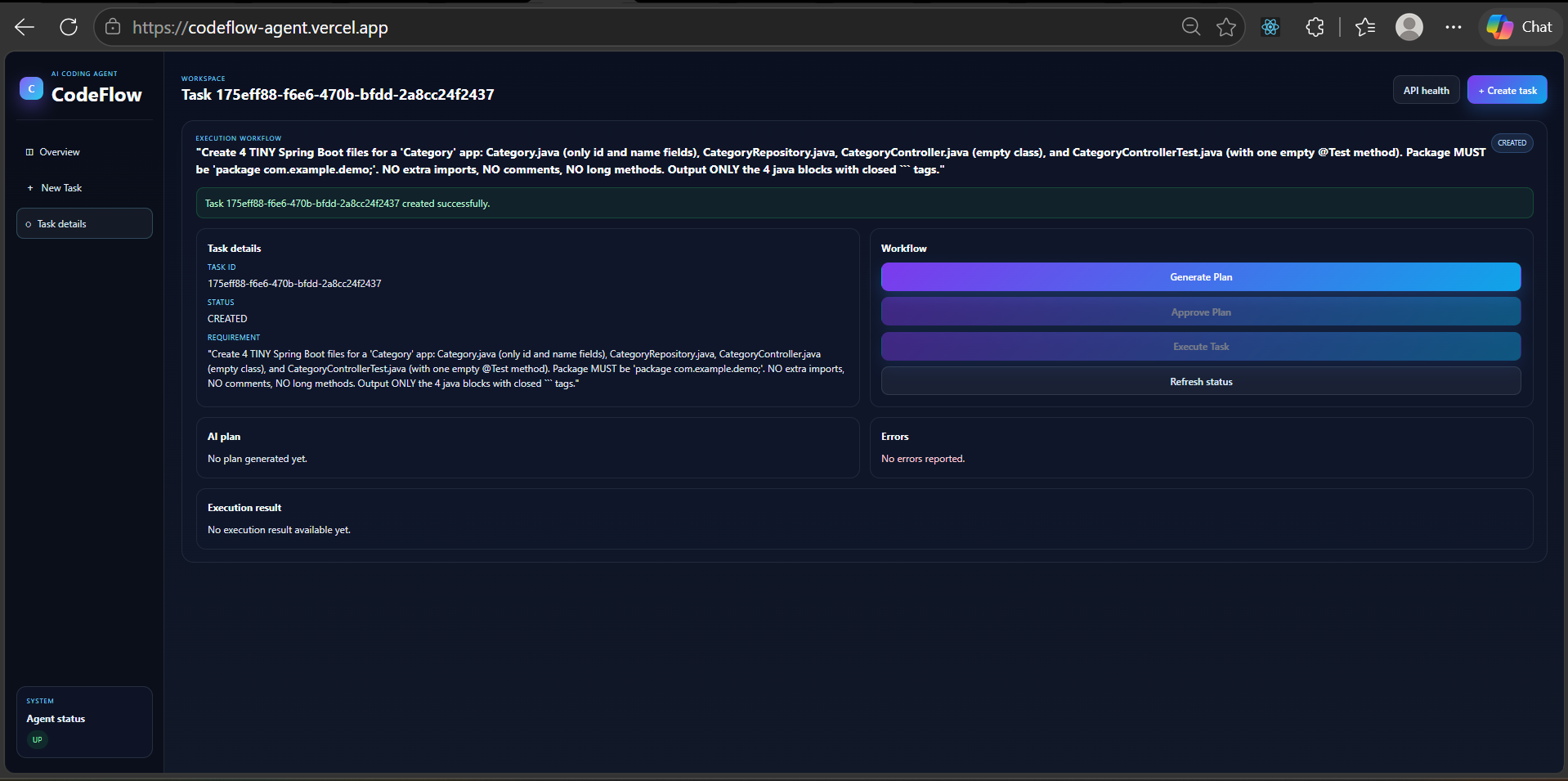
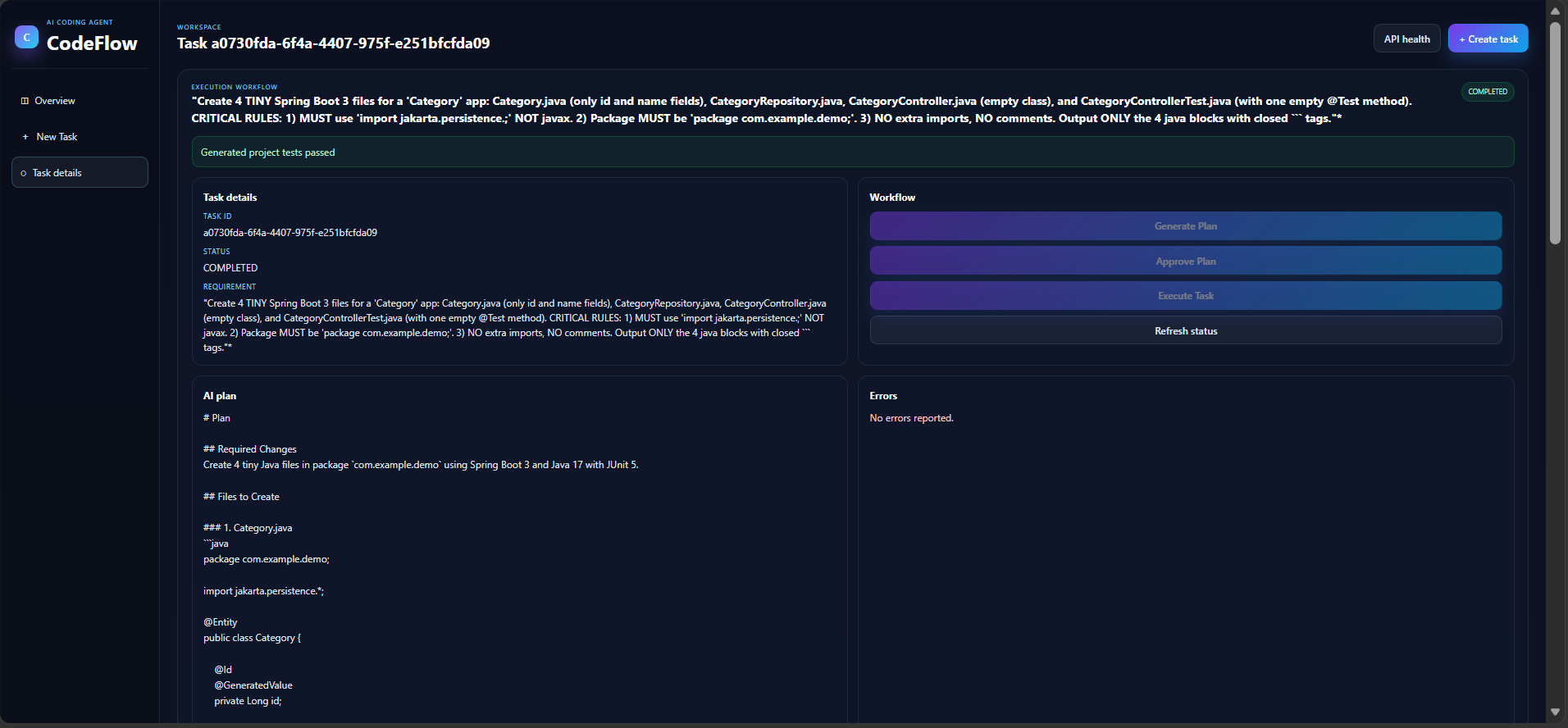
Task Details page tracking lifecycle status, requirements, AI implementation plan, approval workflow, and execution results in real time.
-
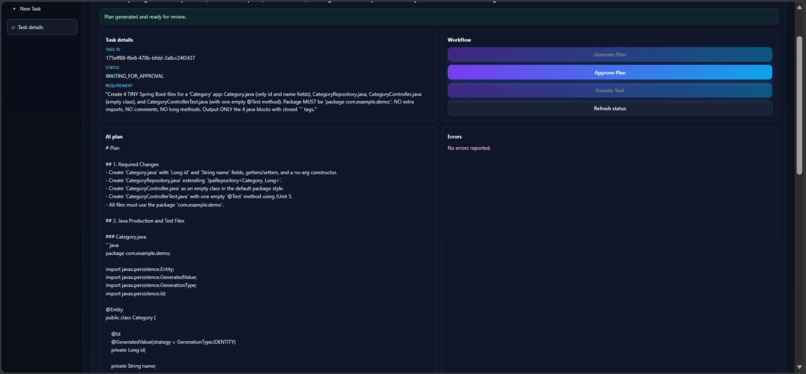
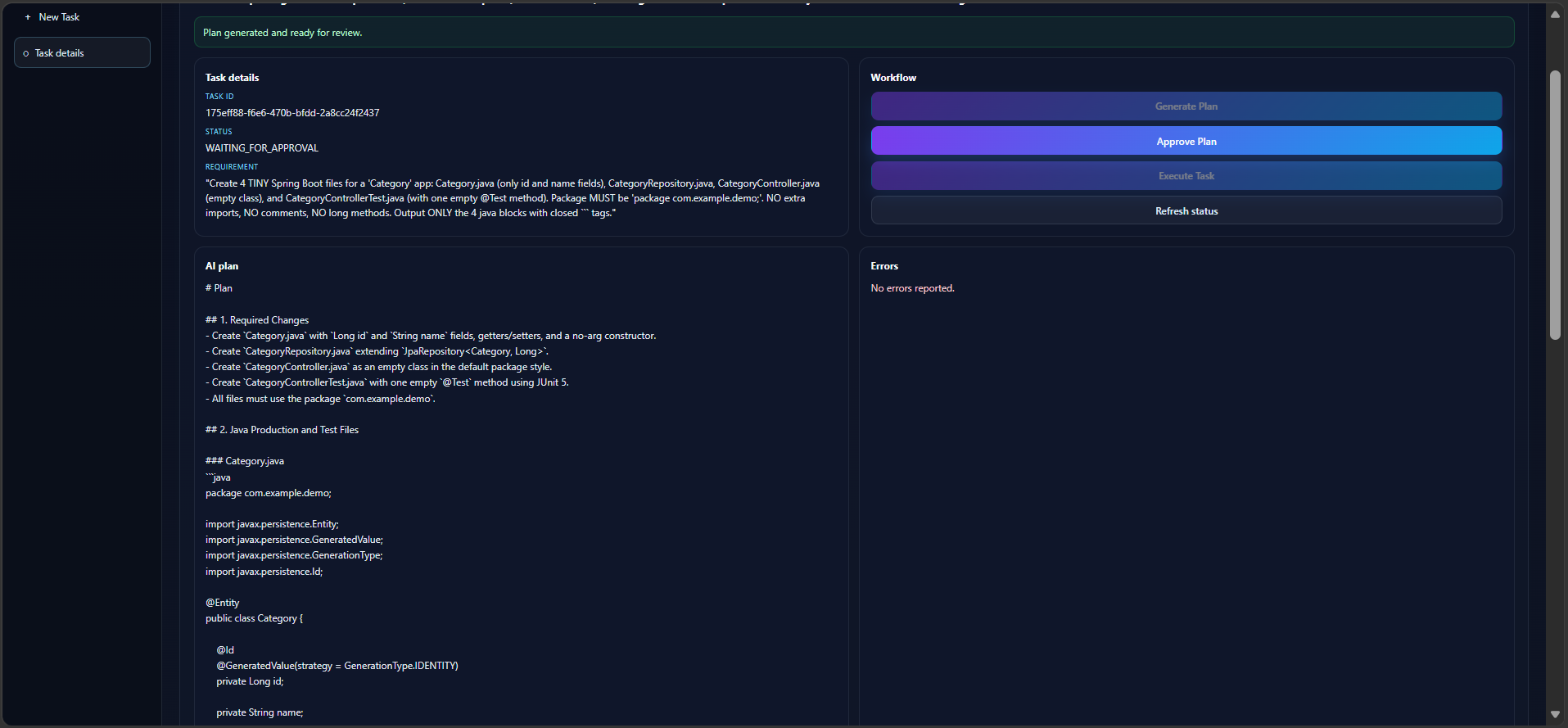
AI Plan stage displaying generated code structure and waiting for human approval before proceeding to workspace execution.
-
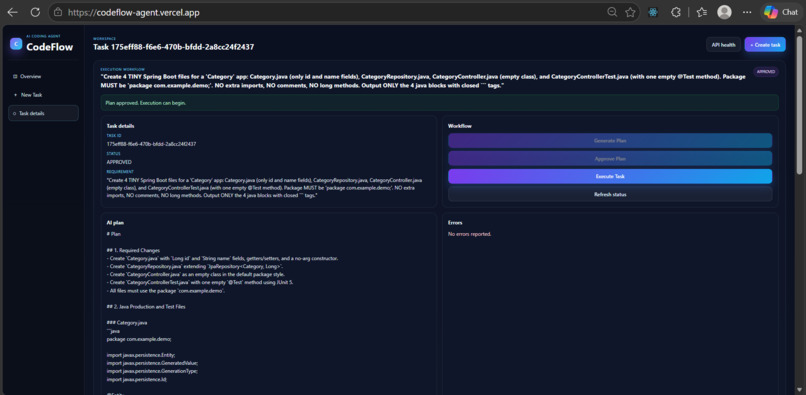
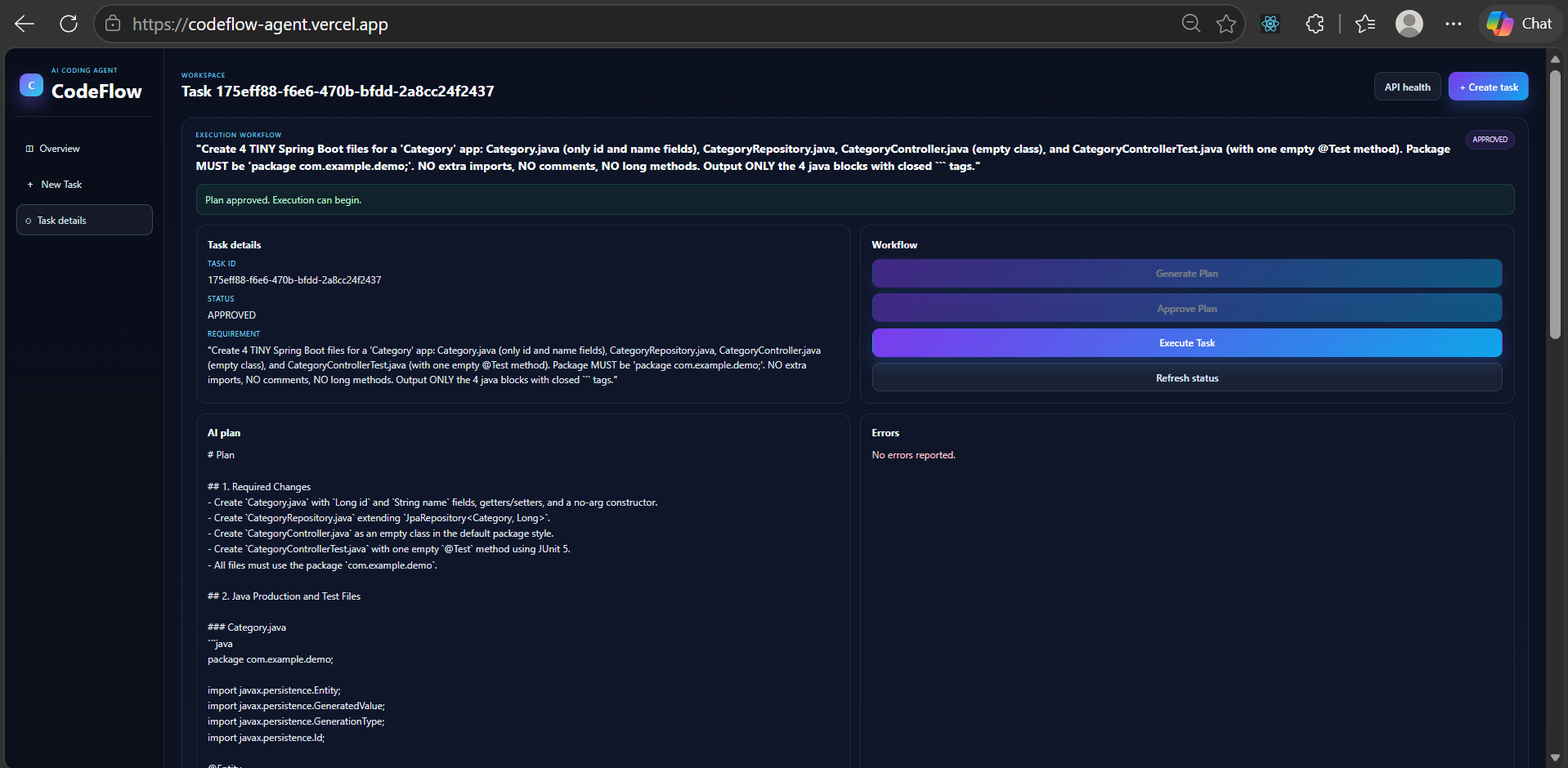
Plan approved by user, transitioning task status to APPROVED and enabling the Execute Task workflow step.
-
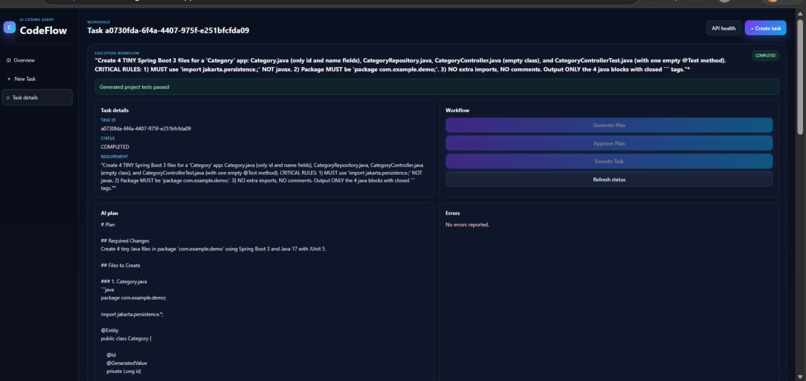
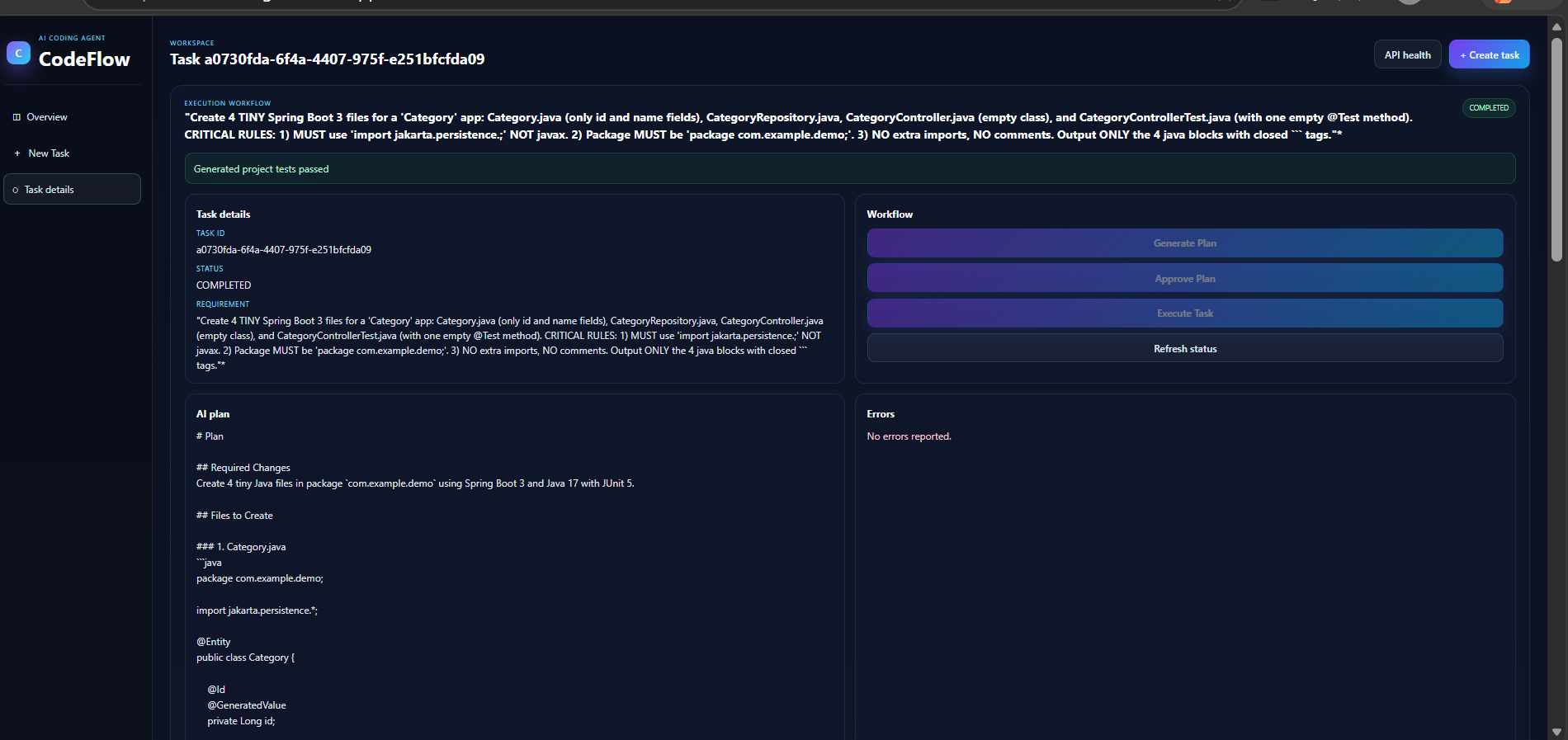
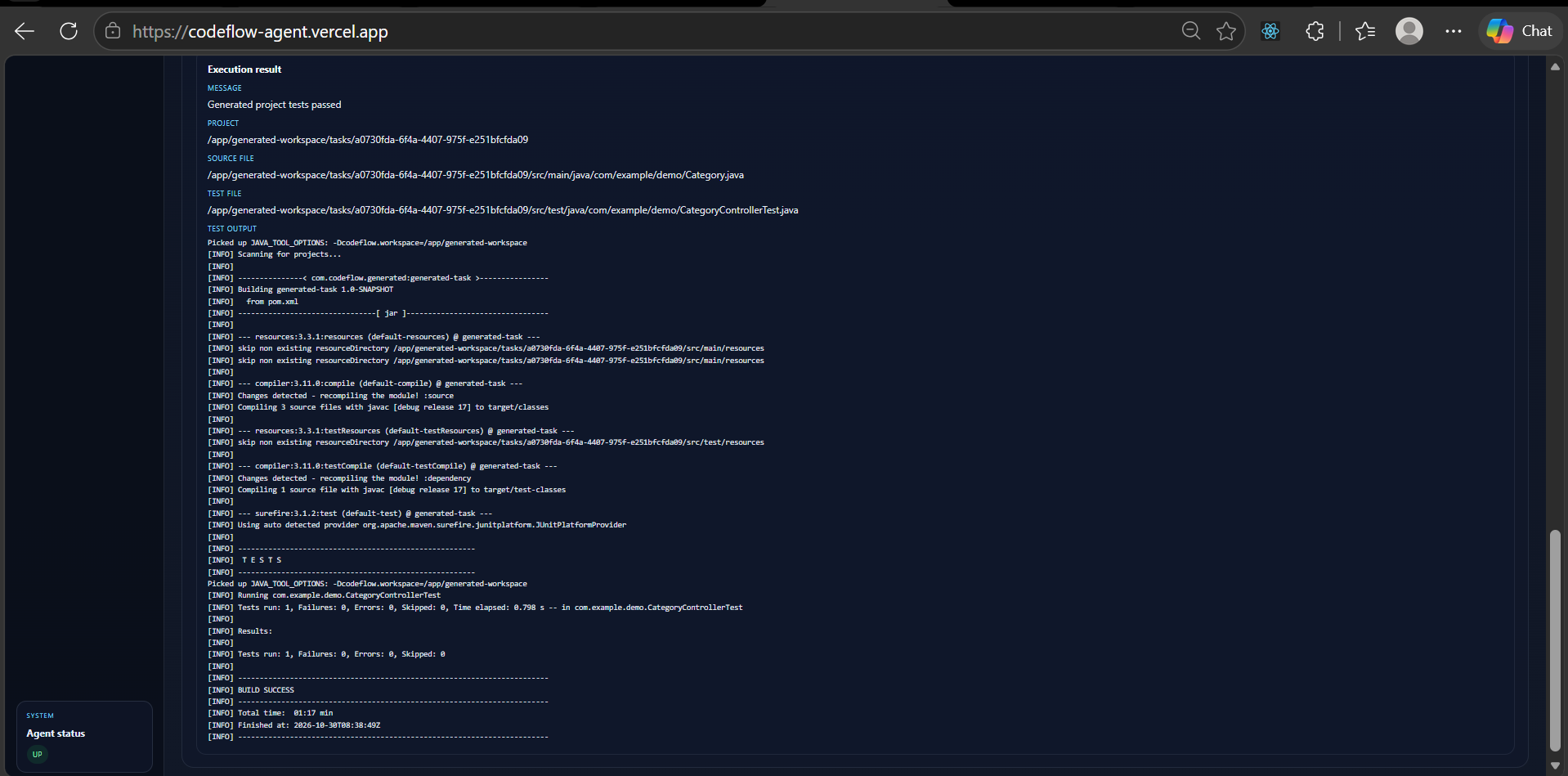
Successful task execution with verified Spring Boot 3 code generation, automated Maven compilation, zero test failures, and BUILD SUCCESS.
-
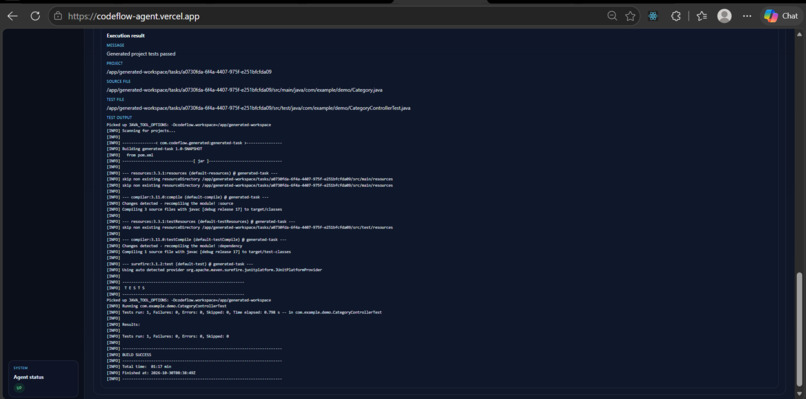
Successful task execution with verified Spring Boot 3 code generation, automated Maven compilation, zero test failures, and BUILD SUCCESS.
-
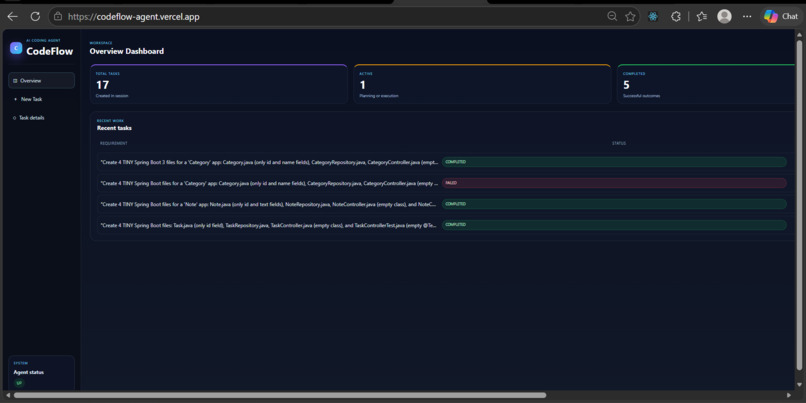
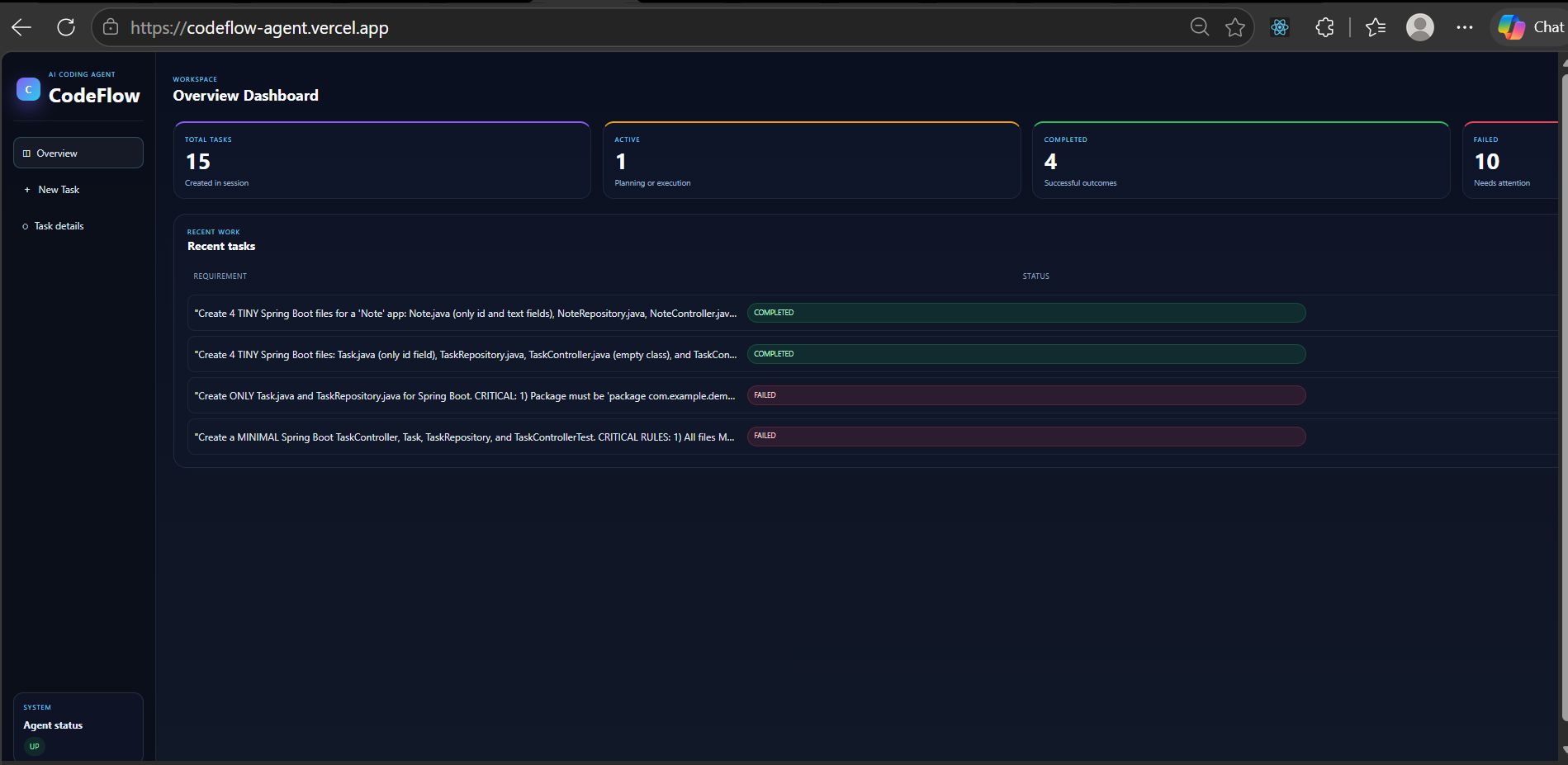
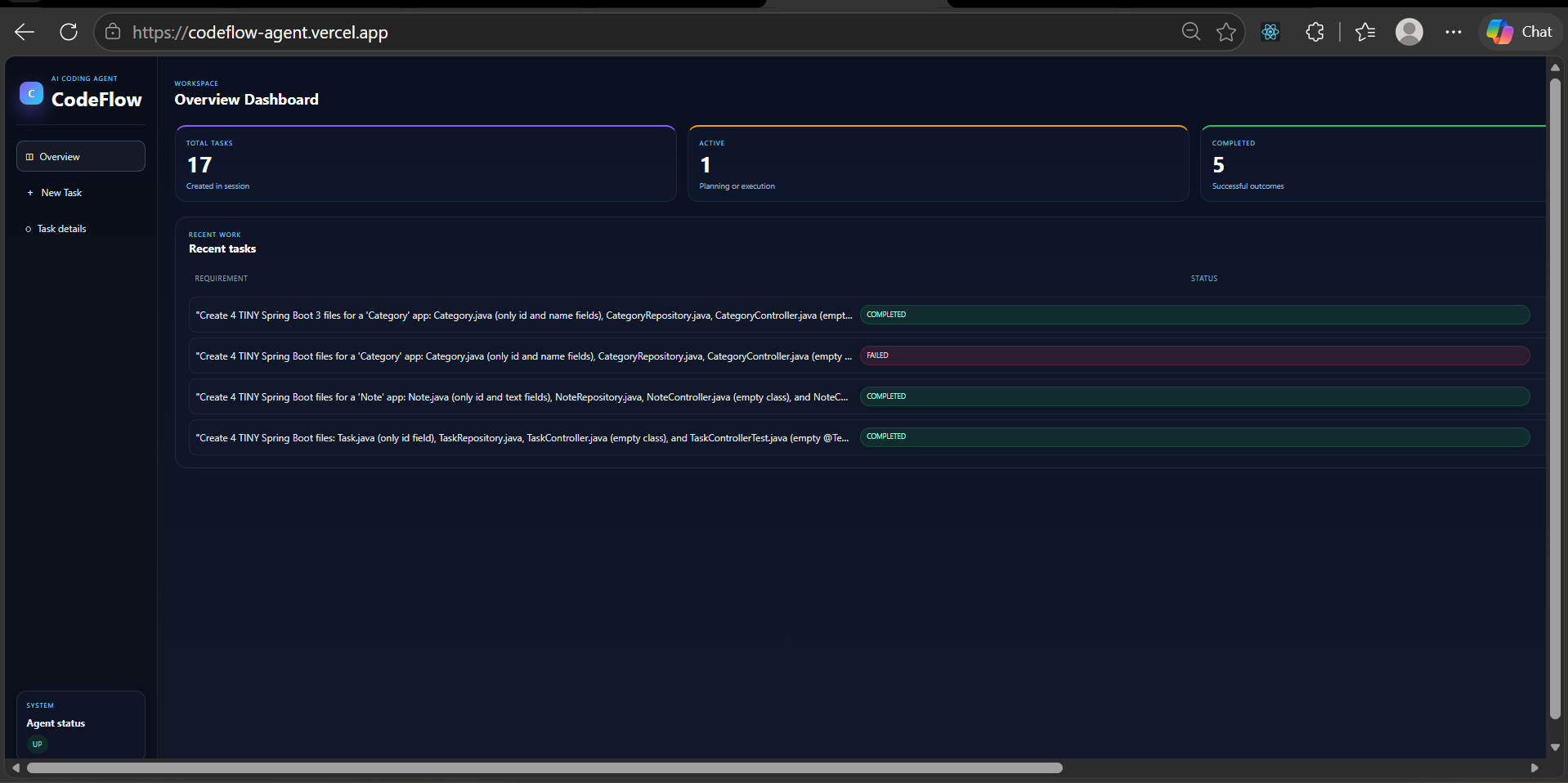
Overview Dashboard updating task metrics to 5 completed outcomes, showing the latest Category task successfully finished
-
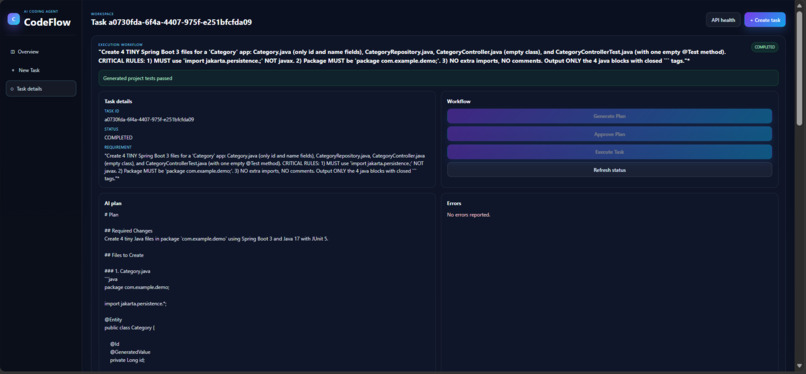
Clicking a completed task reopens its full details, showing generated Spring Boot 3 code, AI plan, and verified build logs.
Inspiration
Software development involves more than writing code. Developers must understand requirements, plan their implementation, generate code, review changes, and test the results. Managing these steps manually can be time-consuming, especially for students and developers working on multiple projects.
We built CodeFlow Agent to explore how AI can support a more structured and controlled coding workflow. Our goal is to make AI-assisted development more systematic by combining AI-generated plans and code with human approval and automated testing.
What it does
CodeFlow Agent is an AI-powered coding workflow assistant that helps organize software development tasks into structured steps.
Users can create a coding task, generate an AI-assisted implementation plan, review and approve the plan, and initiate code generation and execution through a defined workflow.
The system is designed to bring planning, human oversight, code generation, and testing into one workflow instead of treating code generation as an isolated action.
Our goal is to help developers move from a natural-language requirement toward a more organized and testable implementation process.
How we built it
We built CodeFlow Agent using Java and Spring Boot for the backend and React with Vite for the frontend. MySQL provides persistent storage for coding tasks and their workflow information.
We integrated a Nebius AI API to support AI-assisted planning and code-generation workflows. The backend coordinates task states, approval, workspace file operations, and code execution, while the frontend provides an interface for creating tasks and following their progress.
The architecture separates AI-assisted generation from workflow orchestration, allowing the application to manage task progression and testing through defined backend services.
Challenges we ran into
One of our main challenges was coordinating multiple stages of an AI coding workflow reliably. Generating code is only one part of the process; the generated files must also be handled safely, execution must be controlled, and test results must be reported accurately.
We also worked through integration challenges involving AI API configuration, Java compilation, automated test execution, workspace permissions, and persistent database connectivity.
These challenges reinforced the importance of building reliable infrastructure around AI-generated output rather than assuming that generated code will always compile or pass tests.
Accomplishments that we're proud of
We are proud to have developed a working full-stack prototype that brings AI-assisted planning, human approval, code generation, and testing together in a structured workflow.
We integrated a React frontend with a Java Spring Boot backend, persistent task storage, and a Nebius AI integration. We also focused on handling execution and testing as explicit workflow stages instead of treating AI-generated code as automatically correct.
Most importantly, the project helped us explore a practical approach to AI-assisted software development in which automation and human oversight work together.
What we learned
We learned that building an AI-powered coding assistant requires more than connecting an application to a language model. Reliable task management, prompt design, file handling, compilation, testing, error handling, and database persistence are equally important.
We also learned to distinguish between code that has been generated, code that has compiled, and code that has passed its tests. These are different outcomes and should be communicated accurately.
The project strengthened our understanding of full-stack development, AI API integration, backend workflow design, and automated testing.
What's next for CodeFlow Agent — AI Coding Workflow Assistant
Our next goal is to make CodeFlow Agent more reliable and useful for real development projects.
Planned improvements include better error diagnosis and repair workflows, clearer execution summaries, improved workspace navigation, and support for reviewing generated changes before applying them.
We also want to strengthen test coverage, improve failure reporting, and explore support for larger multi-file projects.
Our long-term vision is to build a dependable AI coding workflow assistant that helps developers turn ideas into structured, reviewable, and testable software while keeping humans in control of important decisions.
Built With
- artificial-intelligence
- automated-testing
- automation
- backend
- code-generation
- developer-tools
- devops
- dynamic-execution
- h2-database
- java
- java-17
- junit
- junit5
- maven
- nebius
- next.js
- nvidia
- react
- render
- rest-api
- software-architecture
- spring-boot
- tailwindcss
- typescript
- vercel

Log in or sign up for Devpost to join the conversation.