-
-
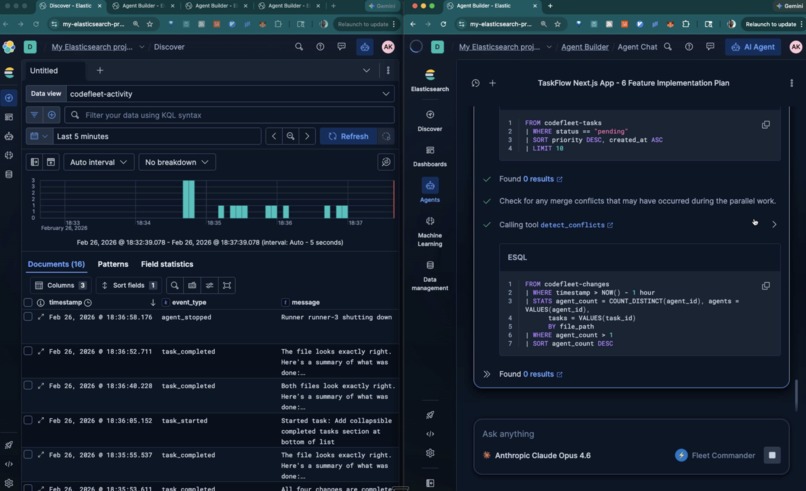
Fleet commander + Kibana
-
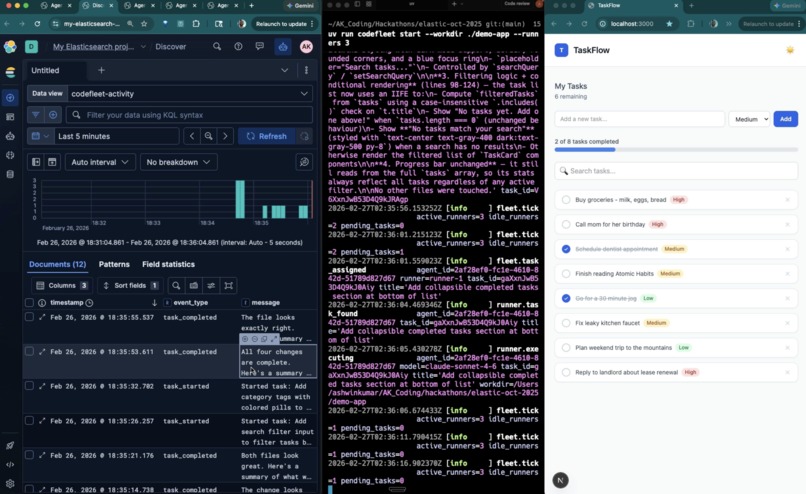
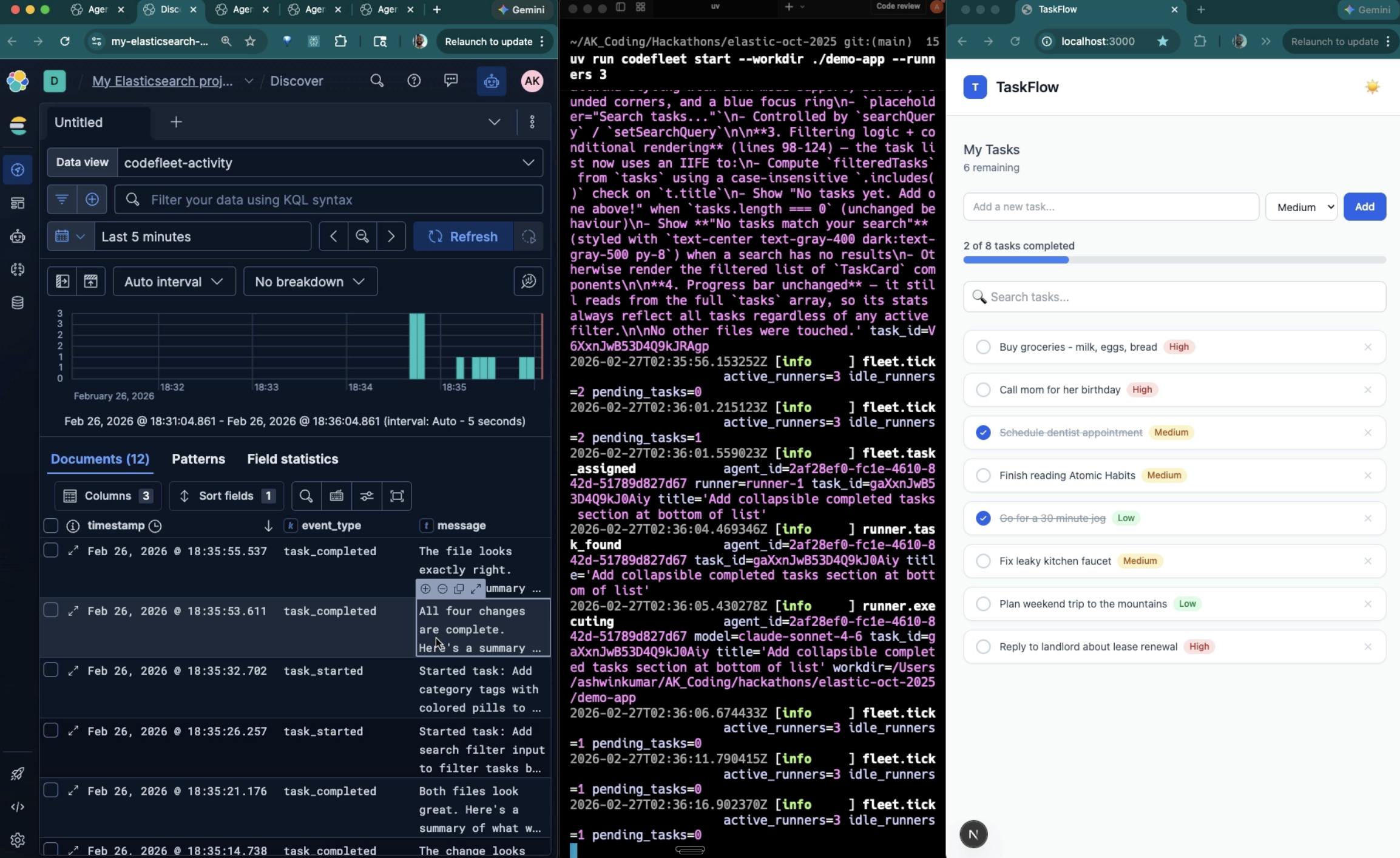
Fleet of coding agents in action
-
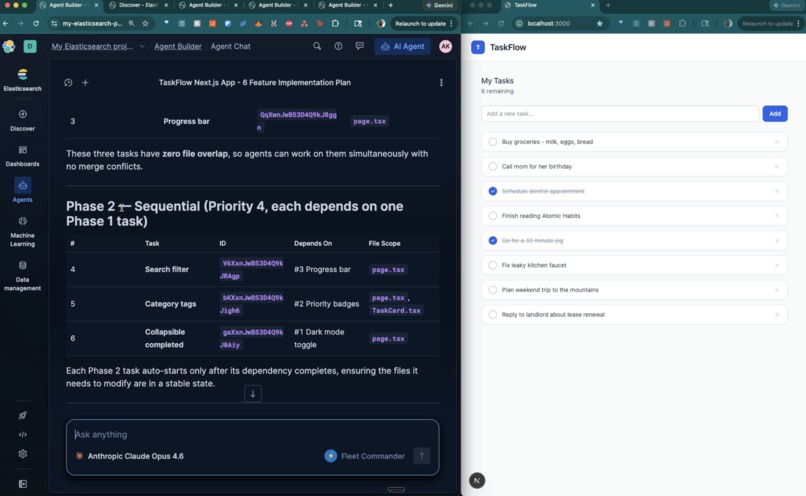
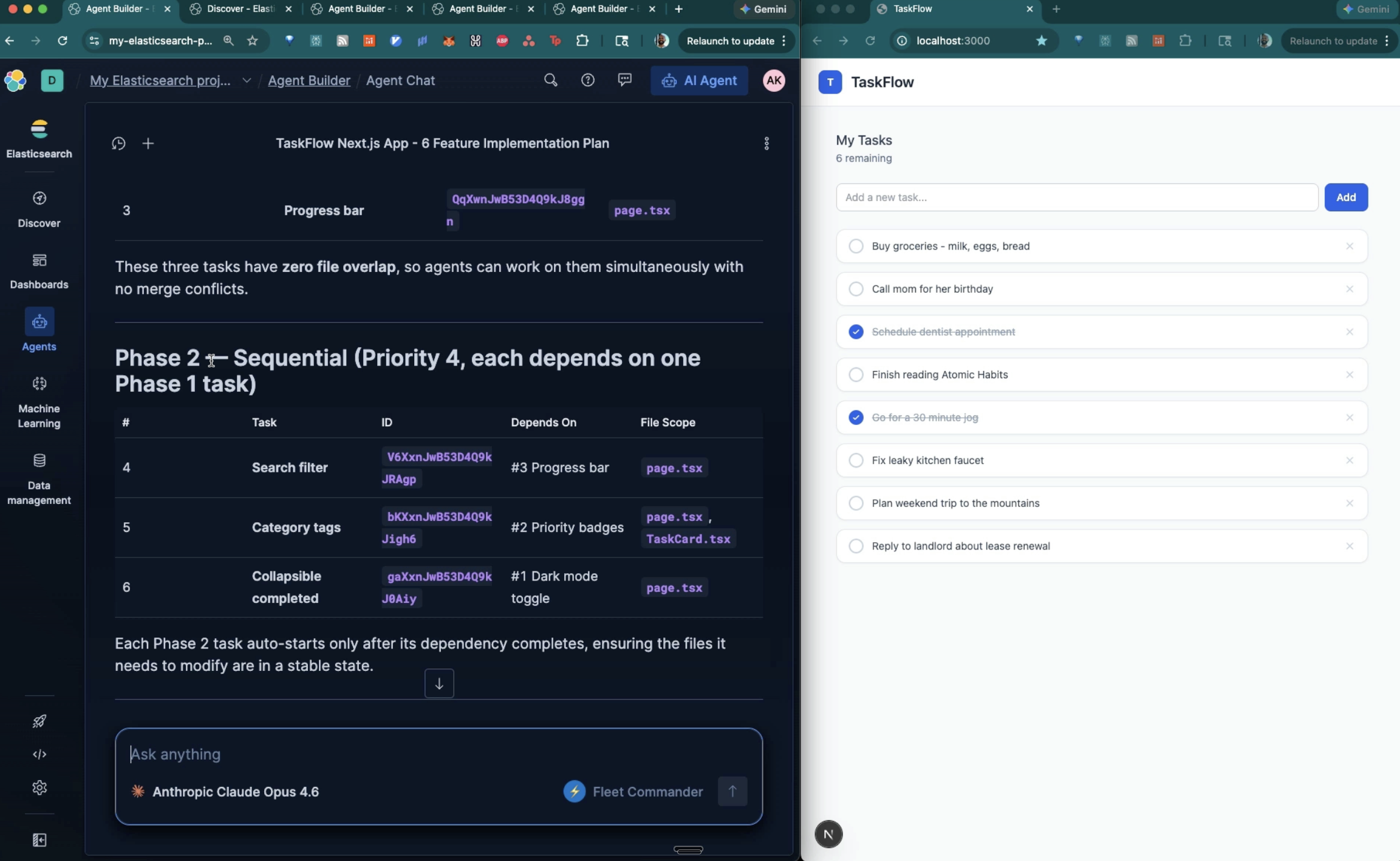
Fleet commander helps break down tasks for agents
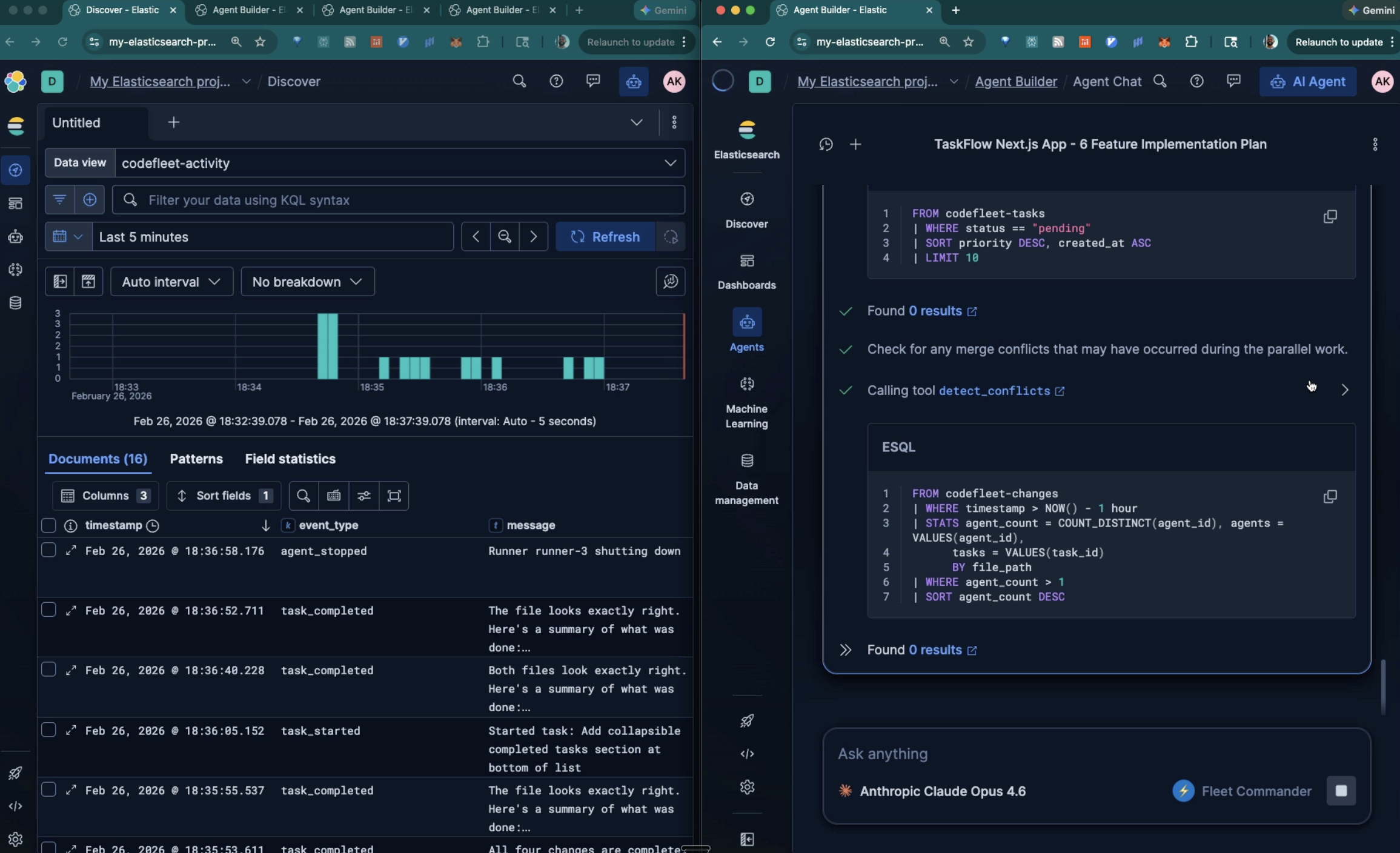
CodeFleet
AI Coding Agent Fleet Commander — orchestrate parallel Claude Code agents with Elasticsearch as the orchestration platform, not just the database.
🔗 GitHub Repository | 📹 Demo Video | License: Apache 2.0
The Problem: AI Coding Agents Don't Scale Without Orchestration
Running one AI coding agent is powerful. Running five in parallel is chaos.
Developers increasingly use AI agents like Claude Code, Cursor, and Codex to write production code. But the moment you try to run more than one agent on the same codebase, everything breaks down:
- No task queue. You manually tell each agent what to do in a separate terminal.
- No conflict detection. Two agents can silently edit the same file and create merge conflicts you don't discover until later.
- No monitoring. You have no idea what each agent is working on, how long it's been running, or when it finishes.
- No auto-assignment. When an agent completes its task, it sits idle until you notice and give it more work.
- No dependency awareness. You mentally track what's blocked by what, and manually trigger the next phase.
Without an orchestration layer, the human becomes the message bus — relaying completion signals between agents, merging branches, copying config files, assigning next tasks. It works, but only because a person is doing the coordination full-time.
Overview of our solution: CodeFleet
CodeFleet automates everything that human was doing — and the orchestration logic itself runs natively in Elasticsearch via Elastic Workflows.

CodeFleet works through 3 simple steps:
Step 1 (Chat with Fleet Commander): You describe what you want to build in natural language — through Kibana's Agent Builder chat UI, Claude Desktop via MCP, or the CLI. The Fleet Commander agent (built with Elastic Agent Builder) breaks your request into tasks with priorities, dependencies, and file scope, and writes them to Elasticsearch via a Workflow tool. Think of it as your AI PM.
Step 2 (Elastic Workflows Orchestrate): This is where Elasticsearch becomes more than a database. Three Elastic Workflows handle the orchestration logic — entirely server-side, no local code needed:
- Auto-Assignment Workflow runs on a schedule, matches pending unblocked tasks to idle agents, and assigns them.
- Task Completion Workflow fires when a runner marks a task complete, automatically unblocks dependent tasks by removing the completed task from their
blocked_bylists, and moves newly-unblocked tasks topending. - Stale Agent Workflow runs on a schedule, detects runners that haven't sent heartbeats, and re-queues their tasks.
Local runners simply poll Elasticsearch for their assignments, execute code via Claude Agent SDK, and report results back to ES — which triggers the next workflow cycle.
- Step 3 (Monitor Everything in Real-Time): Every agent event — task started, file changed, task completed, conflict detected — is indexed in Elasticsearch. Kibana Discover gives you a real-time activity stream. Fleet Commander can answer questions like "any conflicts?" or "what's the status?" by querying ES directly through its ES|QL tools.
Without CodeFleet: What an Engineer Does Today
To understand why Elasticsearch is the right backbone for this, consider what you'd have to build or do manually without it:
| What You Do Today (Manual) | What CodeFleet + Elastic Provides |
|---|---|
| Open 3-5 terminal tabs, copy-paste kickoff prompts to each agent | Runners poll ES for assignments automatically; Auto-Assignment Workflow matches them to tasks |
| Mentally track which tasks are blocked by which | depends_on fields in ES + Elastic Workflow auto-unblocks when tasks complete |
| Relay "agent 1 is done" messages between agents | Task Completion Workflow fires automatically, unblocks dependents |
| Manually assign the next batch of work | Auto-Assignment Workflow matches idle agents to pending tasks every 5 seconds |
| Notice and fix interface conflicts after the fact | ES|QL aggregation detects overlapping file edits in real-time |
| Say "start Phase 2" when you think everything's ready | Workflows cascade: complete → unblock → assign → execute, all automatic |
| Build a React dashboard for monitoring | Kibana dashboards — real-time, zero frontend code |
| Build a chat UI + tool-calling framework | Agent Builder — chat, tools, MCP, all included |
Why Elasticsearch and Agent Builder? (Not Just a Database)
The key insight behind CodeFleet is that Elasticsearch isn't just storage — it's the orchestration platform.
Most AI agent projects use a database to store state and write orchestration logic in Python/Node. CodeFleet pushes that orchestration into Elastic itself:
| What Elastic Provides | What We'd Build Without It |
|---|---|
| Agent Builder — Fleet Commander with AI reasoning | Custom chat frontend + tool-calling framework |
| ES|QL tools — 7 expert-defined queries as agent tools | Build parameter routing + query engine from scratch |
| Elastic Workflows — auto-assignment, dependency unblocking, health checks | Write a custom job scheduler + state machine in Python |
| Semantic search — built-in embeddings for duplicate detection | External embedding API + vector DB setup |
| Kibana Discover — real-time activity stream, zero frontend | Build a log viewer + monitoring dashboard |
| MCP server — IDE integration out of the box | Build an MCP server from scratch |
The orchestration brain lives in Elastic. The local machine only needs thin runners that poll for assignments and execute code. If you replace Elasticsearch with Postgres, you'd need to rebuild the workflow engine, the query tools, the semantic search, the monitoring, and the chat interface — from scratch.
How It Works (Technical Detail)

| # | Component | Technology | Role |
|---|---|---|---|
| ① | User Interfaces | Kibana Chat, Claude Desktop (MCP), CLI | How you interact with the fleet |
| ② | Fleet Commander | Elastic Agent Builder + 8 tools | AI PM: searches backlog, creates tasks, detects conflicts, reviews work |
| ③ | Elastic Workflows | 4 YAML-defined workflows | Orchestration engine: auto-assign, unblock deps, create tasks, health checks |
| ④ | Elasticsearch | ES Serverless (5 indices) | Shared brain: tasks, agents, activity, file changes, conflicts |
| ⑤ | Semantic Search | .multilingual-e5-small-elasticsearch |
Built-in embeddings for duplicate task detection — no external API |
| ⑥ | Kibana | Discover + Dashboards | Real-time fleet status, activity stream, event exploration |
| ⑦ | Runners | Claude Agent SDK (Python) | Engineers: poll ES for assignments, execute coding tasks, report back |
| ⑧ | Your Codebase | Local filesystem | Each runner writes code, reports file changes to ES |
Data flow:
- You tell Fleet Commander what to build (via Kibana, MCP, or CLI)
- Fleet Commander breaks it into tasks with dependencies and creates them in ES via the
create_taskWorkflow - Auto-Assignment Workflow fires every 5 seconds — finds pending unblocked tasks, matches them to idle runners, assigns them
- Runners poll ES, find their assignments, launch Claude Agent SDK sessions, write code
- During execution, runners log every event and file change to ES in real-time
- On completion, runner updates task status → Task Completion Workflow fires automatically, unblocks dependents, moves them to pending
- Cycle repeats: Auto-Assignment Workflow picks up the newly-pending tasks and assigns them to idle runners
- Stale Agent Workflow runs every 60 seconds, re-queues tasks from crashed runners
- Fleet Commander can answer status questions, reassign work, or review completed tasks — anytime via ES|QL tools
Elastic Workflows: Where the Orchestration Lives
The orchestration isn't in Python — it's in Elastic. Here are the 4 workflows that power CodeFleet:
| Workflow | Trigger | What It Does |
|---|---|---|
create_task |
Manual (called by Fleet Commander) | Indexes a new task document with all fields including semantic embeddings for duplicate detection |
auto_assign_tasks |
Scheduled (every 5s) | Queries for pending unblocked tasks and idle agents, assigns tasks to agents, updates both documents |
handle_task_completion |
Alert (task status → completed) | Finds all tasks that depend on the completed one, removes it from their blocked_by lists, sets fully-unblocked tasks to pending |
handle_stale_agents |
Scheduled (every 60s) | Finds agents with stale heartbeats (>2 min), marks them offline, re-queues their assigned tasks back to pending |
ES|QL Tools: Where the Intelligence Lives
The Fleet Commander isn't just a chatbot — it's an agent whose reasoning is grounded in real data through ES|QL tools. Here are the 8 tools that power it:
| Tool | What It Does | ES|QL Pattern |
|---|---|---|
search_backlog |
Find highest-priority unblocked tasks | Filter by status, sort by priority, exclude blocked |
check_agent_status |
See what all agents are doing right now | Aggregate agents by status (idle/working/offline) |
detect_conflicts |
Find files modified by multiple agents | Aggregate file changes, filter count > 1 within time window |
assign_task |
Look up task details for assignment verification | Query task by ID, verify status before assignment |
review_completed |
Review recently completed work | Filter by status=completed, include cost and duration metrics |
find_similar_tasks |
Semantic search for duplicate/related tasks | MATCH query on semantic_text embeddings (built-in .multilingual-e5-small-elasticsearch) |
create_task |
Create a new task in the backlog | Workflow tool — indexes task with semantic field for vector search |
analyze_dependencies |
Check what's blocked by what | Filter on depends_on fields, identify dependency chains |
This is the pattern we love about Agent Builder: business logic lives in expert-defined ES|QL queries, not in LLM hallucinations. The agent reasons about what to do, but the data it reasons over is precise, real-time, and grounded in Elasticsearch.
Agent Builder Features Used
| Feature | How We Use It |
|---|---|
| Custom Agents | Fleet Commander with specialized fleet orchestration instructions |
| ES|QL Tools | 7 parameterized tools for backlog search, agent status, conflict detection, semantic search, dependency analysis, task lookup, work review |
| Elastic Workflows | 4 workflows: task creation, auto-assignment, dependency unblocking, stale agent recovery |
| Semantic Search | semantic_text field with built-in .multilingual-e5-small-elasticsearch inference — no external embedding API |
| MCP Server | Fleet Commander accessible from Claude Desktop — natural language fleet management from your IDE |
| Kibana Discover | Real-time activity stream: every agent event indexed and explorable |
Challenges and Things We Liked
Things we liked:
The ES|QL parameterized tool pattern is production-grade. In most AI agent frameworks, the agent writes its own queries — which means hallucinated SQL, wrong table names, off-by-one filters. With Agent Builder, the queries are written by a domain expert and the agent just fills in parameters. This is how production AI should work, and it's the single biggest differentiator we've seen in any agent framework.
Elastic Workflows let us move orchestration to the cloud. The auto-assignment and dependency unblocking logic that would normally be a complex Python state machine is instead 3 declarative YAML files running server-side in Elastic. When a task completes, the unblocking workflow fires automatically — no local daemon needed for that logic. This means the "brain" runs in Elastic and only the "hands" (Claude Agent SDK runners) need to run locally.
Built-in semantic search was a game-changer. The
semantic_textfield type with.multilingual-e5-small-elasticsearchgave us vector search for duplicate task detection with zero external dependencies. No OpenAI embeddings API, no Pinecone, no vector DB setup. Just a field type in the mapping and it works.
Challenges:
Workflow string handling required coercion logic. Elastic Workflows pass all inputs as strings, but our Pydantic models expect typed lists for fields like
depends_onandfile_scope. We added field validators to coerce CSV strings into lists, and patched our ES search layer to normalize these fields on read. Small friction, but it shows Workflows are still maturing.ES|QL string parameters can't be used in timespan expressions. Our
review_completedtool needed restructuring because you can't parameterizeNOW() - ?since. We also discovered that Agent Builder's param type validation requiresintegerinstead ofnumber— small things that cost real debugging time.
What's Next
| Feature | Status |
|---|---|
| Task queue with dependencies, priorities, file scope | ✅ Shipped |
| Fleet Commander with 8 tools (7 ES|QL + 1 workflow) | ✅ Shipped |
| Claude Agent SDK runners with polling + execution | ✅ Shipped |
| Elastic Workflows: auto-assign, unblock deps, stale recovery | ✅ Shipped |
| Conflict detection tool via ES aggregations | ✅ Shipped |
| Semantic search via built-in Elastic Inference embeddings | ✅ Shipped |
| MCP integration (Claude Desktop) | ✅ Shipped |
| Kibana Discover for real-time event exploration | ✅ Shipped |
| Dynamic runner scaling (0→N based on queue) | ✅ Shipped |
| Automatic dependency unblocking via Workflow | ✅ Shipped |
| Fleet Commander task creation via Workflow tool | ✅ Shipped |
| A2A protocol for cross-framework agent communication | 🔜 Next |
| Git automation (worktree creation, branch merge, PR) | 🔜 Next |
| Custom Kibana dashboards with panels | 🔜 Next |
| Multi-model routing (Opus for complex, Sonnet for simple) | 📋 Planned |
| GitHub/Linear integration for importing backlogs | 📋 Planned |
CodeFleet is open source (Apache 2.0) and designed to run headlessly on always-on machines. It's not a demo — it's a tool built for real AI coding workflows, with Elasticsearch as the orchestration platform.
🔗 GitHub Repository | 📹 Demo Video
Built With
- elastic-search
- javascript


Log in or sign up for Devpost to join the conversation.