-
-
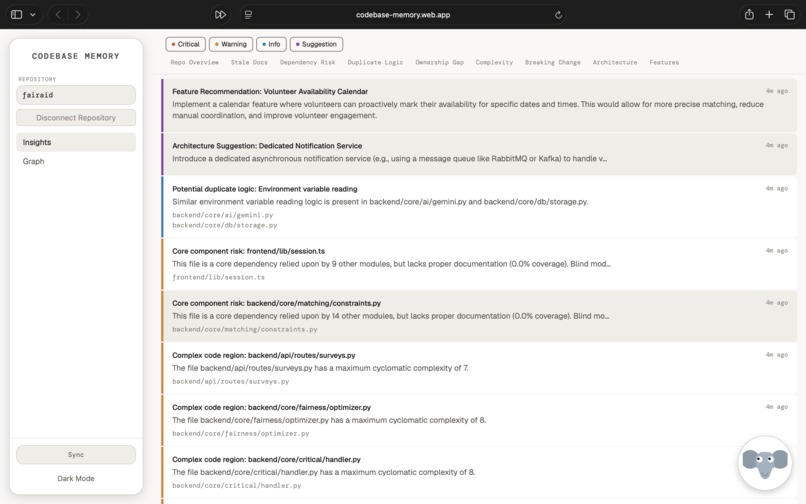
Repo insights
-
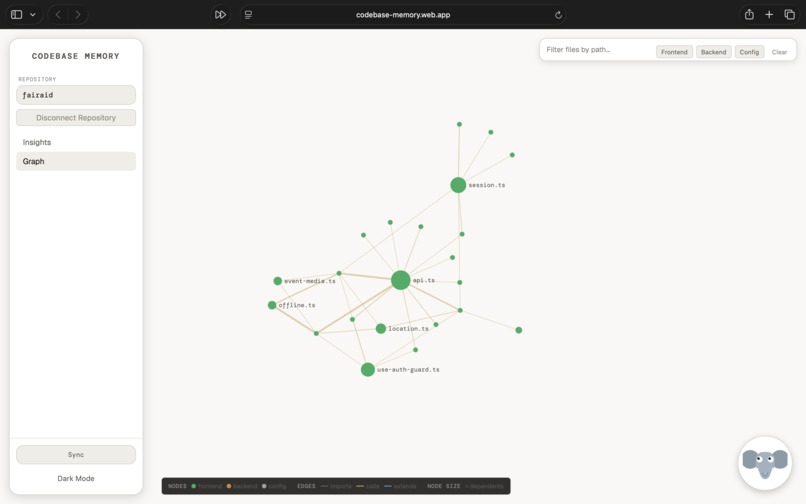
Repo Graph
Codebase Memory
Inspiration
Developers spend a huge amount of time trying to understand unfamiliar codebases. Whether joining a new team, contributing to an open-source project, or inheriting an existing system, the first challenge is always the same: figuring out how everything fits together.
Traditional code search tools can find text, but they don't help developers understand architecture, dependencies, responsibilities, or the relationships between components.
We built Codebase Memory to transform repositories into searchable knowledge bases that developers can explore through natural language, visual graphs, repository summaries, and automated insights.
What it does
Codebase Memory automatically analyzes a Git repository and builds an understanding of the codebase.
The platform:
- Clones and indexes repositories
- Generates embeddings for semantic search
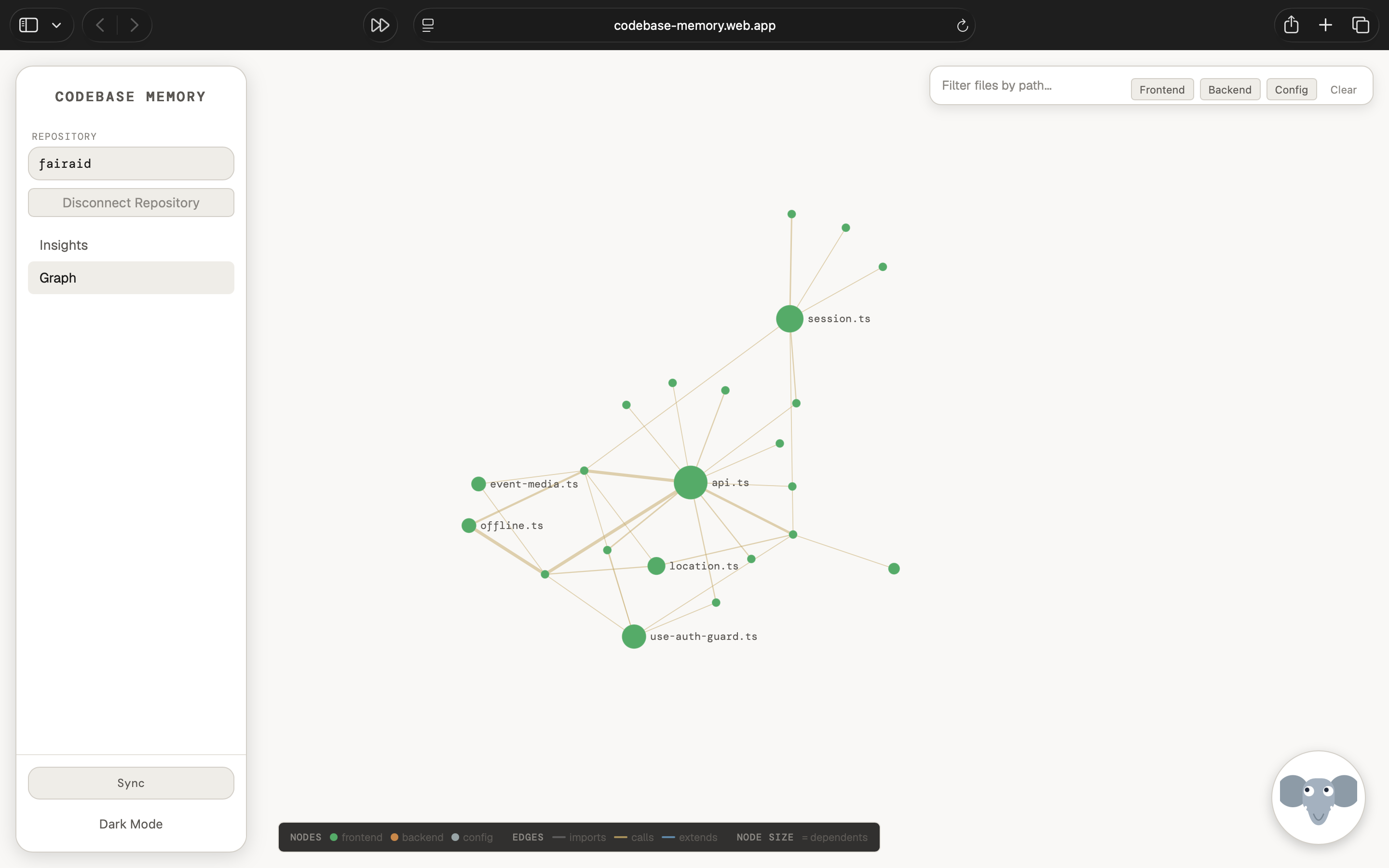
- Builds a relationship graph between files
- Produces repository overviews and architecture summaries
- Answers repository-specific questions through AI
- Generates file-level and subsystem-level summaries
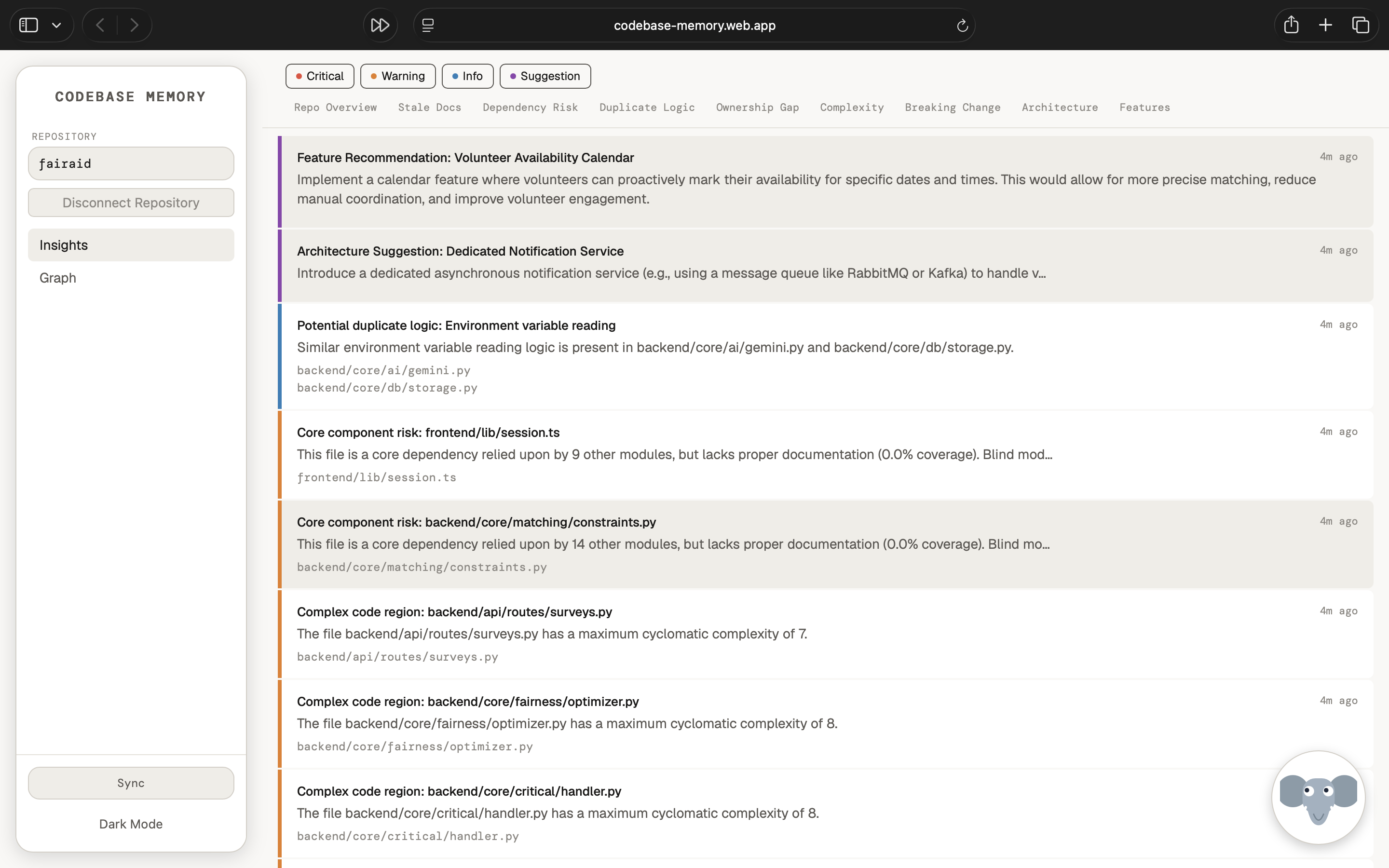
- Identifies risks and improvement opportunities
Instead of spending hours reading code manually, developers can ask questions and explore the repository through a structured interface.
How we built it
The system consists of a React frontend and a FastAPI backend.
During ingestion:
- The repository is cloned.
- Files are parsed and analyzed.
- Code is chunked and embedded.
- Relationships between files are extracted.
- Repository metadata and architecture summaries are generated.
- The data is stored and made searchable.
The frontend provides:
- Repository management
- Architecture visualization
- AI-powered repository chat
- File summaries
- Cluster summaries
- Risk and suggestion analysis
The backend handles:
- Repository ingestion
- Parsing and analysis
- Embedding generation
- Knowledge graph construction
- AI orchestration
- Vector search
Challenges we ran into
One of our biggest challenges was helping the AI understand repositories beyond simple file structures.
Early versions could identify technologies and folders but struggled to explain what a repository actually did. We improved this by extracting repository concepts, architectural signals, and contextual information during ingestion.
Another challenge was handling repository-scale analysis while keeping the experience responsive. We optimized indexing, summary generation, and retrieval workflows to provide useful insights without overwhelming users with information.
We also encountered issues related to AI model configuration, repository understanding, and asynchronous processing during development, which required significant debugging and architectural improvements.
Accomplishments that we're proud of
- Built an end-to-end repository intelligence platform
- Created a repository-specific AI assistant
- Generated architecture-aware summaries
- Built a visual code relationship graph
- Added automated risk and improvement analysis
- Reduced the effort required to understand unfamiliar codebases
What we learned
Through this project we learned a great deal about:
- Repository analysis at scale
- Vector search and embeddings
- Knowledge graph generation
- AI-assisted software engineering
- FastAPI backend architecture
- Frontend visualization techniques
- Designing developer-focused AI tools
We also gained valuable experience balancing AI capabilities with practical developer workflows.
What's next for Codebase Memory
Future improvements include:
- Multi-repository support
- Team collaboration features
- Pull request analysis
- Code ownership detection
- Architectural change tracking
- Advanced dependency visualization
- IDE integrations
- Enterprise-scale repository support
Our goal is to make understanding a codebase as easy as asking a question.

Log in or sign up for Devpost to join the conversation.