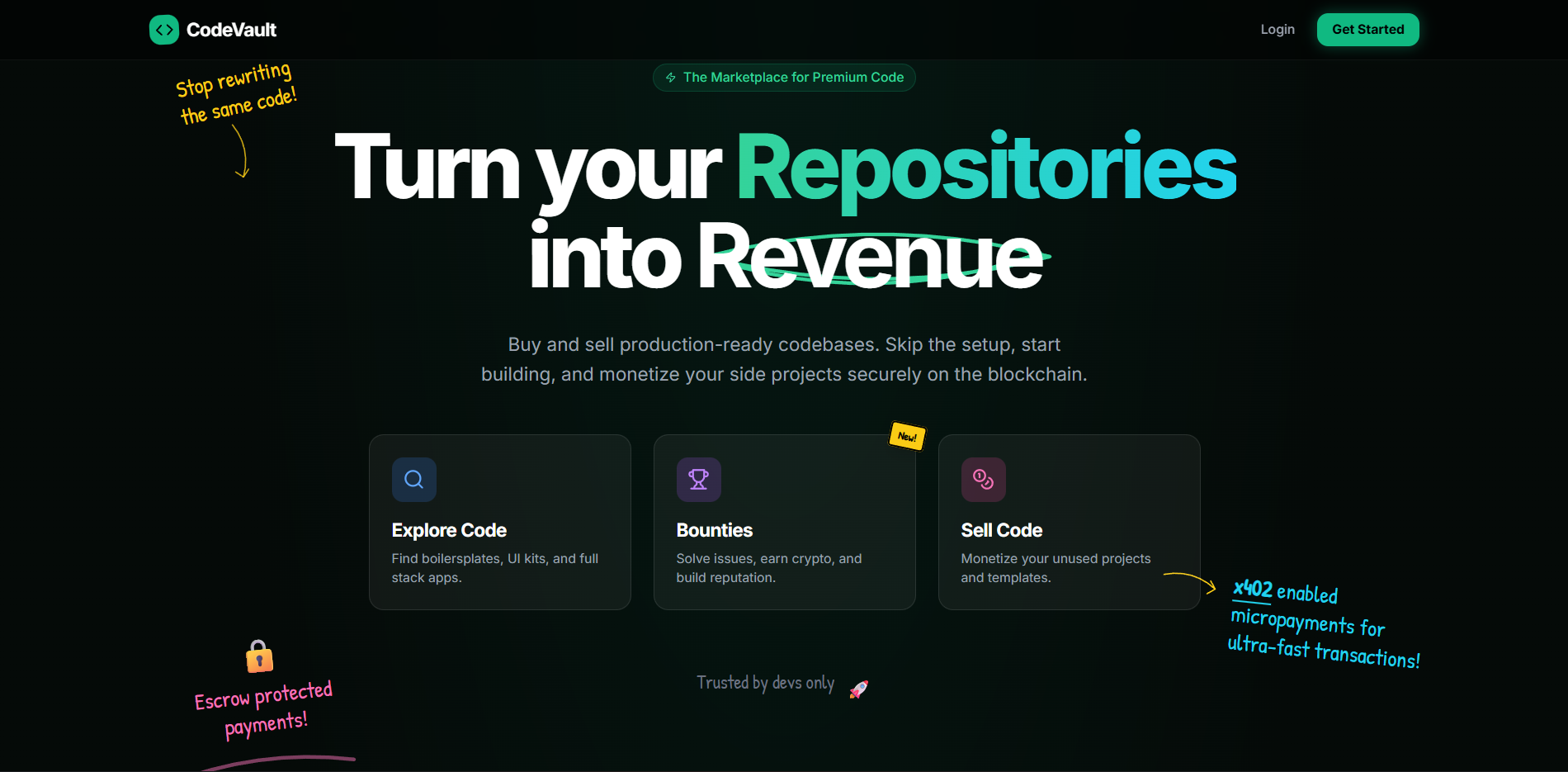
🏛️ CodeVault: Monetize Code, Empower Builders
Inspiration
CodeVault was born from the realization that millions of high-quality projects—from student assignments to SaaS MVPs—are abandoned every year on private drives. This digital waste represents massive lost potential.
We set out to solve two core problems:
For Builders
Independent developers and students in emerging markets have no clear path to monetize their specialized logic without founding a full company.
For Seekers
Social-good startups and non-profits often lack the budget for enterprise software but still need production-ready components to build local solutions.
The Goal
Turn stagnant code into liquid assets that empower global builders and reduce the energy waste of reinventing the wheel.
What It Does
CodeVault is a decentralized marketplace built on the Movement Network that enables:
Decentralized Monetization
Developers list repositories and earn instantly via the x402 protocol.Micropayment Access
Buyers use frictionless micropayments to unlock demo access or purchase full source code.Buildathons
Organizations host transparent bounty campaigns where prize pools are locked and winners are paid automatically via Move smart contracts.On-Chain Reputation
Every contribution and sale is recorded, creating a “Proof of Code” leaderboard for talent discovery.
How We Built It
We used a hybrid stack to balance Web3 security with a smooth developer experience:
Blockchain Core
Built on Movement (M1) using Move’s resource-oriented safety model.Protocol Integration
Implemented the x402 protocol for atomic, low-fee micropayments.Full-Stack Architecture
MERN stack (MongoDB, Express, React, Node) with a high-contrast Neo-Brutalism UI.Authentication
Used Privy for social logins, abstracting away seed phrase complexity for students.
Challenges We Ran Into
Blockchain Explorer Syncing
Testnet explorer latency made transaction verification unreliable. We built custom logging tools to track internal transaction states in real time.Wallet Adapter Conflicts
Conflicts between injected providers (Razor, Backpack) caused global object overrides. We implemented strict provider detection to prevent frontend crashes.Contract Deployment Complexity
Moving from local Move environments to the M1 testnet involved dependency mismatches, resource-group errors, and repeated “out of gas” failures before stabilizing bounty contracts.Remote Connectivity & CORS
Coordinating a Netlify frontend with a Render backend while enforcing strict security headers and ensuring database writes only occurred after verified on-chain transaction hashes.
Accomplishments
- Shipped a functional full-stack Move dApp on the Movement testnet
- Implemented a working x402 micropayment flow
- Enabled developers to monetize a project in under 2 minutes
What We Learned
Move Safety
Move’s resource-oriented architecture is fundamentally safer for marketplaces than traditional EVM-based languages.Economic Fair Pricing Model
Price_{Access} = \frac{\sum (Dev\_Hours \times Rate)}{Project\_Scalability}
Built With
- aptos
- express.js
- javascript
- mongodb
- move
- node.js
- privy
- react
- tailwind
- typescript


Log in or sign up for Devpost to join the conversation.