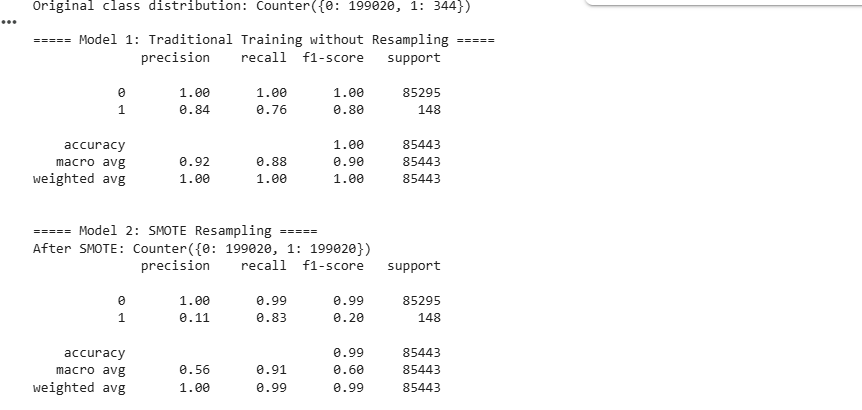
This study addresses critical gaps identified in recent literature by providing a direct comparative analysis of Standard SMOTE and the hybrid SMOTE-ENN technique, evaluating both their influence on data distribution and classification performance metrics. Unlike prior works that focus exclusively on either performance evaluation or visualization, this research integrates both aspects, offering a holistic understanding of each method's impact. A unique contribution of this study lies in its visualization of how these resampling techniques reshape the decision boundaries, an area that remains underexplored in existing studies. Furthermore, the research emphasizes the hybrid approach's effectiveness, showcasing the advantages of SMOTE-ENN over basic oversampling strategies — particularly in cleaning noise and enhancing classifier performance. By leveraging application-driven metrics such as precision, recall, and F1-score, the study aligns closely with practical scenarios where minimizing false positives or false negatives is crucial. Overall, the findings provide empirical guidance for selecting appropriate resampling methods based on dataset characteristics and problem-specific needs, thereby contributing valuable insights for practitioners and researchers working on imbalanced classification problems.
Code Surprise
Analysis of Standard SMOTE and the hybrid SMOTE-ENN technique, evaluating both their influence on data distribution and classification performance metrics.
Updates

Leave feedback in the comments!
Log in or sign up for Devpost to join the conversation.