-
-
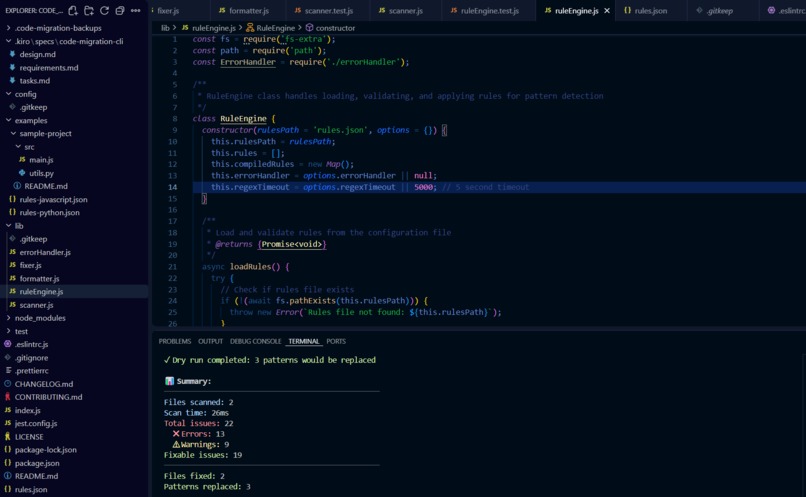
Sample output of my project
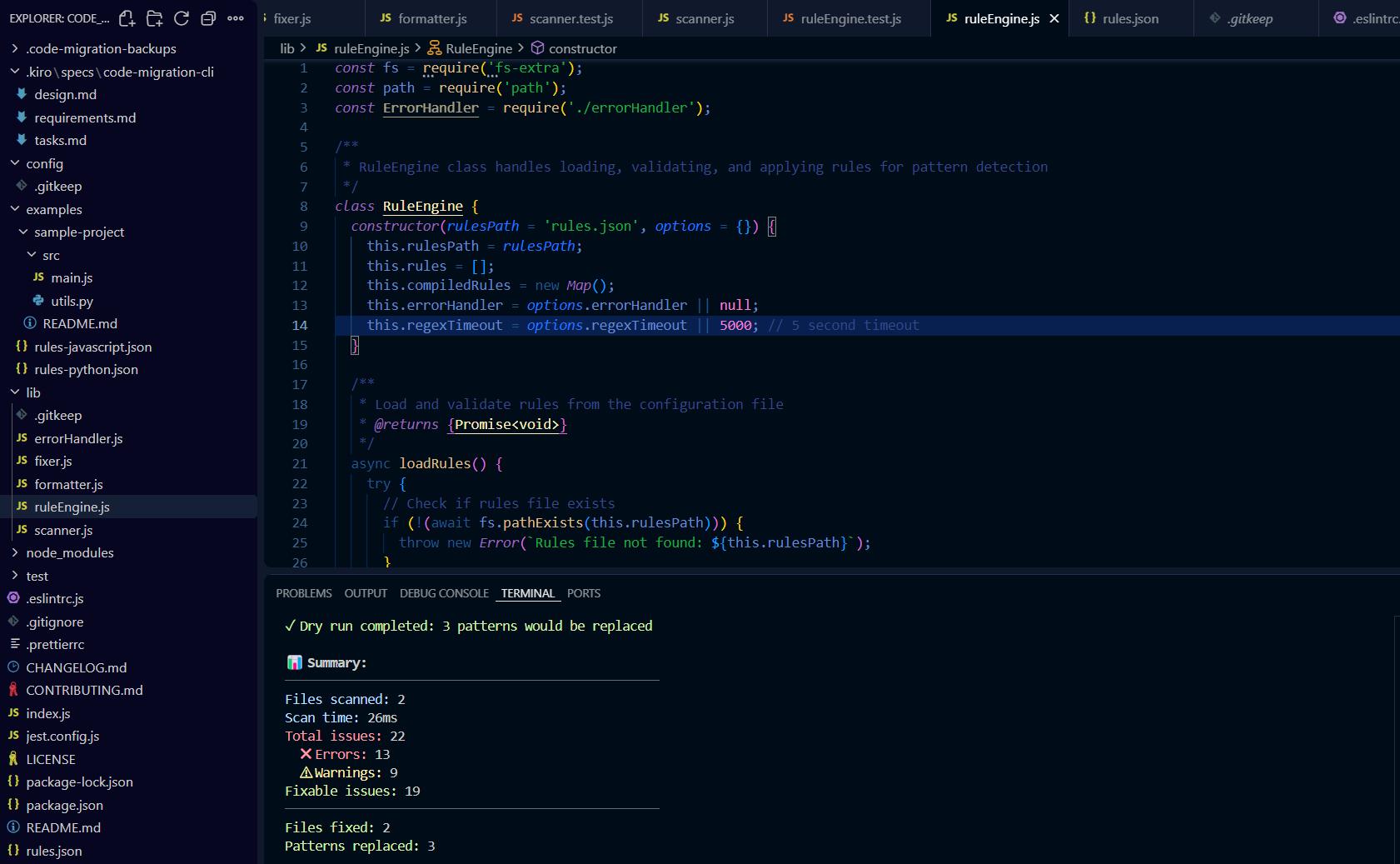
Code Migration CLI Tool
About the Project :
The Code Migration CLI Tool is a developer-focused utility built with Node.js to automate the process of modernizing legacy codebases. It scans through projects, identifies deprecated or outdated code patterns, and refactors them into modern, optimized alternatives.
This project was inspired by the common challenge developers face during large-scale migrations — manual refactoring is time-consuming, error-prone, and repetitive. I wanted to build a tool that could save developer time, reduce technical debt, and ensure smoother transitions between frameworks or versions.
What Inspired Me :
During my internships and personal projects, I noticed how legacy code often slows down development. Migrating from one framework version to another (like old JavaScript patterns to ES6+, or deprecated APIs to modern equivalents) requires repetitive manual work. This sparked the idea to create a CLI-based automation tool that could perform these transformations systematically.
What I Learned :
Deepened my knowledge of Node.js and CLI app development.
Learned how to design a modular rule engine to handle multiple migration rules flexibly.
Understood how to implement file scanning, AST (Abstract Syntax Tree) parsing, and code refactoring strategies.
Explored test-driven development (TDD) by automating unit tests to validate refactoring accuracy.
How I Built It :
Scanner Module → Walks through directories and reads project files.
Rule Engine → Contains migration rules, e.g., replacing deprecated syntax with new equivalents.
Example: Converting var → let/const.
Example: Updating old function callbacks → ES6 arrow functions.
Refactor Module → Applies rules and rewrites the files safely.
Testing Integration → Automated tests ensure that migrated code works as expected.
Mathematically, you can think of the tool as applying a transformation function:
𝑀 ( Code
)
∑
𝑖
1 𝑛 𝑅 𝑖 ( Code ) M(Code)= i=1 ∑ n
R i
(Code)
where 𝑅 𝑖 R i
is a refactoring rule applied to the codebase.
Challenges Faced :
Designing a flexible rule engine that could adapt to multiple use cases.
Ensuring backward compatibility while applying transformations.
Maintaining code readability after refactoring.
Handling edge cases, like partial code migrations where manual intervention was still required.
Outcome :
The tool significantly reduced migration time, minimized human errors, and helped in seamlessly modernizing legacy codebases. It was a great learning experience in building scalable developer utilities.
Built With
- astparsing
- commanderjs
- fsextra
- mocha
- node.js

Log in or sign up for Devpost to join the conversation.