-
-
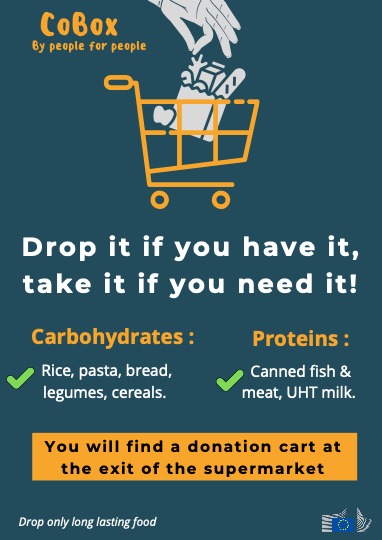
CoBox info poster - displayed at entrance of the supermarket
-
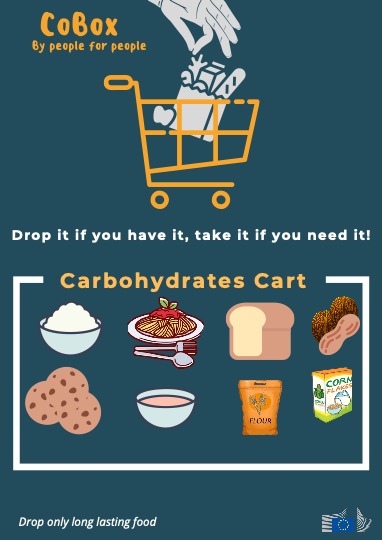
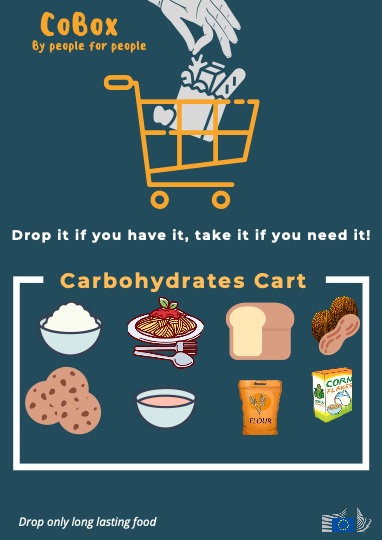
CoBox info poster - to be displayed on carbohydrates cart
-
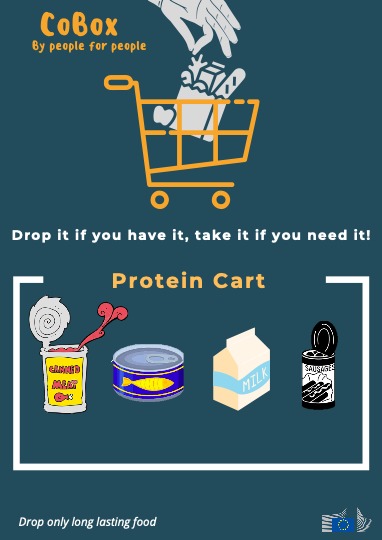
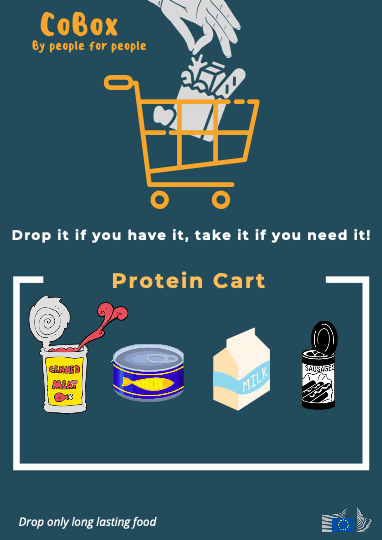
CoBox info poster - to be displayed on proteins cart
The problem your project solves
As coronavirus crisis continues, thousands of people face financial issues and uncertain future. According to the EU employment statistics data, the unemployment rate across Europe is increasing and currently stands at 7.3% and forecasted to 11% by 2021 (1). Economy is struggling, people are losing jobs and families are facing unprecedented issues such as not being able to afford groceries. At the same time, this new segment of population “the new poor” are not used to receive support therefore, traditional food banks may make them feel uncomfortable. In addition, search on internet made us realise organizations mainly target homeless, rather than families in financial need.
The solution you bring to the table
We provide a solution based on re-invented carts that will be installed at the exit of supermarkets where people can drop long-lasting food and people in need can collect them. The main driver for this solution is the sense of kindness and community of people to help each other. Similar solutions are already in place in some countries in Europe although they are at the local level and not harmonized at a larger scale. We aim to use two distinct carts, one designated for products rich in carbohydrates, such as rice, pasta, cereals and legumes, and the second cart for protein rich aliments, such as canned fish, canned meat, UHT milk. The distinction of the carts has the goal to guide people who donate in case they are not sure about the best aliment to use, and to avoid waste of fresh food, and offer a more equilibrated diet for people in need, who can use the spared money to buy fresh fruits and vegetables according to their preferences. The go-to-market strategy for this solution is based on three strong pillars: branding, marketing activities and the financial support of the initiative. We ideated a strong brand to enhance the sense of help, trust and kindness within local communities. As mentioned, the concept consists in a cart with the logo of the initiative; the supermarkets will use two of their carts and they will receive the pdf version of the flyer to attach on the cart. This approach will ensure a fast scaling of the initiative at the european level while acting local. Powerful offline and online marketing activities are required to spread this message and empower the local communities to help each other. In particular, we will use the distribution of paper flyers in the supermarkets, the social media channels of local influencers and TV advertisements. This “glocal” approach for the marketing activities will assure a major penetration within the community thanks to the strong brand at the european level and, at the same time, thanks to the use of local languages and local people at the local and community level. The financial support of this initiative relies on three main stakeholders that will support the costs for printing the flyers depending on the willingness to pay: the supermarkets, printing shops and hubs, european funds and crowdfunding campaigns. To maintain the hype on the initiative, we aim to launch every 6 months a one week European competition, where the city collecting the most donations wins. This could ensure the motivation from the donors is maintained, with the possibility of each mayor to empower and support such initiatives.
What you have done during the weekend
The activities of the weekend were divided in four different phases: ideation in order to define a concept and a solution, research in order to validate the assumptions and refine the idea, execution of the prototype and the go-to-market strategy in terms of branding, logistics and marketing.
The solution’s impact to the crisis
The overall unemployment rate in the EU is 7.3%, and is expected to rise to 11% by 2021, with potential recovery only achieved in 2024 (1). McKinsey estimates 60 million europeans are at risk of losing their job, due to this pandemic repercussion (1). Anticipating solutions for this future population in need becomes of primary importance. Our solution could help reducing the impact of coronavirus on low income families which was in 2017 of 113 millions (2). Implementing this initiative now will help low income families to rely less on national unemployment funds.
The necessities in order to continue the project
A key necessity to move the project forward is the partnership with national retail federations with an harmonisation at European level, to ensure all countries and cities in Europe can implement this initiative. We believe our solution is very simple, we do not need physical equipment or softwares, therefore all the money received will be used for brand awareness, marketing and implementation of the solution at European level.
The value of your solution(s) after the crisis
McKinsey estimates a recovery in unemployment rates no earlier than 2024. This suggest the unemployment funds may be highly pressured until 2024. Our solution can alleviate the reliance of low income families on those funds. In addition, by educating the population to a community mindset, we can sustain donations for long term, even after coronavirus crisis and recovery, to help those more in need.
The URL to the prototype
We don't have a website yet.
References : (1) McKinsey unemployment forecast 2020 (2) Eurostat Europe 2020 indicators - poverty and social exclusion .




Log in or sign up for Devpost to join the conversation.