-
-
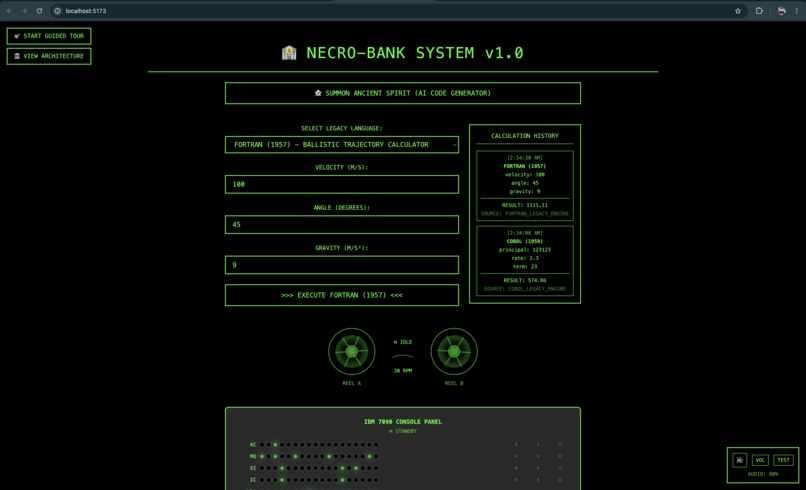
The OG Landing Page
Inspiration
We were fascinated by the challenge of bridging the 60+ year gap between vintage computing and modern web development. The idea that authentic COBOL code from 1959 could power a React application in 2024 felt like digital archaeology meets practical engineering. We wanted to prove that legacy systems aren't just museum pieces—they're battle-tested business logic that can be resurrected and integrated into contemporary architectures.
What it does
COBOL Resurrection Bridge is a universal legacy system integration platform that executes calculations using authentic vintage code from four different computing eras: COBOL (1959), FORTRAN (1957), PASCAL (1970), and BASIC (1983). Users interact with an immersive "haunted mainframe" web interface featuring punch card visualizations, spinning tape reels, and terminal animations. The system includes an AI-powered code generator that creates syntactically correct vintage code from natural language descriptions, and provides a reusable NPM toolkit for modernizing other legacy systems.
How we built it
We implemented a three-tier architecture: (1) Legacy engines—compiled binaries from authentic vintage source code using GnuCOBOL, GNU Fortran, Free Pascal, and FreeBASIC; (2) Universal bridge server—Node.js/Express API using the bridge pattern to spawn child processes and communicate with any compiled legacy binary; (3) Immersive UI—React application with TypeScript, featuring museum-quality components like punch card visualizers and tape reel animations. We integrated GPT-4 for AI code generation and used property-based testing with fast-check to validate calculations across 100+ random inputs per language.
Challenges we ran into
Getting four different vintage compilers working across multiple operating systems was surprisingly complex—each had different installation procedures and quirks. Parsing the output from legacy binaries required careful regex patterns since each language had slightly different formatting conventions. The AI code generation needed extensive prompt engineering with few-shot examples to produce era-appropriate syntax (like COBOL's IDENTIFICATION DIVISION structure). We also struggled with making the UI feel authentically vintage while remaining usable—balancing nostalgia with functionality required multiple design iterations.
Accomplishments that we're proud of
We successfully resurrected and integrated four different legacy languages spanning 26 years of computing history. The universal bridge pattern we developed is genuinely reusable—the NPM toolkit can modernize any legacy system with compiled binaries. Our property-based testing suite validates calculation accuracy across thousands of random inputs, giving us confidence in the system's correctness. The immersive museum UI with punch cards, tape reels, and authentic sound effects creates a genuinely educational experience. Most importantly, we proved that legacy code isn't technical debt—it's valuable business logic that deserves preservation.
What we learned
We gained deep appreciation for the engineering constraints of vintage computing—COBOL's verbose syntax made sense when punch cards were the input medium. We learned that the bridge pattern is incredibly powerful for system integration, and that process spawning in Node.js can effectively communicate with any executable. Property-based testing proved invaluable for validating mathematical calculations across edge cases. We also discovered that AI code generation works remarkably well for vintage languages when given proper context and examples. Finally, we learned that making technical history accessible and engaging requires thoughtful UX design.
What's next for cobol-resurrection
We plan to add support for more vintage languages (Ada, PL/I, RPG, Algol) and expand the museum UI with additional components like oscilloscope displays and paper tape readers. We want to enhance the AI capabilities to translate code between languages and automatically generate tests. The toolkit needs Docker image generation and Kubernetes deployment templates for production use. We're also exploring partnerships with organizations that maintain legacy systems to provide real-world modernization consulting. Ultimately, we envision COBOL Resurrection Bridge becoming the standard toolkit for legacy system integration and preservation.
Built With
- basic
- cobol
- express.js
- fortran
- javascript
- node.js
- pascal
- react
- tailwind
- typescript
- vite

Log in or sign up for Devpost to join the conversation.