-
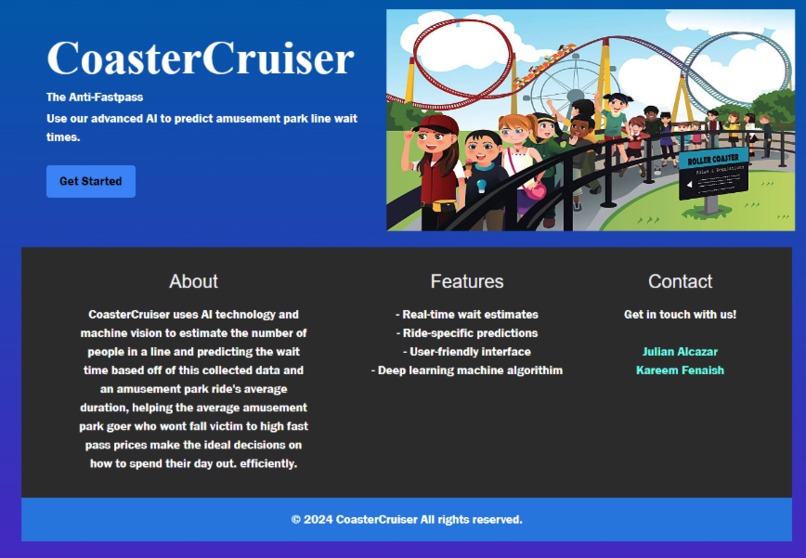
Landing Page
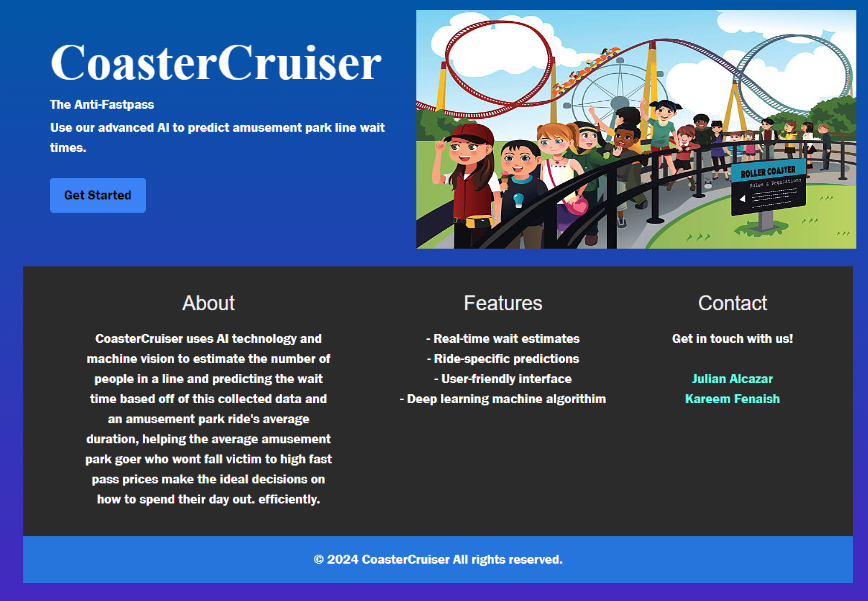
Inspiration
The idea for CoasterCruiser came from one of our teammates who frequently visits amusement parks with their family and understands the frustration of waiting in long lines with inaccurate wait time estimates. After experiencing how much time can be wasted due to unpredictable queues, they wanted to create a solution that would make amusement park visits more enjoyable by providing reliable, real-time wait time predictions.
What it does
The goal of CoasterCruiser was to leverage advanced machine learning algorithms to predict rollercoaster and attraction wait times in real-time. By analyzing crowd density, weather conditions, and ride popularity, CoasterCruiser aimed to deliver accurate queue time estimates, helping park visitors plan their day more efficiently and avoid unnecessarily long waits. Unfortunately, while we developed the system architecture and data integration, the machine learning model did not fully function as expected.
How we built it
We built CoasterCruiser using Python for backend processing, OpenCV for visual tracking, and TensorFlow for machine learning. Our goal was to develop an algorithm that processes live queue footage, detects the number of people in line, and integrates external data sources—like weather APIs and historical trends—to improve the accuracy of our predictions. Despite making significant progress in developing the system, we faced challenges that prevented full implementation.
Challenges we ran into
One of the main challenges was the complexity of processing live footage efficiently. We struggled to fine-tune our machine learning models to handle real-time video analysis while maintaining accuracy. The visual tracking system also presented difficulties when trying to distinguish between people in line and objects like ride decorations or park infrastructure.
Additionally, integrating multiple data streams (e.g., weather updates and ride status alerts) into our model proved complex. Balancing all inputs and ensuring a smooth user experience while handling real-time data was a task we did not fully complete, but it gave us valuable insights into improving our system.
Accomplishments that we're proud of
Although we did not achieve full functionality, we’re proud of the clean, intuitive user interface we designed. The app's layout makes it easy for users to navigate and quickly access queue information, which was a key goal from the start.
We’re also proud of the foundation we laid for the machine learning model. While it didn’t fully succeed in predicting wait times, we created a solid base for future development by combining crowd analysis with external data sources, and we gained valuable experience in building this complex system.
What we learned
CoasterCruiser taught us the importance of flexibility and iteration in development. Our team learned to pivot between tasks and adapt when we encountered roadblocks, which helped us approach problems from fresh perspectives. We also gained experience with machine learning, visual tracking, and real-time data integration.
More importantly, we learned that balancing technical challenges with user experience is key. While the project didn’t reach full functionality, we now have a clearer understanding of how to improve both the accuracy and user-friendliness of our system.
What's next for CoasterCruiser
Looking ahead, we plan to refine our machine learning model and work on addressing the challenges we faced. We aim to collaborate with theme parks to access real-world data and improve prediction accuracy. By partnering with parks and testing our system on a larger scale, we hope to enhance CoasterCruiser’s features and potentially introduce options like virtual queue management and ride scheduling to further improve the visitor experience.
Built With
- heroku
- javascript
- matplotlib
- mongodb
- opencv
- python
- react
- scikit-learn
- tensorflow
- weatherapi

Log in or sign up for Devpost to join the conversation.