-
-
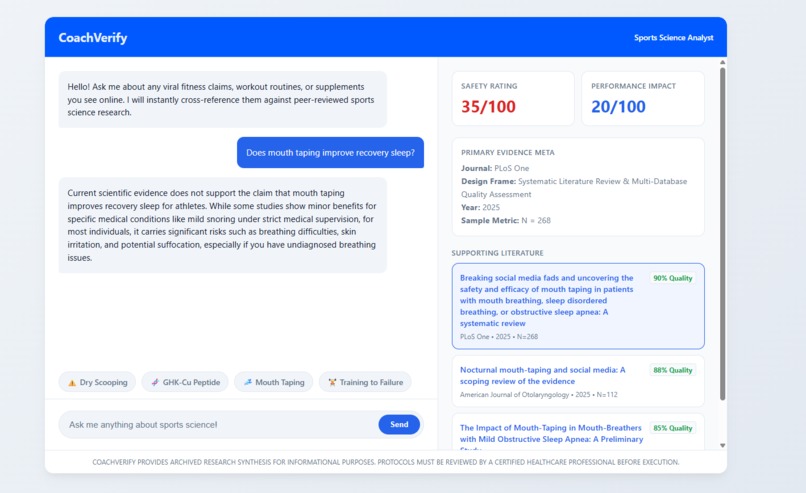
Sample interaction
-
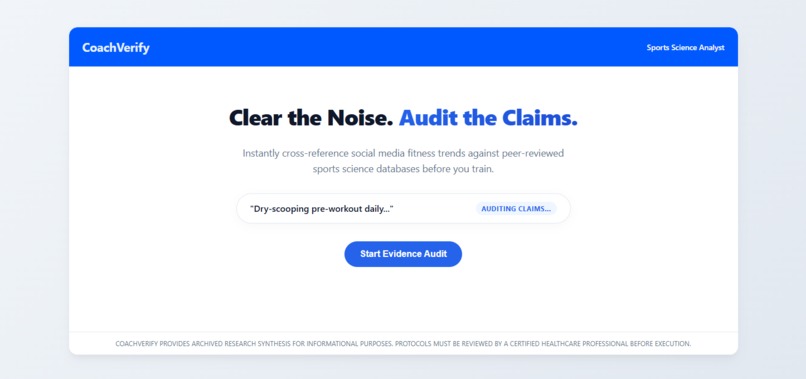
Hero page
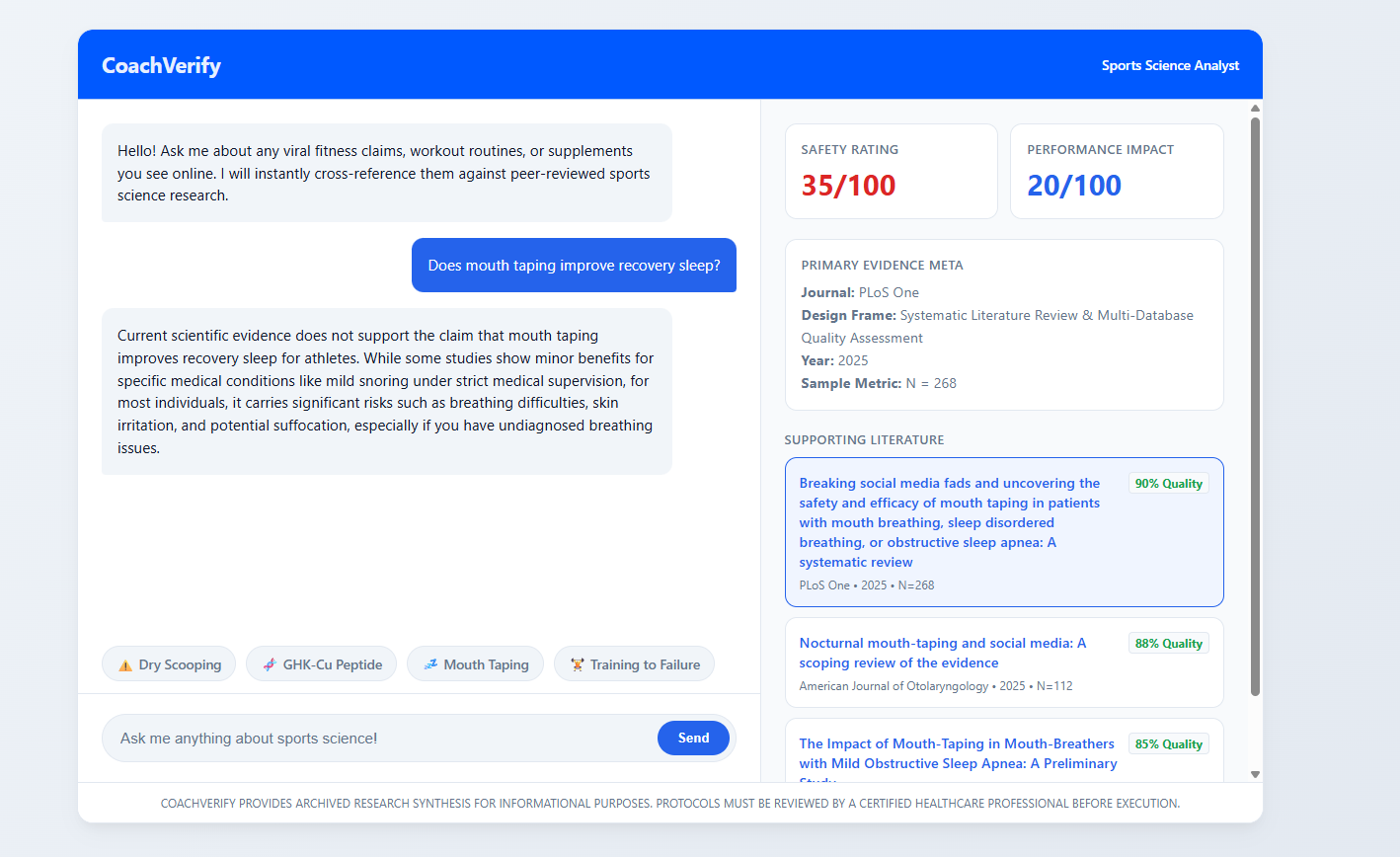
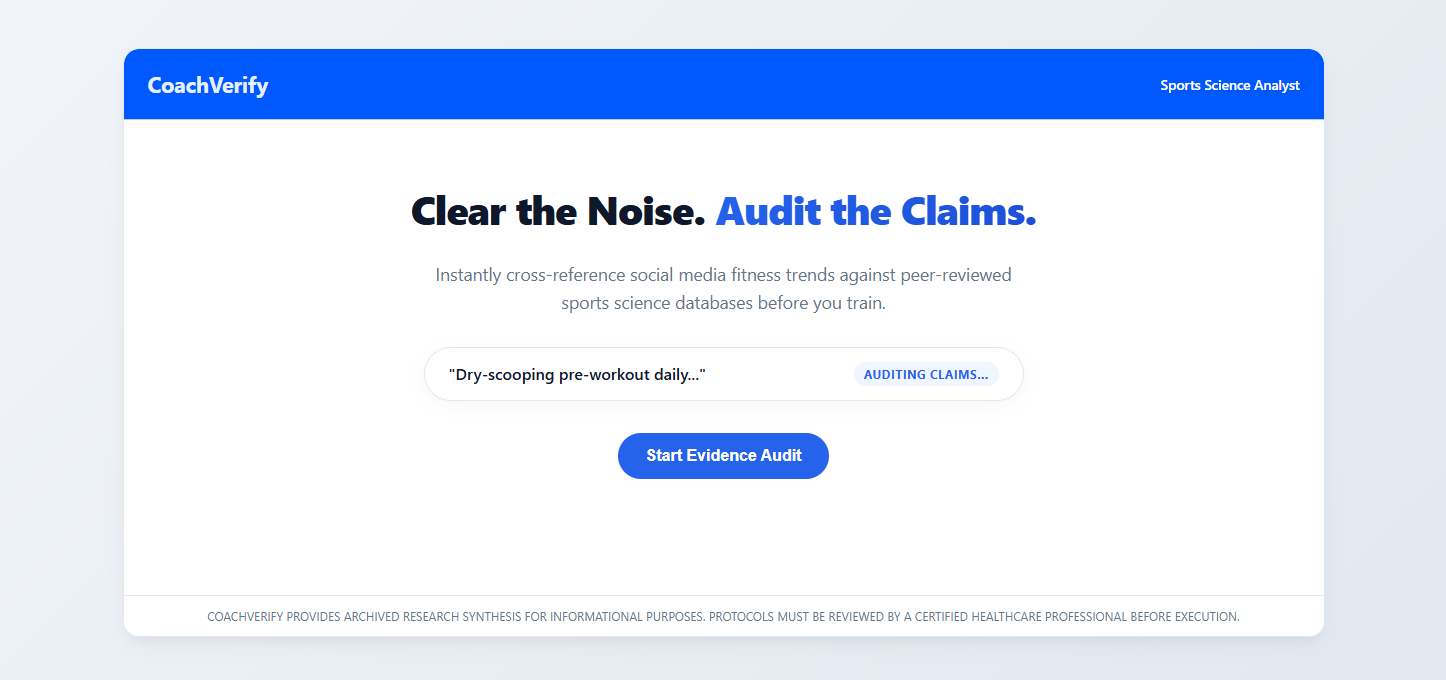
Inspiration
Up to 95% of teens ages 13 to 17 use social media, with 6 in 10 teens using apps like TikTok and Instagram. Peer-reviewed research also states that 64% of nutrition posts on TikTok are inaccurate. The significance of this issue prompted us to take action in creating a tool to combat the spread of such misinformation. As student athletes ourselves, we witness firsthand this significant amount of misleading internet health science information. Two of us also conduct scientific research as part of our school's research program and concluded that there is no better way to debunk these problems than with a transparent literature audit.
What it does
CoachVerify takes in an input from a user, such as a question about a controversial social media health trend, and sees how well it stacks up against modern scientific literature. It defines how credible a certain research source is with a "quality" rating and details metrics on how safe or impactful that inputted health science practice is.
How we built it
The application was constructed using python, html, css, and javascript. The backend was created using the flask framework and the frontend was purely html, css, and javascript. The frontend was built with a clean UI tailored for ease of use by student athletes. The backend leveraged the google gemini API for NLP, summarization (of research papers), and data classification.
Challenges we ran into
- Because of the 1-week timeline, mapping out infinite sports science cases was infeasible. In order to overcome this, however, we integrated a local database that contained enough research papers to robustly demonstrate the concept of our MVP. It wasn't a perfect fix and it was the challenge that was most off-putting for our project.
- Structuring the unstructured data of academic research was challenging. Because of the dense academic jargon of these papers, we had to translate the language into a specific format that the frontend could successfully understand. This required the use of the external pydantic library in order to get the AI model to return its response in a valid JSON schema which the frontend could successfully parse.
- Thinking about the user of our software gave us the most challenge intellectually. This was an issue our technical skills couldn't answer, lending itself to more a philosophical challenge. We'd ask ourselves if this explanation was too complex for someone at the high-school level, if the design was too professional, or if the insights were insufficient. This required us to carefully tune our system to synthesize information from the database into digestible but not overly simplified explanations. ## Accomplishments that we're proud of
- We are most proud of developing a RAG (Retrieval-Augemented Generation) AI software which can successfully translate dense academic literature into something more understandable at the student-athlete level. This is a task we thought were reserved for those with PhDs in computer science, not something that high school students could actually do themselves.
- Creating a user friendly frontend with modern design schemes. We're very proud of how we navigated the overlapping layers of CSS and created an interactive AI that has a high-performance interface tailored for student athletes. Although we did frequently use AI coding assistance, human in-the-loop programming about our frontend was necessary to avoid a sprawling UI.
- Sticking to our beliefs and seeing an idea all the way out. Initially, the whole team had doubts on what our idea should be. We spent a lot of time on the drawing board, and weren't sure what CoachVerify would be, if anything at all. We are all so proud of ourselves for sticking with our idea through the doubts and developing functional software. ## What we learned
- Learning how to structure data with Pydantic is essential for any AI or NLP-based framework. It serves as the bridge between unstructured AI outputs into production-ready code.
- Trust the process. You will never feel 100% ready about an idea that you have. That's why it's just an idea. Getting building as soon as possible is much better practice than waiting for your idea to be completely flawless. ## What's next for CoachVerify
- Integration of a larger sports science database. As of right now, CoachVerify doesn't exhibit even nearly enough knowledge to account for all the wild advice you can find on social media. This is why we plan to use public research database APIs (Consensus, Semantic Scholar). Because they are often dependent on usage periods and require authentication, they were not implemented for the MVP.
- Automated social media video auditing. This would make it a lot easier for users to assess the validity of claims on social media. By simply pasting a link to a TikTok or Instagram reel, CoachVerify would be able to parse the audio or use the on-screen text to query its database and return an answer grounded in science.

Log in or sign up for Devpost to join the conversation.