-
-
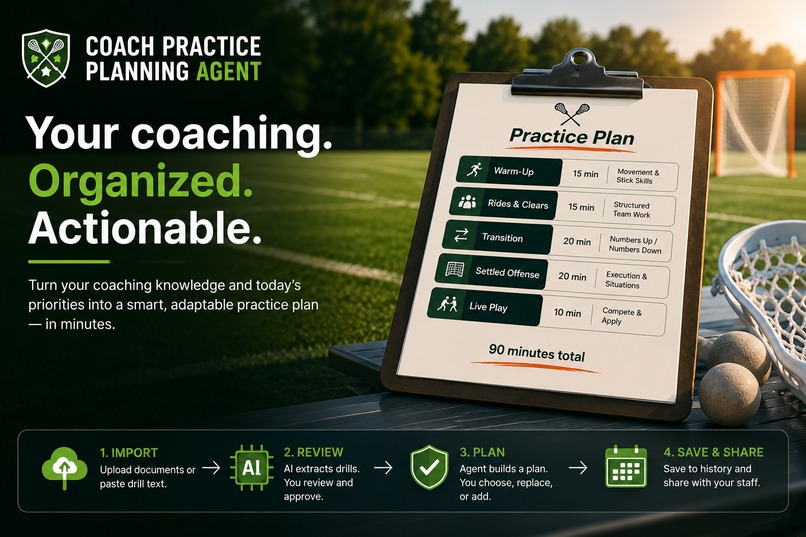
Turn coaching knowledge and daily priorities into an organized, actionable practice plan—with the coach always in control.
-
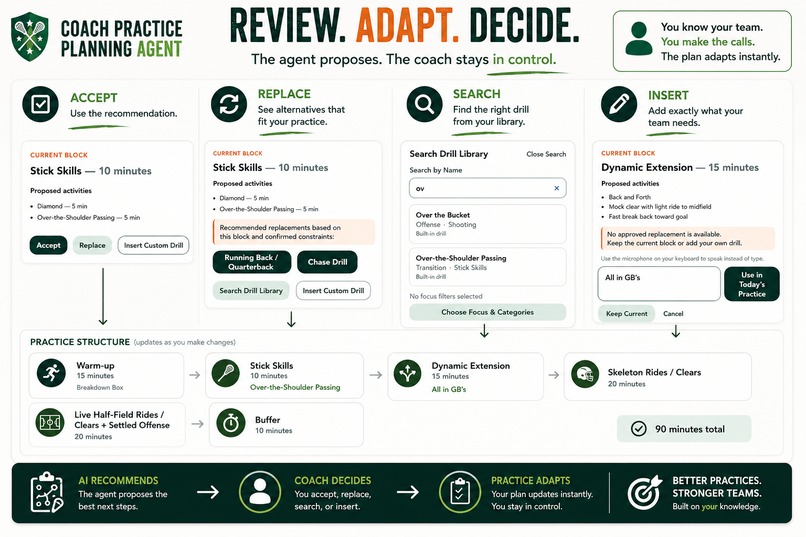
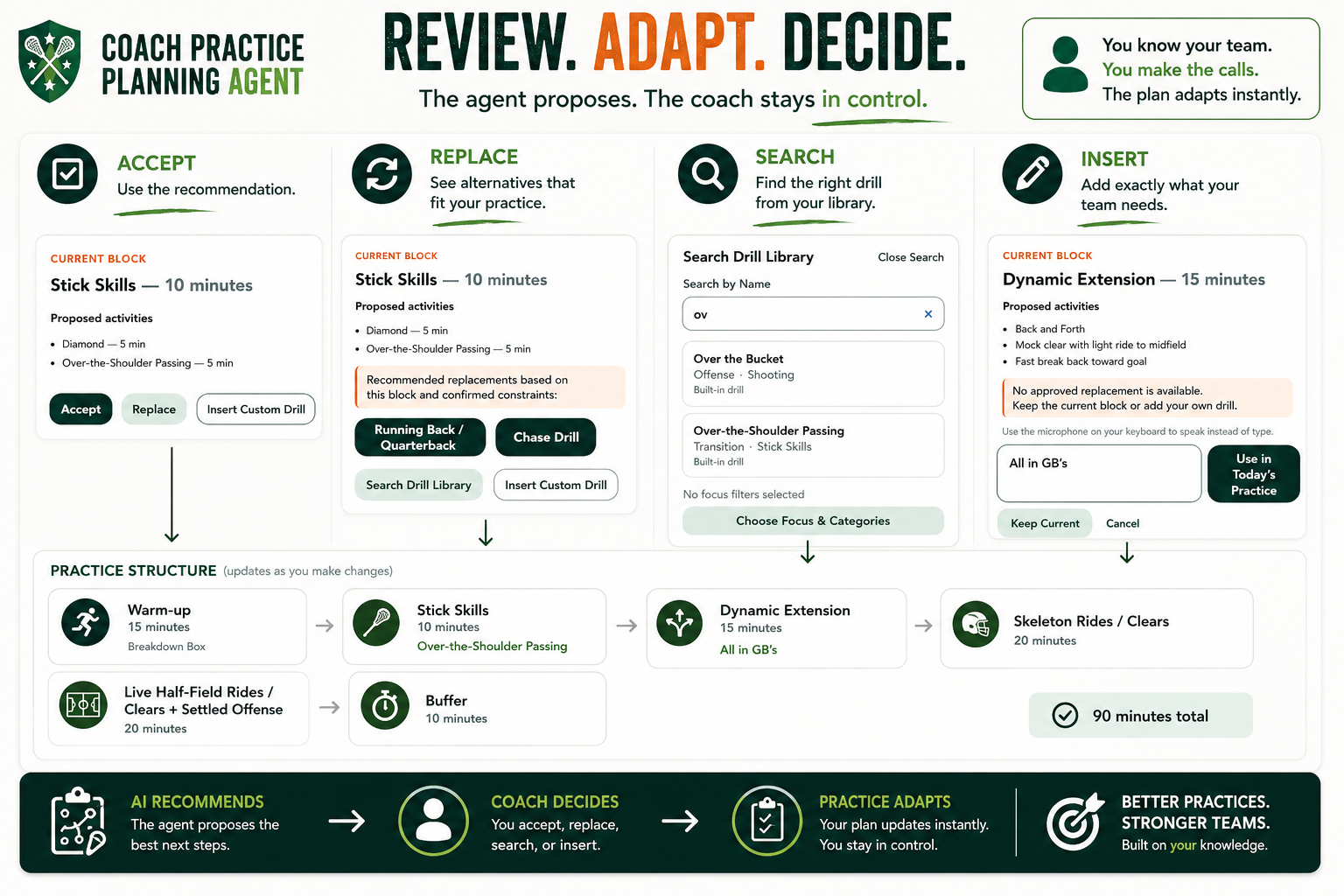
Review every block, replace recommendations, search the drill library, or add your own drill before approving the practice.
-
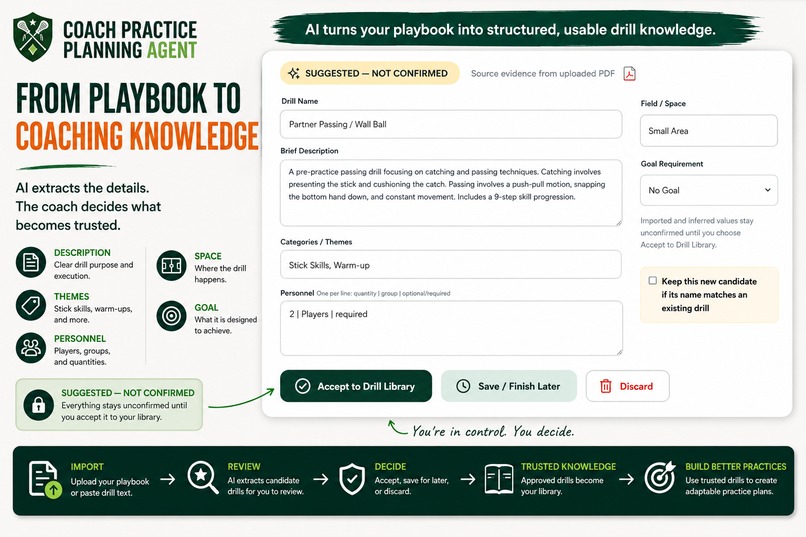
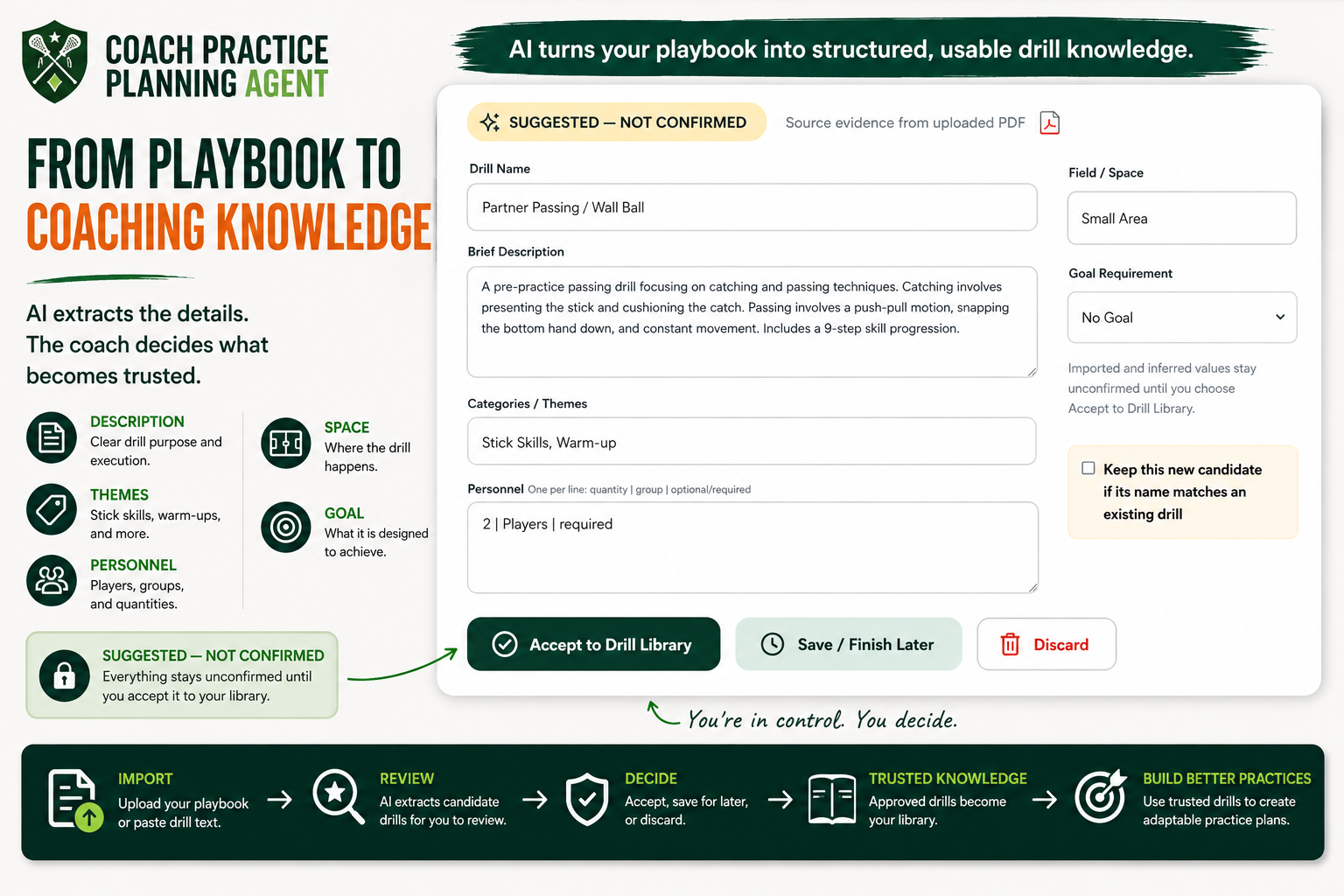
Import coaching documents, review AI-extracted drill candidates, and decide what becomes trusted library knowledge.
-
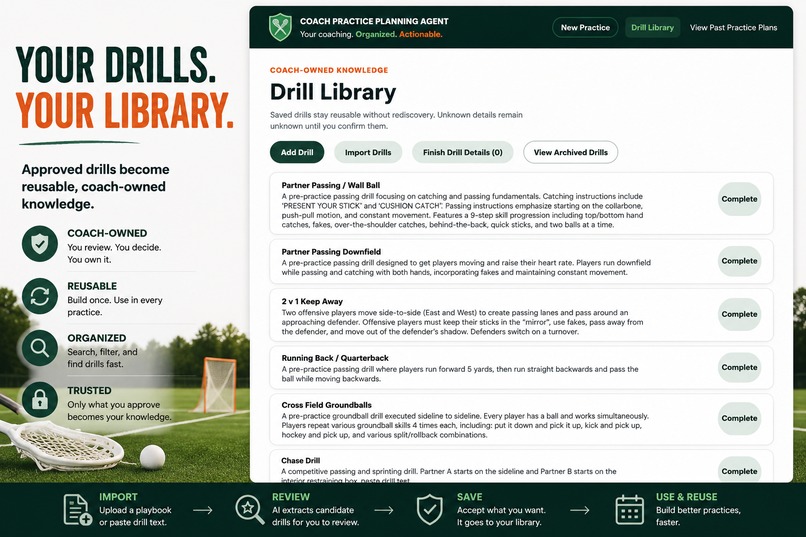
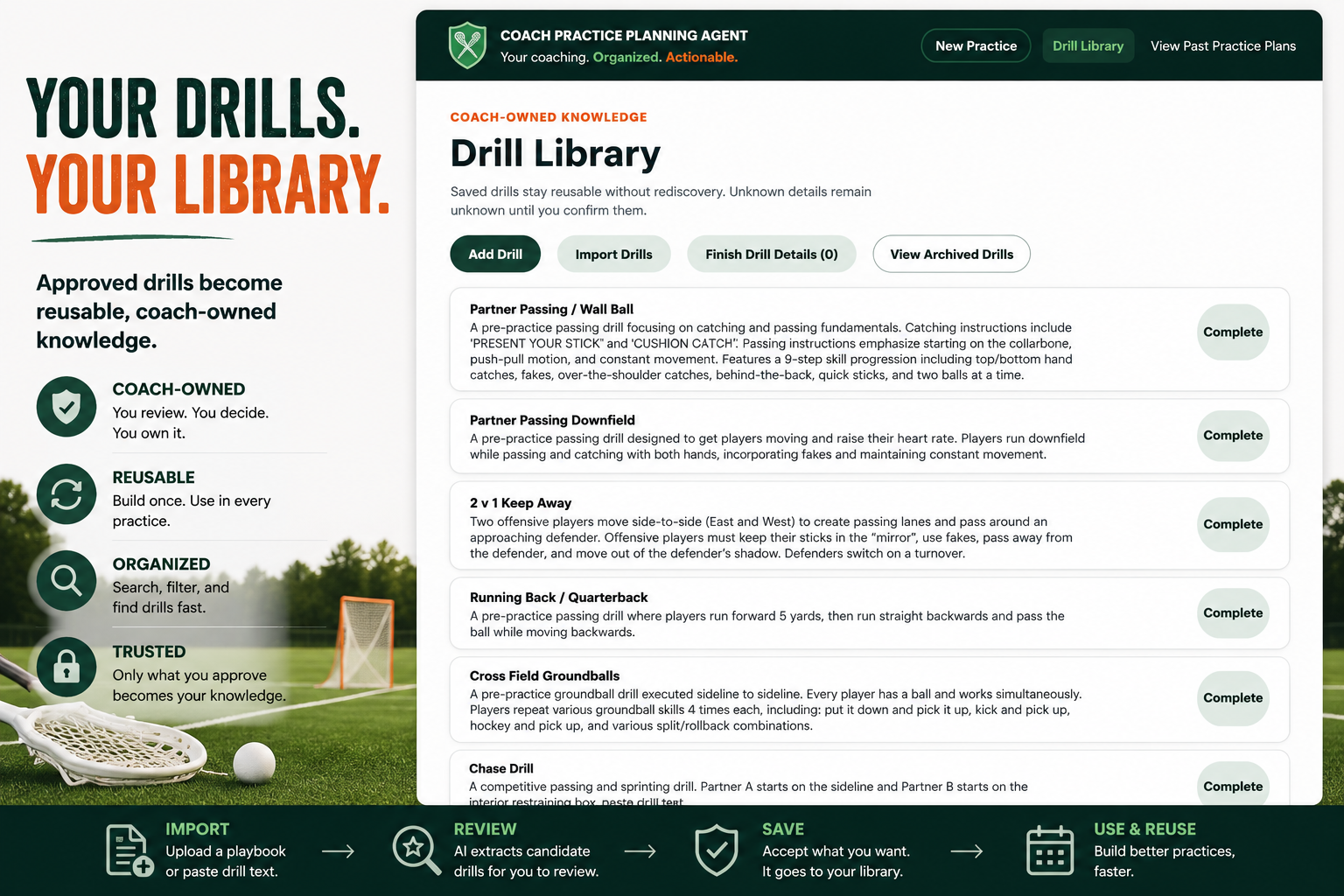
Build a trusted drill library from coach knowledge, documents, and AI-assisted imports.
-
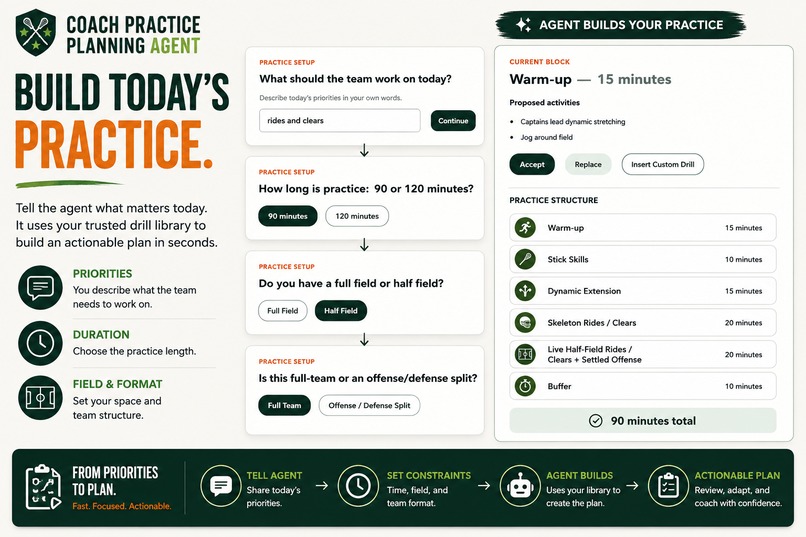
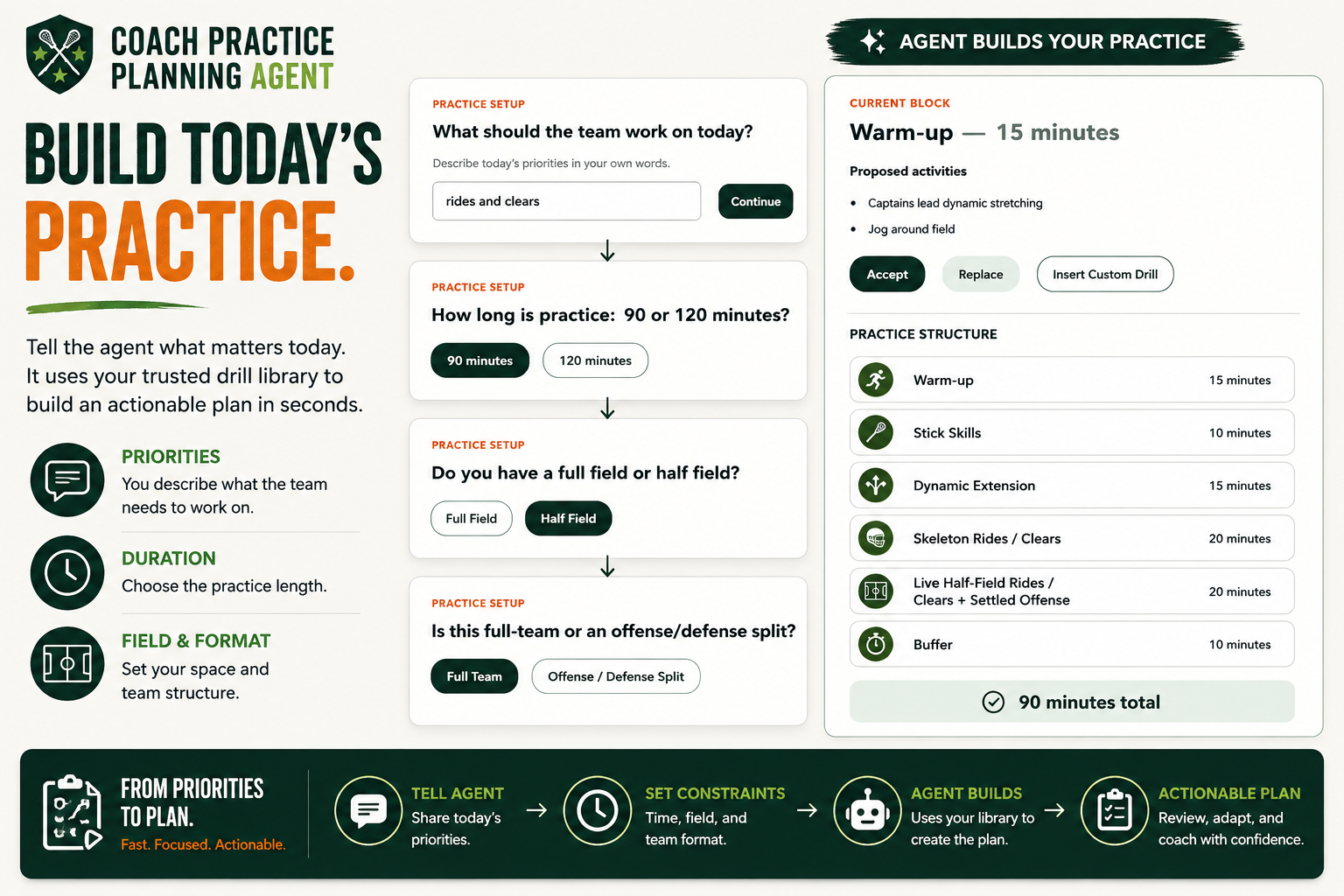
Set the day’s constraints and priorities, then generate a structured practice grounded in the coach’s drill library.
-
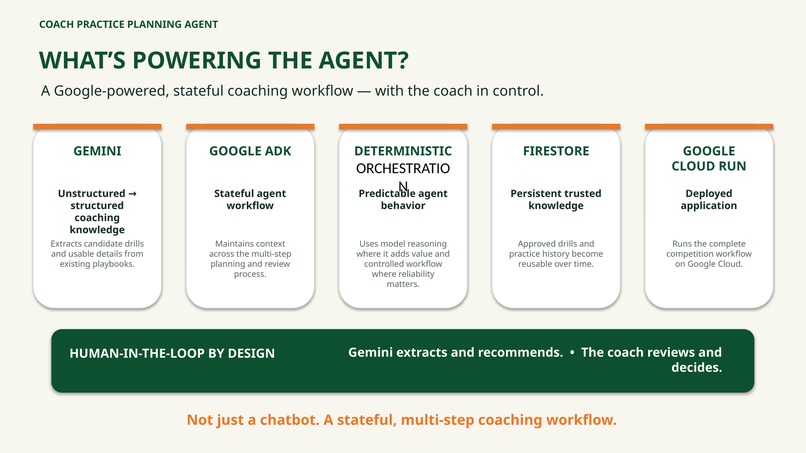
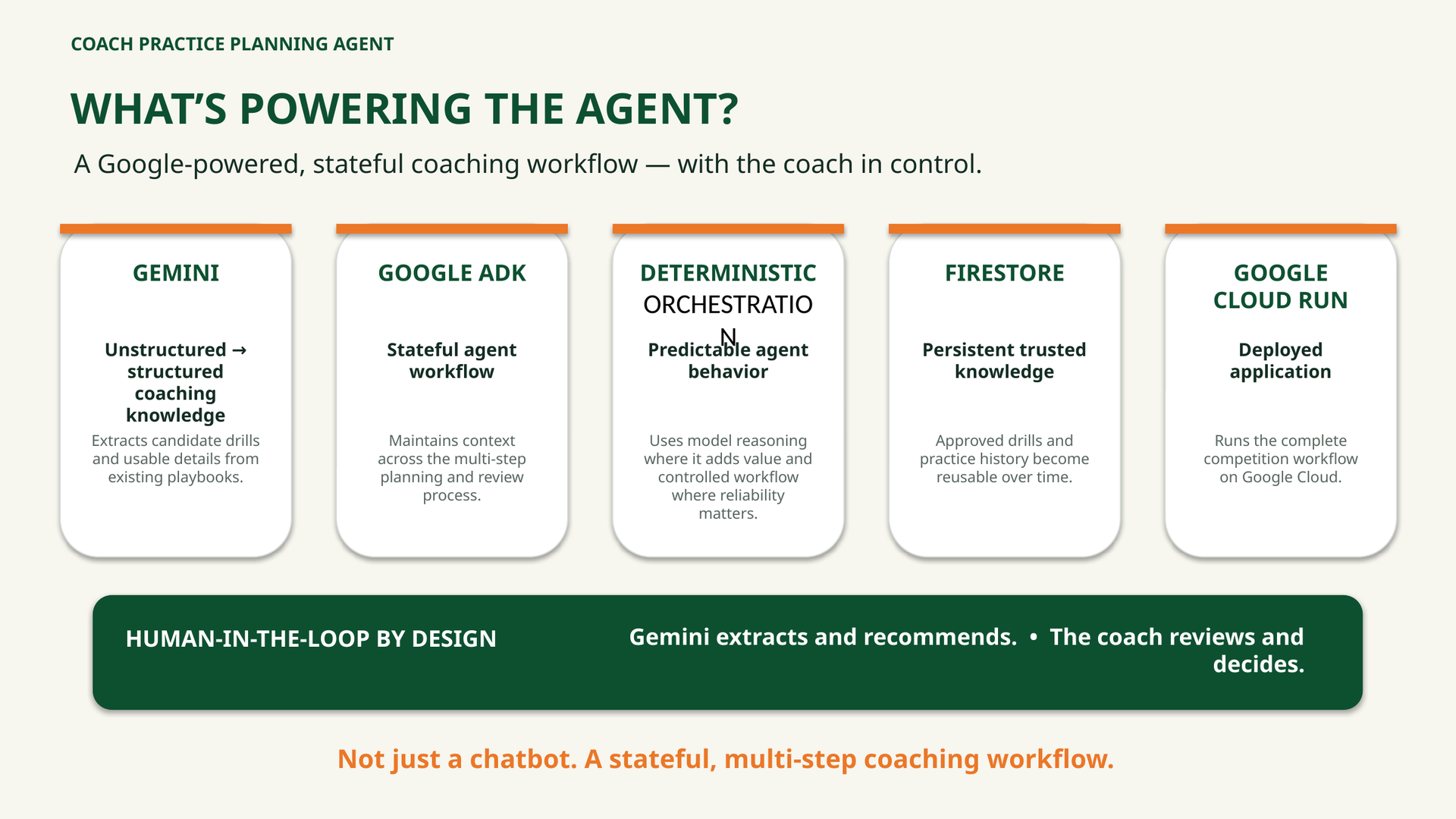
Gemini coordinates the workflow while deterministic scheduling, retrieval, and validation keep the coach in control.
-
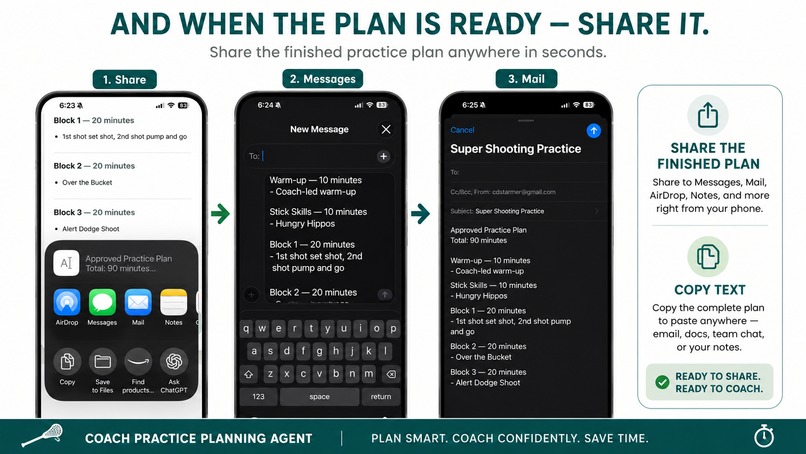
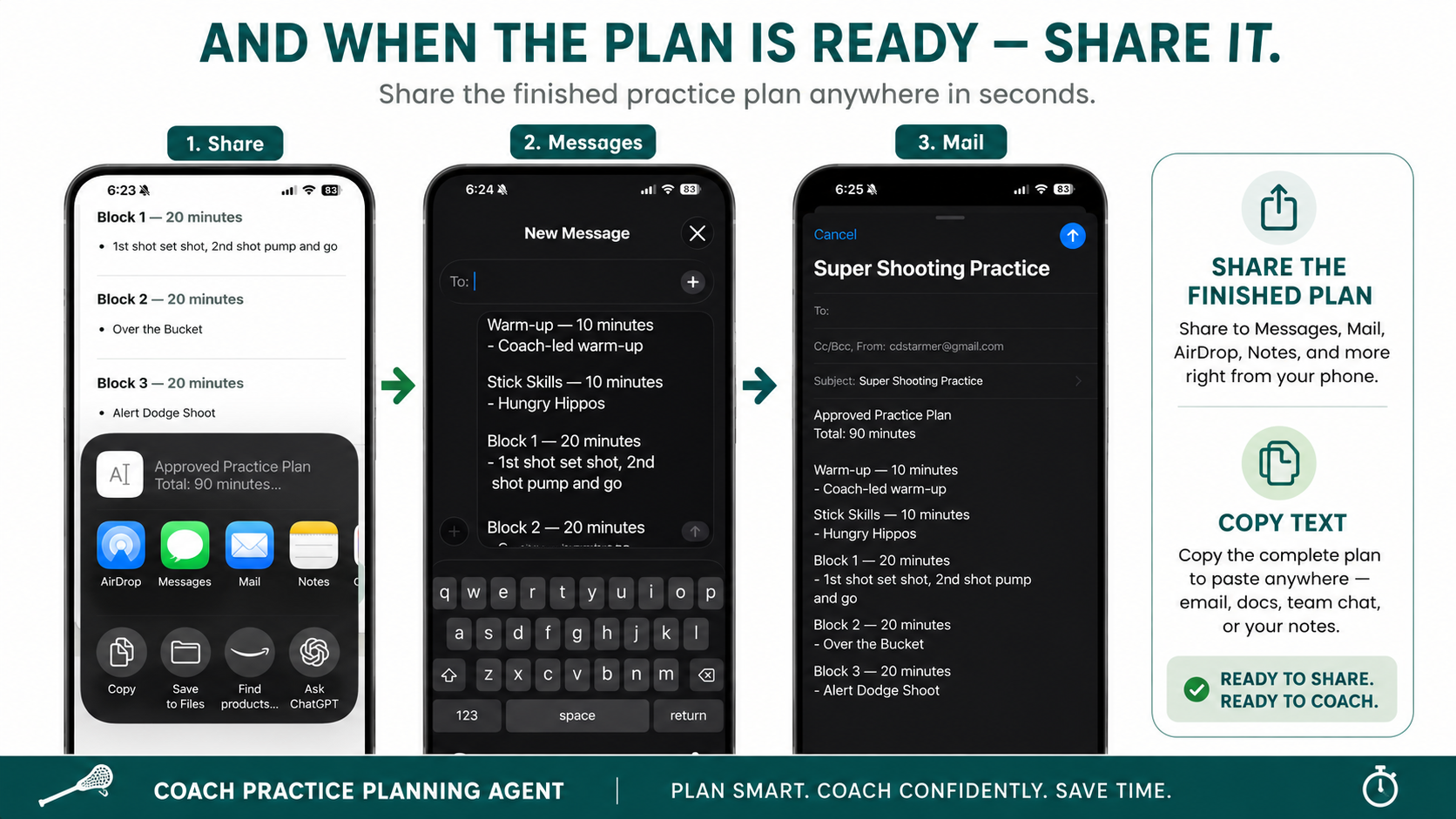
Sharing features that can make the last part of planning seemless
Inspiration
As a lacrosse coach, I have been handed paper practice plans so every coach could be “on the same page.” But once practice starts, a drill name on a sheet of paper does not necessarily tell an assistant coach how the head coach wants that drill run. The coach still has to explain the knowledge behind the plan.
That led to a bigger question: What if the practice plan could carry the coach’s knowledge with it?
There is another problem: coaches do not have extra time to document everything they know every day. Their knowledge may live in old playbooks, drill sheets, previous practices, or simply in their heads.
I built Coach Practice Planning Agent to help capture that knowledge, organize it, and put it to work—without taking control away from the coach.
What it does
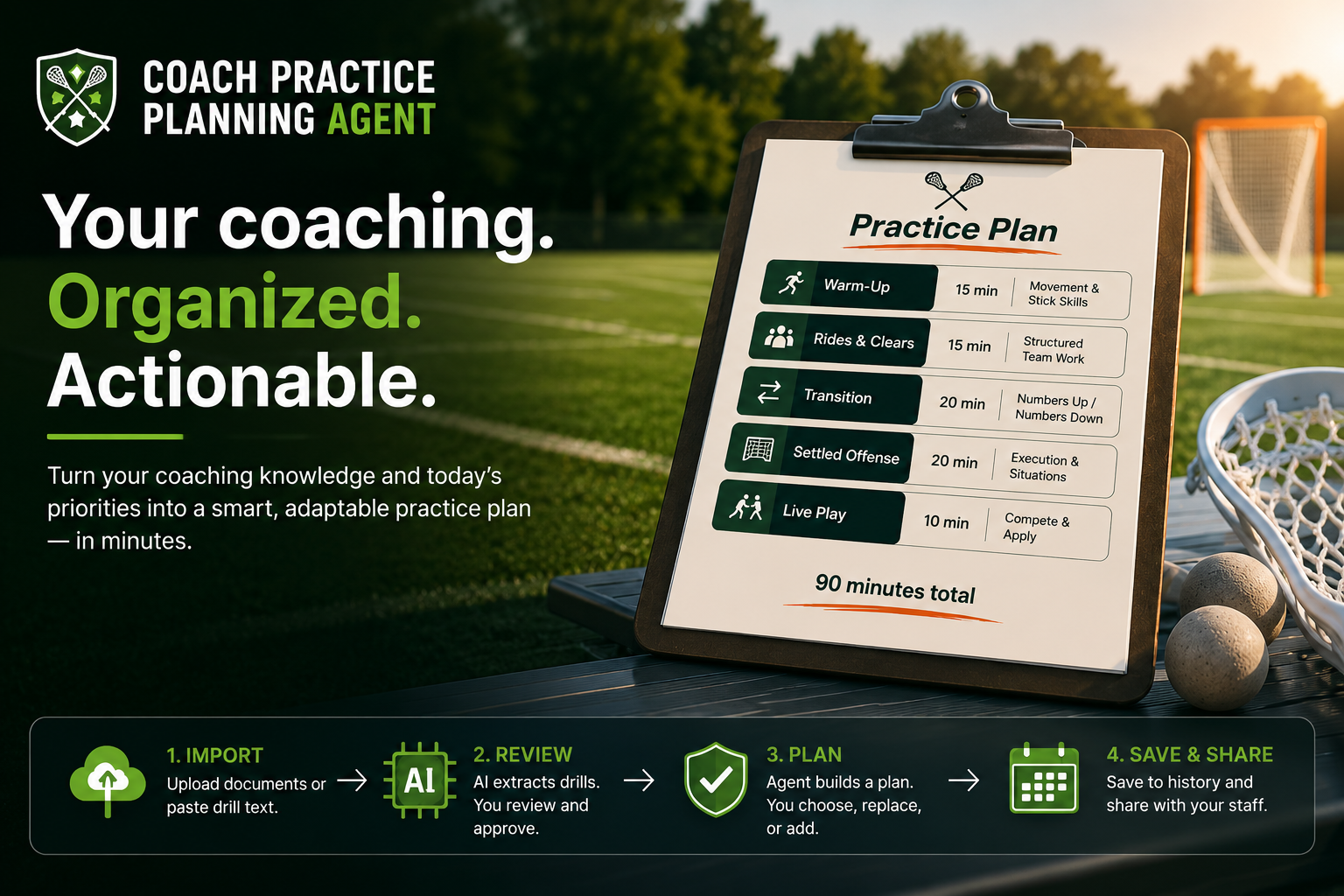
Coach Practice Planning Agent turns coaching knowledge and today's practice constraints into an actionable, adaptable practice plan.
A coach can import an existing playbook or paste drill text. Gemini extracts candidate drills and structured details such as descriptions, themes, personnel, field/space requirements, and goal requirements. These are suggestions—not automatically trusted facts. The coach reviews, accepts, edits, saves for later, or discards them before they become part of the Drill Library.
The Drill Library becomes reusable, coach-owned knowledge. Coaches can also add drills manually and finish missing details later rather than interrupting today's workflow.
When planning practice, the coach provides today's priorities in natural language along with constraints such as practice duration, available field space, and team format. The agent builds a structured practice and then works with the coach block by block.
The coach can accept a recommendation, replace it, search the trusted Drill Library by name or coaching focus, or insert a custom drill on the spot. Completed practices can be saved to Practice History, reused, copied, and shared with the coaching staff.
The goal is not to automate the coach out of practice planning. AI recommends. The coach decides.
How we built it
The project is built as a stateful, multi-step agent workflow using Google's agentic AI stack.
Gemini performs unstructured-to-structured knowledge extraction from coaching documents, turning existing playbooks into candidate drills and usable drill metadata.
Google Agent Development Kit (ADK) supports the stateful agent workflow across intake, planning, review, replacement, and completion.
I use deterministic orchestration around the model so important workflow behavior remains predictable while Gemini reasoning is applied where it adds value.
Firestore provides persistence for trusted Drill Library knowledge and saved practice information so the system becomes more useful over time rather than starting over with every session.
The competition application is deployed on Google Cloud Run.
Human-in-the-loop validation is a core architectural decision: AI-extracted information remains unconfirmed until the coach chooses what becomes trusted coaching knowledge.
This is not just a chatbot. It is a stateful, multi-step coaching workflow.
Challenges we ran into
One of the biggest challenges was balancing AI flexibility with coaching trust.
Automatically extracting drills from a playbook is useful, but automatically treating everything the model extracts as correct would undermine the system. That led to a review workflow that clearly separates suggested information from coach-confirmed knowledge.
Another challenge was making the agent useful without making the coach perform more administrative work. Coaches may not have time to completely document a drill when they think of it, so the system supports incomplete drills and a Finish Later workflow.
Practice adaptation created another challenge. A useful coaching agent cannot simply generate one plan and stop. Coaches need to reject recommendations, search their own knowledge, substitute drills, and add something entirely new when the situation demands it. Building those control paths became a major part of the product.
Finally, we worked to keep the experience practical on both desktop and mobile while preserving predictable workflow state throughout a multi-step interaction.
Accomplishments that we're proud of
The biggest accomplishment is building an end-to-end workflow around a real coaching problem rather than creating a one-time AI plan generator.
The agent can take an existing coaching document, use Gemini to extract structured drill knowledge, place that knowledge behind a human review boundary, preserve approved information in a reusable Drill Library, use that knowledge while constructing a practice, and then allow the coach to continuously adapt the result.
The deployed competition build also supports Practice History, reuse, copy/share workflows, manual drill creation, incomplete drill enrichment, duplicate awareness during import, Drill Library search and filtering, custom drill insertion, 90- and 120-minute practices, field and team-format constraints, and mobile keyboard dictation.
Most importantly, the coach remains the authority throughout the workflow.
What we learned
The most important lesson was that the valuable asset is not simply the generated practice plan. It is the coaching knowledge behind the plan.
AI becomes more useful when that knowledge can accumulate rather than being rediscovered every time a coach starts a new conversation.
We also learned that human-in-the-loop design does not have to make an agent less capable. In this case, it makes the system more useful: Gemini can do the heavy lifting of extracting and organizing information while the coach establishes what should actually be trusted.
That creates a compounding loop:
Coaching Knowledge → Trusted Drill Library → Today's Priorities → Agent-Built Plan → Coach Review & Adaptation → Save / Share / Reuse
What's next for Coach Practice Planning Agent
The next evolution is to make the coaching knowledge behind a practice even easier to pass between coaches.
A major next step is preserving diagrams and images from imported playbooks alongside each drill. A field diagram can communicate positioning, movement, and setup in ways that text alone cannot.
The Drill Library can also evolve into shared team knowledge with role-based access. A head coach could maintain authority over the trusted library while assistant coaches receive access to the full details behind the drills in an upcoming practice. That would allow an assistant to prepare before arriving at the field instead of seeing only a list of drill names.
Over time, the goal is for the system to become more than a practice generator: a living coaching knowledge system that helps a staff preserve what it knows, plan faster, communicate better, and continually improve.


Log in or sign up for Devpost to join the conversation.