Inspiration
I’m juggling teaching, building a startup, work, family, and friends and I often feel overwhelmed and mentally scattered.
I’ve tried private coaching and therapy. They work. But they’re expensive and not financially sustainable for everyday decisions or recurring overwhelm. High-level coaching is powerful but it’s not accessible in the moments you actually need clarity.
So I turned to AI. Like many people, I used ChatGPT as my default thinking tool. But I used one single chat for everything work strategy, planning, writing, venting, life decisions. Over time, it became chaotic. The context was mixed, responses felt inconsistent, and I constantly had to figure out how to prompt it properly. Instead of getting support, I felt like I was managing the system.
That’s when I realized the problem wasn’t AI, it was my structure.
Instead of one messy chat, what if I had different “coaches” for different situations like a calm coach for overwhelm, a planner for work decisions, a boundaries coach for relationships. Each built around a specific way of thinking.So instead of prompting, I could just pick the right thinker.
That idea became Coach OS , and it aligned closely with Simon’s brief: coaching that feels accessible, calming, and practical and available exactly when people need it most.
What it does
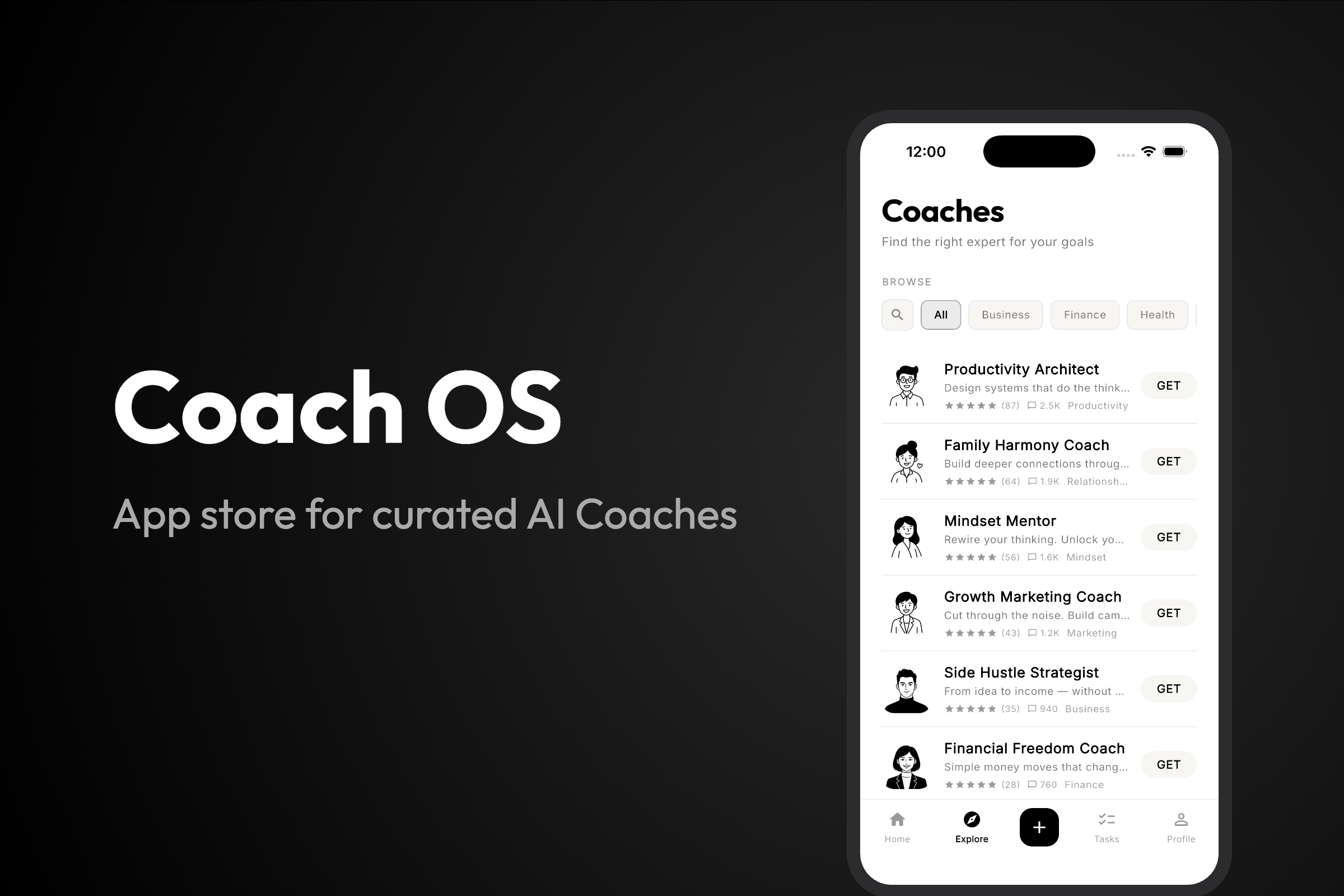
Coach OS is an app store for AI coaches built by real experts. It is designed to help you find the right support for the moment you’re in, and make high quality coaching-level accessible whenever you need it.
Instead of scheduling an expensive session or figuring out how to prompt an AI, users simply choose a coach built for their situation: productivity coach, family relationship coach, mindset mentor, marketing specialist and others. Each coach is designed by an expert who knows that area inside and out, so you're not getting generic AI responses.
For Better Creating’s audience, this removes friction. When you're overwhelmed trying to figure out what deserves your time, this gives you a way to work through it without needing to learn AI or stare at a blank chat. You just open the app, pick the coach that fits, and start a conversation.
For creators like Simon: Coach OS lets you turn your frameworks into AI coaches people can use anytime. Your decision-making process becomes a Product Strategy Coach. Your conflict resolution method becomes a Difficult Conversations Coach. Your expertise helps people at scale, not just in scheduled sessions.
How we built it
We built Coach OS around three principles: approachable design, human-centered framing, and immediate usefulness. Each one targets a real reason people don’t get value from AI, even when the technology is good.
Design (familiar + minimal): We designed Coach OS to feel instantly familiar, like apps people already use. The navigation is simple home, Explore, and Tasks so users don’t have to learn a new system. We kept the UI minimal (mostly black and white, lots of whitespace, clear typography) to reduce mental load and make it feel calm. We also avoided AI jargon and feature clutter, so the user always knows what to do next.
Human-centered framing: Coach OS is curated by real people who specialize in specific areas like careers, communication, burnout, and habits. People don't fully trust AI advice when it feels generic or random but they do trust guidance that comes from someone credible.
Every coach in Coach OS is built this way, a therapist defines how the burnout coach asks questions and gives advice, a career counselor shapes how the transition coach helps you clarify next steps. So instead of "AI guessing," you get structured expertise that feels reliable enough to actually use for decisions, reflection, and follow-through.
Immediate usefulness We designed onboarding to make the user feel heard from the first screen. Instead of asking them to set things up or build anything, we start with simple, human questions like “How are you feeling?” and “What do you need right now?” That way, the user can begin quickly and feel supported right away without needing to know anything about AI or “how to use the app.”
Challenges we ran into
- Designing the boundary between coaching and therapy. We wanted Coach OS to feel human and supportive but not cross into therapy. Emotional support tools often lean heavily into processing feelings, which can create resistance or feel overwhelming for many users. At the same time, purely transactional AI tools feel cold and impersonal. The challenge was finding the balance: supportive, but not therapeutic. Practical, but still human.
We solved this by focusing on structured thinking, clarity, and action. Coach OS helps users think better and decide clearly without positioning itself as a mental health solution.
- Accountability without becoming a nagging productivity app. Most AI tools are famously bad at accountability. They provide insight, but don’t help users act on it. At the same time, too many reminders can feel intrusive and quickly turn the product into just another productivity app yelling at you.The challenge was designing accountability that feels lightweight and supportive not spammy or overwhelming.
We focused on subtle check-ins tied directly to user-defined tasks, so reminders feel relevant and helpful rather than constant or generic.
Accomplishments that we're proud of
We turned my real frustration using one messy AI chat for everything into a product that solves it.
As a non-technical builder, my perspective shaped the design, Coach OS us simple, focused, and instantly usable instead of overwhelming.
We shipped something monetizable, not just interesting. People can pay for Coach Os from day one, because it has a clear value proposition: specialist-designed coaching you can trust, accessible when you need it, for less than the cost of one real coaching session.
What we learned
When AI is organized with clear roles and boundaries, it becomes reliable enough for real decisions. And that small design shift can fundamentally change how people think, decide, and trust technology.
Building great products isn’t just about technology , it’s about understanding the problem deeply and grounding the solution in real expertise. As a non-technical founder, I focused on clarity and usefulness, my technical cofounder made it real, and collaborating with Simon added credibility and depth.
What's next for Coach OS
Roadmap Phase 1 (Months 1–3): Prove We Can Make Money Focus: Retention and paid users. Goal: Show that users come back and are willing to pay.
Phase 2 (Months 4–6): Grow the Creator Side Focus: Add more expert-built coaches.
- Build simple onboarding tools for creators
- Add more specialized coaches
- Launch creator monetization Goal: More creators = more value = more paying users.
Phase 3 (Months 7–12): Make It Easier to Use Focus: Reduce friction.
- Integrate more tools like Notion and Todoist
- Add light community features
- Launch Android Goal: Fit into users’ real workflows so they stay longer.
Future: Marathon Agent A longer-running coaching experience that supports users across multiple days not just single sessions.

Log in or sign up for Devpost to join the conversation.