🌍 CO2 Flow – Revolutionizing Carbon Trading & Emission Analytics
🚀 What Inspired Us
The growing urgency around climate change and the alarming levels of air adulteration, especially in urban centers like Delhi, inspired us to create CO2 Flow. We envisioned a platform that not only tracks carbon emissions but also empowers individuals, businesses, and governments to take actionable steps towards a greener future. Our goal was to simplify carbon trading, make emission data transparent, and incentivize sustainable practices — all while leveraging the latest in AI, blockchain, and IoT technologies.
🧠 What We Learned
Building CO2 Flow was a transformative learning experience. We deepened our understanding of:
- Real-time data handling using IoT devices and integrating them into a scalable dashboard.
- Blockchain integration with Ethereum for secure and transparent P2P carbon credit trading.
- Utilizing Gemini API for seamless market data and transactions in the energy price charts.
- Enhancing UI/UX with Tailwind CSS, making complex data simple and engaging.
- Handling complex backend logic with Node.js while managing data through MongoDB for real-time analytics.
We also explored GHG protocols and compliance standards, ensuring that our emission tracking aligns with global environmental regulations.
🏗️ How We Built It
Frontend:
- Built with React.js and styled using Tailwind CSS for a clean, responsive UI.
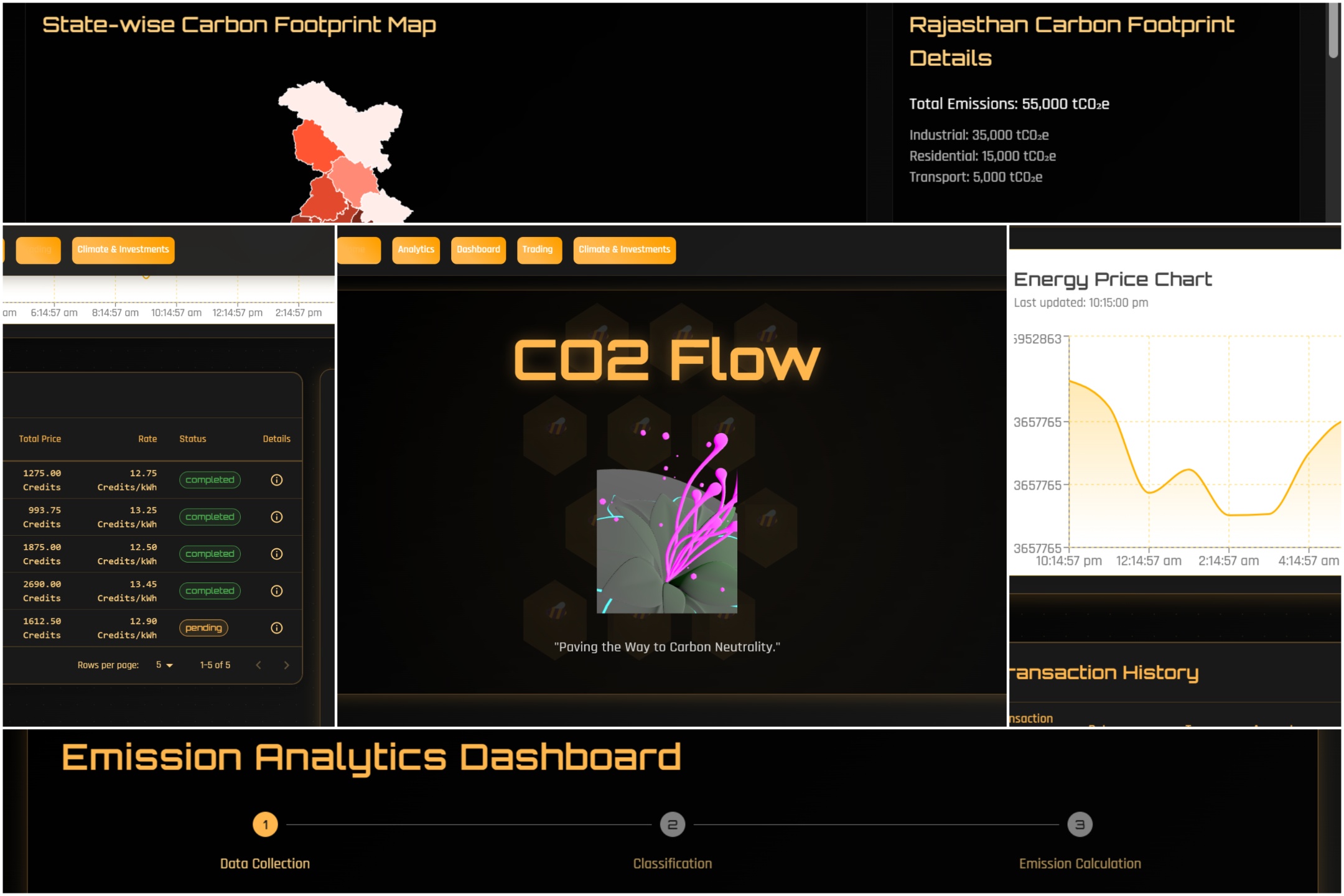
- Integrated Gemini API for live energy price charts, featuring order books and transaction history.
- Developed multiple dashboards:
- Emission Analytics Dashboard (emission classification, supply chain hotspots, carbon footprint tracking)
- Climate Energy Price Chart
- Investment & Initiatives Platform (rewarding renewable energy sellers)
- Government Dashboard (for policymakers and regulators)
- Built with React.js and styled using Tailwind CSS for a clean, responsive UI.
Backend:
- Powered by Node.js and Express.js for scalable and efficient backend services.
- MongoDB for storing user data, emission logs, and trading history.
- Integrated IoT devices for real-time air quality tracking, feeding data directly into the analytics engine.
- Powered by Node.js and Express.js for scalable and efficient backend services.
Blockchain Integration:
- Utilized Ethereum for P2P carbon credit trading.
- Smart contracts for secure, transparent, and automated transactions.
- Carbon Currency Points awarded for renewable energy contributions, fostering eco-friendly initiatives.
- Utilized Ethereum for P2P carbon credit trading.
⚡ Challenges We Faced
Real-time Data Integration:
- Managing data from IoT sensors while ensuring low latency was challenging.
- Solution: Implemented MQTT protocols for efficient data transmission.
- Managing data from IoT sensors while ensuring low latency was challenging.
Blockchain Scalability:
- Integrating Ethereum while mitigating high gas fees was tricky.
- Solution: Adopted Polygon as a sidechain for lower transaction costs.
- Integrating Ethereum while mitigating high gas fees was tricky.
Complex UI/UX Design:
- Presenting detailed emission data in an accessible format was difficult.
- Solution: Used Tailwind CSS and data visualization libraries for a user-friendly interface.
- Presenting detailed emission data in an accessible format was difficult.
GHG Compliance Tracking:
- Ensuring compliance with GHG protocols required advanced logic.
- Solution: Developed a dynamic compliance module adapting to global standards.
- Ensuring compliance with GHG protocols required advanced logic.
Multi-Dashboard Synchronization:
- Keeping multiple dashboards updated in real-time was complex.
- Solution: Implemented WebSockets for live data synchronization.
- Keeping multiple dashboards updated in real-time was complex.
🌟 Final Thoughts
CO2 Flow demonstrates how technology can drive climate action. By combining AI, IoT, blockchain, and real-time analytics, we created a platform that empowers communities, businesses, and governments to monitor, reduce, and trade carbon emissions efficiently.
This journey taught us the importance of collaboration, problem-solving, and innovation, all driven by a vision for a cleaner, greener planet.
🔮 What’s Next for CO2 Flow
We’re just getting started. The next steps for CO2 Flow include:
🔗 Advanced IoT Integration:
Expanding the network of IoT devices for more granular, real-time air quality and emission tracking, ensuring even higher data accuracy.📊 Dedicated Government Dashboard:
Creating a specialized dashboard for governments and regulators, providing city-wide and national-level insights into emissions, supply chain hotspots, and GHG compliance status — helping drive policy and enforcement.🌐 Cross-Platform Expansion:
Bringing CO2 Flow to mobile and tablet devices, allowing users and policymakers to monitor emissions and trade carbon credits anytime, anywhere.💡 AI-Powered Insights:
Integrating more robust AI models to provide predictive analytics, highlighting future emission hotspots and offering actionable recommendations.🎯 Gamified Incentives:
Introducing challenges and leaderboards to motivate users and businesses to lower their carbon footprints and earn Carbon Currency Points.
🔗 Useful Links
- 🌐 Project Live: CO2 Flow Website
- 💾 GitHub Repo: Ohm My Hive
- 🎥 Project Demo: Watch on YouTube
- 🎥 Pitch Deck: Watch on Canva
Built With
- aurdino
- geminiapi
- javascript
- node.js
- react
- tailwindcss


Log in or sign up for Devpost to join the conversation.