-
-
Interface
Most "agentic shopping" demos we'd seen worked by having an AI agent drive a headless browser through a UI built for humans clicking buttons, parsing HTML, guessing at what a page meant. It's slow, brittle, and worst of all, invisible: the human has no idea what's happening until the agent reports back a summary at the end.
WebMCP flips that entirely. A page can declare what an agent is allowed to do search_products add_to_cart checkout with typed schemas, so the agent calls real functions instead of pretending to be a mouse. We wanted to build something that showed off what changes once a human and an agent aren't just near each other, but genuinely sharing the same piece of state in real time. Grocery shopping felt like the perfect testbed: it's repetitive, constraint-heavy work ("stay under budget," "keep it vegetarian," "don't forget the eggs") that's exactly what an agent is good at, while still being something people want a say in; nobody wants an AI silently deciding what's for dinner.
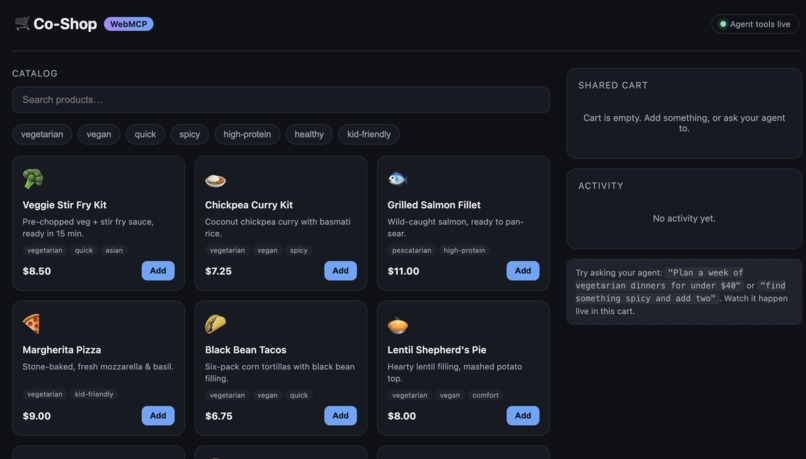
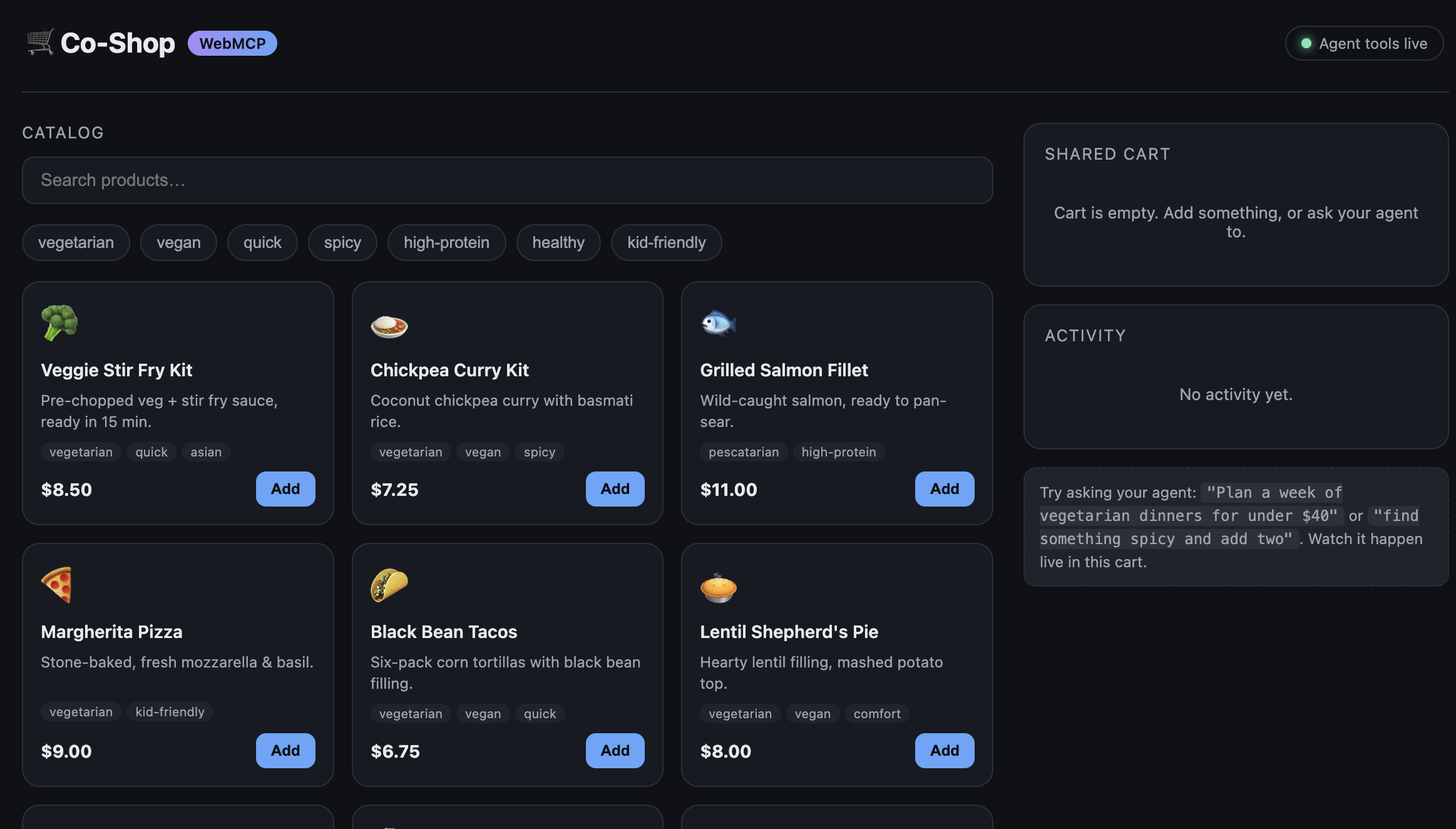
That became Co-Shop: a storefront where you and your agent literally share one cart.
What it does Co-Shop is a grocery catalog with a shared cart. A human can browse and add items by clicking, same as any store. An AI agent through ChatGPT's WebMCP-enabled browser, or any WebMCP-aware client can call into the same cart through seven registered tools:
search_productsfree-text / category / tag / price searchadd_to_cart,remove_from_cart,update_quantitydirect cart editsget_cartread the current shared state, including what the human addedplan_dinnersa compound tool: give it a day count, a diet, and a budget, and it picks matching dinners and adds all of them in one callcheckoutplaces the order and clears the cart
Every action human or agent shows up instantly with a badge (YOU or
AGENT), a highlight animation on agent-added items, and a live activity
feed narrating the back-and-forth. Ask your agent "plan a week of
vegetarian dinners under $40" and watch the cart fill up in front of you,
still fully editable.
How i built it
The whole app is a single Next.js (App Router) page with one client
component holding the cart and activity-log state. On mount, it registers
all seven tools with document.modelContext.registerTool(...), each with
a JSON Schema inputSchema and an execute function but critically,
those execute functions call the same internal helpers
(addToCart, removeFromCart, checkout, etc.) that the UI's own click
handlers call. That was the core design decision: there's no separate
"agent path" and "human path," just one state, mutated from two places.
Tools are registered inside a useEffect and cleaned up via an
AbortController passed as the registration's signal. Every execute
returns the WebMCP content-array shape
({ content: [{ type: "text", text: JSON.stringify(...) }] }) so the
agent gets structured JSON back not just a confirmation string which
matters a lot for a compound tool like plan_dinners, where the agent
needs to know things like "only 5 of 7 requested days fit the budget."
Challenges i ran into
- Stale closures. Tools are registered once on mount, so their
executefunctions would otherwise capture a stale snapshot of the cart. We solved this by keeping the state update functions themselves as the single source of truth (viasetStatefunctional updates) rather than reading from a captured variable. - Making agent actions legible, not just correct. It's not enough for the tool calls to work a judge (or a shopper) needs to see the difference between "I added this" and "the agent added this" at a glance. That's what drove the AGENT/YOU badges, the purple pulse animation, and the activity feed.
- Testing without a live agent. Early on, we stubbed
document.modelContextin a headless browser to exercise the tools programmatically before ever touching a real agent client — that caught a few bugs (like quantity handling onupdate_quantity) well before we tested against ChatGPT's actual WebMCP browser. - Getting the deploy pipeline right on a deadline. Wiring up GitHub, Vercel, and an MIT license that GitHub actually detects in the About section took more back-and-forth than the code itself.
What i learned
WebMCP's real power isn't "agents can now click your buttons for you" it's that a page and an agent can share one source of truth instead of two. That's a genuinely different interaction model from screen-scraping or API wrapping, and it's why an agent's actions in Co-Shop feel like someone else shopping with you, not an AI doing your shopping for you somewhere off-screen.
What's next
Natural extensions: letting the agent negotiate substitutions when a
diet/budget can't be satisfied exactly, a compare_products tool for
side-by-side agent recommendations, and multi-user shared carts where two
humans and an agent are all in the same session at once.
Built With
- css3
- javascript
- model-context-protocol
- nextjs
- react
- vercel
- webmcp


Log in or sign up for Devpost to join the conversation.