-
-
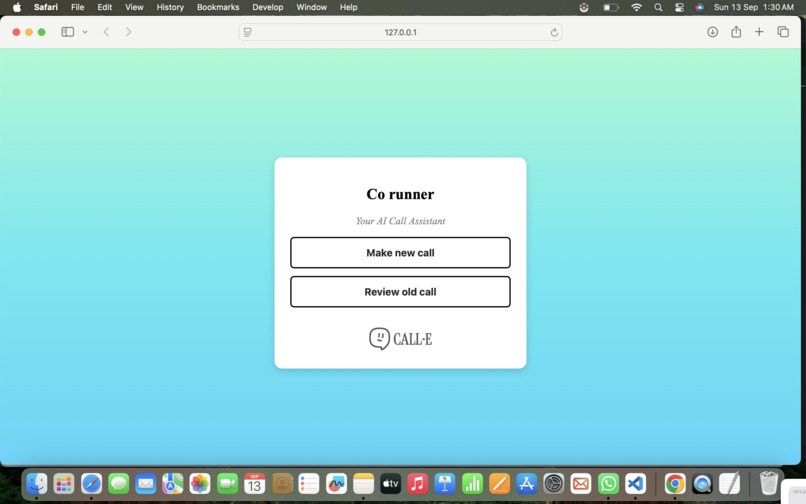
Main Dashboard
-
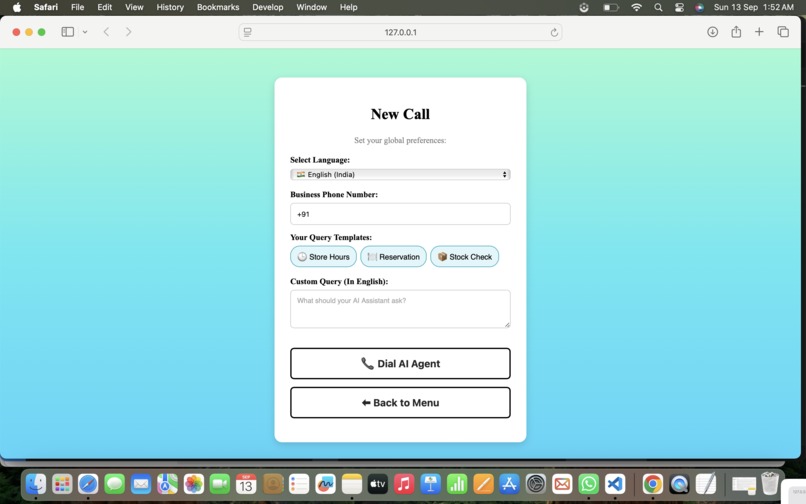
New Call Dashboard
Attention Please
Due to real-world network latency, please fast-forward the demo video from 2:26 to 3:45 to skip the polling loop, as I wanted to respect your 3-minute limit while demonstrating our custom regional fallback handler working lively.
Inspiration
For international business travelers and cross-border entrepreneurs, language barriers are incredibly expensive. Missing a critical logistics update, miscommunicating a reservation time, or being unable to verify vendor availability can completely disrupt supply chains. As an individual builder, I wanted to create a streamlined utility that completely removes this barrier, enabling global travelers to conduct frictionless international commerce anywhere in the world without compromising deal execution.
What it does
Co-Runner is a client-side application dashboard that lets travelers deploy fluent, localized AI voice agents to make real-time business calls worldwide. The user inputs their task and selects a destination language. The application automatically maps the E.164 country code parameters, triggers a CALL-E REST API voice agent to handle the conversation natively, and securely streams structured, English-translated evidence back to the traveler's persistent call logs.
How we built it
The application is built entirely with a clean client-side stack using semantic HTML, custom CSS gradients, and modular Vanilla JavaScript structures. It integrates directly with the official CALL-E REST API Gateway (https://heycall-e.com), leveraging custom asynchronous polling loops to continuously track call states (completed, failed, canceled). It bypasses heavy server requirements by storing user call logs securely in the browser's persistent localStorage.
Challenges we ran into
The biggest obstacle during development was managing international carrier latency and unexpected network routing drops over global connections. During testing—particularly when routing voice agents through regional Indian lines—calls would occasionally hang in queue states or take a long time to connect. Navigating the REST lifecycle API smoothly without letting the client interface crash or lock up required deep optimisation of the polling logic.
Accomplishments that we're proud of
Even though network routing latency meant we couldn't get the lightning-fast call execution speed we originally hoped for, I am incredibly proud of how robustly the application handles these delays. Building a resilient asynchronous fallback handler that automatically catches 90-second polling timeouts and warns travelers about active regional carrier delays was a huge engineering win that keeps the application stable under real-world conditions.
What we learned
Building this project taught me a massive amount about managing asynchronous API Lifecycles and handling long-running remote processes over REST. I also learned the vital importance of protecting application environments; I learned how to set up secure .gitignore patterns and config.example.js blueprints to build open-source tools without ever risking or leaking private developer API keys.
What's next for Co-Runner: Global Travel AI Call Assistant
The next phase for Co-Runner is adding a dual-call speculative architecture to eliminate incoming call-queue holds entirely. I also plan to integrate live browser speech-to-text inputs so business travelers can dictate call instructions naturally on the move, transforming Co-Runner into the ultimate companion for cross-border commerce.
Built With
- call-e
- css3
- github
- html5
- javascript
- rest-api
- sdk

Log in or sign up for Devpost to join the conversation.