
Inspiration
Interline transportation in the air cargo industry allows airlines to transport cargo on each other’s behalf, typically to destinations not directly served by an airline or limited capacity. While useful for expanding network coverage, these agreements can also pave the way for deeper collaborations and future joint ventures. Although these agreements are beneficial in expanding network coverage, they can come with several challenges.
The process of interline agreements are carried out manually and include long bureaucratic steps takes a lot of time. Lengthy bureaucratic processes are handled through extensive email traffic and paper-based documents. Each company share various agreement clauses in different formats which are extremely difficult to review. Due to the lack of common standard agreement template, different Regulations of Companies & Documentation Errors lead to delays, penalties, or shipment refusals. Divergent terminology, leading to misunderstandings among stakeholders. Ensuring compliance with each airline’s local rules, customs requirements, and international aviation laws can be complex.
We can summarize Interline Process Challenges in Air Cargo Industry under three main topics;
Communication
- Lack of common platform for interline capacity visibility
- Unawareness of interline capacity and rates
- Inability to communicate between airlines
Digitalization
- Inconsistent messaging among stakeholders
- Incompatible data models for communication
- Non-transparent cargo tracking process
Customer Dissatisfaction
- Reluctance to handle interline shipments
- Loss of airline reputation
Our solution: Co-Freight
A shared booking system based on One Record Data Model allows full visibility of shipments and confirmed bookings based on space availability.
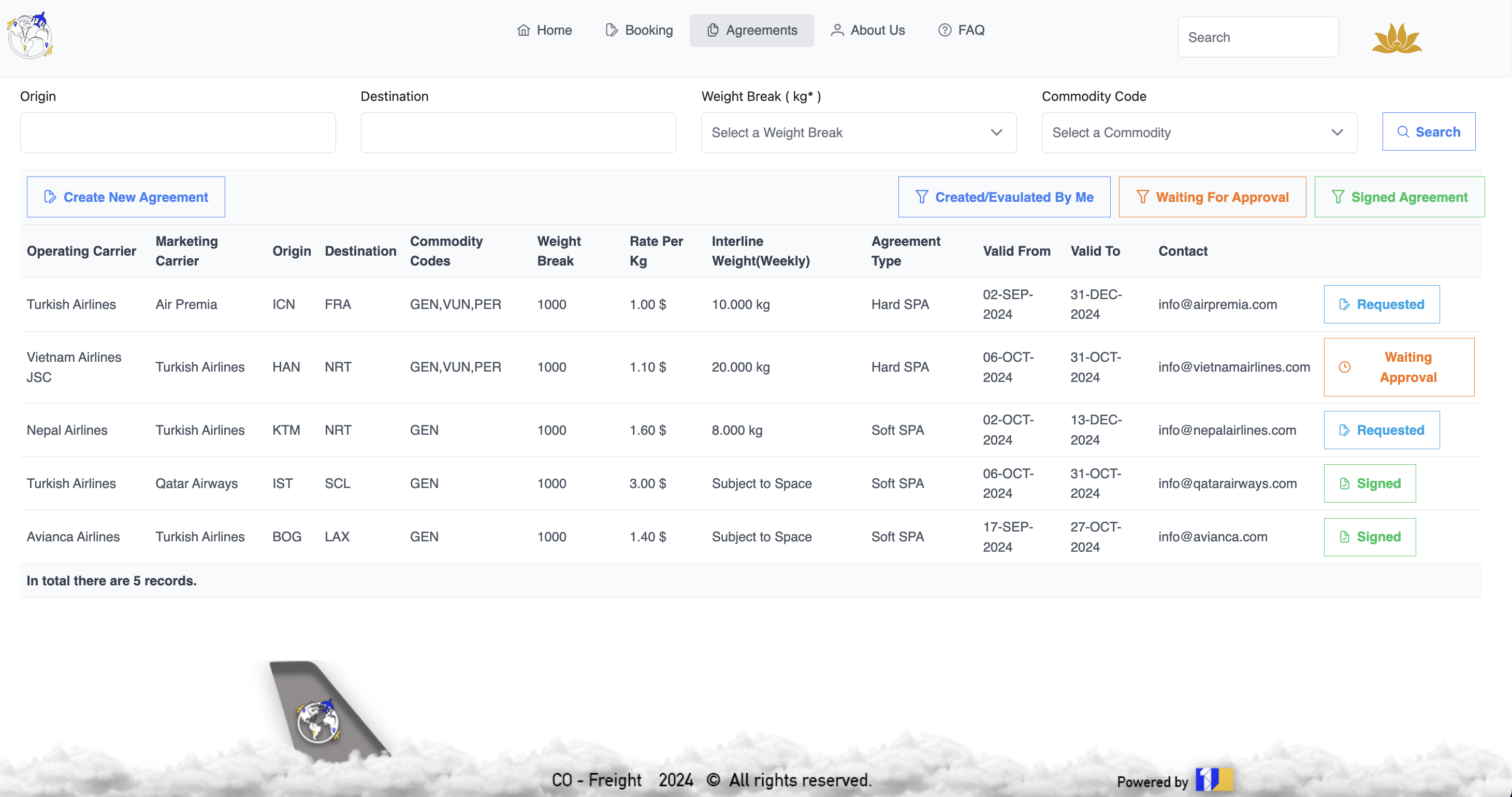
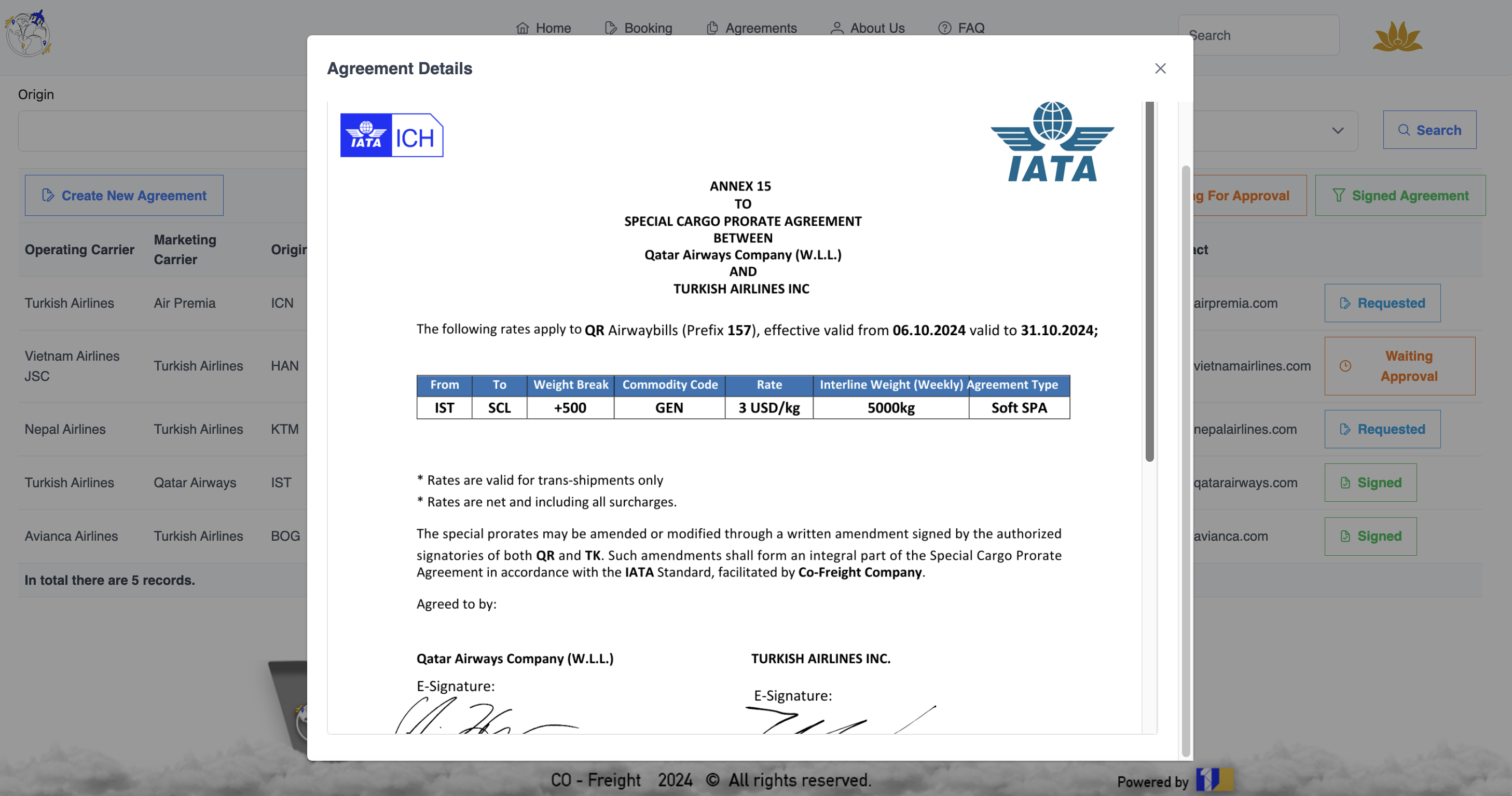
A globally common platform will be created where agreement requests based on their connection needs can be made quickly, an agreement document will be automatically generated using the ExternalReference data model of One Record. As a result, agreements will be linked to bookings using the One Record Data Model.
The agreement processes will be completed in a digital environment through digital approval processes (e-signature), ensuring a paperless workflow.
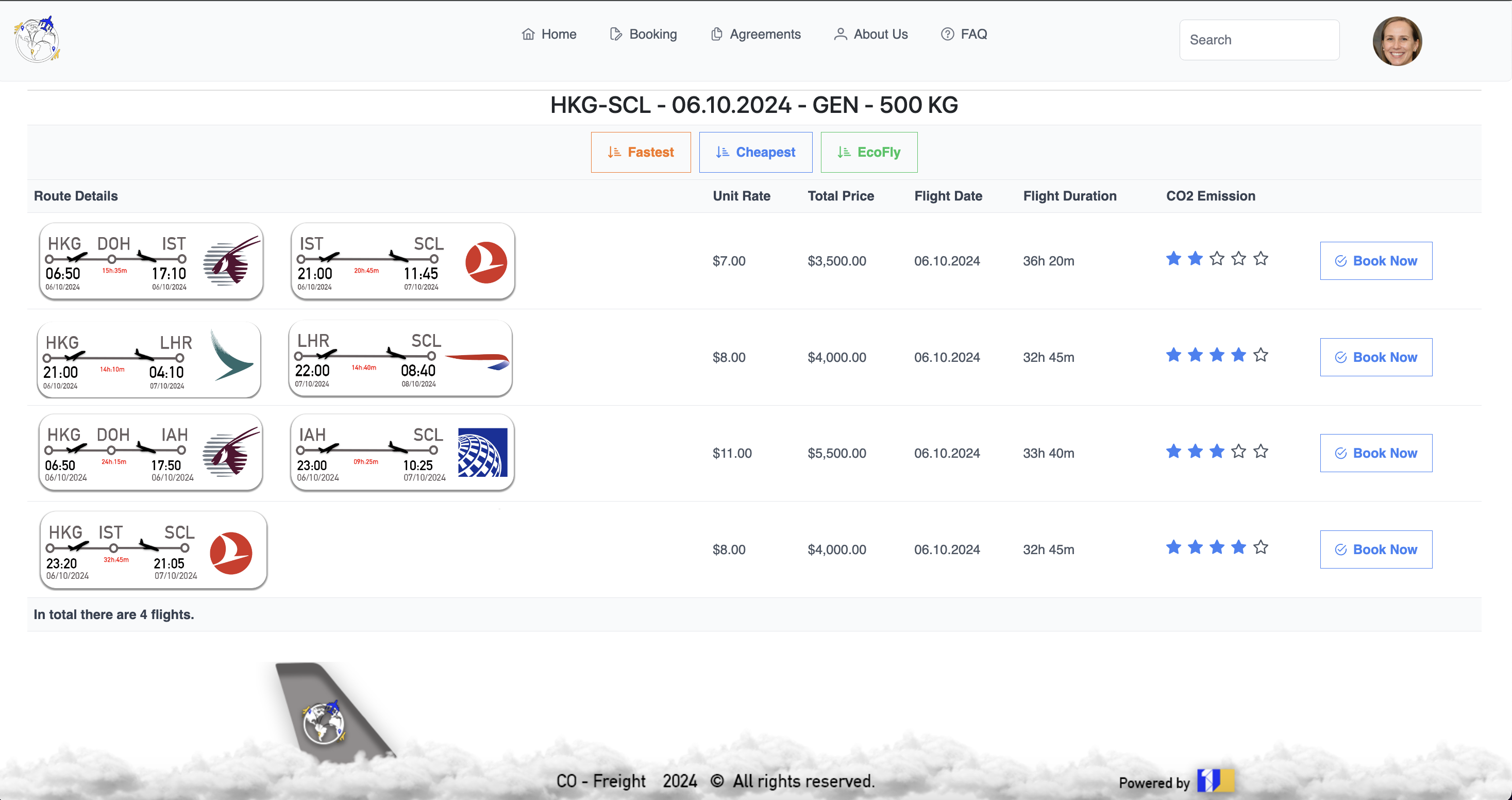
An agent will be able to query the required route (Origin-Destination) for the desired departure date, and the system will offer various options, prioritizing optimal rates and CO2Emissions value of One Record Data Model for the agreed airlines and routes. This ensures that airlines do not miss available opportunities.
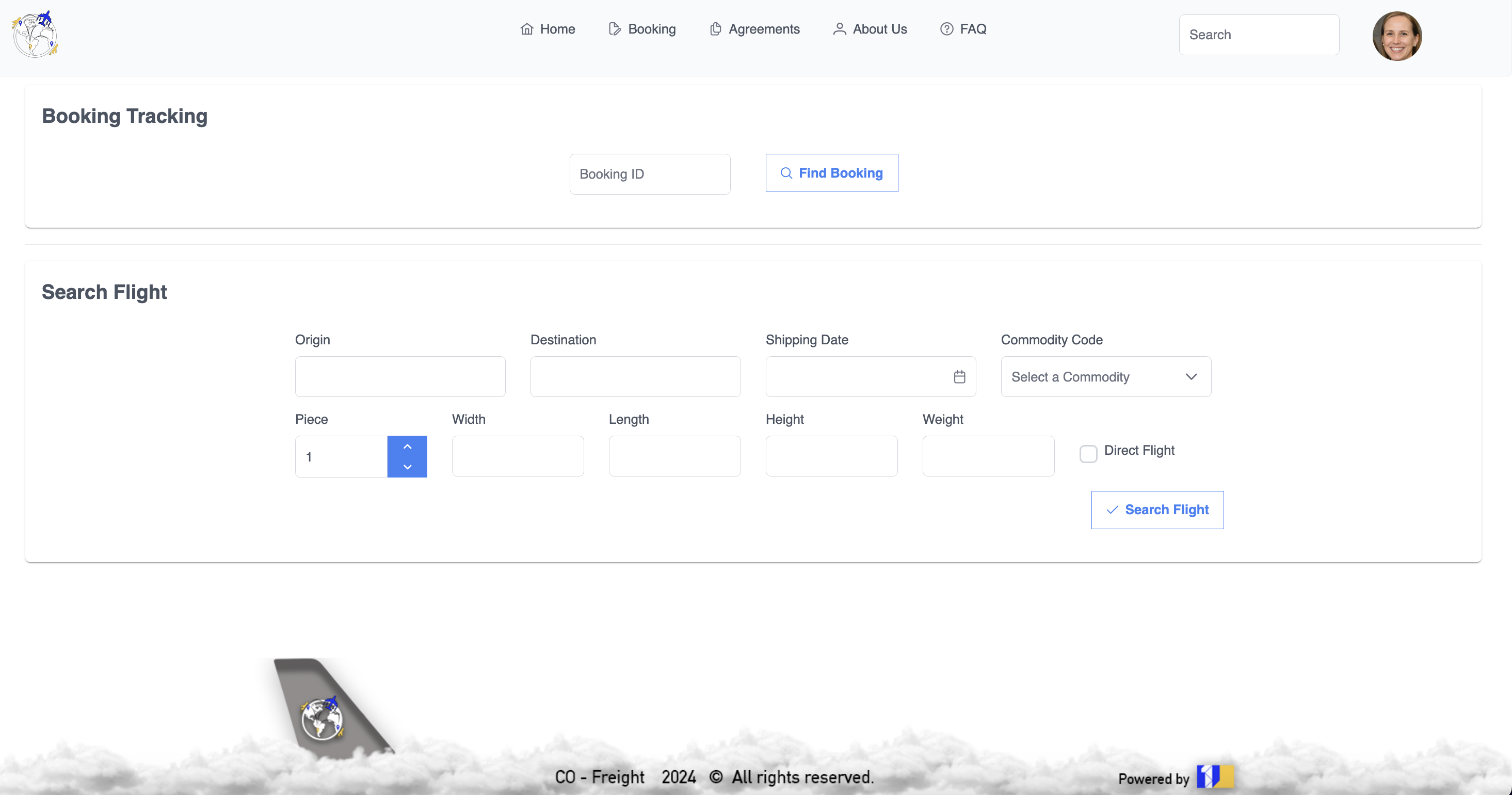
After the agent will create a confirmed booking with minimal entries for the combined interline route quickly, the booking data will be shared with all parties through the One Record Data Model. During transportation, the status of booking will be updated by stakeholders using the One Record Data Model as well, avoiding misinterpretations and contributing to greater reliability of knowledge representation. The shipment tracking process is transparent to all parties, using the same ontology.
How we build it
Our project’s architecture combines cutting-edge technologies to ensure both robustness and scalability. On the front end, we leveraged Angular11 with PrimeNG, allowing us to create a highly interactive, responsive user interface. The back end is powered by Spring Boot on JDK 17, which provides a solid foundation for building interline services, offering seamless integration capabilities and robust set of Middleware APIs with high performance.
We adopted the IATA One Record data model fully, which played a crucial role in standardizing the agreement templates, booking data management across all interline airlines. This standardization is essential for streamlining the complex processes involved in interline cargo agreements. Moreover, system offers best interline option with AI according to cheapest, fastest, the most eco-friendly in terms of CO2 emissions value.
Each airline can upload its agreement documents to our platform. The agreement clauses are mapped to common generic data model through semantic scanning of the documents.
Addressed Challenges
One Record Challenge: We are making full use of the One Record data standard through booking and interline agreements, and we are also contributing to it with more entities.
Open Challenge: We also tackling to Open Challenge through with our global solution about interline agreement and booking problems in the air cargo ecosystem.
What we are proud of
We develop a globally common platform where companies can make collaboration across the air cargo ecosystem. Our solution leverages state-of-art technology, user friendly interfaces with minimal entries by defining, structuring, and sharing knowledge across different stakeholders in a consistent and unambiguous manner.
Under the guidance of One Record Team, besides fully utilizing existing assets, we contribute to the One Record Data Standard with Capacity entity, this will be expanded adding Schedule with the next generation of Co-Freight.
Next steps for Co-Freight
In the next phase, we will focus on the available capacity of airlines by integrating their allocated interline capacity into the Co-Freight System, including precise weight and rate details, under the Search Interline Options tool.
In addition, continuing to extend the scope and types of collaborative agreements in Air Cargo Industry, such as including Trucking Companies for road transportation and Joint Venture Agreement options, further strengthen our end-to-end solutions globally on world in the future. Even space, as well 😊
Built With
- adobe-photshop
- adobe-premiere-pro
- ai
- angular-11
- bootstrap
- css.
- java17
- json-ld
- ocr
- onerecord
- primeng
- spring-boot


Log in or sign up for Devpost to join the conversation.