Inspiration 💡
The rise of prediction markets has been something to watch over the past couple of years. We have seen from platforms like Polymarket and Kalshi just how much predictive power collective, incentive-aligned forecasting can hold, often outperforming traditional polling and analyst forecasts on everything from elections to macro events. Since this predictive power is so good at acting as a real-world indicator, we wanted to apply to something more than speculation and entertainment. At the same time, we didn't have to look far for a reason to care about climate specifically. So far this summer in Southern Ontario, we lived through weeks of record-high temperatures, soon followed by wildfire smoke so severe it pushed local air quality to among the worst in the world. It was a powerful reminder that climate change isn't a future problem, and it's already reshaping daily life where we live. We decided to take the predictive power that's currently being used to bet on entertainment and politics, and redirect it towards the cause of climate change. Our market lets people financially prepare for severe climate events, and surfaces real risk signals to help communities and institutions act before crisis hits.
What it does ⚙️
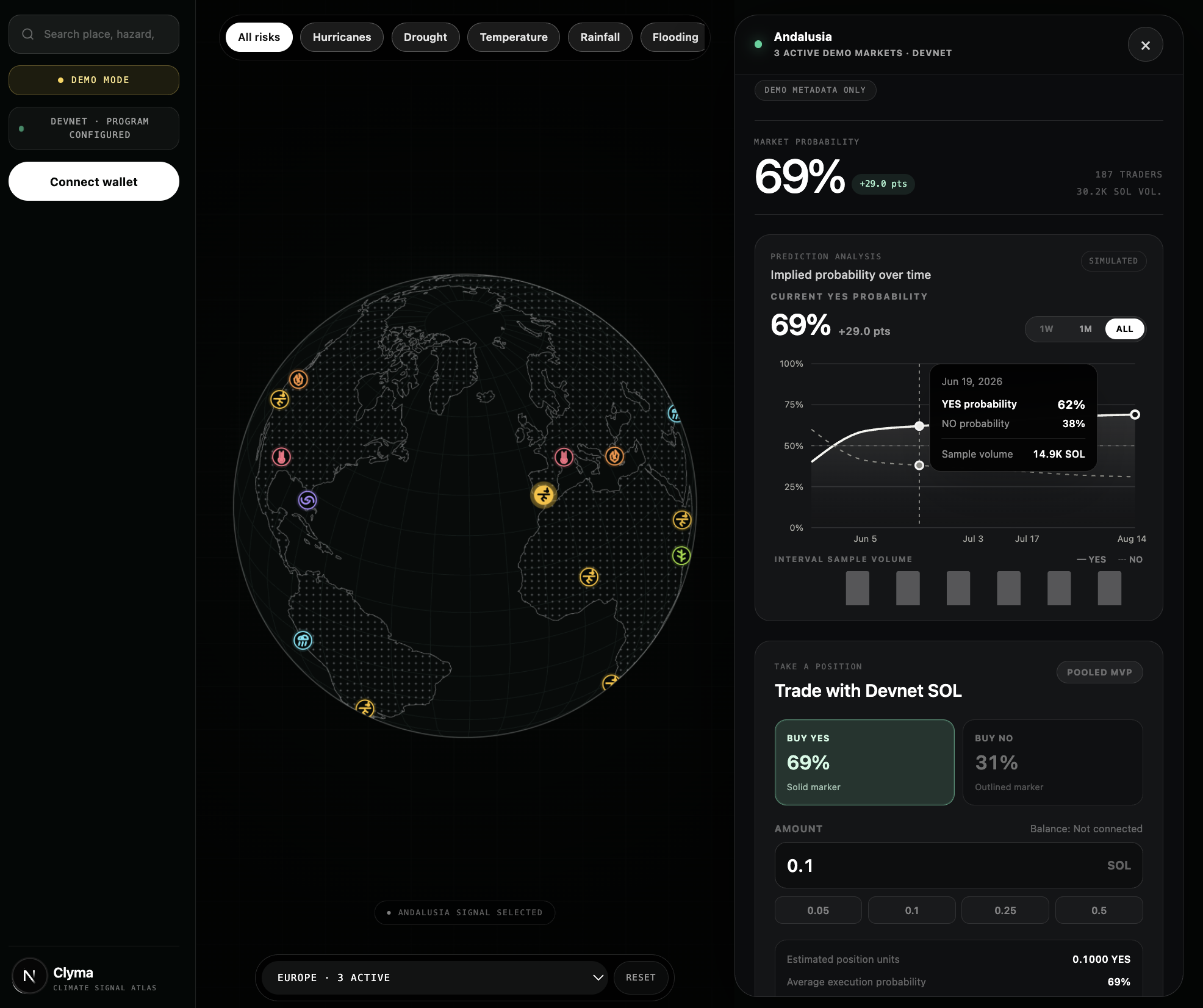
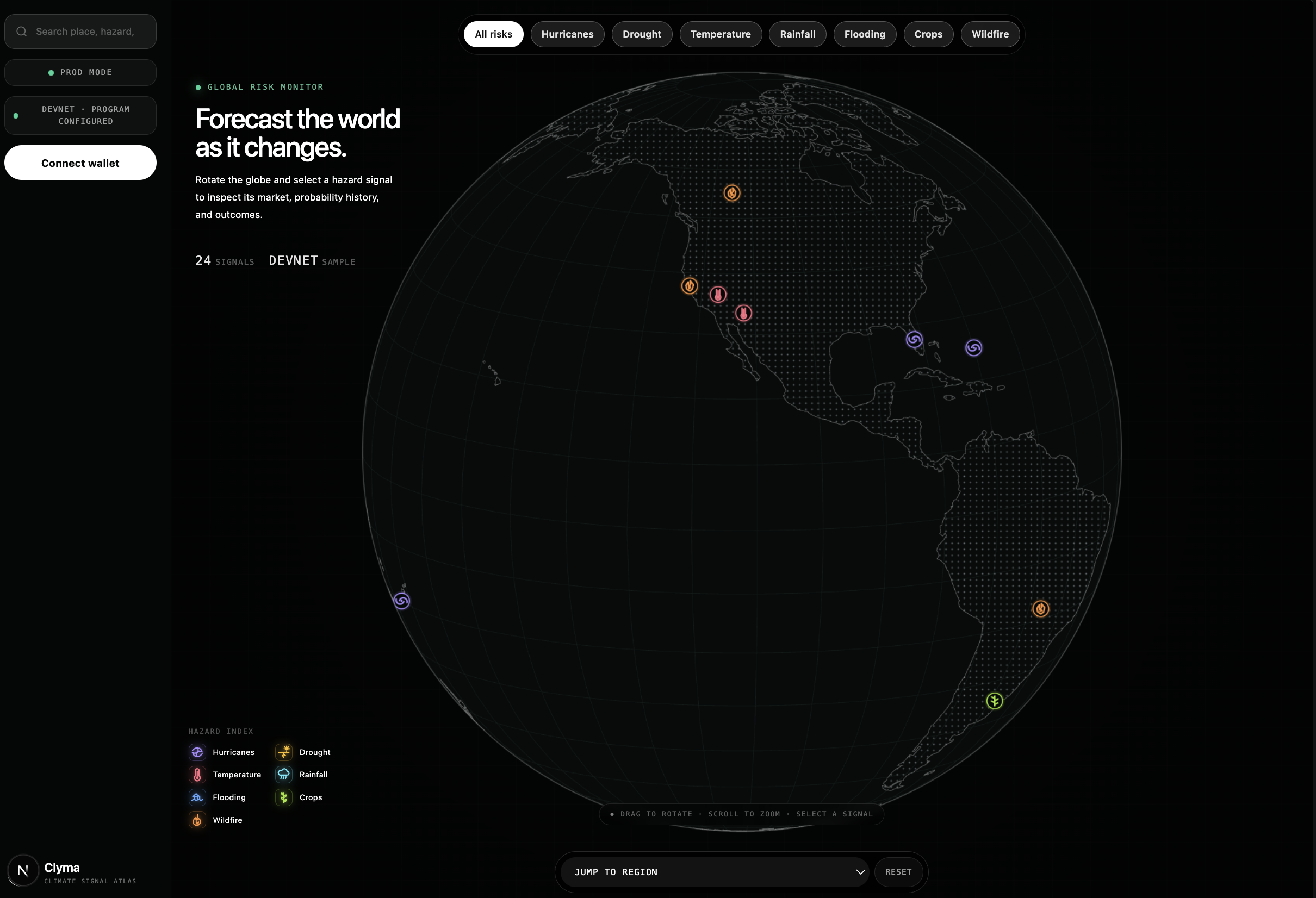
Clyma is a prediction market built on Solana that lets people take financial positions on real climate events like droughts, hurricanes, and floods, wildfires. Rather than simply "betting on the entertainment", users have the ability to hedge against climate risk. This allows the market to be used as a form of accessible, fast-settling climate insurance. The core experience is an interactive globe where users can filter by hazard type and explore live climate risk markets by region.
Core features:
- Interactive global map interface with hazard filters and exploration by region
- Financial hedging against climate disasters, with fast payouts instead of a traditional insurance claims process
- Model-driven initial odds-setting, grounded in each event's real risk profile
- Transparent, source-linked markets citing the reputable data source each market resolves against
- Fully automated resolution
- A "My Positions" view to track your open and settled bets
- Historical probability charts per market, showing how trends in risk assessment over time
How we built it 🔨
Market generation: Gemini
We use Gemini to generate our tradeable markets. Gemini uses climate data APIs and is able to determine which climate risks best represent crucial hazards around the globe. Gemini can then turn them into well-formed, specific YES/NO market questions with reputatable sources for settlement, and accurate geolocation.
Odds-setting: Fine-tuned model via FreeSolo
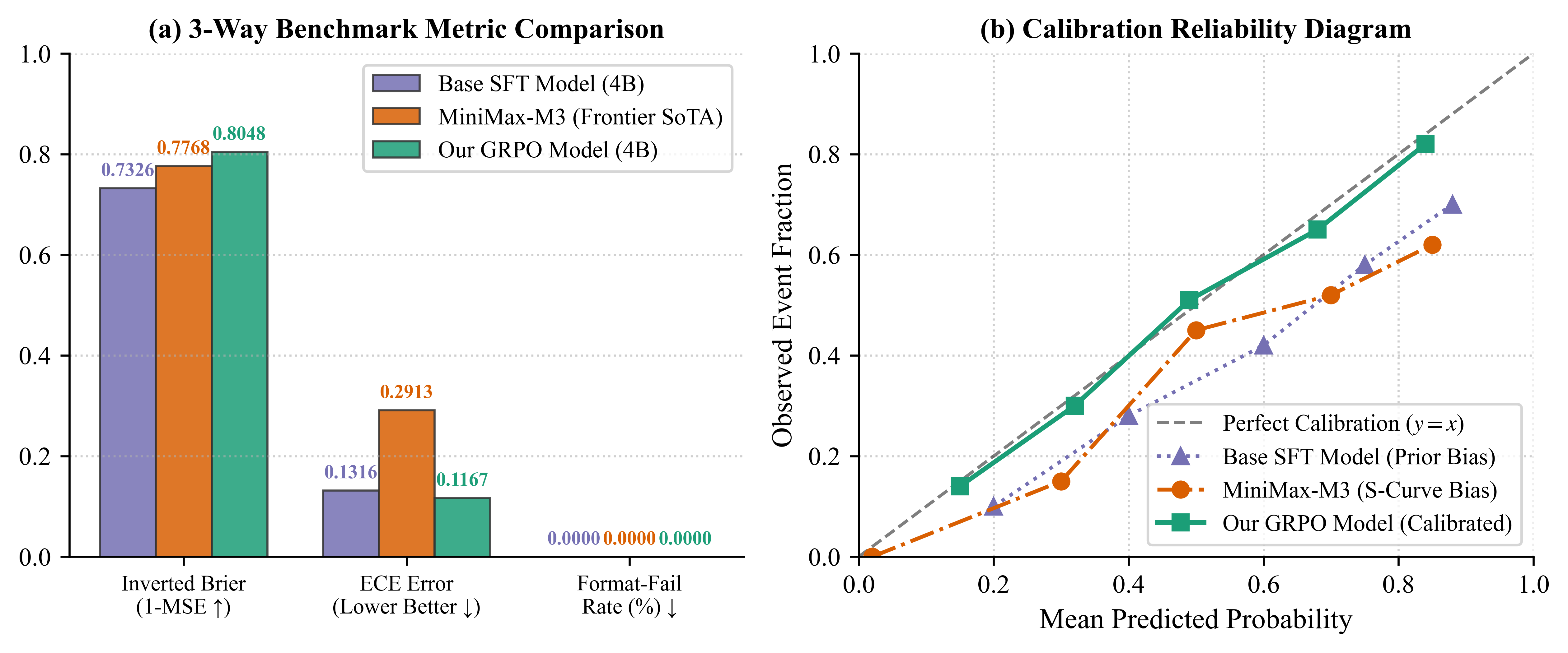
Rather than launching every market at a naive 50/50, we used the FreeSolo post-training platform to create a model capable of acting as our oddsmaker. The model is trained on various global datasets and produces initial probabilities based on the risk profile of each climate event and region.
Onchain layer: Solana
Solana underpins the parts of the app that need trust and speed: user identity (wallet-based sign-in), market state, and all deposit/payout transactions live onchain via a custom Anchor program. This is also what makes near-instant payout on resolution possible.
Frontend: React
The interactive globe, market browsing, position tracking, and probability charts are all built in React, giving us a single, responsive interface for exploring markets by hazard type and region.
Database: MongoDB
MongoDB handles all off-chain application state including user profiles, positions, transaction records, resolution data, and historical price snapshots for charting.
Challenges we ran into ⚔️
Designing meaningful markets
It was much harder than expected to define markets that were simultaneously interesting to trade, specific enough to resolve unambiguously, and tied to a genuinely reputable data source.
Automated market-making math
Implementing the actual pricing mechanism (how odds shift as trades come in), was one of the trickier technical pieces.
Fine-tuning an oddsmaking model under real constraints
Post-training a model to act as a credible oddsmaker is a hard problem even with abundant data and time. For this hackathon, with limited data and a tight deadline, we really had to balance between a model that was actually useful and one we could realistically finish training in time.
Learning Solana from zero
None of us had worked with a blockchain before this project, so everything from wallet integration, to Anchor program structure, was learned in real time while building. That steep learning curve shaped a lot of our time budget, but it also meant we came out the other side with a real, working understanding of how identity, markets, and transactions can live onchain.
Accomplishments that we're proud of 🏆
Redirecting predictive power toward something that matters
Prediction markets have proven how powerful crowd-driven forecasting can be, but that power is almost always pointed at entertainment or speculation. We're proud of actually building something that channels that same mechanism toward the cause of climate change. Our platform gives people a way to hedge against real disasters while generating a signal that could help direct attention to where climate action is needed most.
A dynamic market creation system
Rather than hand-crafting markets one by one, we built a system that pulls together climate data APIs and historical trends to generate markets that are both meaningful and fairly priced from the moment they go live. Our fine-tuned model allows initial odds that reflect genuine risk, and every market is fully live and tradable on Solana devnet, with real signed transactions settling deposits and payouts onchain.
What we learned 📚
The power of Solana
Coming in with zero blockchain experience, we walked away with a real appreciation for what Solana specifically enables. We now understand that near-instant, low-cost transactions are really powerful. Solana makes instant disaster payout actually feasible, versus the days-to-weeks a traditional insurance claim takes.
The power of strong UI
A prediction market is fundamentally about data like probabilities, trends, risk. From this project and we learned how much a genuinely well-designed interface (our interactive globe, live-updating odds, clear charts) changes whether that data actually lands with people.
Repurposing powerful technology for social good
Our biggest takeway might be how a lot of today's most talked-about technology like prediction markets, fine-tuned models, blockchain infrastructure, tends to get built and marketed toward speculation, entertainment, or profit, but very little of that power gets pointed at problems that actually matter. Building this project reinforced for us that the tools aren't the problem but instead it's all about where we choose to point them.
What's next for Clyma ⏩
Scaling to a much larger set of markets
Our dynamic market creation system was built to generalize, so the natureal next step would be to scale it up to continuously generate and manage a much larger, more comprehensive set of markets across regions and hazard types.
Advanced trading options
Beyond simple buy-yes/buy-no positions, we want to give traders more sophisticated tools to manage risk like limit orders, and stop-losses. Such features would allow hedging against climate events to be as precise and flexible as hedging in any mature financial market.


Log in or sign up for Devpost to join the conversation.