Inspiration
Do you know that feeling you get when you see something you like? Well, this project idea fell right there. It had room for innovation and it is a task that matters. That's all we need.
What it does
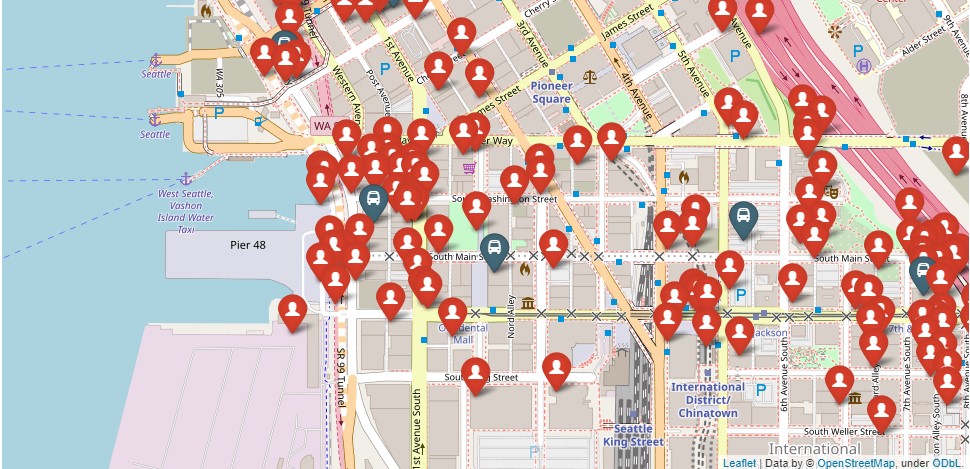
It demonstrates one of the best ways to go about listing stations.
How we built it
We repurposed data to simulate users and then used a clustering technique for bus stop discovery.
Like any engineering project, we broke it down into smaller components to make it easier. This is what the raw roadmap we came up with looked like:
Step 1
Make a blank map with points of pickup and drops. Assumption made that the time is same for parties.
Lvl 1 distribution: Easy clusters
Lvl 2 distribution: More complicated clusters.
Optional: Analysis from simulation
Solution: Basic Bus stop point from clustering.
Step 2
- Proper map with roads.
- Bus stop needs to map close to a road not a blank space such as a green area.
Step 3
- Time difference in pickup points
Step 4
- Connect bus stops
Step 5
- Additional challenges
- Possible Route between stops
- Minimum profitability
- Ant optimization to find profitability
We did not achieve all these steps.
Challenges we ran into
We had no data. We started with the idea of making fake data ourselves but then it occurred to us that Kaggle might have something we can refashion for our simulation.
I found one team member but unfortunately, their skill set could not supplement the project nor was I capable of harnessing their hidden talent. Alas, had to do everything myself. With a team, I could have used other models and innovated further.
Accomplishments that we're proud of
Building a complete proof of concept.
What we learned
Just keep on swimming
What's next for Cluster Stop
There are research papers that use Neural Networks in the context of smart cities for tackling traffic congestion. I have a gut feeling that might be worth looking into.
Built With
- jupyter-notebook
- python


Log in or sign up for Devpost to join the conversation.