-
-
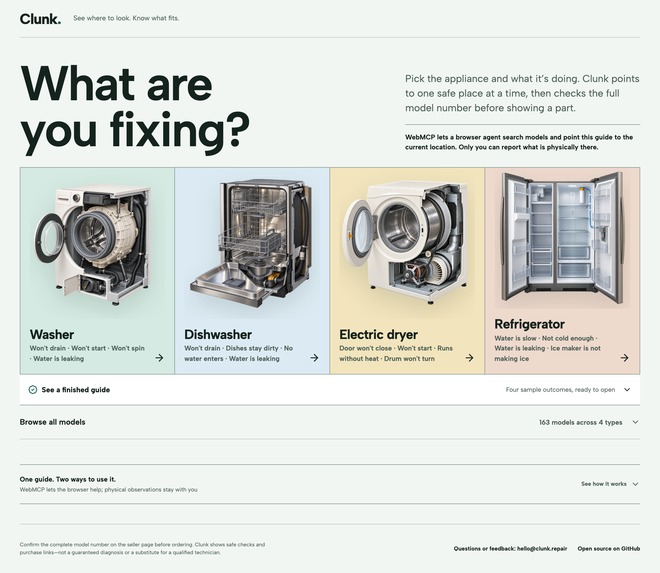
Clunk Homepage
-
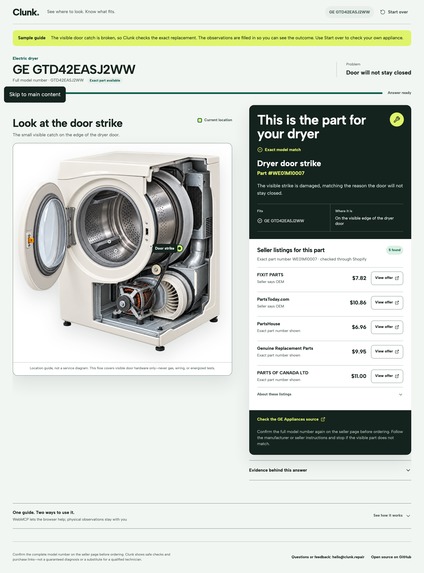
Clunk Part Result
-
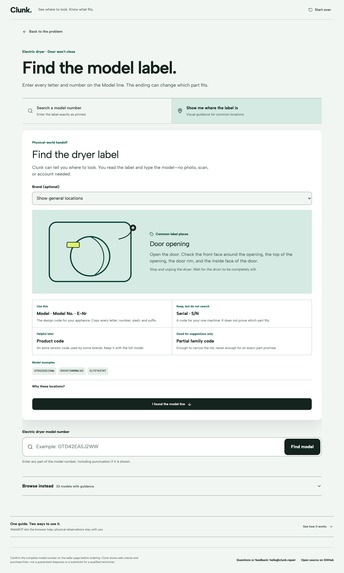
Clunk Model Label Guide
Appliance troubleshooting crosses a physical boundary. A browser agent can organize model data, sources, and next steps, but it cannot read the rating label in a laundry room or see a cracked door catch, blocked filter, leak, smoke, or unsafe access. People are left translating between search results, manuals, videos, parts stores, and chat messages, often while compatibility and safety claims blur together.
Clunk is an open-source visual repair guide for washers, dishwashers, electric dryers, and refrigerators. It gives the person beside the appliance and a compatible browser agent one shared, visible repair state. The agent handles structured lookup and navigation. The person supplies every physical observation. Clunk’s deterministic engine enforces sequence, model/problem coverage, exact-fit evidence, and terminal safety stops.
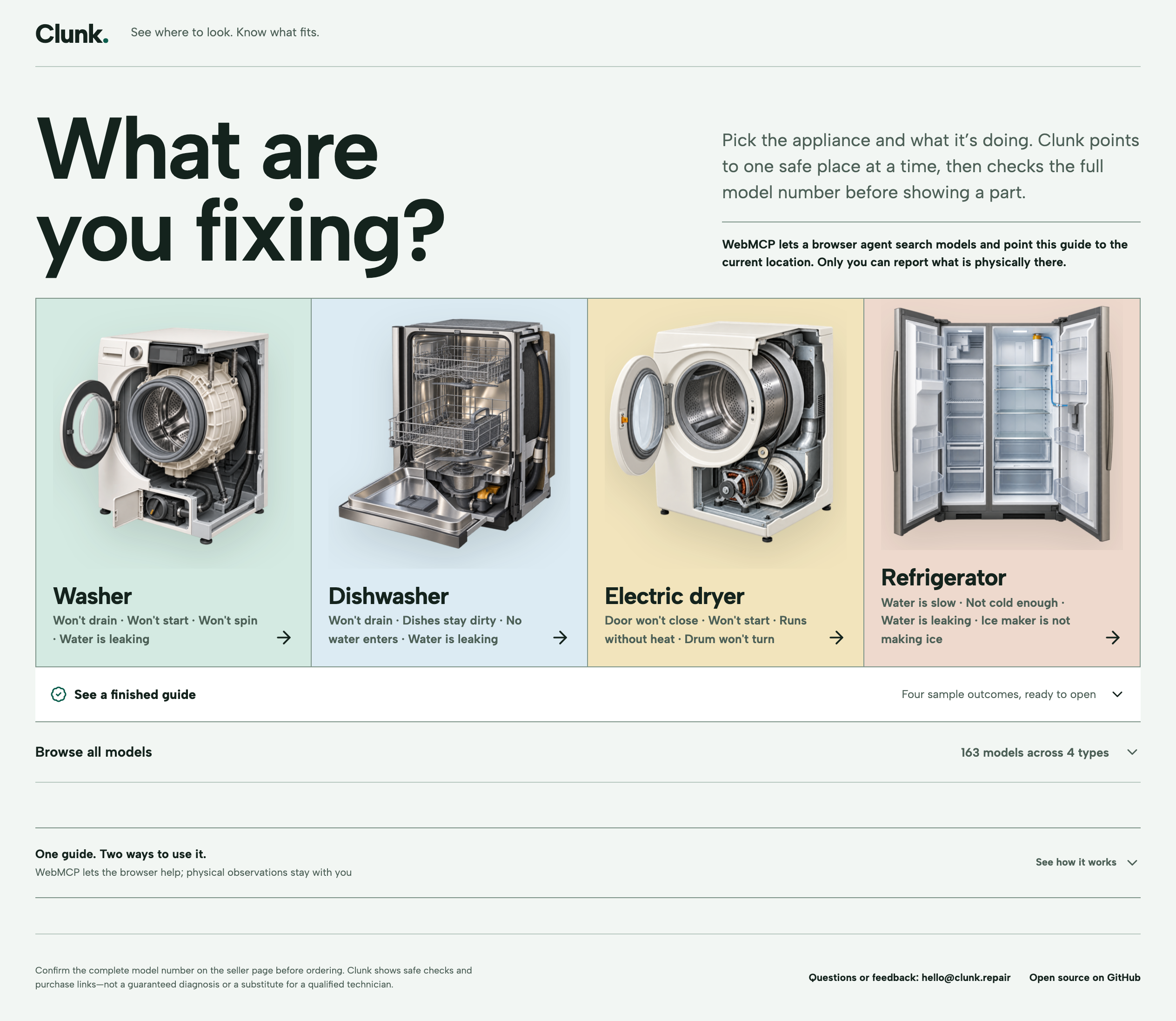
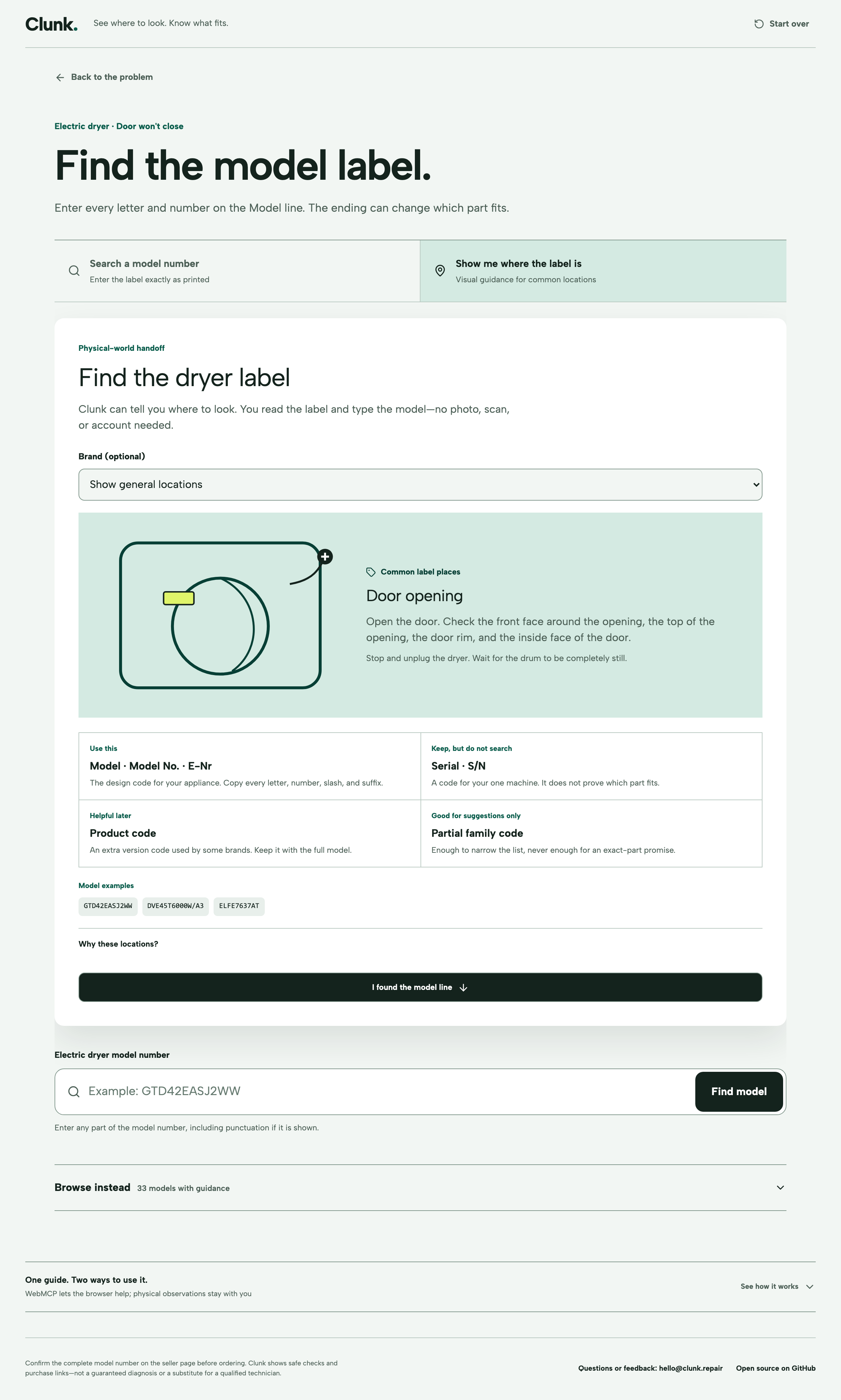
The experience begins with four recognizable appliance choices and plain descriptions of what is happening. Clunk then helps the person find the complete model number, including common rating-label locations and the difference between Model/Model No./E-Nr and Serial/S/N. Search is punctuation- and case-insensitive, preserves ambiguous suffixes, and refuses to turn a partial family code or nearby model into an exact compatibility claim.
Once a supported model and problem are selected, Clunk highlights one physical location at a time and asks one bounded question. The possible outcomes are intentionally honest: no part is needed; more model detail is required; the observations support an exact source-backed part; or the visible checks are over and a qualified professional should continue. Smoke, a burning smell, heat, an active leak near power, damaged access, or unsafe reach removes the purchase path and ends the flow.
WebMCP is the collaboration layer. All eight in-page tools are discoverable from page load: catalog search, exact selection, state reading, diagnosis start, component focus, person-supplied observation recording, part resolution, and safe escalation. Each result includes nextTools, the authoritative list of actions that are valid for the current phase. The shared engine independently rejects invented IDs, unsupported model/problem pairs, out-of-order observations, premature part lookup, and post-terminal advancement. The visible page mirrors every accepted or rejected action, so the agent’s work is inspectable instead of hidden in a separate chat transcript.
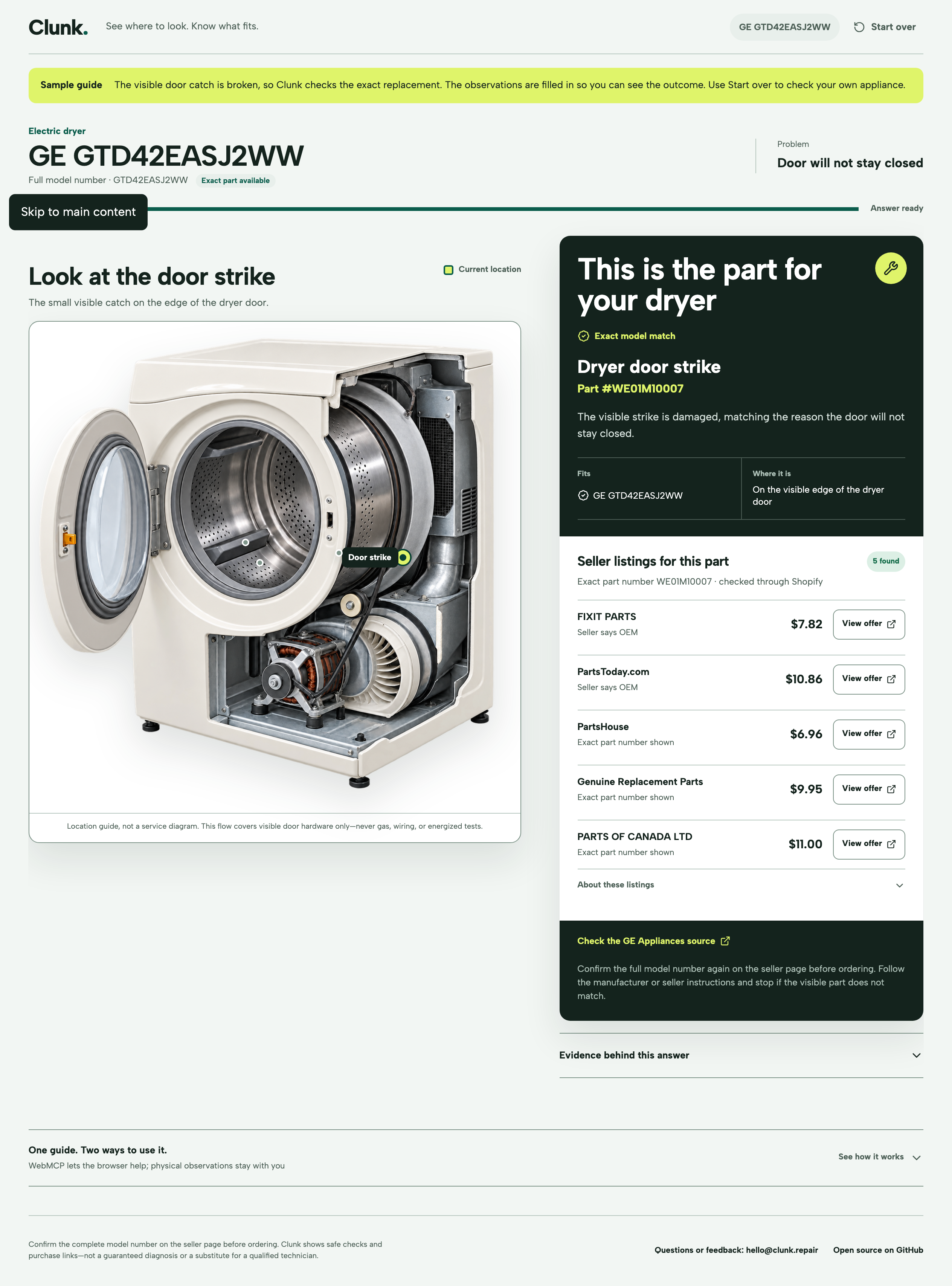
The key handoff is concrete. For GE dryer GTD42EASJ2WW, the agent can search and select the exact model, start the door-closure guide, and focus the visible door strike. It must then wait for the person to confirm that the unplugged dryer is safe and report what the strike looks like. Only after the person reports the damaged strike does find_compatible_part become valid, resolving to GE part WE01M10007. If the person reports smoke or a burning smell instead, Clunk enters a terminal stop and exposes no part or seller route.
Compatibility and commerce remain separate. Manufacturer or authorized-parts evidence maps one complete appliance code to one exact SKU. Only then does Clunk ask Shopify Global Catalog over UCP for current listings containing that exact part number. Nearby SKUs and unavailable results are rejected, seller “OEM” or “compatible” language remains a seller claim, and checkout stays on the merchant’s site. A catalog failure cannot weaken or rewrite Clunk’s fit decision.
The release catalog contains 163 source-backed U.S. appliance identities across 11 brands: 56 washers, 33 dishwashers, 33 electric dryers, and 41 refrigerators. All 782 possible model × problem pairs are classified. There are 766 supported pairs and 16 explicit stops where the current evidence does not justify a guide. Eighty-four complete model revisions have at least one exact-part route. The illustrations are original location guides, not model-specific service diagrams.
Clunk is static React, TypeScript, CSS, JSON, local fonts, and original visuals. It needs no account, database, private key, payment handling, or app-side model call. Browsers without WebMCP retain the complete manual journey, and a separate stateless remote MCP endpoint offers five bounded read-only catalog and diagnosis tools for clients that cannot operate the visible page session.
Judges can replay every outcome without credentials. See a finished guide runs clearly labeled observations through the same public action layer, while the live inspector shows the source-labeled activity trail and currently valid actions. Deterministic fixtures and browser tests cover the contracts, responsive layouts, keyboard and touch access, reduced motion, exact-code handling, nearby-SKU rejection, no-part answers, and safety stops. Those fixtures verify the product’s rules; they are not presented as autonomous-agent scores.
The larger pattern extends beyond appliances: agents are good at structured evidence and process state; people remain essential where software cannot observe the physical world. WebMCP lets both collaborate through the real product interface while the site keeps its own rules in force.
Eligibility note
Clunk was created during the submission period on August 26, 2026. The public repository was created that day. An imported framework scaffold retains an August 20 template commit timestamp; all Clunk product, WebMCP, catalog, design, evidence, and testing work was completed during the submission period.
AI tools used
Codex for scoping, implementation, debugging, testing, and browser verification; Lovable for the initial project and GitHub-connected hosting; OpenAI text-to-speech (Ash) for demo narration. The app itself makes no model call.
Built With
- codex
- lovable
- openai
- react
- shopify
- typescript
- vite
- webmcp


Log in or sign up for Devpost to join the conversation.