Inspiration
We were inspired by seeing many landmine survivors who are struggling to make a living to support their families but are unable to do anything since disabled people do not have many opportunities available to them unless they have connections, which gradually damages their confidence, causes emotional distress, and can lead to depression or even the loss of their lives. Not only that, they also often get discriminated against by people in their surroundings and are mocked not only for their uselessness but also for their families' situations, which make them fall deeper into despair. When this happens, they do not know where to ask for help, do not know the benefits that are available to them, or miss many chances to get support since most of their documents were lost during the accident, as well as having limited knowledge, which makes it harder for them to create a better environment for themselves as well as their families. Over time, the number of these people continued to grow, but the support provided by the government or organizations cannot reach everyone since the survivors' information is lacking or does not exist at all, as they have limited digital literacy. Having constantly witnessed this, we decided to build an AI tool that helps those survivors navigate resources that are available to them and, most importantly, regain the confidence to stand up again and live their lives openly without caring about other opinions or blaming themselves.
What it does
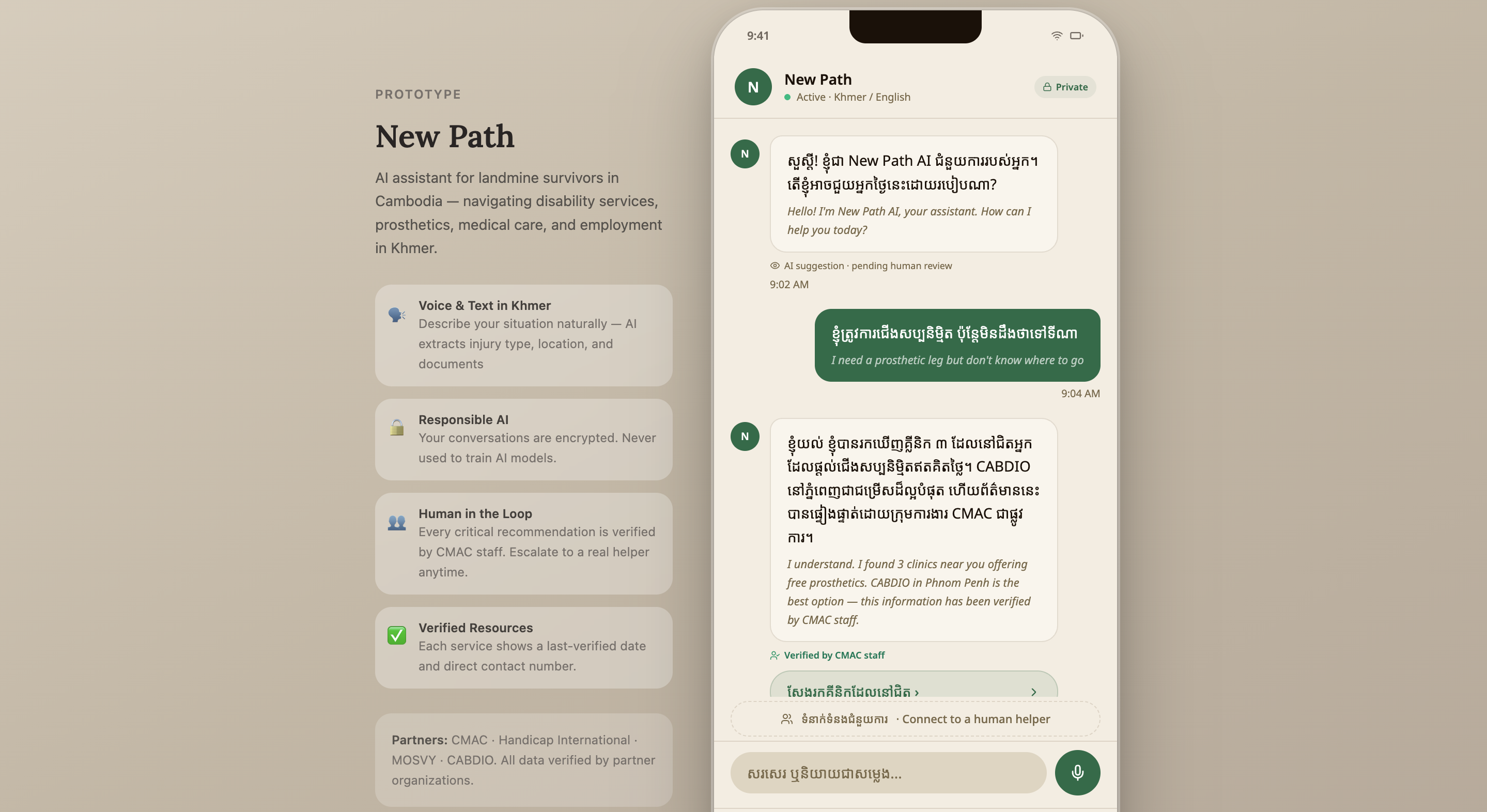
The application is a mobile-first web demo that provides a chat-style interface. Landmine survivors can describe their situations through text or voice messages and receive AI-generated responses that could guide and match them with suitable support. The interface is designed to be simple, accessible, and easy to understand, with a focus on clear communication and bilingual support in both Khmer and English languages.
How we built it
We built New Path as a mobile-first web application using React and TypeScript. The interface was designed to resemble a smartphone application, making it familiar and accessible for users. We used component-based development to organize different features such as authentication, AI chat, service discovery, case management, and user support into separate and reusable sections. This application also has a bilingual Khmer-English interface to ensure accessibility for Cambodian landmine survivors who cannot understand English.
Challenges we ran into
The main challenge was designing an interface that is both simple and accessible for users with low digital literacy. We spent a long time designing it to ensure the content translation is accurate enough for people to understand, since machine translation from English into Khmer often produces not only grammatical errors but also meaning errors, and ensuring the AI could correctly understand user inputs and generate responses that were accurate, relevant, and helpful for both text and voice interaction features.
Accomplishments that we're proud of
We are proud of creating a clean and functional chat-style interface that effectively demonstrates how an AI support system could look and feel. We successfully designed a mobile-friendly layout that prioritizes accessibility and user experience. We are also proud of adapting the idea into a realistic demo that communicates its purpose clearly without requiring complex backend systems.
What we learned
Throughout this time, we have learned that AI is not a tool that brings danger to humans, but rather helps them solve many problems and improve people’s lifestyles to a better condition than we imagine, as long as we use it in the right direction. During the implementation, we learned how to integrate AI-powered assistance into a web application. We discovered how to send user messages to the AI model, process responses, and display them in a conversational chat interface. Since our application is intended to support landmine survivors, we had to think carefully about accessibility, clear communication, bilingual support in Khmer and English, and how to present information in a respectful way. This experience showed us that building an AI application involves not only programming but also understanding user needs and creating a reliable user experience.
What's next for Clueless
In the future, we plan to improve this project by integrating a real AI model using APIs such as OpenAI or Gemini. We also aim to expand accessibility features such as voice input, improved Khmer language support, and offline functionality. Additionally, we would like to connect the system with real support resources so that it can become a practical tool for assisting landmine survivors more effectively.
Built With
- css
- radix
- react
- shadcn/ui
- tailwind
- typescript
- vite


Log in or sign up for Devpost to join the conversation.