Inspiration
Co-owning real-world assets is broken. Today, teams rely on spreadsheets to track ownership, manually calculate payouts, pay legal fees for every structural change, and face zero liquidity when trying to exit positions.
We asked a simple question:
What if there was an operating system for shared ownership?
What It Does
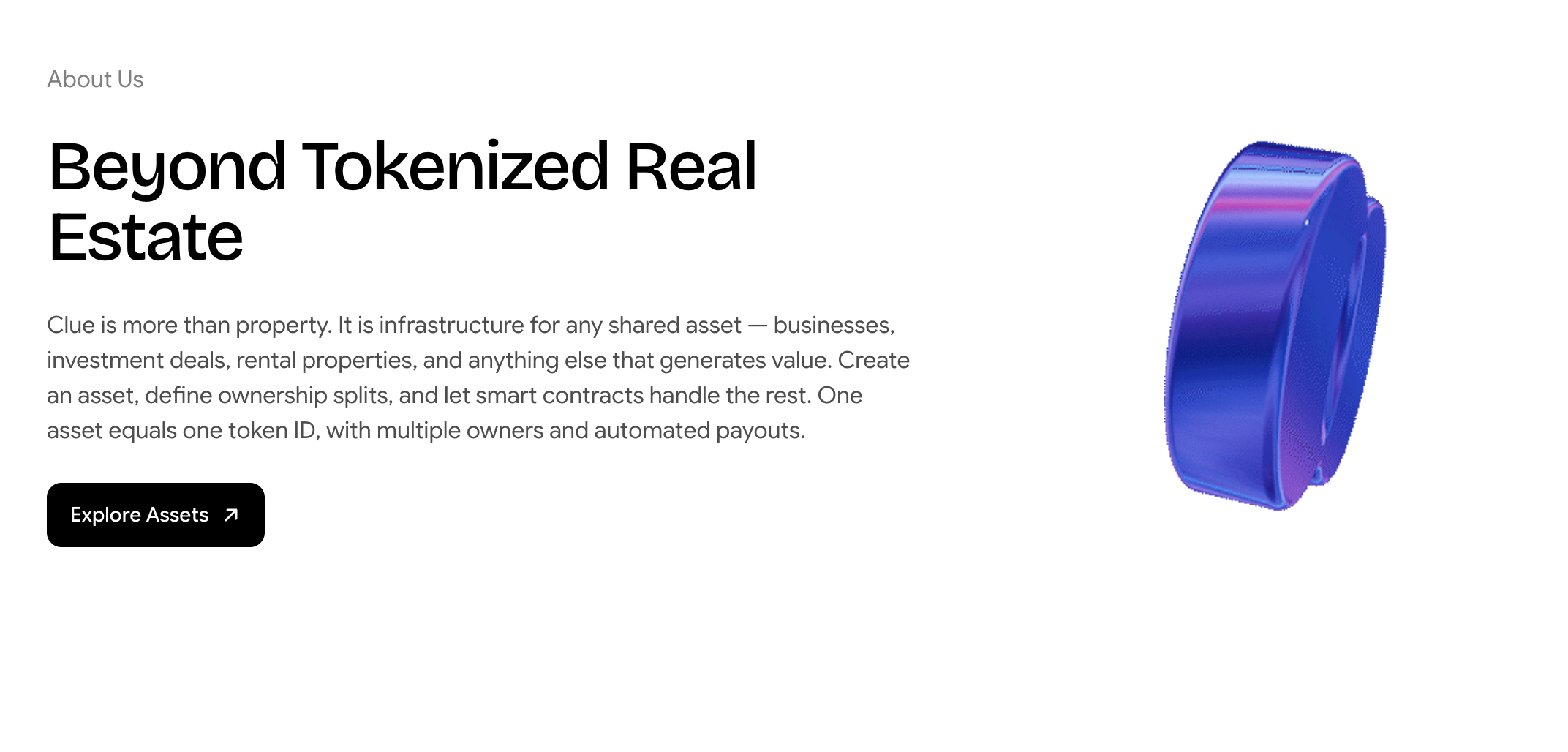
Clue is infrastructure for fractional ownership of real-world assets — including property, businesses, and investment deals.
Teams can create an asset, define ownership splits, and let smart contracts handle execution:
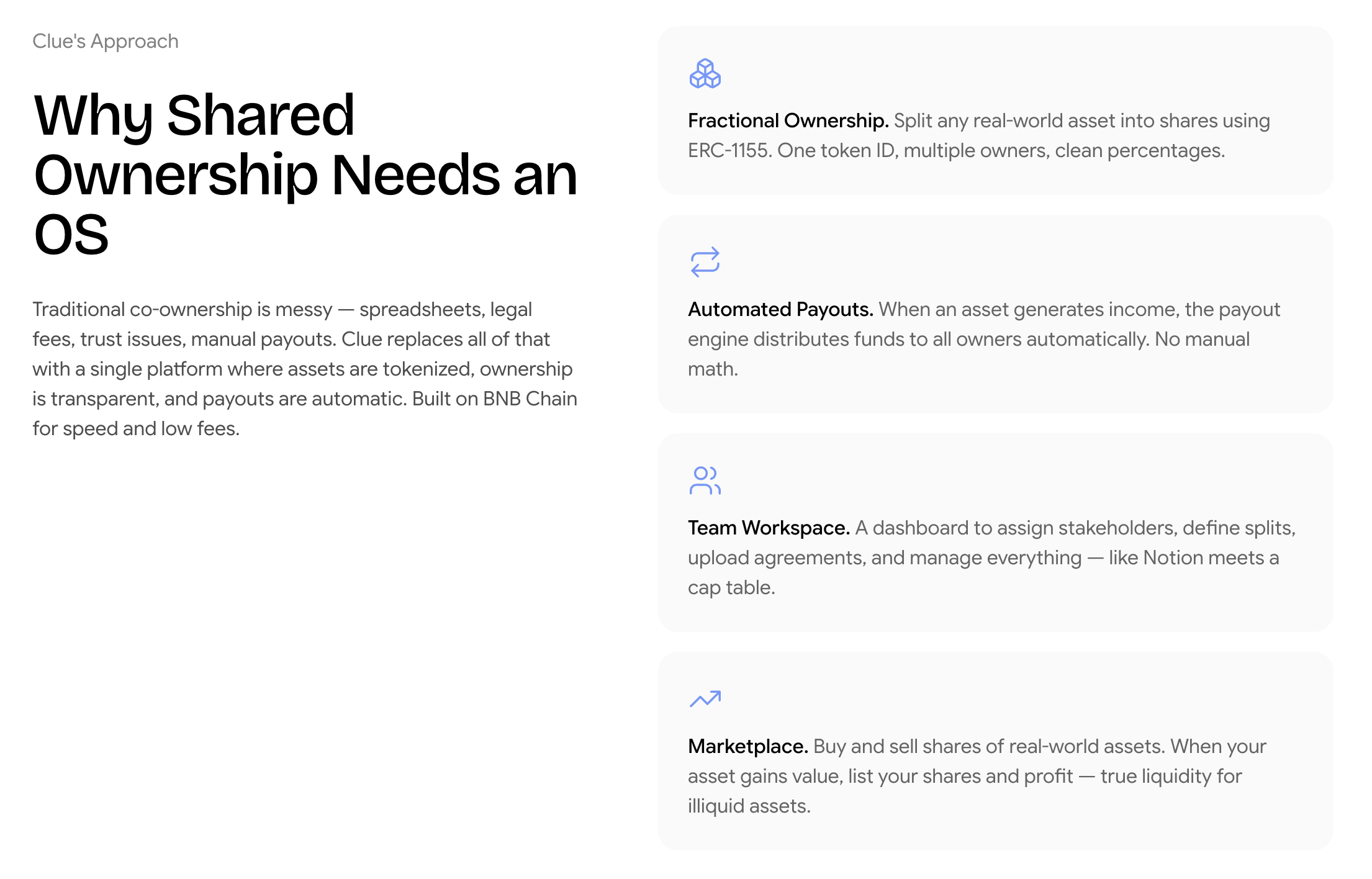
ERC-1155 Tokenization
One asset = one token ID, enabling multiple shareholders within a single contractAutomated BUSD Payouts
Income is distributed proportionally to all owners on-chainMarketplace
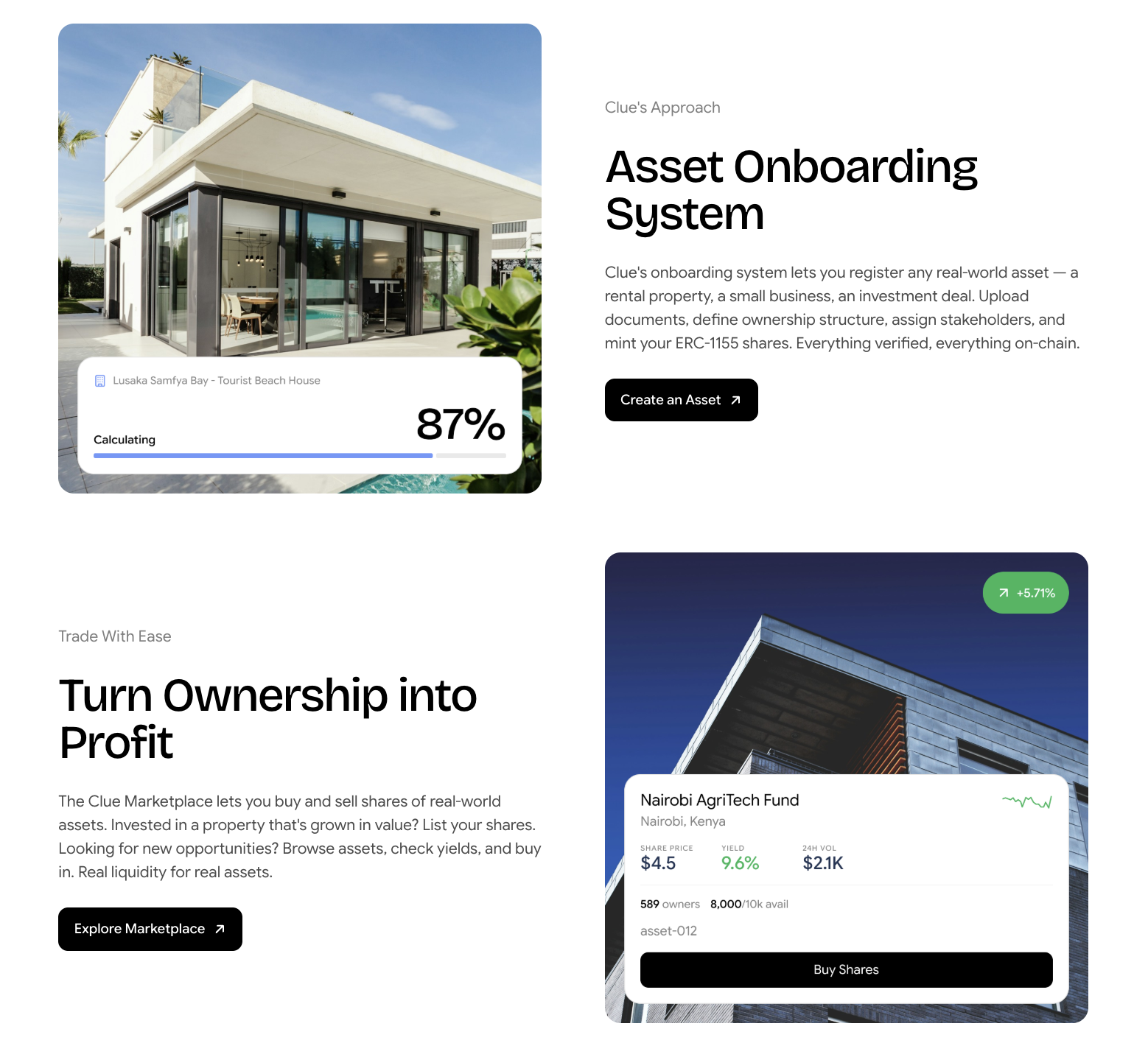
Buy and sell ownership shares peer-to-peer, unlocking liquidity for traditionally illiquid assetsOn-Chain KYC Enforcement
Identity verification powered by Didit, enforced via theKYCRegistrysmart contract on every transferTeam Workspace
A unified dashboard to manage assets, stakeholders, documents, and payouts
How We Built It
Frontend
- Next.js 16
- React 19
- Tailwind CSS v4
- TypeScript
- Deployed on Vercel
Backend
- NestJS
- PostgreSQL
- Prisma ORM
- Deployed on Railway
Smart Contracts
- Solidity
ClueRWA(ERC-1155)ClueMarketplaceKYCRegistryMockBUSD
- Deployed on BNB Chain (BSC Testnet) via Hardhat
Authentication
- Privy (wallet + social login + embedded wallets)
KYC / AML
- Didit (identity verification across 220+ countries and 1,300+ AML watchlists)
- Enforced on-chain via
KYCRegistry
Storage
- 0G (encrypted decentralized storage for KYC documents and audit trails)
Settlement
- BUSD stablecoin on BNB Chain
Challenges We Faced
Enforceable KYC at the protocol level
We embedded KYC checks directly into the ERC-1155 transfer logic, ensuring all transfers revert without valid verification — even for direct contract interactions.Bridging off-chain and on-chain identity
Connected Didit verification to on-chain KYC status using webhook-driven updates into theKYCRegistry.Building a real trading experience
Designed a marketplace with price charts, order books, and live activity feeds using pure SVG — no external charting libraries.
What We Learned
ERC-1155 is ideal for RWAs
A single contract can represent unlimited assets with fractional ownership.Frontend-only compliance is ineffective
True enforcement must exist at the smart contract level.Stablecoin settlements are critical
Using BUSD removes volatility risk for real-world asset payouts.
What’s Next
- Mainnet deployment on BNB Chain
- Regulatory compliance (MiCA, SEC Reg D)
- Fiat on-ramp (card → BUSD)
- Mobile application
- Multi-chain expansion
Tech Stack
Next.js, React, TypeScript, Tailwind CSS, NestJS, PostgreSQL, Prisma, Solidity, Hardhat, BNB Chain, ERC-1155, BUSD, Privy, Didit, 0G, Vercel, Railway, viem, wagmi
Try It Out
Built With
- 0g
- bnb
- nestjs
- nextjs
- privy
- railway

Log in or sign up for Devpost to join the conversation.