Inspiration
When we read that this competition focused on seated, hands-first experiences within a confined space, one idea immediately clicked: a miniature world on the table.
There's something fascinating about miniature things like Hot Wheels, Lego, figurines, and Transformers. Complex and intricate worlds contained in a tiny form have a charm of their own.
The Japanese cartoon Doraemon captures this perfectly. Shrink something down, and suddenly it becomes an adorable little thing you can carry in your pocket. We wanted to bring that magic into mixed reality by creating a small, living world that appears on your real table.
When something tiny and alive appears in front of you, you instinctively feel responsible for it. That sense of care led us toward pets and livestock: a tiny farm with hens you can interact with, poke, and protect.
Once we had something worth protecting, the next question was: what's the threat?
The answer came from a timeless cartoon trope: high-tech aliens invading a low-tech world. The contrast between chrome 1950s flying saucers and clucking barnyard hens is inherently funny. That contrast becomes even more entertaining when these two worlds collide during gameplay.
The other half of our inspiration came from something familiar: the things we do with our hands.
Think about what people do when they're bored and don't have their phones around. They pretend their hand is doing parkour on a car window, aim finger guns at passers-by and whisper "pew pew", imagine clapping so hard that it sends a shockwave through the room, or stretch two fingers into a slingshot and aim at anything.
These are things almost everyone has done as a child. They never stopped being fun; they just weren't possible to bring into the real world.
Hand tracking on mixed reality headsets changes that. CluckOff takes those childhood gestures, the slingshot, finger guns, and thunderclap, and gives them a reason to fire: a flock of hens that need saving.
That is the core of CluckOff: a miniature world you want to protect, defended by imaginary weapons you always wished were real.
What it does
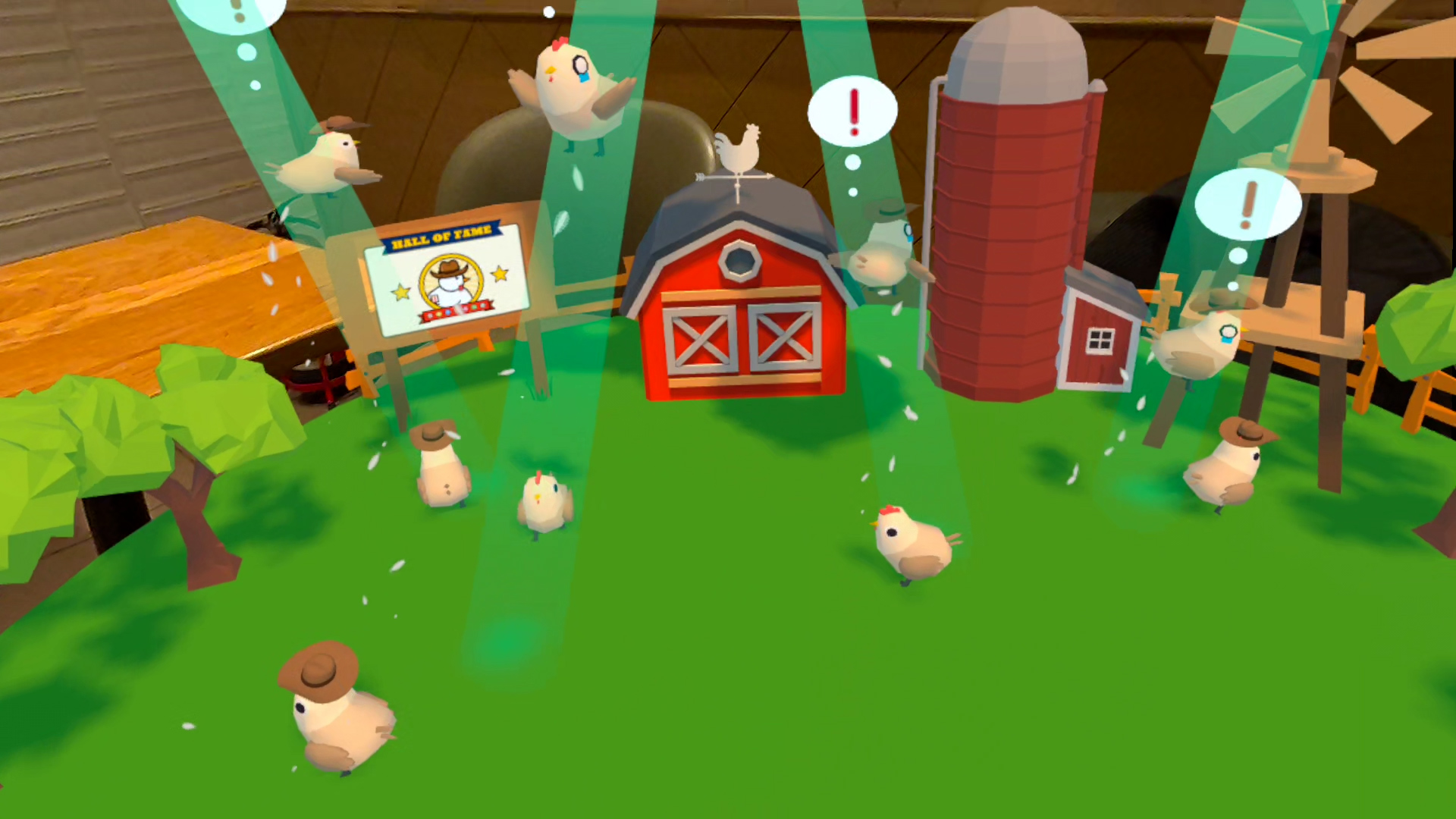
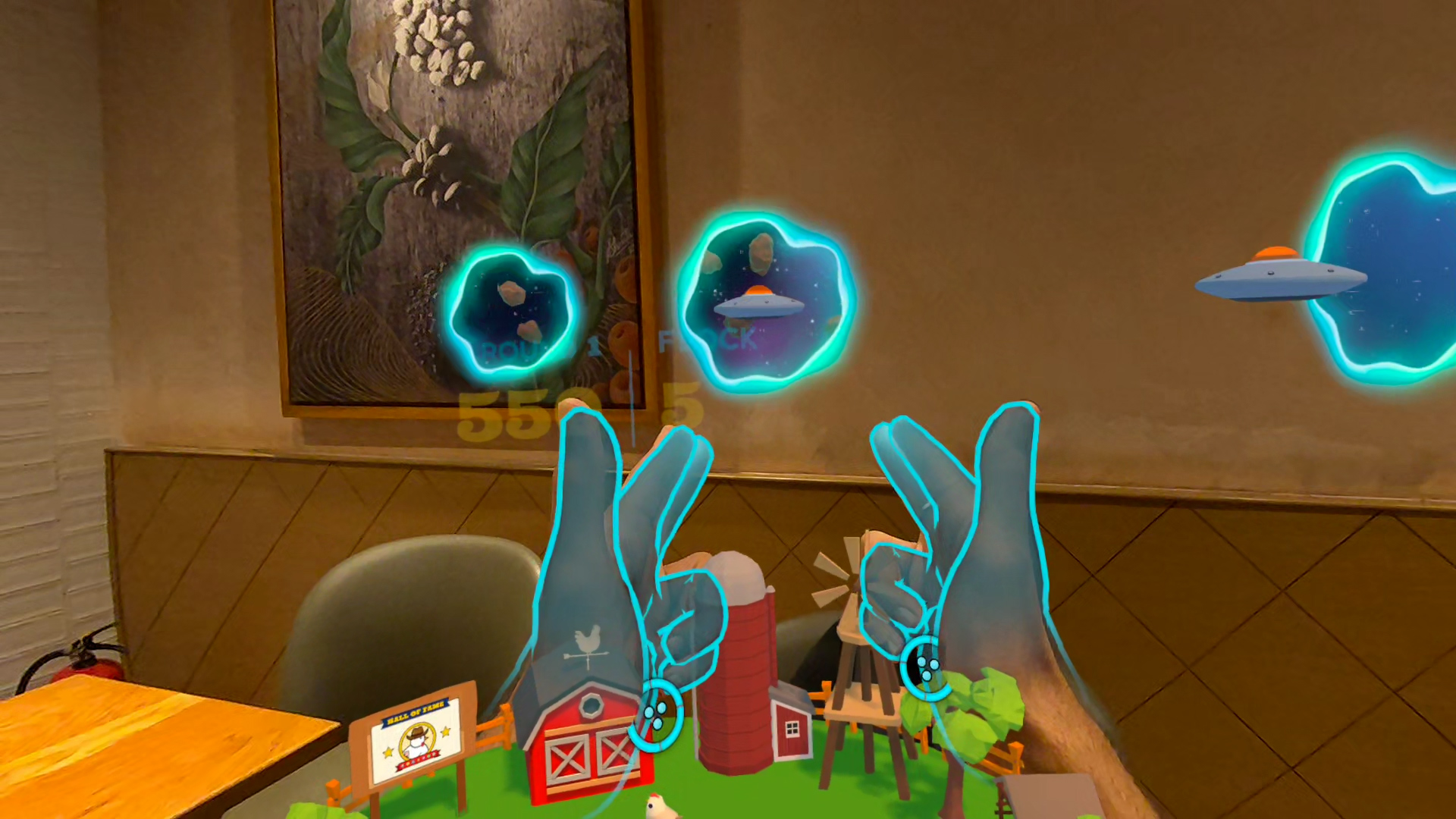
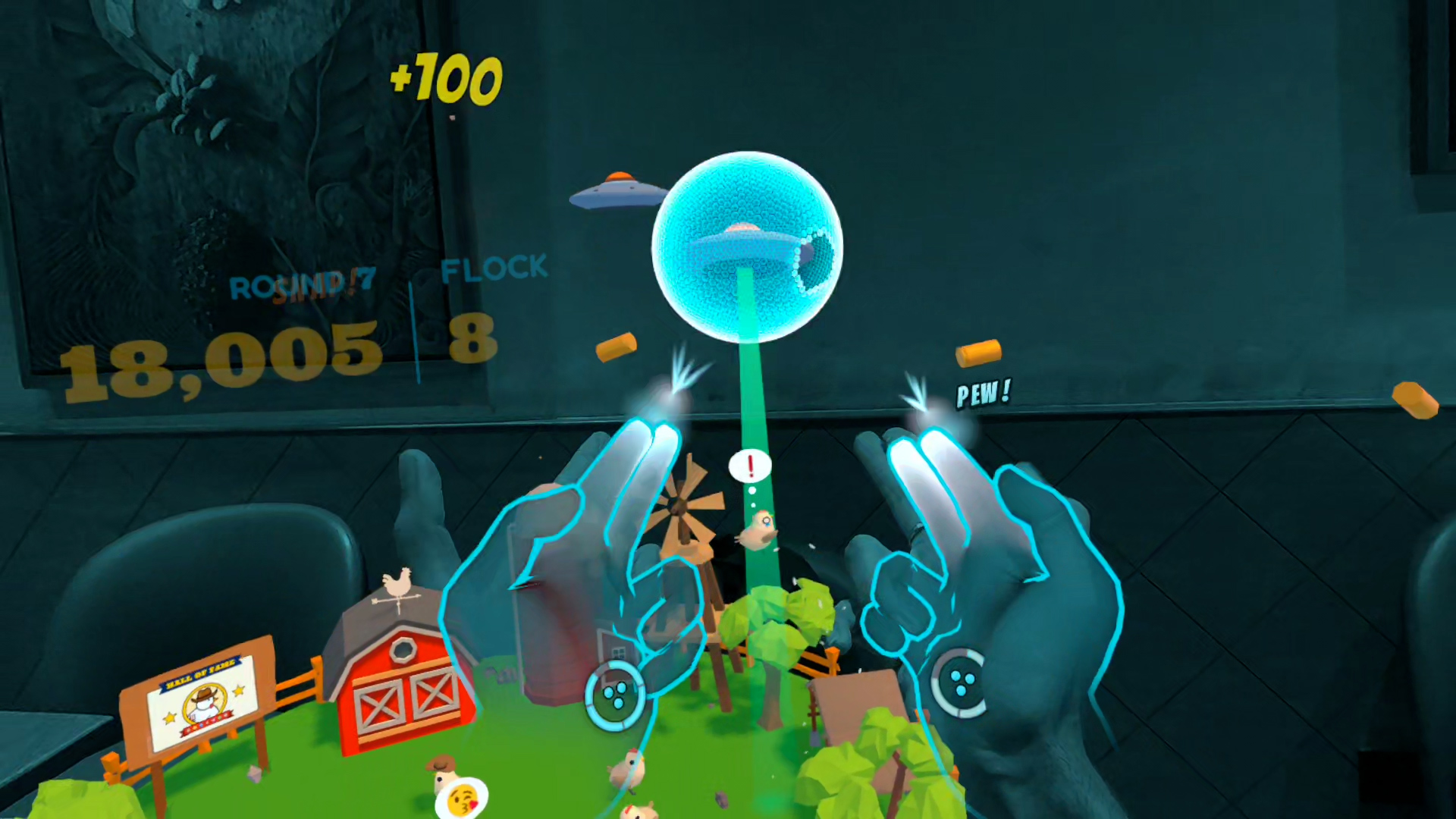
CluckOff is a seated, hands-only tabletop defense game. UFOs try to beam your hens off a tiny farm; you stop them with hand gestures, rebuild your flock between rounds, and see how long you can keep it going.
Defend with your hands
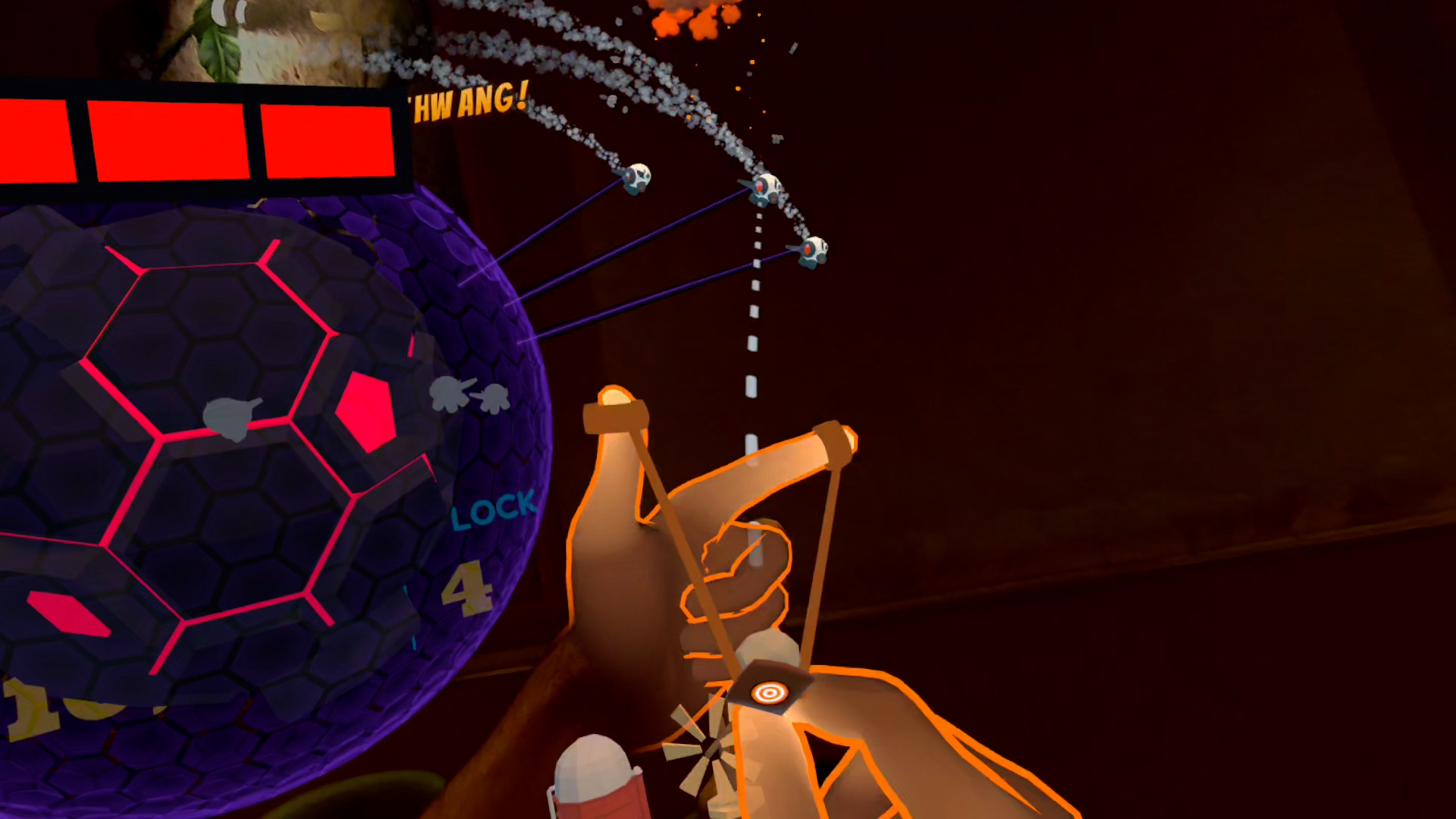
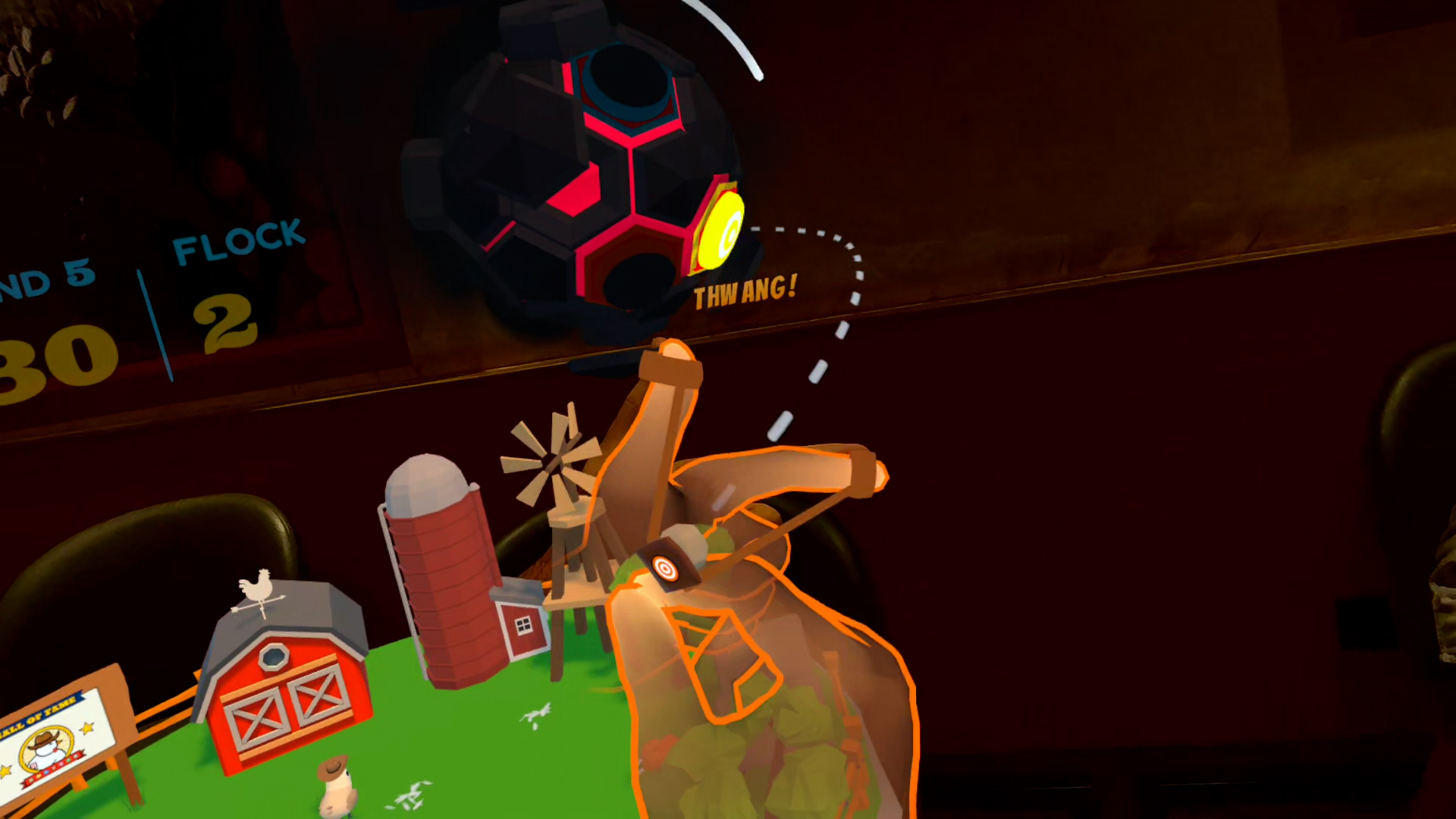
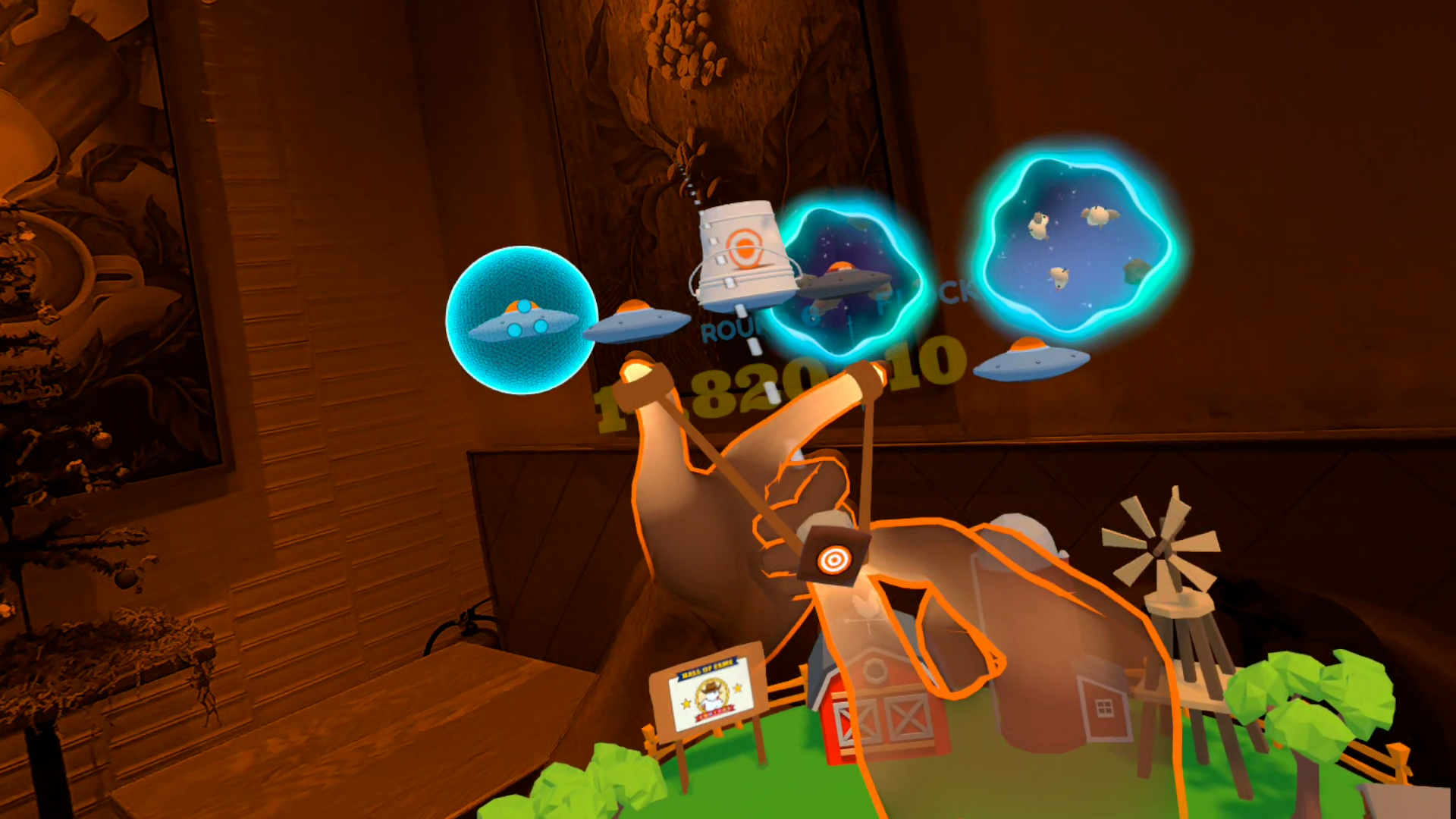
- Slingshot: pinch, pull back and release to fling stones in a real arc. Each UFO has an orange headshot spot for bonus damage.
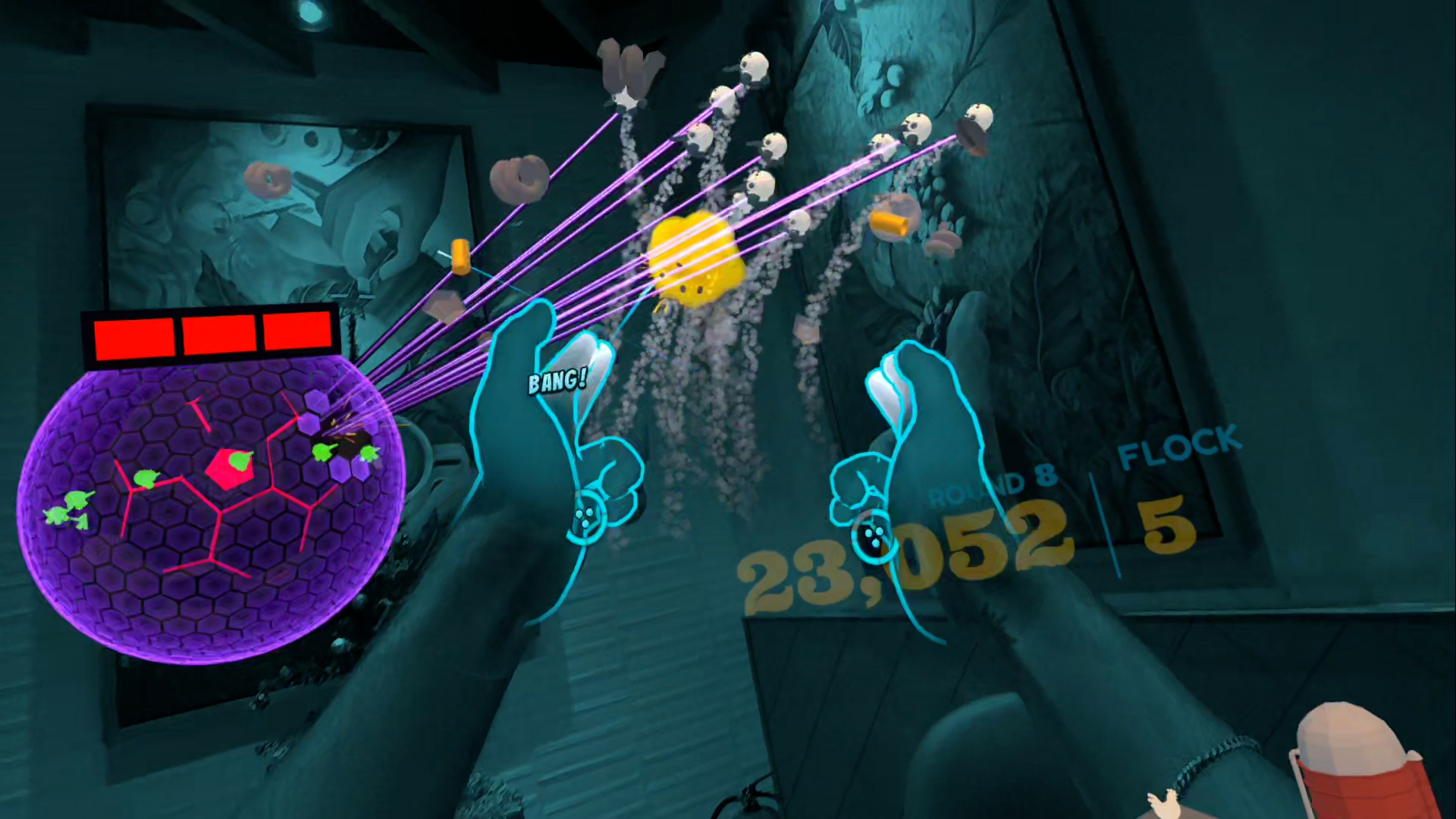
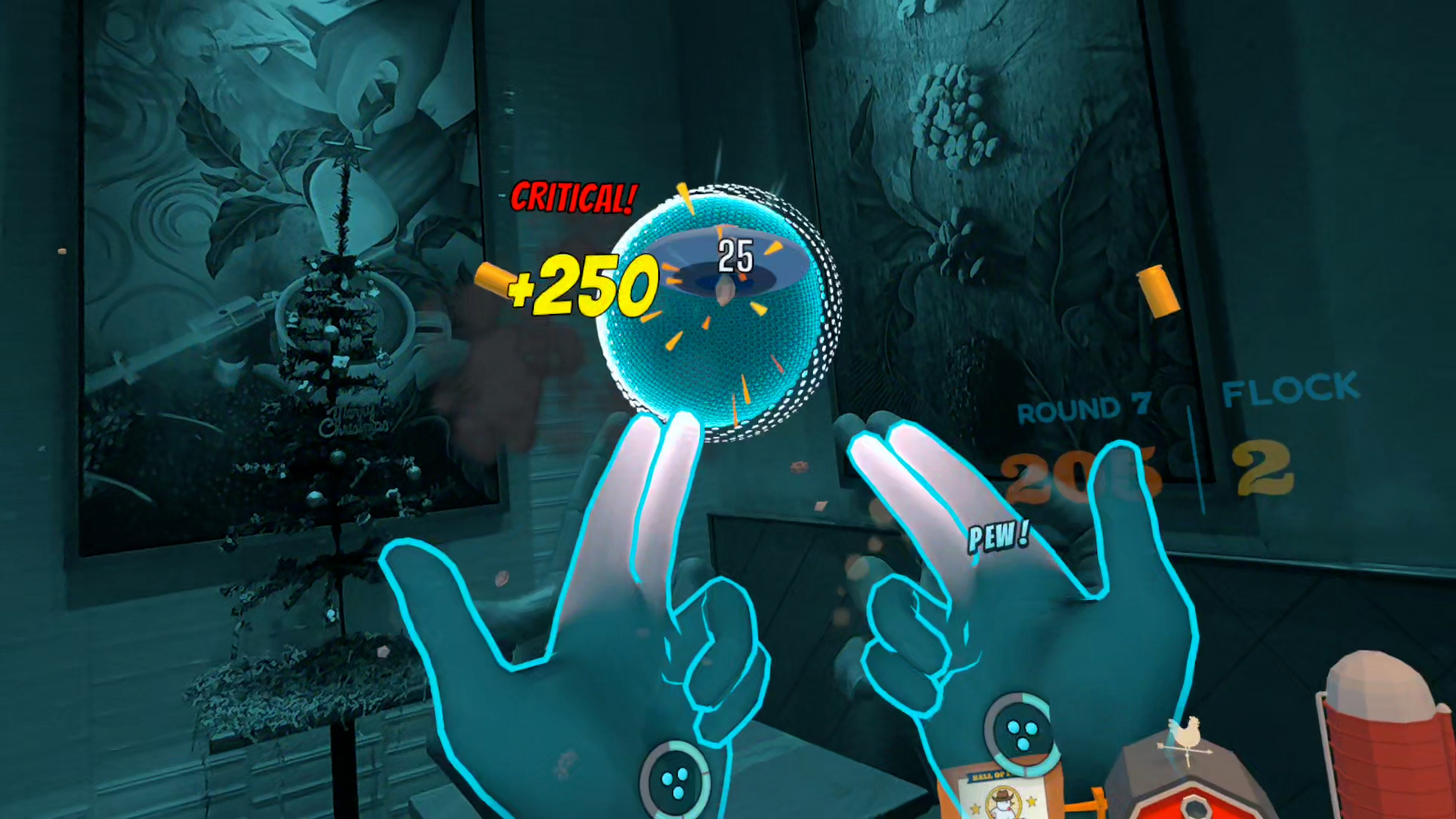
- Finger guns: point and flick to fire rapid cyan bolts. Overheat after 20 shots, then cooldown.
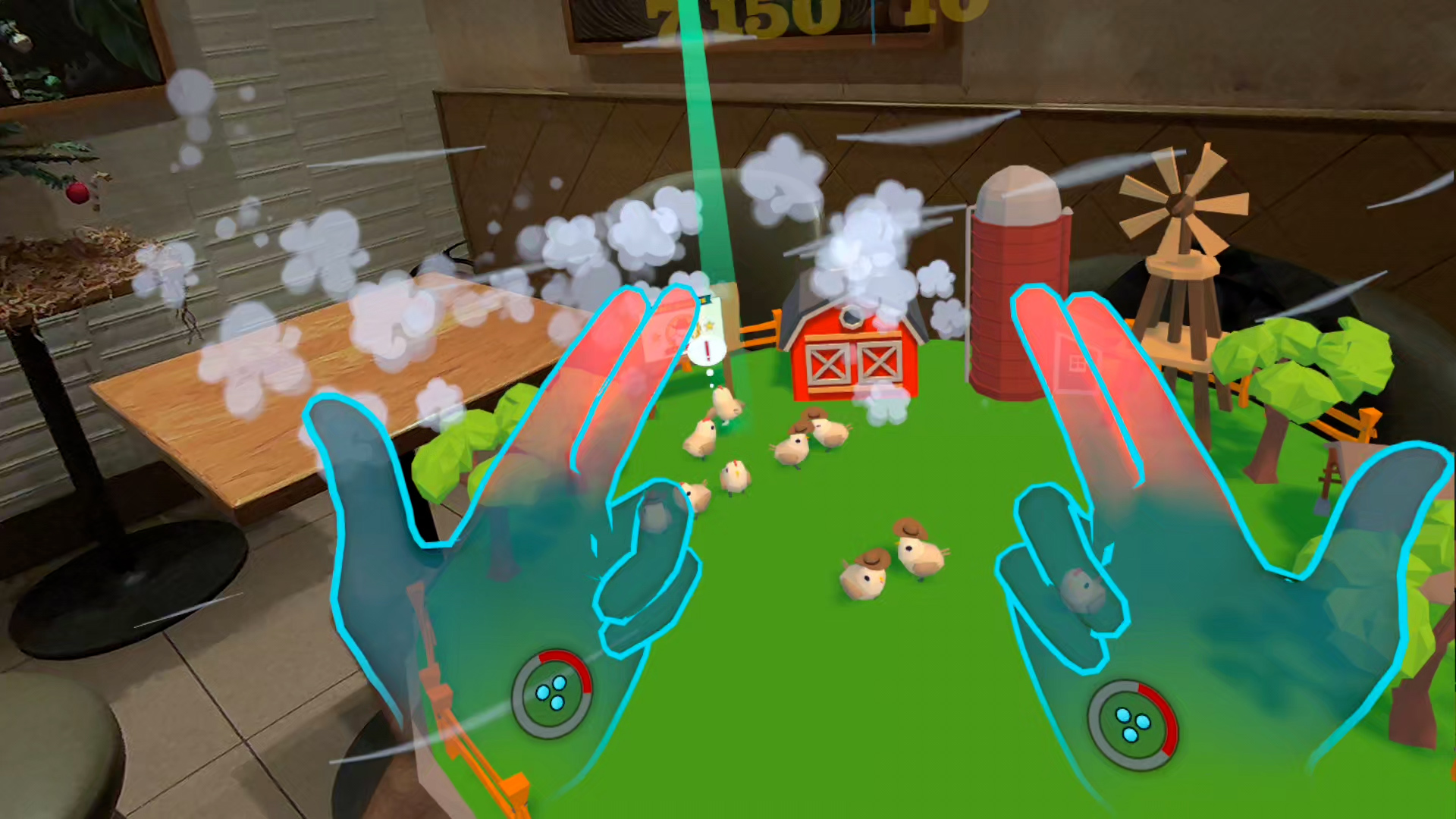
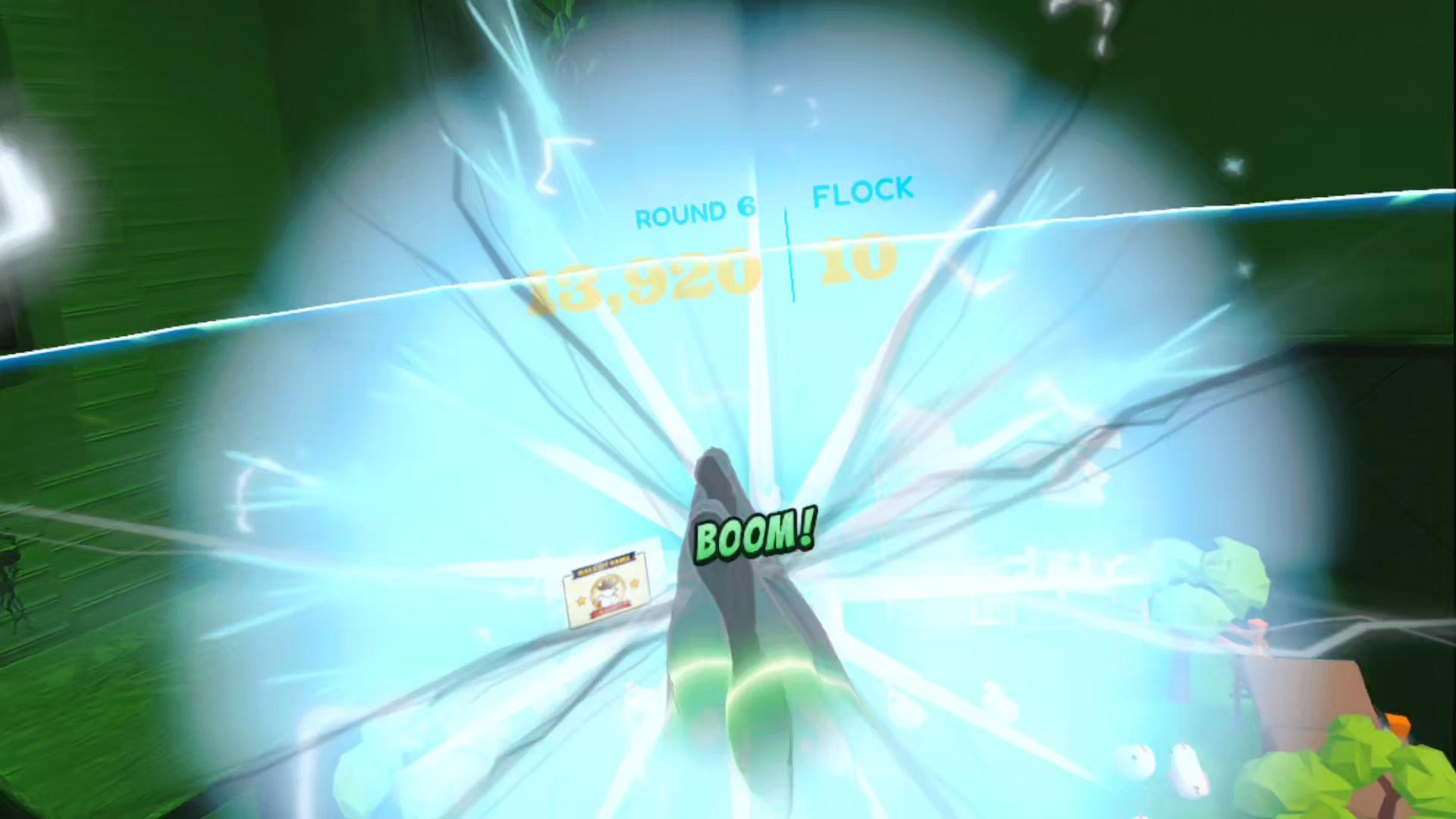
- Thunderclap: clash your fists or clap to send a table-wide shockwave. The meter charges from headshots and lost hens, a panic button that earns itself through skilful play and pressure.
- On Fire (Hat-trick): land 3 slingshot headshots in a row and the world reacts - passthrough tints red for as long as the streak holds. Pure visual spectacle; no damage change.
Read the enemy
Seven enemy types, each demanding a different response.
- Scouts are the standard abductors, any weapon works.
- Tanks are tougher Scouts with a smaller headshot spot.
- Holographic Scouts hide behind a cyan hologram shell, only finger gun bolts break it.
- Bucket Scouts wear a tin bucket with a painted bullseye, only a slingshot stone knocks it off. Bolts ricochet off the bucket and can hit a nearby UFO.
- Shifter Scouts switch between both shield types on a timer, forcing the player to watch, wait, and pick the right weapon.
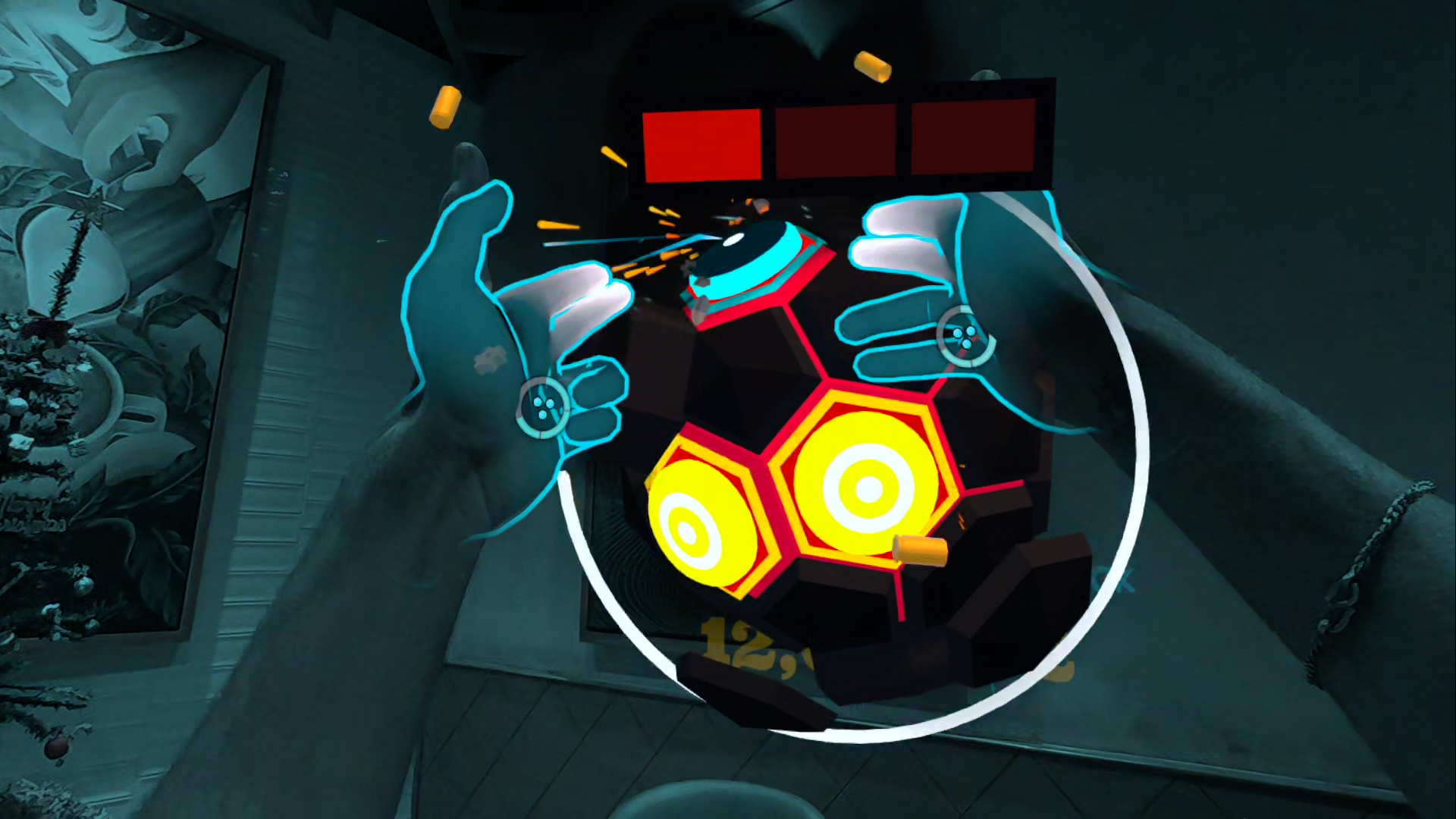
- The Mothership boss is a large geometric structure of armoured hexagon panels. It launches a drone swarm that powers a translucent tether shield. Destroy the drones or land a Thunderclap to shatter the shield and stun the Mothership, then strike the exposed compartments with the matching weapon. Each compartment shows an orange bullseye (slingshot) or cyan dot cluster (finger guns); the wrong weapon bounces with a TINK and flashes the right icon. The Mothership arrives in Round 3 and returns every 2-3 rounds, one tier harder each time.
- Drones are small and fragile; they power the Mothership's shield and buzz the player's hands to distract.
Care for the flock
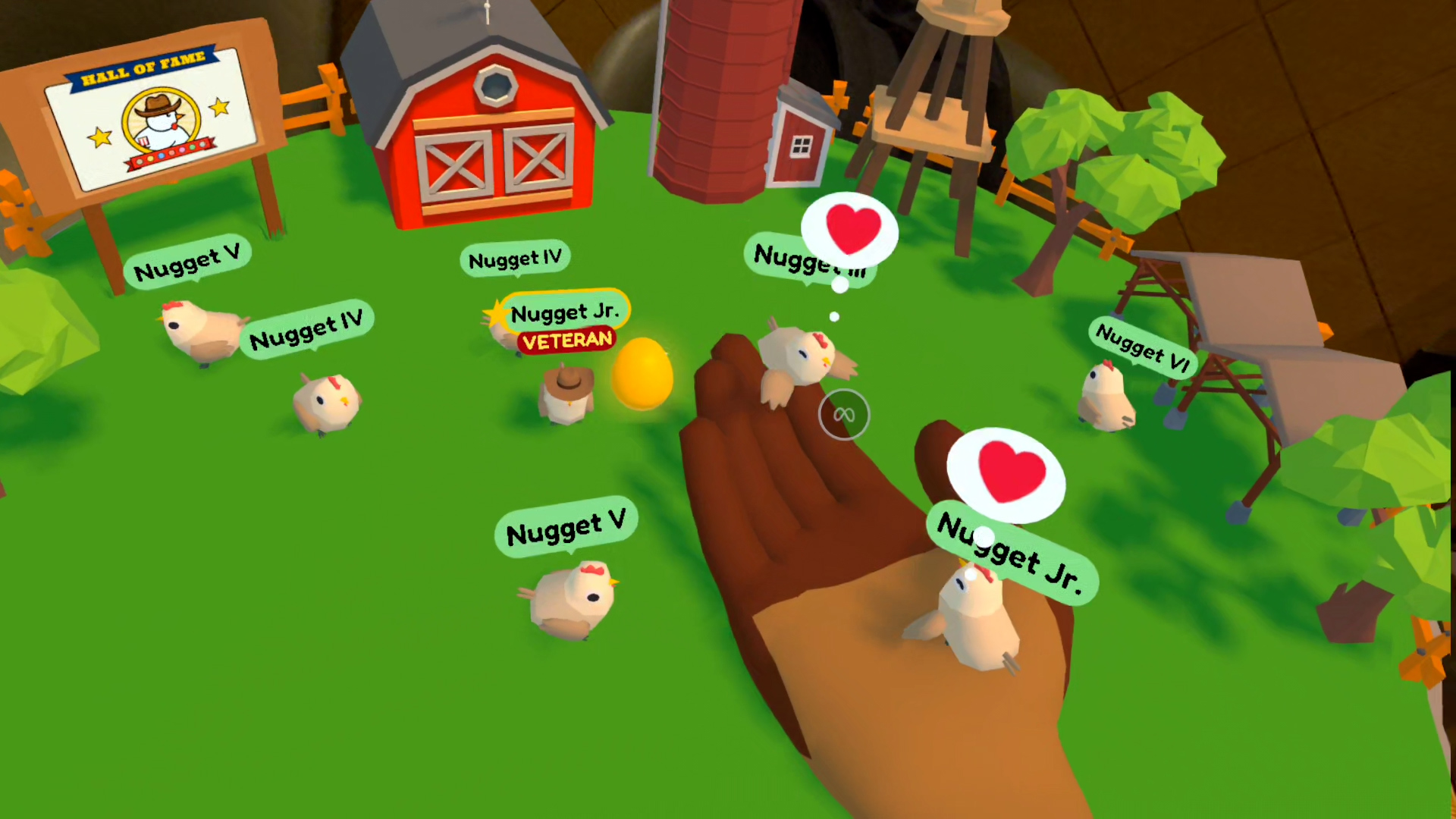
- Pop the Eggs: during the 15-second break between rounds, hens wander and lay eggs. Each egg starts golden and slowly tints toward rotten green. Poke it with your fingertip before it turns and it hatches a chick, adding a hen to the flock. Miss it and it splats.
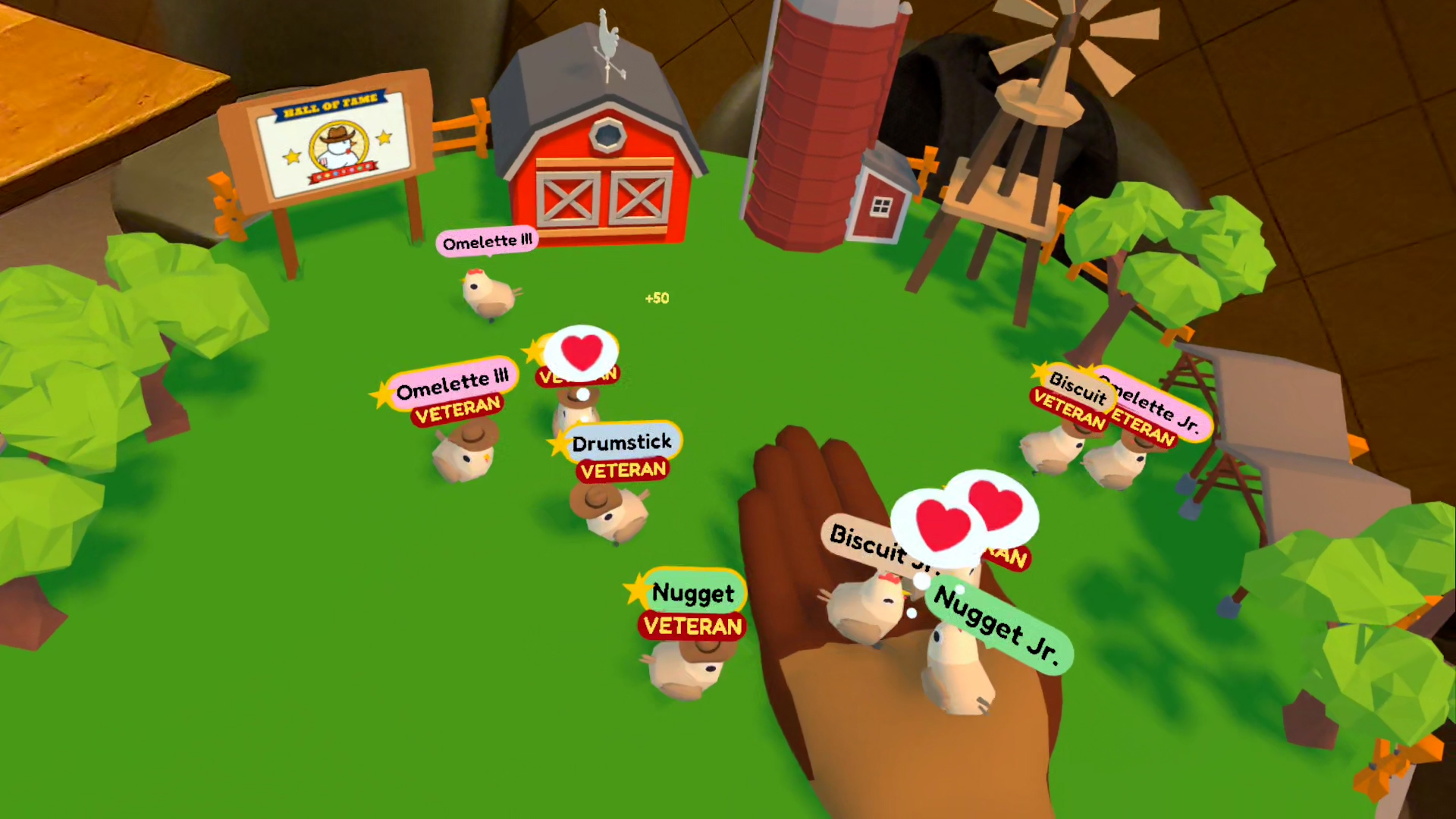
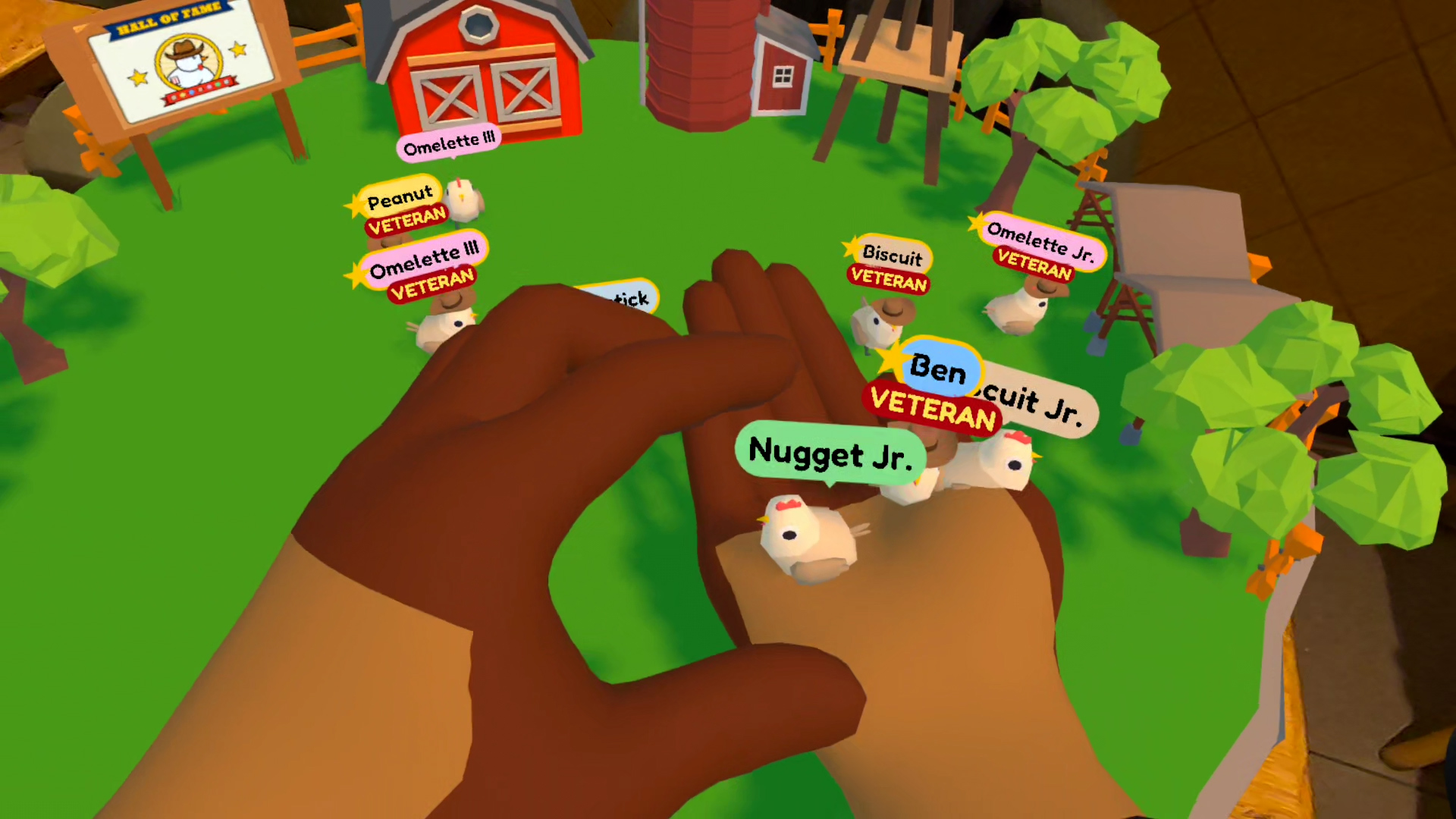
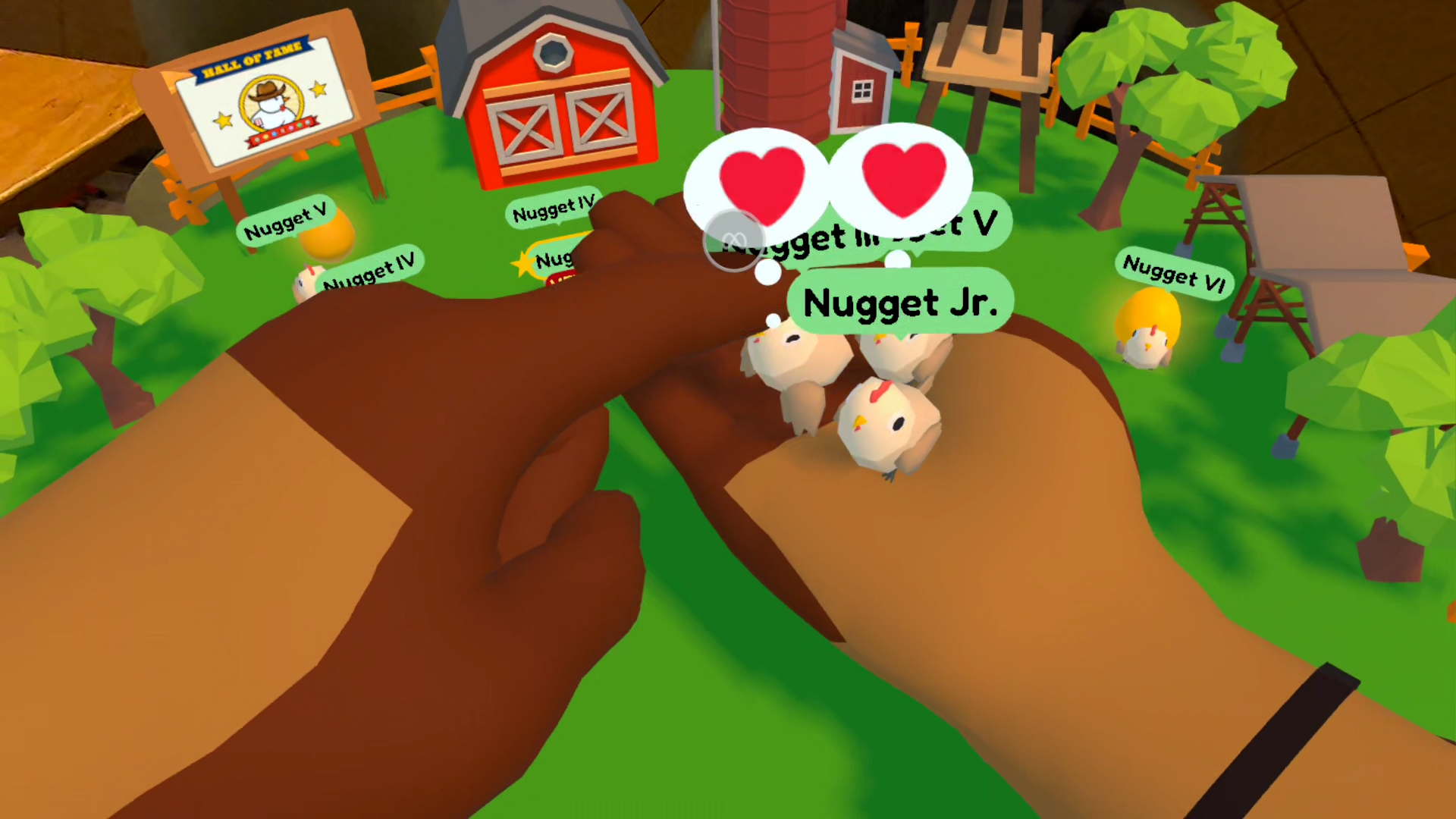
- Pet and hold your hens: touch a hen during the break and she coos with a heart emoji. Cup your palm on the farmland and hens recognise it as a perch - they climb on, rest and walk around your hand. A tiny world you can literally hold.
- Every hen has a name and a family tree. The 7 founders - Biscuit, Peanut, Bean, Big Barb, Omelette, Nugget and Drumstick - pass their names to descendants: Bean Jr., Bean III, Bean IV. Lose a founder with no offspring and that name is retired for the run.
- A hen that survives 3 rounds earns veteran status: a cowboy hat and star badge, honoured with a poster at the start of the break.
- The Hall of Fame board on the farm tracks each family's veteran count across runs, a persistent high score for every bloodline.
Runs that change
- After each round's break, the player picks 1 of 3 modifier cards drawn from a pool of 12 (5 Weapons, 7 Enemy, 2 rares). Each card lasts one round and bends the game: cloudy weather that hides UFOs, gusty winds that push your stones off course, a magnetic field that pulls bolts toward headshot spots. No category label is shown, read the card's short description and decide.
Game Over
When the last hen is taken, the UFOs mock the player - they fly in circles around the empty farm, kicking up a trail of dust. Then a massive UFO portal opens above the farm. One by one, the UFOs fly back through it, and for a brief moment the player can see through the portal into space, where their abducted hens float among the stars, a last glimpse of the flock they lost. The Game Over screen shows the run's stats with Retry as the primary action.
How it uses Meta Quest
- Hands-first, end to end: every action, from placing the farm, through onboarding, battle, breaks and the boss fight, uses hand tracking with no controllers.
- Distinct gestures, each with a job: pinch-pull-release for the slingshot, point-and-flick for finger guns, a two-hand clash or clap for the Thunderclap, a fingertip poke to hatch eggs, a stroke to pet, and a cupped palm for hens to perch on. Players switch gestures by tactical choice, not by habit, because each enemy type demands the right one.
- Your version of the gesture: everyone who has pretended to fire a slingshot or a finger gun as a child did it their own way. Some use thumb and index for a slingshot, others index and middle; some flick a thumb for a gun, others flick the whole hand and for a shockwave some clap, others bump fists. We kept every mechanic open to these variations so that a player who has always imagined their finger guns a certain way is not disappointed when they try it in our game. The gestures are designed to meet the player's instinct, not to override it.
- Seated and passthrough: play sitting down at home, in a café, or on a plain seat. The farm floats in passthrough and the player places it anywhere in front of them. Passthrough dims for the splash screen and brightens as the game logo lands, keeping the transition natural.
- Fast cold start: the game logo appears immediately on launch, rises, and the farm appears beneath it. The player positions, confirms and plays within seconds. Returning players can skip the intro with a pinch.
- Staged onboarding, discover, don't memorise: instead of teaching all three weapons upfront, each one is introduced across the first three rounds when the player needs it. Round 1 is slingshot only; Round 2 introduces finger guns the moment a Holographic Scout shrugs off the slingshot; Round 3 earns the Thunderclap when the meter fills under pressure. By Round 4 the player has all three weapons and understands the colour/icon language from experience, not from a tutorial card. How to Play in the farmyard lets the player replay onboarding anytime.
- Comfortable by design: the floating HUD sits behind and above the farm, in line with the action, always facing the player. Essential text uses thick outlines and shadows to read over any real room. The game runs at 70-72 fps on Meta Quest 3 and 3S.
How we built it
- Engine and SDKs: Unity 6000.0.68f1 with the Meta XR SDK v207.0.0 for hand tracking and passthrough.
- Design-first approach: a full game design document, gameplay and enemy-logic spec, weapons spec and onboarding flow were written before any code. HP and damage tables, wave scaling formulas, Mothership fight tiers and a mercy rule (easing the boss after repeated misses) were defined on paper so development could build toward a proven design.
- Art direction: a subtle retro-futurist western theme, a rustic farm in wood, rope and sunlight against chrome 1950s saucers with glowing domes and rivets. The contrast sits in the two sides, not in a full western setting, so the game can grow without being boxed in.
- Typography as identity: two font pairings, each with a job. Ultra (heavy slab-serif) and Fredoka for the visual identity - logo, cards, the floating HUD, name tags. Bangers and Big Shoulders Display for in-combat effects - damage numbers, PEW!, THWANG!, HEADSHOT. All outlined against any real-world background.
- Modifier card system: 12 cards designed as collectible trading cards with coloured frames (blue for Weapons, red for Enemy, gold for rares), sunburst art panels, and short ▲/▼ descriptions. No paragraph of rules, just enough to make a fast choice.
- Team:
- Harsh Soni - Concept Design, UX/UI Design, Sound Design, Art Direction, Project Management, QA
- Shane DSouza - Concept Design, Development, Art Direction
- Nikhil Bansal - Concept Design, Development, Art Direction
Challenges and what we learned
- Getting the slingshot right. The core mechanic had to feel intuitive on the first attempt. If a player tries the gesture, there should be almost no room to fail. Early iterations had tracking jitter and inconsistent release detection that made the slingshot feel unreliable. Getting the pinch-pull-release to feel as natural as stretching a real rubber band took significant hand-tracking tuning.
- Making every gesture matter. Finger guns alone get repetitive fast. Shields that only one weapon can break turned weapon choice into a quick read-and-react puzzle and gave each gesture a reason to exist. The Mothership fight pushes this further: each compartment shows which weapon it needs, and the wrong one visibly bounces off.
- A boss you can't get stuck on. Early Mothership fights could stall when a player kept missing the drone-kill window. A mercy rule now trims the swarm and widens the stun window after repeated misses, then resets on a successful hit, so players always progress without the game feeling like it gave up on them.
- Reading over a real room. Text and eggs kept vanishing against bright passthrough backgrounds. Eggs got the golden-to-green colour transition with a hop and shadow to stand out against any surface; all text got thick outlines and shadows, with the floating HUD placed behind the farm against the sky rather than against cluttered real-world surfaces.
Future plans
Target launch on the Meta Horizon Store: December 2026.
- Hen voices with AI: seven founders, each with their own personality and accent (a laid-back surfer, an impatient Russian, a deadpan French gamer). Lines are written and voice generation is complete. Beyond scripted lines, we plan to adopt AI so the hens can hold context-aware conversations with each other and respond directly to the player's actions, turning the flock into characters that feel alive, not just animated.
- Co-op: two players share one farm, each owning a weapon colour. With weapons split between players, coordination becomes essential. One player breaks a Holographic Scout's shield, the other finishes it off. Defence becomes a conversation.
- Your room as the farm: send UFOs through real walls and ceiling using spatial anchors to remember the farm's position between sessions.
- Farm customisation and building: a build mode that lets the player swap farm assets, choose layouts, and make the farm feel like their own between runs.
- Built for future hardware: designed to adapt to Meta's evolving headset lineup, including narrower field-of-view considerations.
- More to come: portal orientations that change how UFOs enter each round, a day-night cycle that shifts the mood across a run, a Fireball power-up that turns the Hat-trick into a splitting projectile, rescue missions with rare Caged Hen UFOs, random events like meteor showers, and new farm biomes.

