-
-
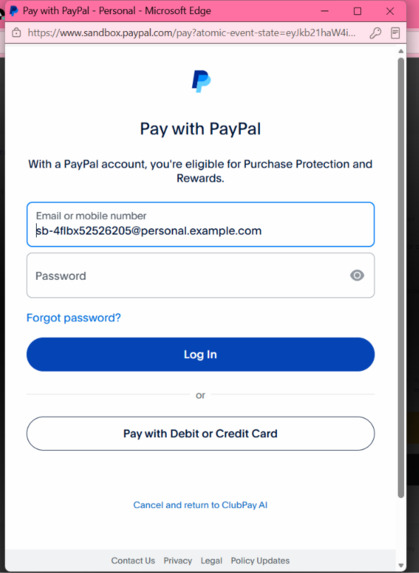
Payment gateway
-
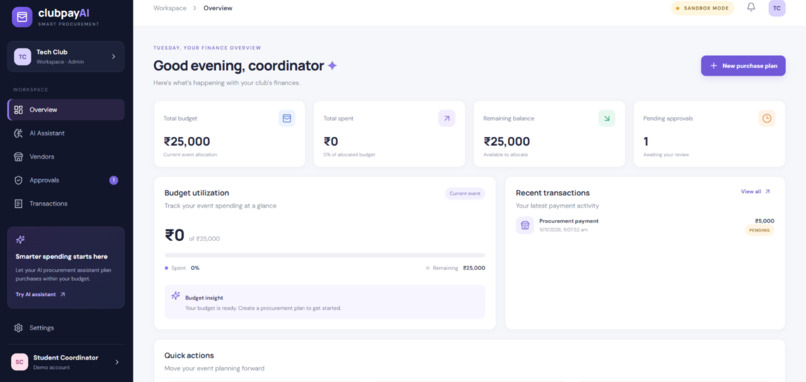
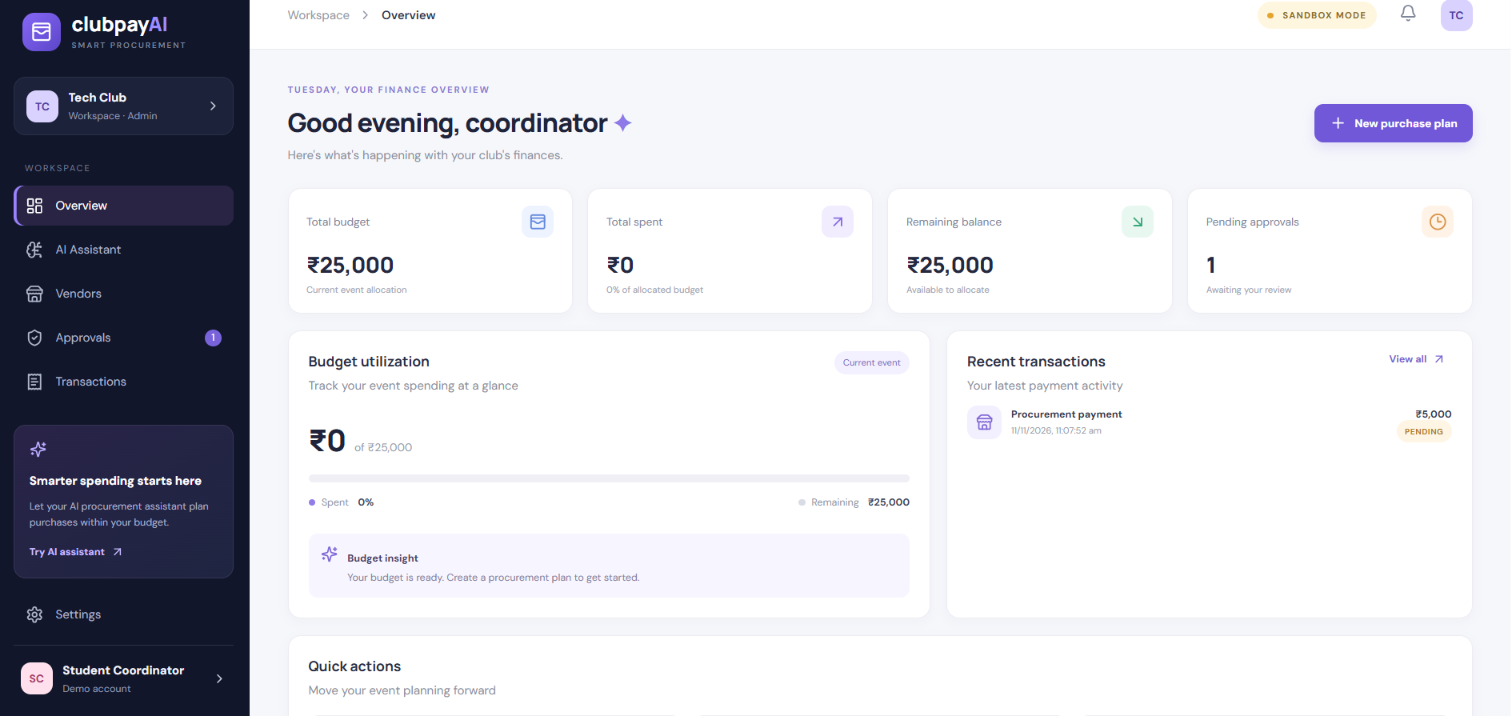
Dashboard
-
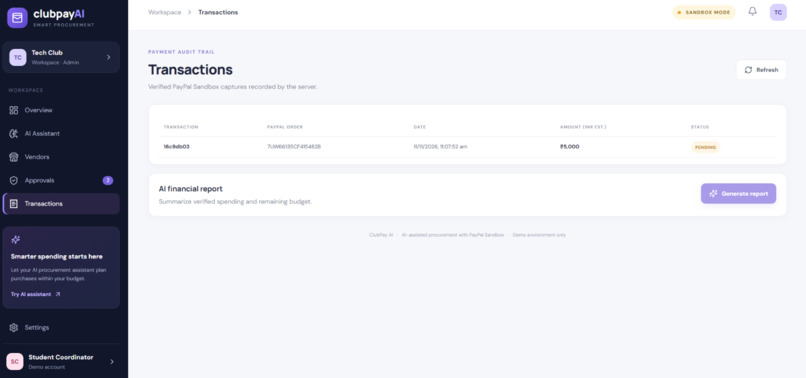
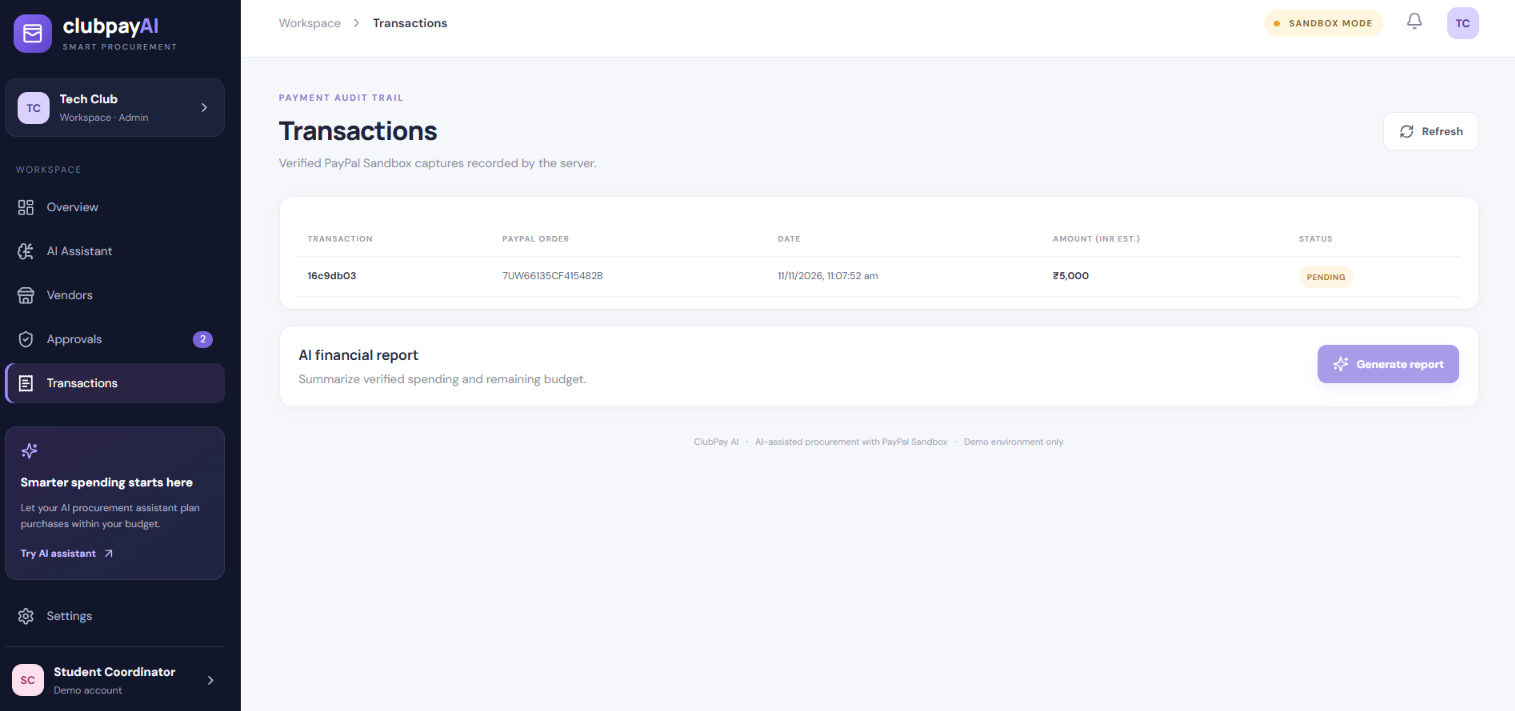
Transactions
-
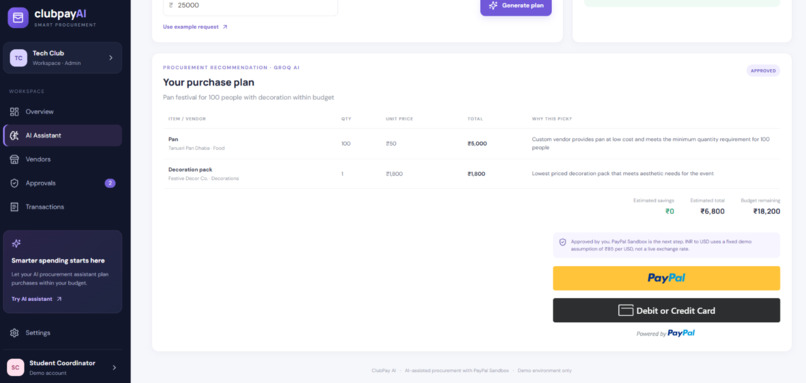
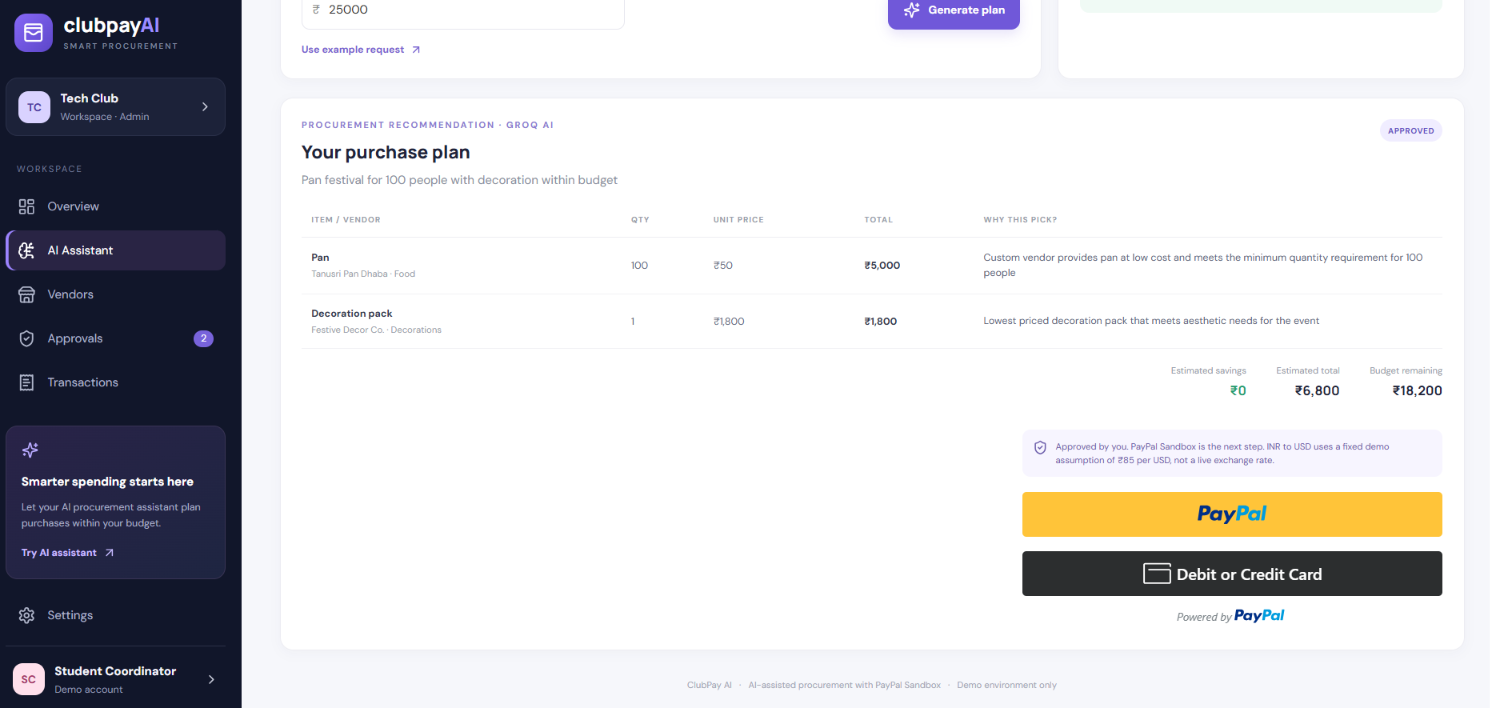
Approved plan payment
-
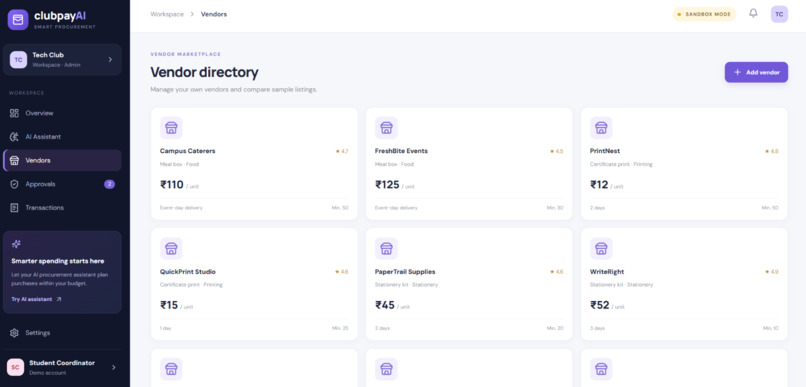
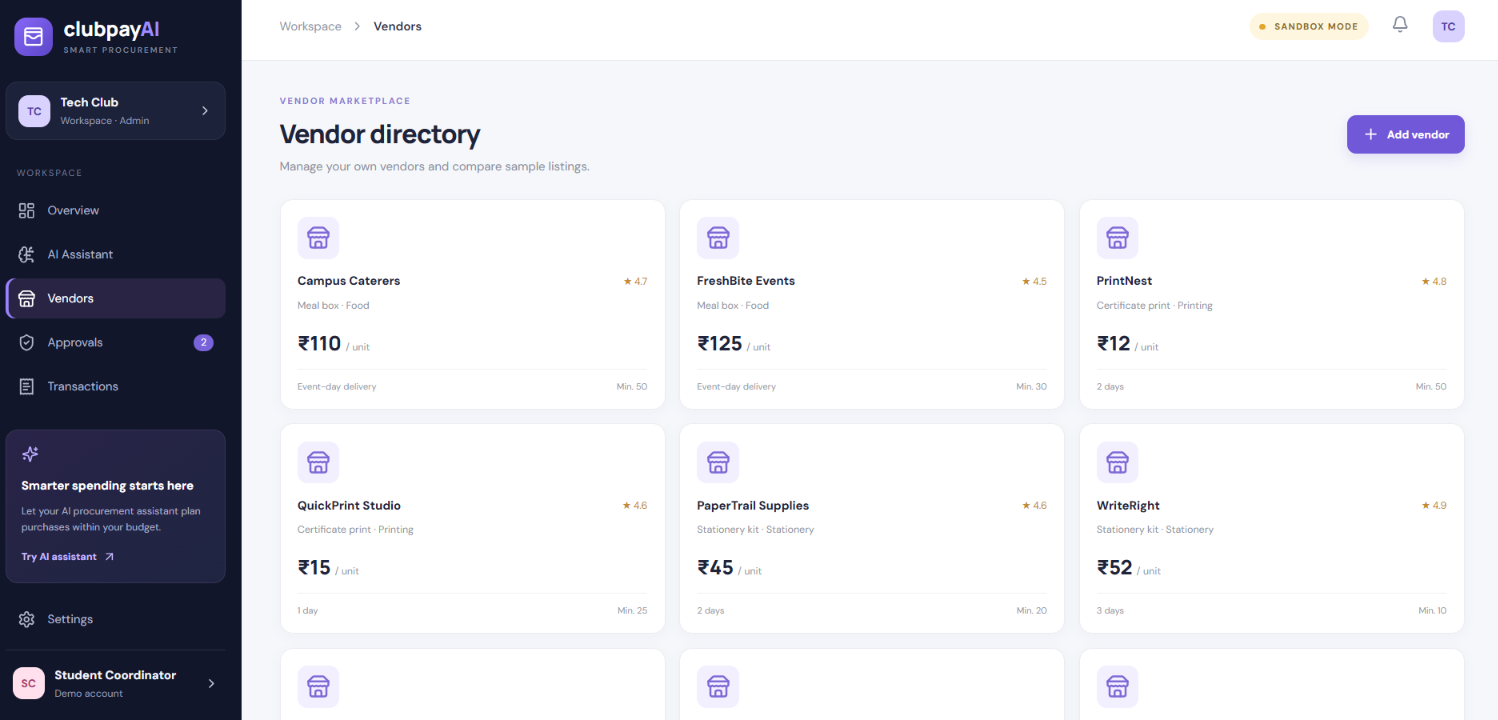
Vendors
-
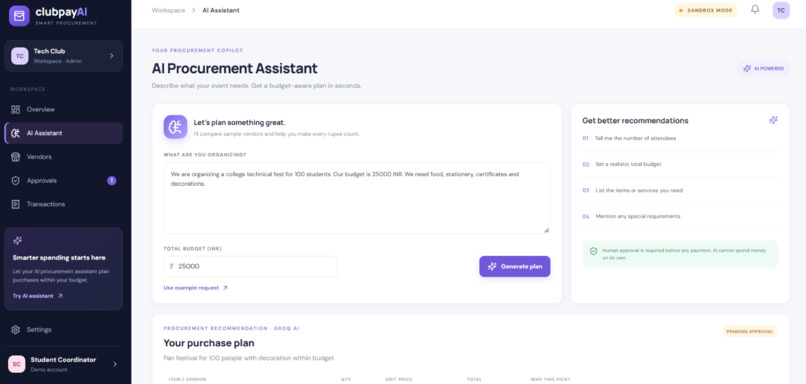
AI Assistant
-
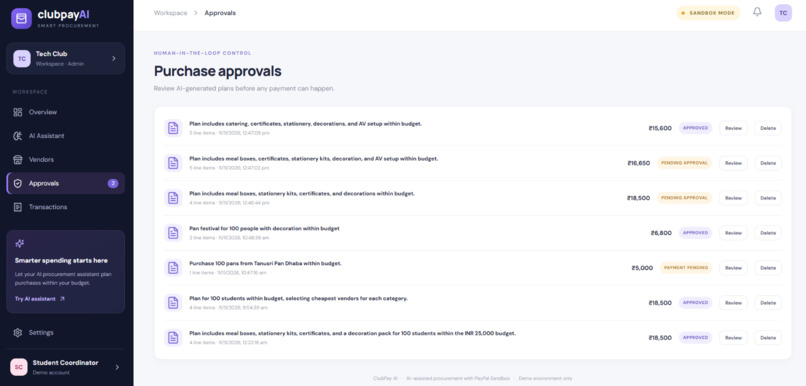
Approvals
Inspiration
College clubs regularly organize events, workshops, competitions, and activities. But managing purchases for these events can become surprisingly complicated. Teams need to compare vendors, stay within budgets, track expenses, and ensure that payments are approved by the right people.
We wanted to simplify this process by combining AI-powered procurement planning with a structured payment workflow. That's how ClubPay AI was born.
What it does
ClubPay AI is an AI-powered procurement assistant designed for college clubs and small teams.
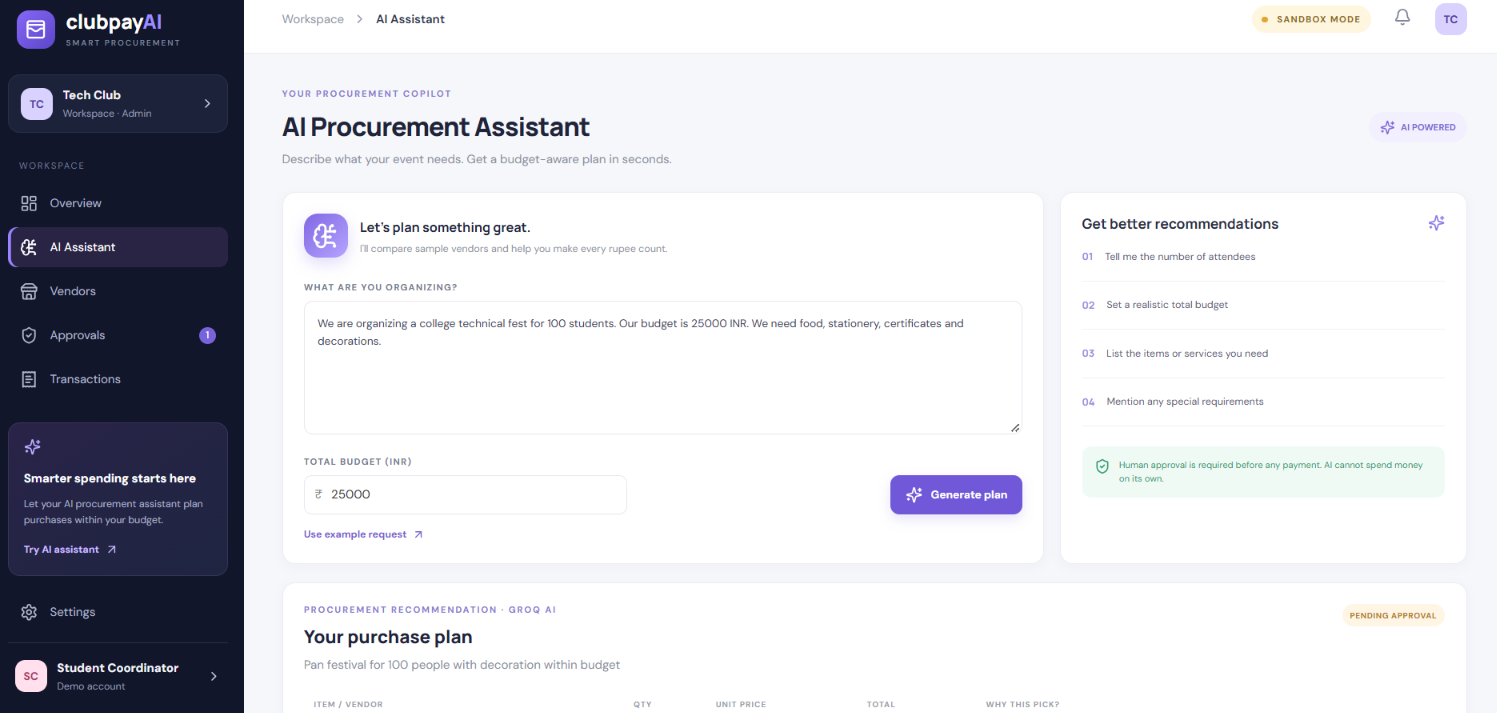
Users can describe their event requirements and budget in natural language. The AI analyzes their needs, recommends suitable vendors from the available catalogue, and generates a procurement plan.
The platform also provides:
- AI Procurement Planning: Converts event requirements into structured purchase plans.
- Vendor Comparison: Helps users compare available vendors, prices, and delivery timelines.
- Budget Management: Tracks estimated spending and remaining budget.
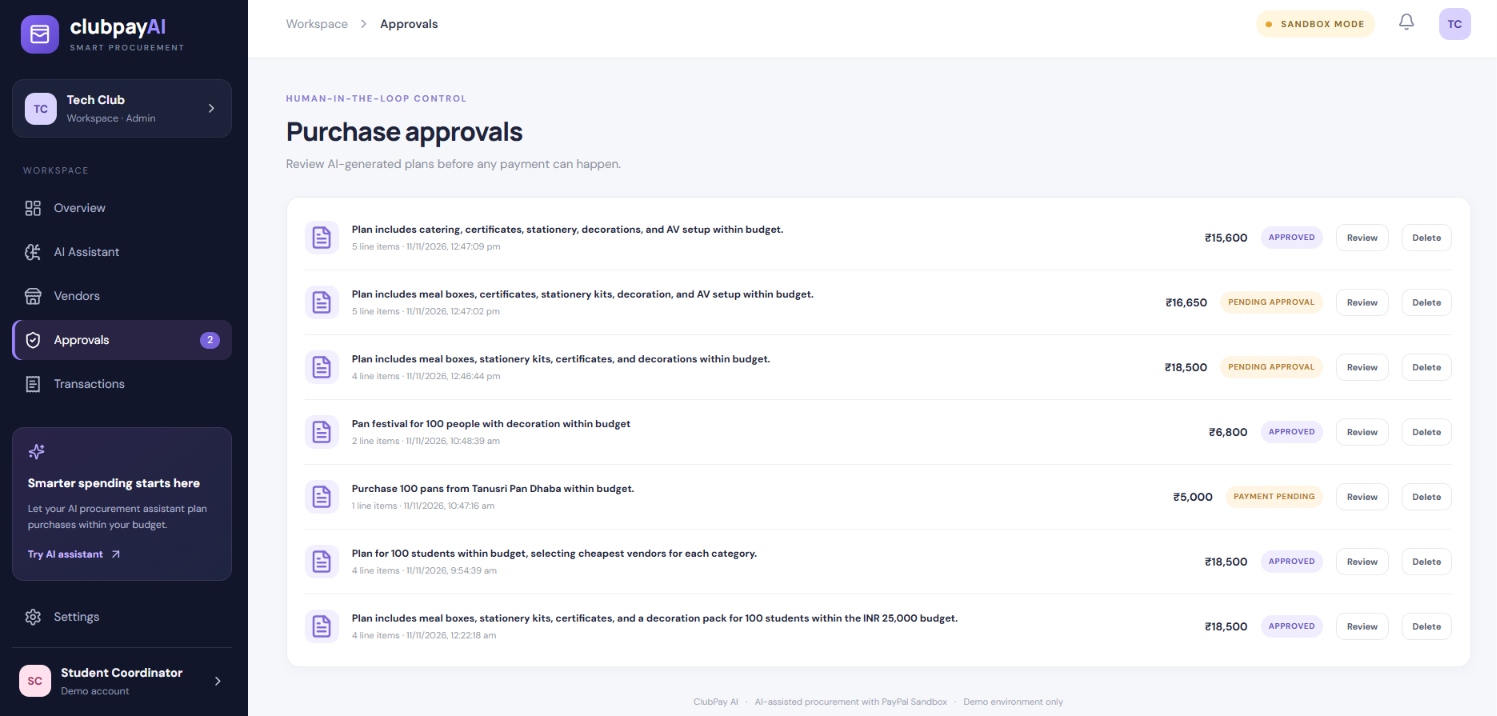
- Human Approval Workflow: Requires approval before a purchase can proceed to payment.
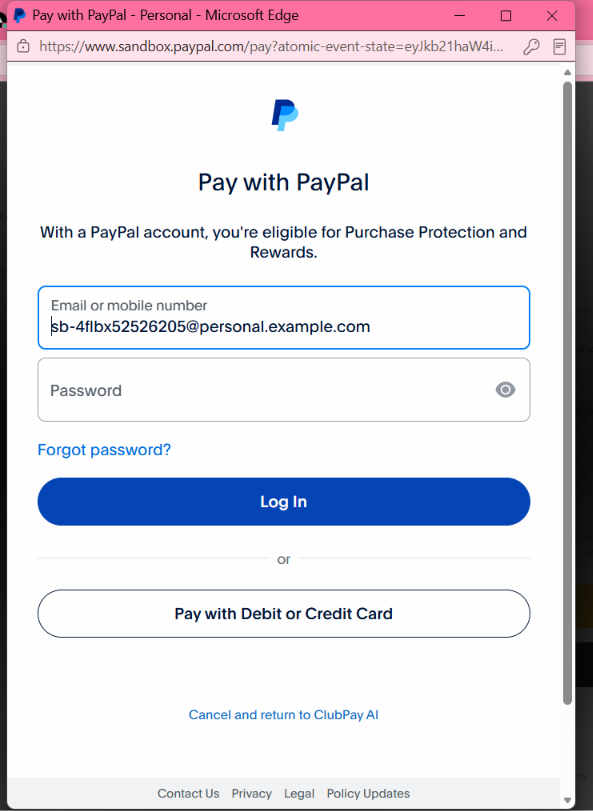
- PayPal Integration: Uses PayPal Sandbox to demonstrate secure payment creation and capture.
- Transaction Tracking: Maintains payment records and displays financial activity.
- AI Financial Reports: Generates summaries to help teams understand their spending.
How we built it
We built ClubPay AI using a full-stack architecture.
- Frontend: React.js and Vite for an interactive procurement dashboard.
- Backend: Node.js and Express.js for API endpoints, purchase workflows, vendor management, and payment handling.
- AI Integration: Groq API to interpret natural-language requirements and generate procurement plans.
- Payments: PayPal REST APIs and PayPal JavaScript SDK in Sandbox mode.
- Data Storage: JSON-based local persistence for the prototype.
- Deployment: Render for the backend and Vercel for the frontend.
An important design decision was to keep a human in the loop. AI can recommend and organize purchases, but it does not independently authorize payments. The user must review and approve a purchase before proceeding.
Challenges we faced
One of our biggest challenges was integrating multiple services into one working application. Connecting the frontend to the backend, configuring environment variables, integrating the Groq API, and handling PayPal Sandbox payment responses required several rounds of debugging.
We also encountered deployment issues, particularly with cross-origin requests between Vercel and Render. Identifying and resolving the CORS configuration issue helped us get the deployed frontend communicating with the backend.
Another challenge was handling different payment states correctly. We learned that initiating a payment and receiving a confirmed completed transaction are not the same thing, and that payment status must be verified before updating financial records.
What we learned
Building ClubPay AI taught us how to bring AI, backend systems, frontend development, and payment infrastructure together into one application.
We gained practical experience with API integration, environment configuration, deployment, debugging, payment workflows, and designing human-in-the-loop systems.
Most importantly, we learned that useful AI applications are not just about generating intelligent responses. They should solve real problems, fit into practical workflows, and keep important decisions under human control.
ClubPay AI is our step towards making procurement smarter, more transparent, and easier for student communities.


