
Inspiration
Community clubs run on burned-out volunteers. The club secretary of every sports club, PTA, scout troop and neighborhood league spends 5–10 hours a week on member email: sign-ups, address changes, fixture questions — and, once a month, a letter that needs a human heart, like a single parent asking for a fee waiver.
We wanted an agent that takes the repetitive 80% off that plate — without ever touching the 20% that deserves human judgment. Not "AI does everything", but an agent that knows exactly where to stop.
What it does
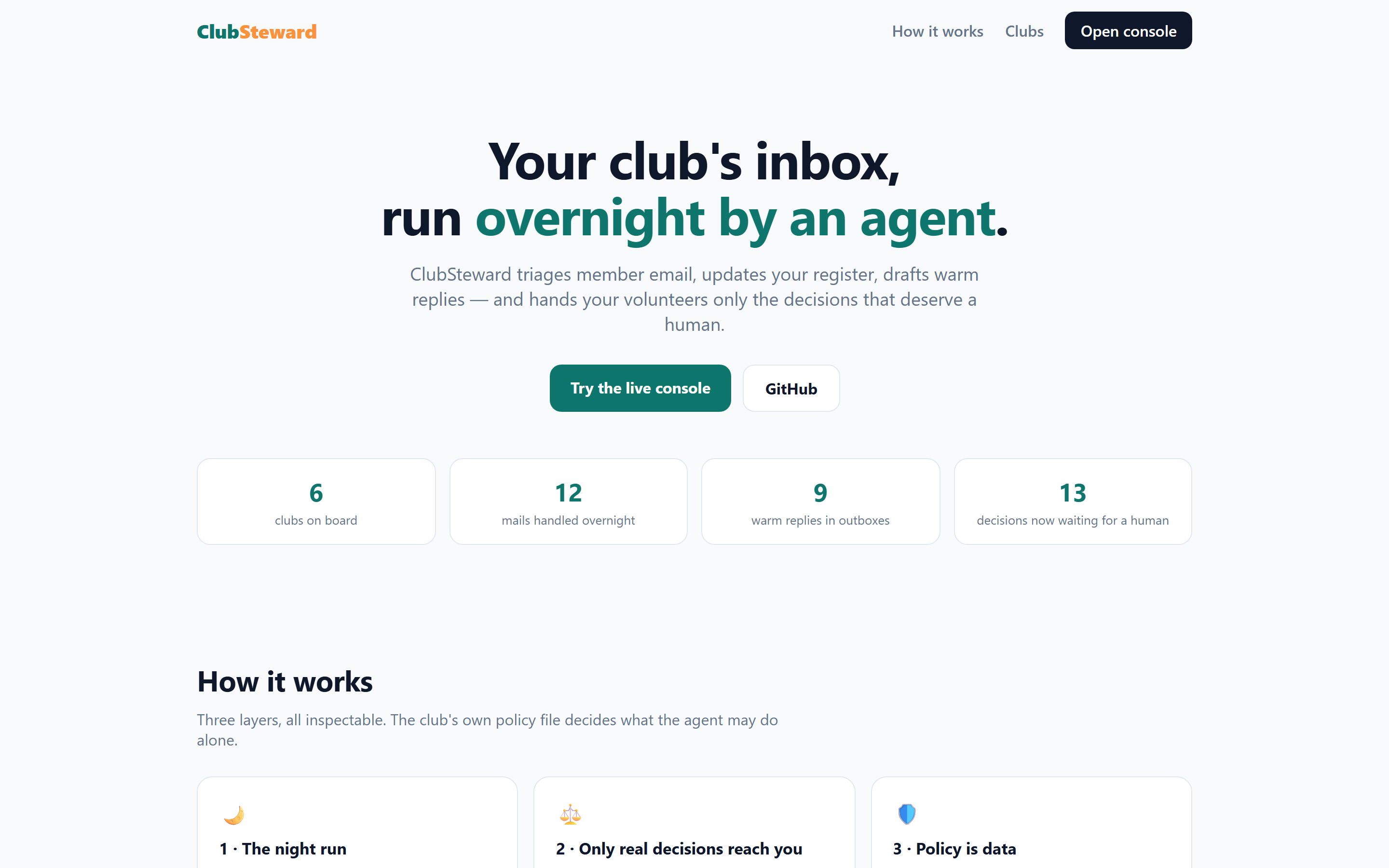
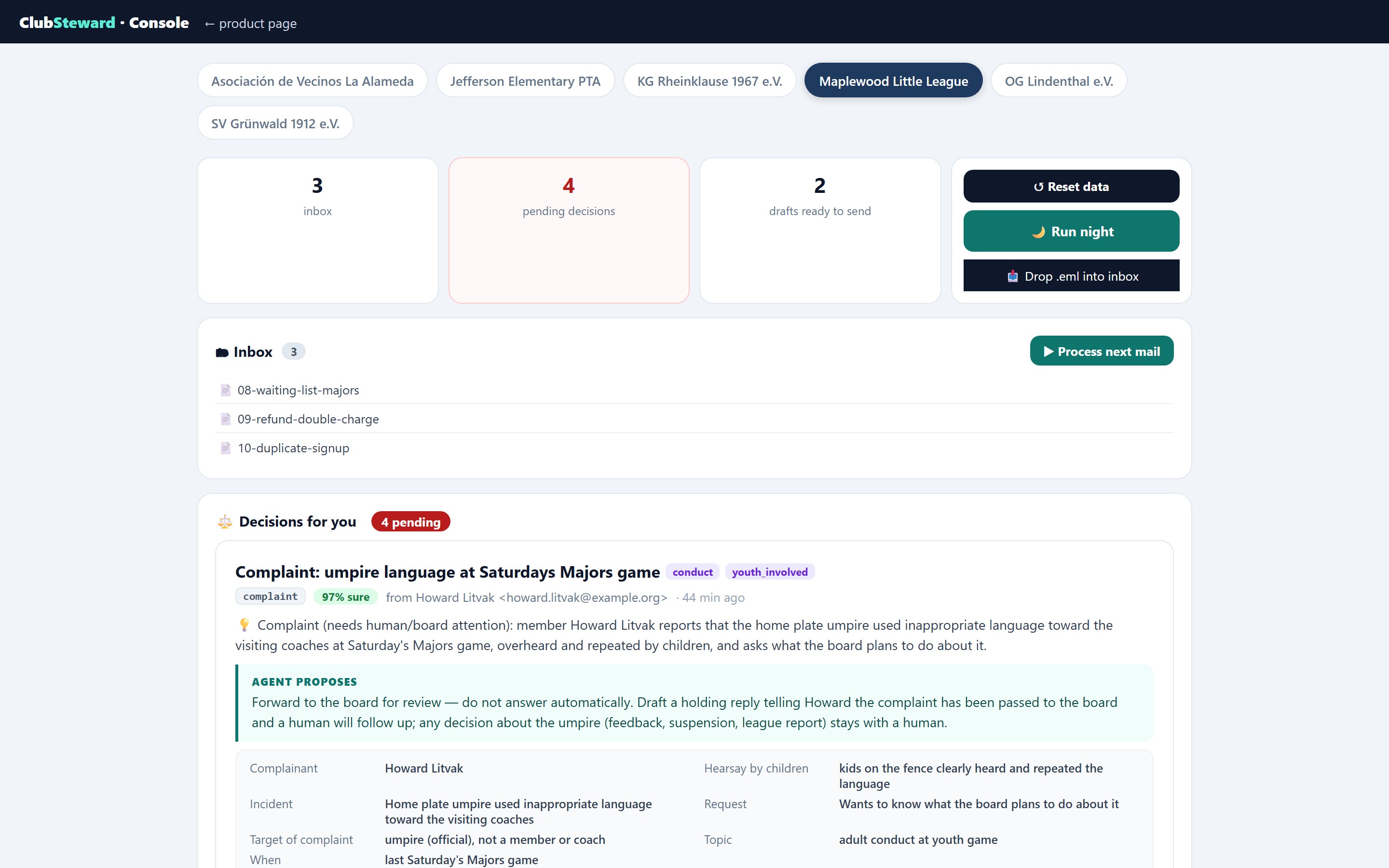
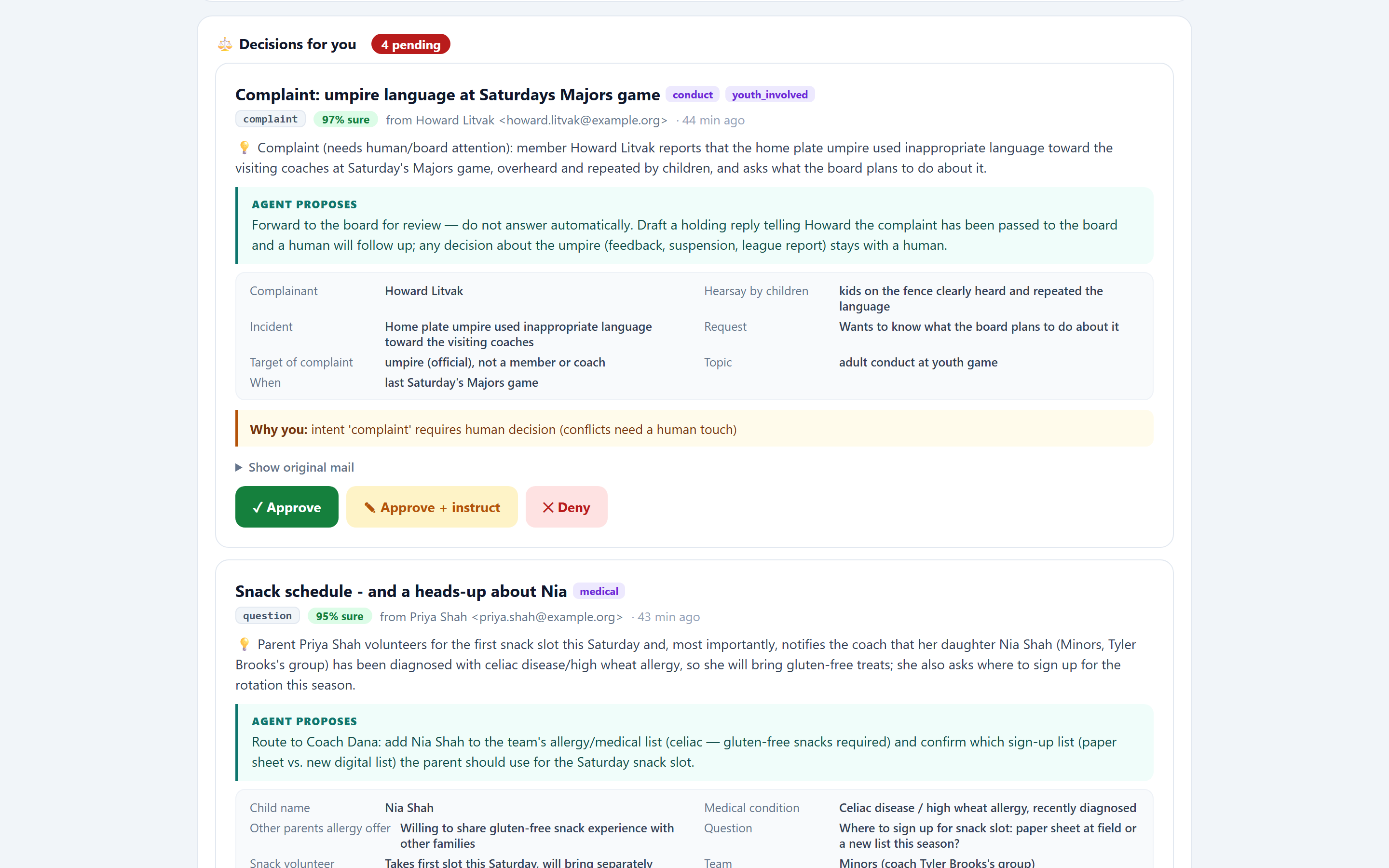
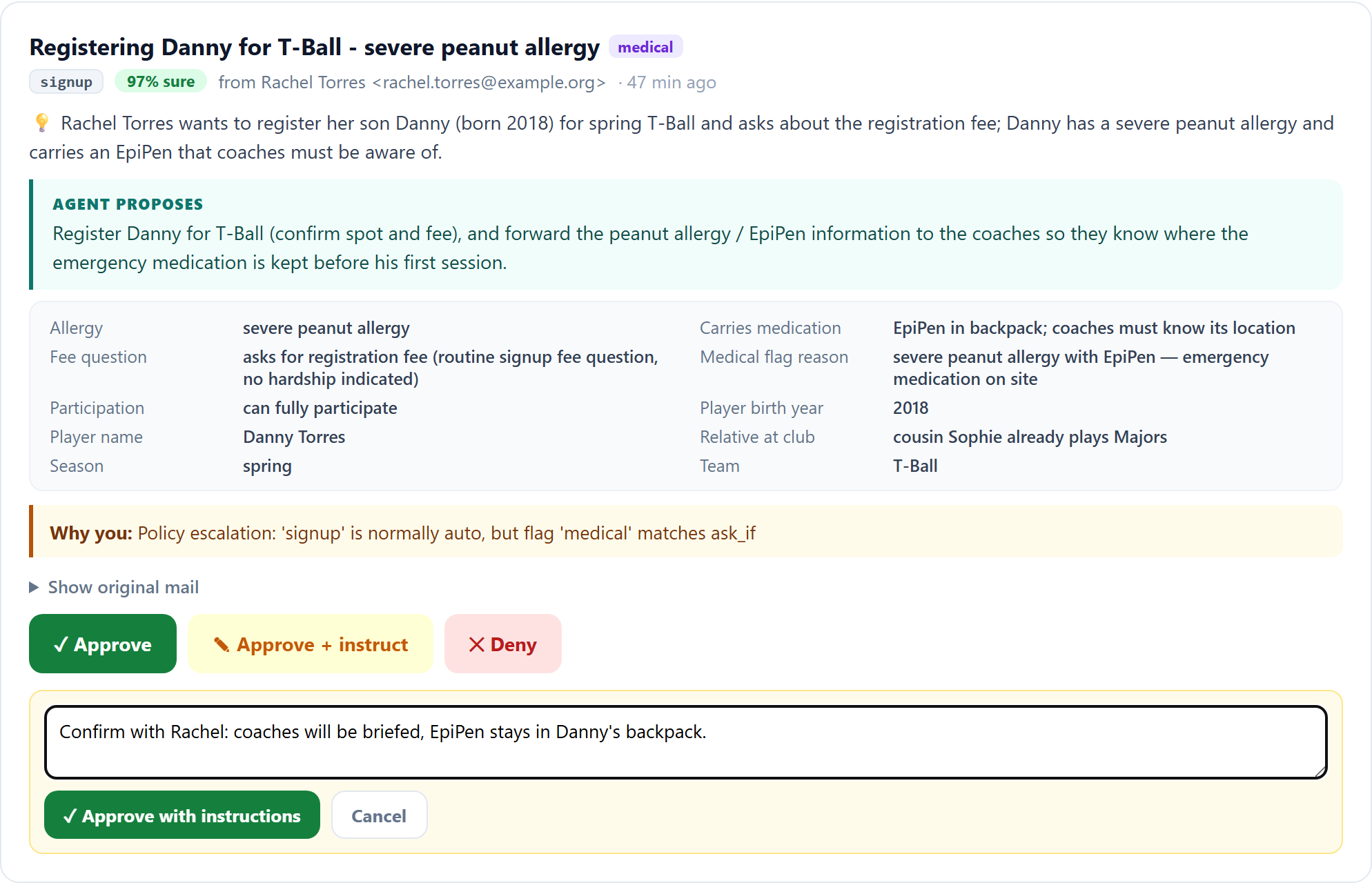
ClubSteward runs the club's inbox overnight, unattended. It triages every mail (structured extraction: intent, facts, confidence), updates the member register, drafts warm on-brand replies — and queues only real judgment calls for the secretary: hardship waivers, mid-season cancellations, complaints. Each becomes a decision card: the original mail, what the agent understood, what it proposes, and the exact policy line that escalated it ("Warum du?" — in the club's own language). Spam is discarded silently.
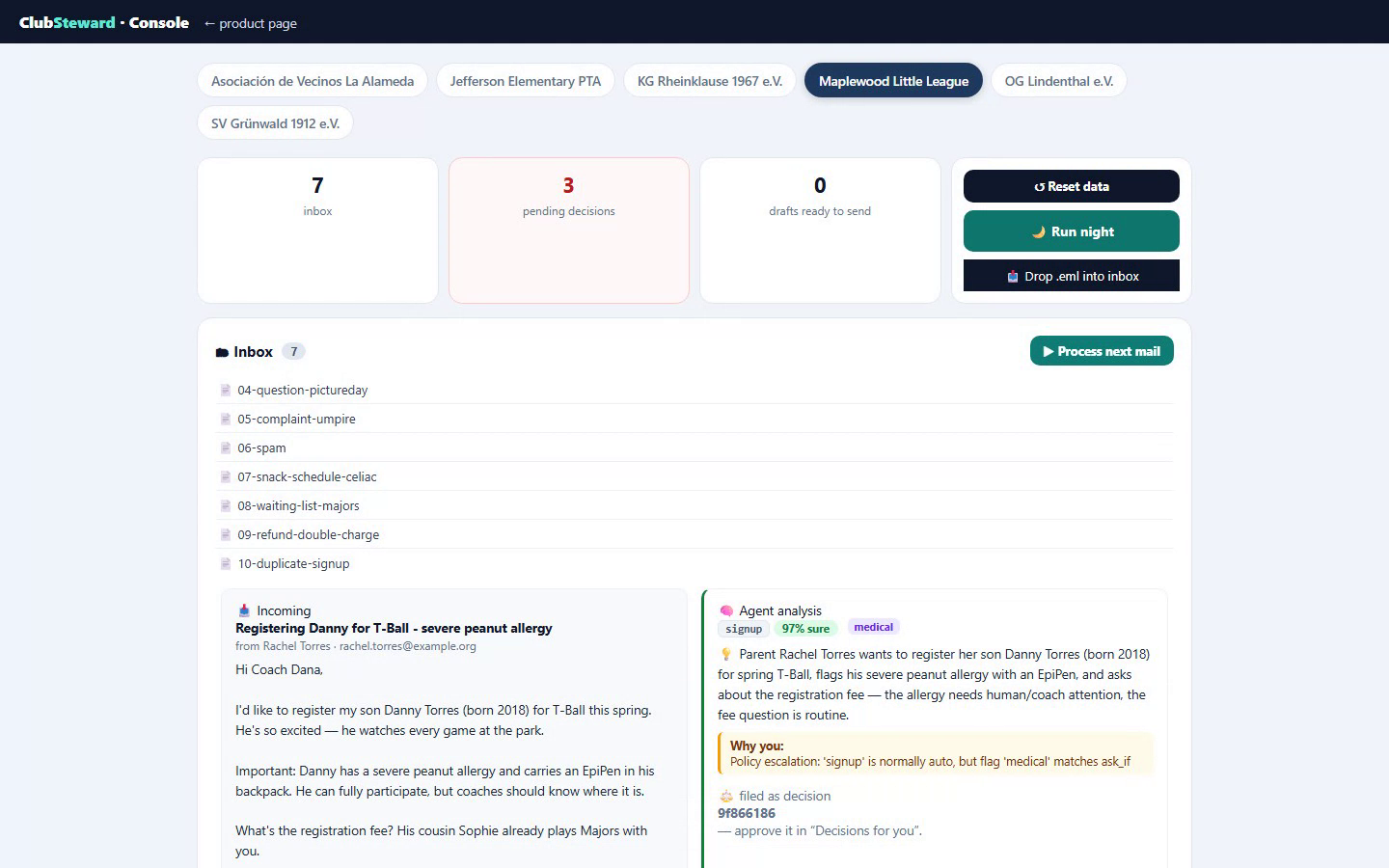
It escalates on conditions, not just intents: a plain sign-up runs automatically, but the same sign-up mentioning an asthma inhaler is flagged medical and stopped by the club's own ask_if policy rule. Six demo clubs ship in three languages (German, English, Spanish) — replies always arrive in the member's language, signed by the club.
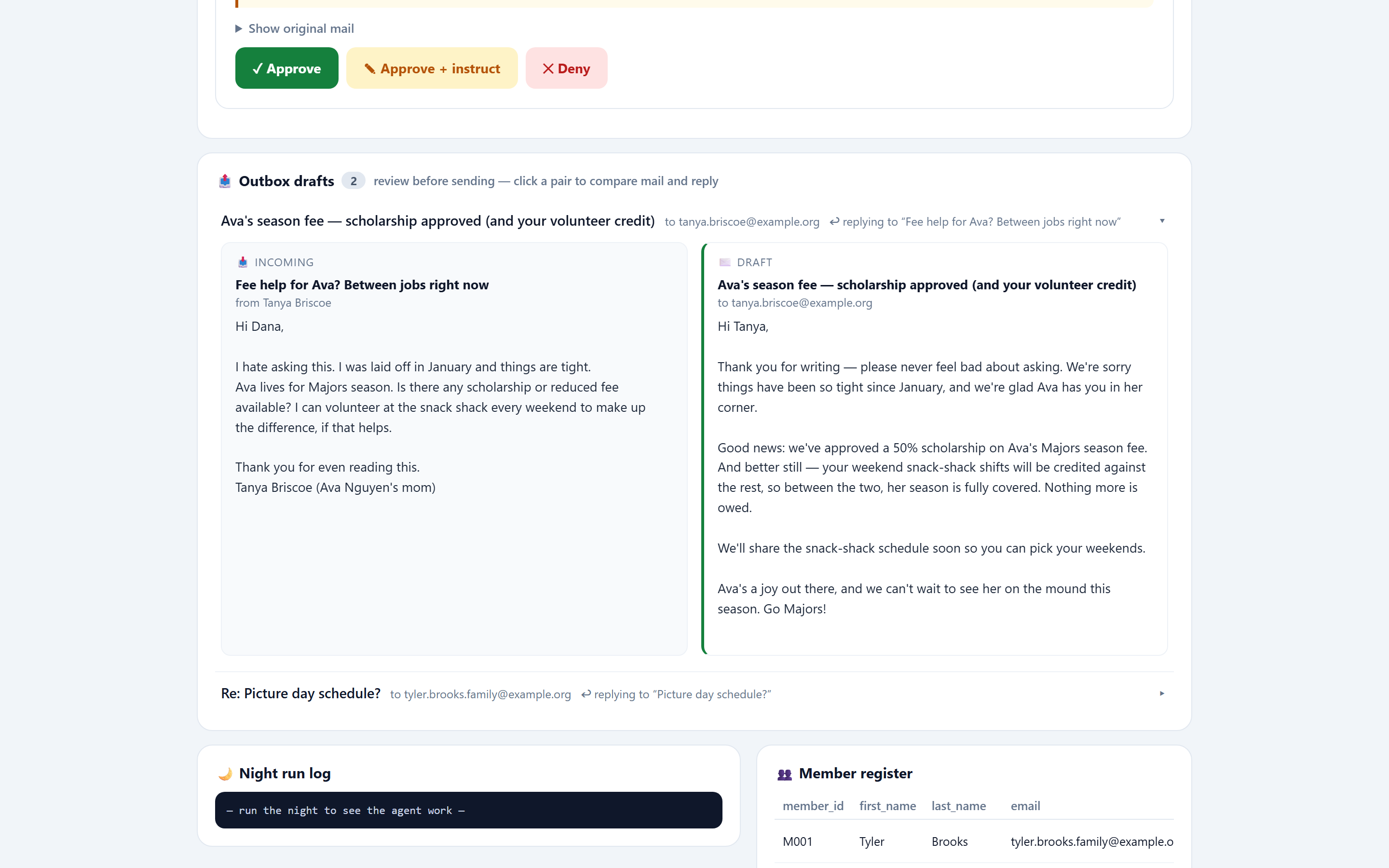
The web console is the secretary's morning: step through mails live (mail left, agent analysis right), approve with one instruction, review every draft side-by-side with the mail it answers. Nothing is ever sent automatically. A full night costs about one cent.
How we built it
- Strands Agents SDK (Python): two specialized agents — a Triage agent using
structured_output(Pydantic) and an Act agent with five custom tools — running inside the SDK's HumanInTheLoop intervention with a custom, policy-driven approval classifier. Read tools run free, writes need policy or a human, unknown tools fail closed. - Policy as data: the club's entire governance lives in a 30-line YAML file that drives routing (auto/ask/reject), the runtime approval classifier, and reply tone. Volunteers edit YAML, not code.
- Web console: FastAPI + vanilla JS, no build step — the same pipeline a judge can drive live with Reset data → Process next mail → Approve + instruct → Run night/Stop.
- GLM (Z.ai) via LiteLLM's OpenAI-compatible provider. No cloud, no accounts — runs on a laptop.
- Eval harness: a labeled 10-mail corpus regression-tests triage accuracy on every change.
- Replay mode: judges without an API key replay a recorded real session, clearly labeled as recorded.
Challenges we ran into
- Making "only ask a human when it matters" an engineered property, not a vibe: we solved it with three inspectable layers — policy route (auto/ask/reject), tool-category gating, and per-case context. The same YAML powers all three.
- The model was confidently wrong in both directions. A polite follow-up mentioning fee relief triaged as a mere "question" (our eval harness caught it — the fix is regression-tested). Another mail sat at 90% confidence on a partial address change: confidence alone wasn't enough, so we added condition flags (
ask_if: billing_address_unclear) andmin_confidence— below the threshold the agent asks instead of guessing. - Governance must speak the tenant's language: decision reasons are generated in the club's locale, so a German club's board reads "Warum du?" — policy transparency that a volunteer actually reads.
Accomplishments we're proud of
- The agent refuses to invent: it flagged a "brother already in the club" claim it couldn't verify instead of granting a sibling discount.
- Escalation is explainable to a non-programmer: every decision card shows the exact policy line that stopped the agent.
- A complete, honest product loop — overnight run → morning decision cards → updated register and outbox — for about one cent per night, fully local except the one LLM call.
What we learned
Autonomy is a spectrum you can data-drive. The hardest part wasn't making the agent capable — it was engineering the places where it must stop. For volunteer organizations, the policy file is the product: governance that a non-programmer can read, edit, and trust.
What's next for ClubSteward
- IMAP/SMTP adapters for real mailboxes (same pipeline, folder boundaries stay)
- Multi-club hosting with per-club policy files
- Optional managed runtime for clubs that don't want to run a laptop overnight
Built with
python, strands-agents-sdk, litellm, glm-5-turbo (z.ai), pydantic, fastapi, vanilla-js, uv
Built With
- glm-5.3-flash
- litellm
- pydantic
- python
- strands-agents-sdk
- uv


Log in or sign up for Devpost to join the conversation.