-
-
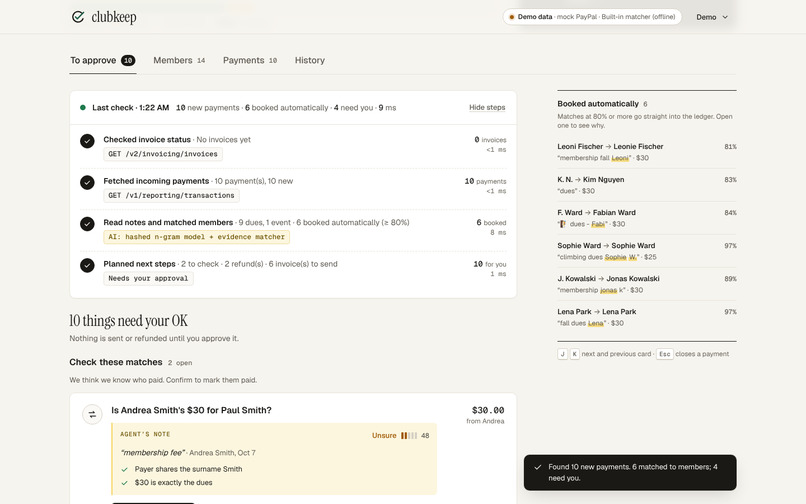
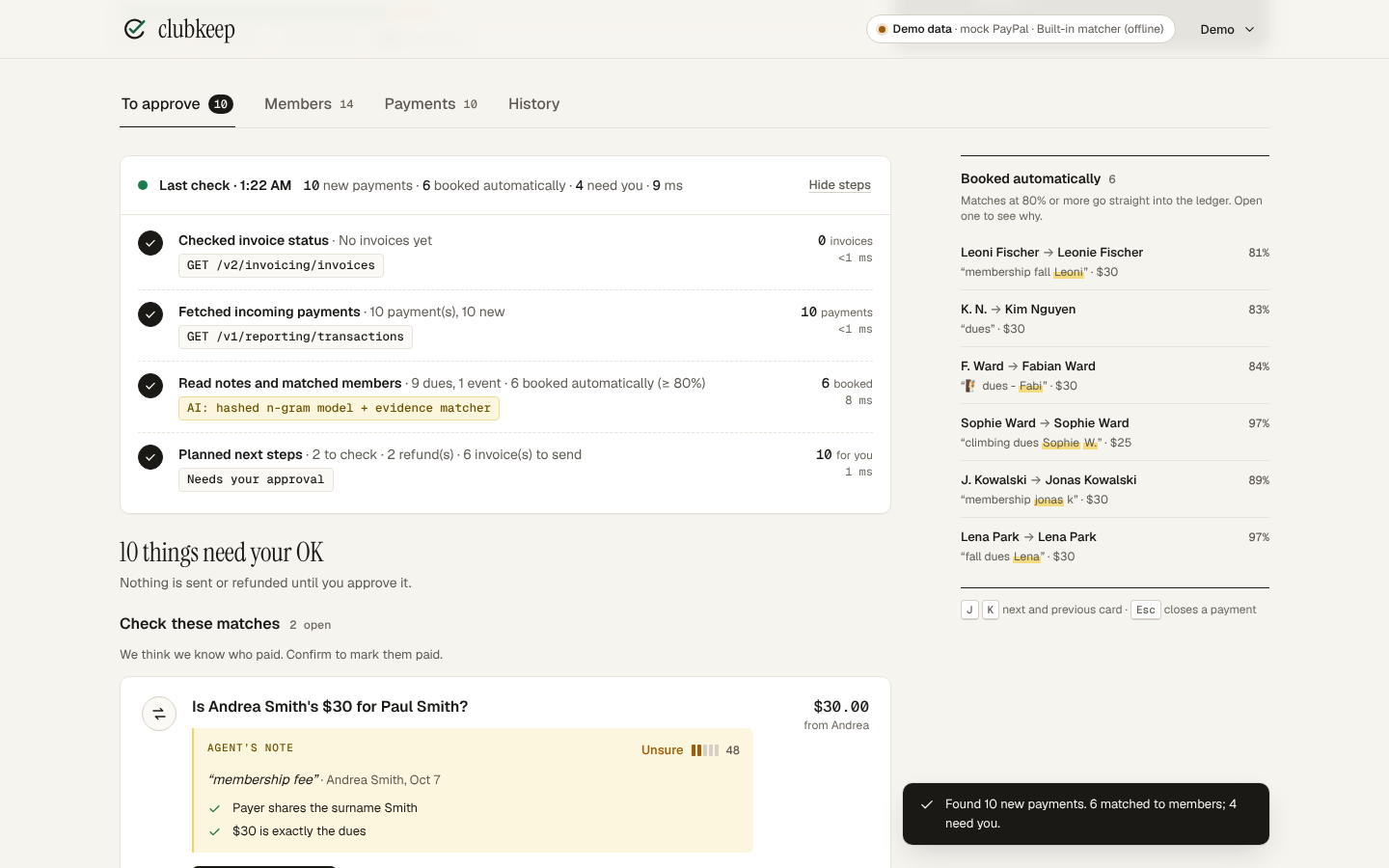
The approval inbox: refunds, invoices and unsure matches wait for one click from the treasurer.
-
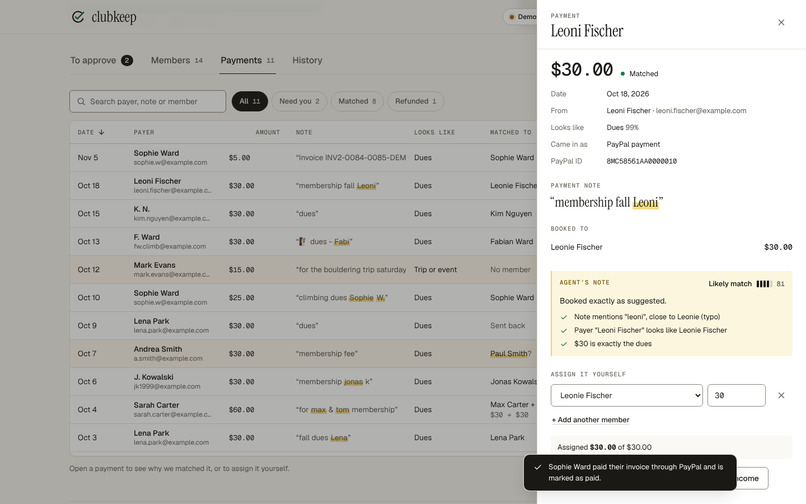
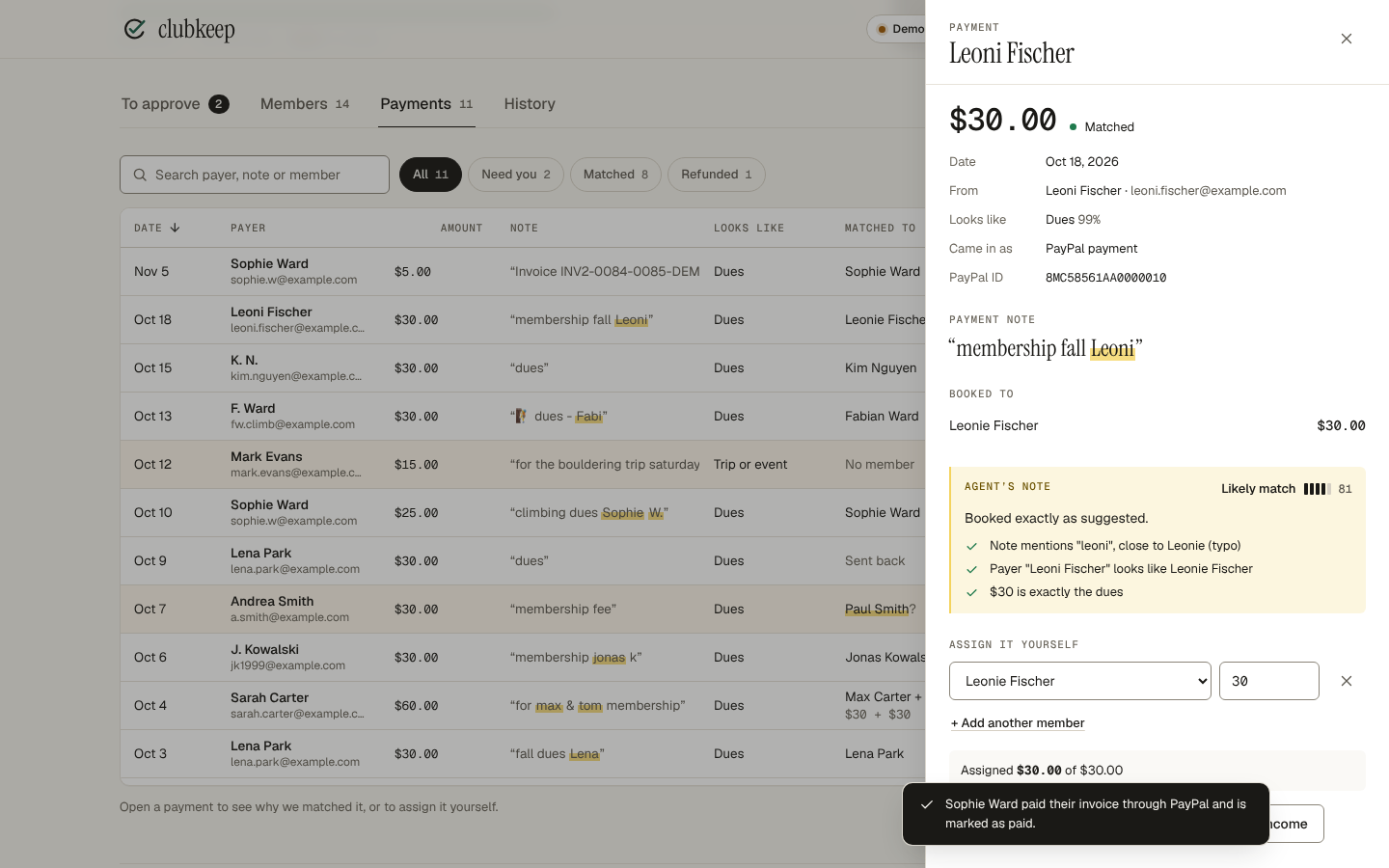
Every match shows its reasons: here the AI explains why a messy payment note belongs to this member.
-
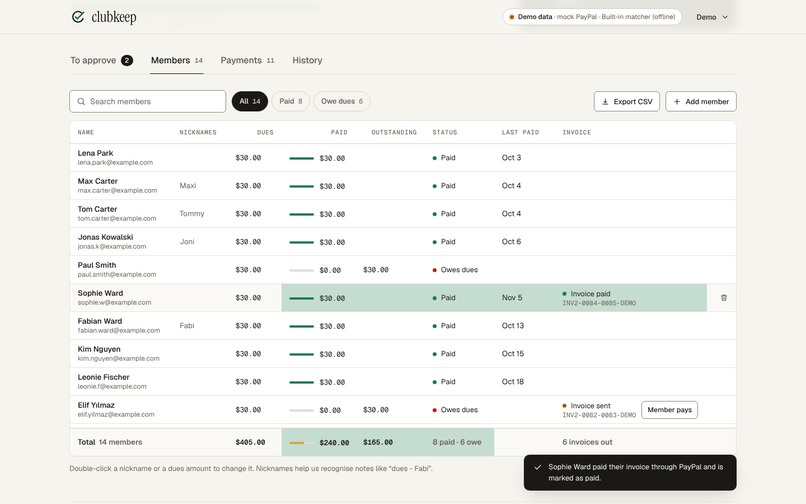
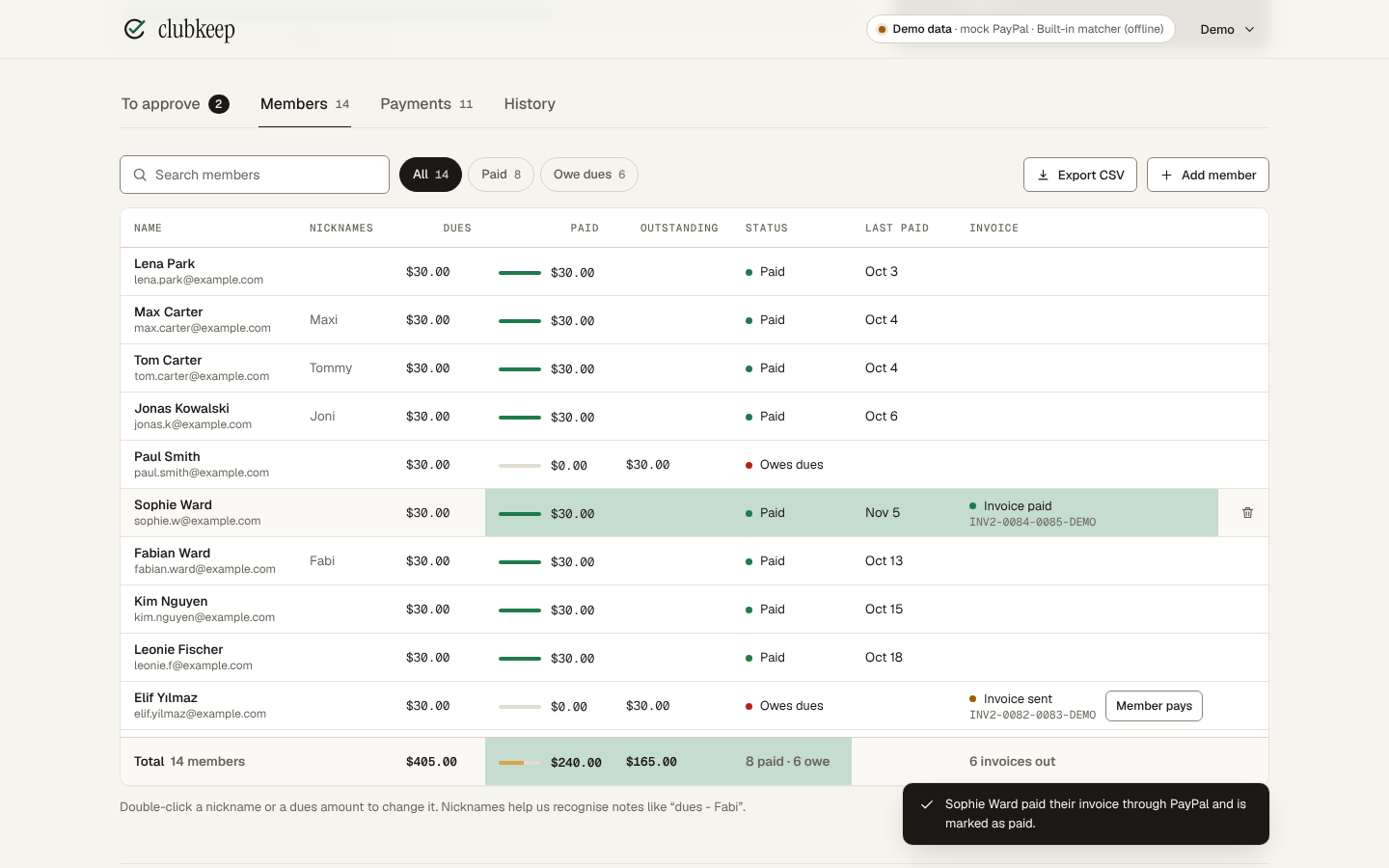
Members in AG Grid: who has paid, who still owes, and each member's PayPal invoice status.
-
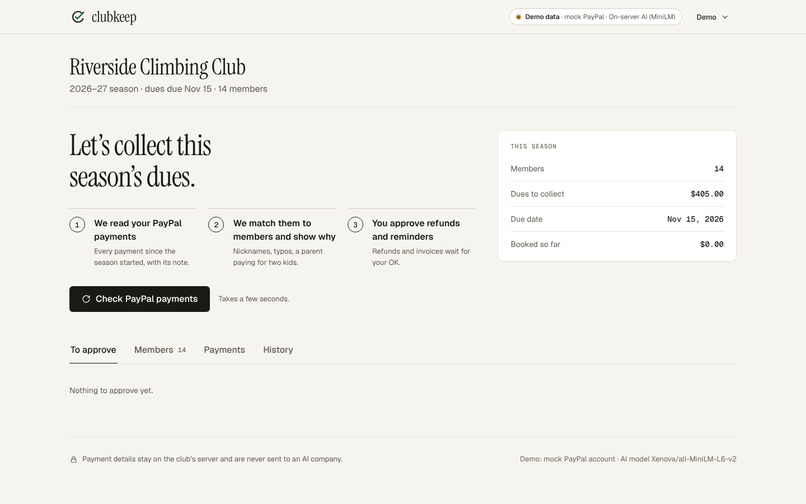
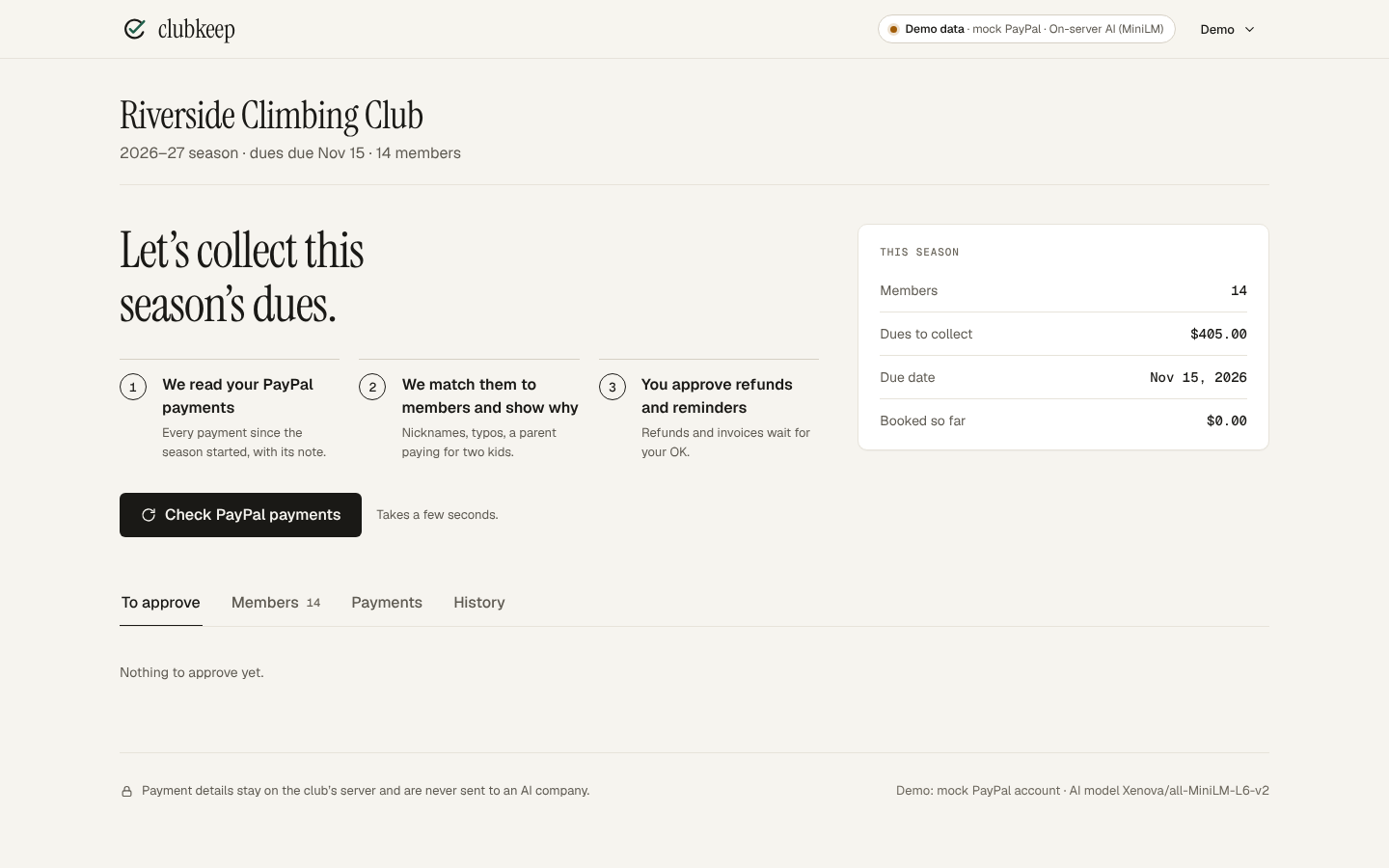
The start screen: 14 members, $405 in dues to collect, one button to check PayPal.
Inspiration
Anyone who has been treasurer of a club knows the start-of-season PayPal inbox. "for max & tom membership" from someone called Sarah. "🧗 dues - Fabi" from F. Ward. "dues" from K. N. The same $30 from Lena, twice. $15 from a stranger for the bouldering trip. You end up with PayPal in one tab, a spreadsheet in the other, and an evening gone.
Sports clubs, student clubs, choirs and community groups run on volunteers, and the treasurer job changes hands every year or two. We wanted the boring part to go away without handing member data to a paid AI service the club would never pay for anyway.
What it does
Clubkeep connects to a club's PayPal account and works through the dues for the current period:
- Syncs incoming payments from PayPal Transaction Search (a webhook endpoint can trigger the sync).
- Matches each payment to member(s) from the note, payer name and payer email, handling nicknames, initials, typos, parents paying for children, and one payment covering several members ($60 = two people's dues).
- Applies confident matches automatically and shows the reasons for each one. In the demo club, 6 of 10 payments are matched on the first run: "Fabi" is Fabian Ward, "Leoni" is Leonie Fischer, K. N. is Kim Nguyen by email.
- Asks when it isn't sure. Sarah Carter's $60 split between Max and Tom ("Note names 'max' and 'tom'", "Payer shares surname Carter") and Andrea Smith's "membership fee" for Paul Smith come back as match proposals.
- Detects what doesn't fit: duplicates, overpayments, underpayments, and payments that aren't dues at all.
- Proposes the fix as a PayPal action: a refund through Payments v2 (Lena's duplicate, Mark's trip money), or an invoice through Invoicing v2, sent to the member, with a reminder later (Sophie's missing $5, and everyone who hasn't paid).
- Waits for the treasurer. Every action that moves money is a proposal you approve, reject or edit. Approve all reminders in one click if you like.
- Shows everyone's status in AG Grid: paid, partial, unpaid, overpaid, outstanding amount, invoice status. Export to CSV.
It runs with no keys at all against a built-in mock PayPal, so the demo always works; with sandbox keys the same buttons hit the PayPal sandbox.
How we built it
- Backend: Node 20 and Express, a JSON file store with atomic writes, and a treasurer agent that runs sync -> match -> auto-apply -> propose -> execute on approval.
- PayPal: a client interface with two implementations. The sandbox client handles OAuth2, Transaction
Search (
/v1/reporting/transactions), Invoicing v2 (create, send, remind, list for status), Payments v2 capture refunds and webhook signature verification. The mock implements the same methods in memory, plus demo helpers for simulating a payment or an invoice being paid. - AI: transformers.js running
Xenova/all-MiniLM-L6-v2locally on CPU for English sentence embeddings (payment vs. member similarity, and the note's intent: dues, event, donation, other). The quantized model is about 23 MB, small enough for Render's free 512 MB instance. On top sits a transparent scoring engine: typo-tolerant name and nickname matching, initials, payer email, shared surnames and dues arithmetic, producing allocations with a confidence score, reasons and alternatives. A hashed character n-gram embedder is the offline fallback and is used in tests. - Frontend: plain JavaScript single-page app with AG Grid Community for the members and payments grids, a review queue and an activity log.
- Deploy: Render free tier via
render.yaml. - Tests:
node:testwith a fake embedder and the mock PayPal client. - Demo video: recorded from the running app with Playwright, with the picture timed to each sentence of
the narration. The voice is AI-generated with Kokoro-82M, an open-source (Apache-2.0) text-to-speech model
run offline through
kokoro-onnx.
Challenges we ran into
- Splitting one payment across several members. Matching is easy when it's one-to-one. "for max & tom membership" from a parent needs the names in the note, the shared surname and the amount to agree before you can confidently allocate $30 + $30.
- Knowing when not to be confident. A wrong auto-match is worse than no match. Andrea Smith paying "membership fee" probably means Paul Smith, but "probably" isn't good enough to book it. We spent real time on the threshold and on making the reasons visible, so the treasurer can trust the green rows and focus on the rest.
- Transaction Search latency in the sandbox. New transactions aren't searchable immediately, which is awkward for a live demo. The mock client with the same interface let us build and demo the full flow while the sandbox caught up.
- Free AI that's good enough, on a free server. No paid API was a hard constraint, and the model has to fit next to the app in 512 MB. A small embedding model alone isn't enough for names and nicknames, so the scoring engine does the precise work and the model handles the fuzzy language.
Accomplishments that we're proud of
- The AI doesn't stop at a suggestion: approve a proposal and a real PayPal refund or invoice goes out.
- Every automatic decision explains itself in plain language.
- It costs nothing to run: no paid AI API, free hosting tier, open source.
- The full demo works with zero setup, and the same code path runs against the PayPal sandbox.
What we learned
- For money, explainability beats cleverness. A treasurer will accept "$60 = $30 + $30, surname Carter" much faster than a bare confidence score.
- A small local embedding model plus hand-written scoring rules can cover a narrow domain well, without an LLM.
- PayPal's REST APIs cover the full loop a treasurer needs (read, refund, invoice, remind, notify), so the product can act instead of just reporting.
- Building against a mock with the exact same interface as the real client made the sandbox integration a configuration change rather than a rewrite.
What's next for Clubkeep
- Try it with real club treasurers and tune the matcher on what they actually receive.
- Bank-transfer import next to PayPal, since many clubs get dues both ways.
- PayPal Subscriptions for recurring dues and Payouts for reimbursing members' expenses.
- Remember the treasurer's manual corrections as aliases for next time.
- A handover report for the next treasurer and the annual audit.
- Other languages, in the interface and through an optional multilingual model.
Built With
- ag-grid
- css3
- express.js
- html
- hugging-face
- javascript
- node.js
- paypal
- paypal-rest-api
- paypal-webhooks
- transofrmers.js
