-
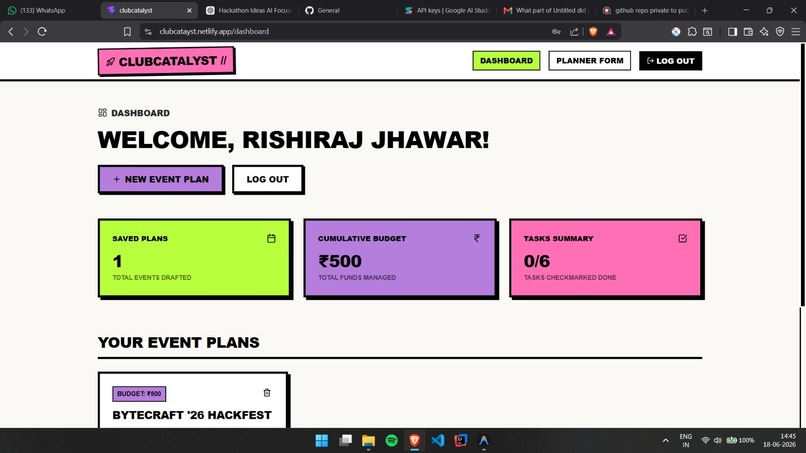
Screenshot of dashboard
Inspiration
Running a university club is incredibly rewarding, but the operational overhead is massive. Student leaders spend dozens of hours doing grunt work: drafting event proposals, calculating tiny budget line-items, sourcing corporate sponsors, writing cold emails, and assigning tasks across volunteer teams. This administration distracts from the core mission: building community.
We created Club Catalyst to act as an automated, AI-powered "Chief of Staff" for student organizations. We wanted to build a unified event-workspace generator that transforms a simple event prompt into a structured, executable blueprint in seconds, giving student leaders their time back.
What it does
Club Catalyst is a full-stack, AI-driven event workspace generator and project management application built for student clubs.
When a user provides an event name, target audience, budget, and description, Club Catalyst coordinates with Google Gemini 1.5 Flash to instantly generate:
- Interactive Timelines: Phase-by-phase chronological tracking of tasks from pre-planning to post-event.
- Granular Budget Calculators: Proportional breakdown of allocations (venue, decor, catering, marketing) mapped to the user's budget.
- Sponsorship Matchmakers & AI Pitch Writers: A matching engine that finds potential brand sponsors based on the event's theme and generates highly-personalized cold emails using Gemini.
- Actionable Tasks Kanban: Complete lists of tasks with on-demand AI sub-step generation (e.g. clicking a task like "Book Venue" generates the exact phone call checklist and vendor form requirements).
- Risk Mitigation Matrix: Pre-emptively identifies potential points of failure (weather, low turnouts, technical issues) and provides actionable mitigations.
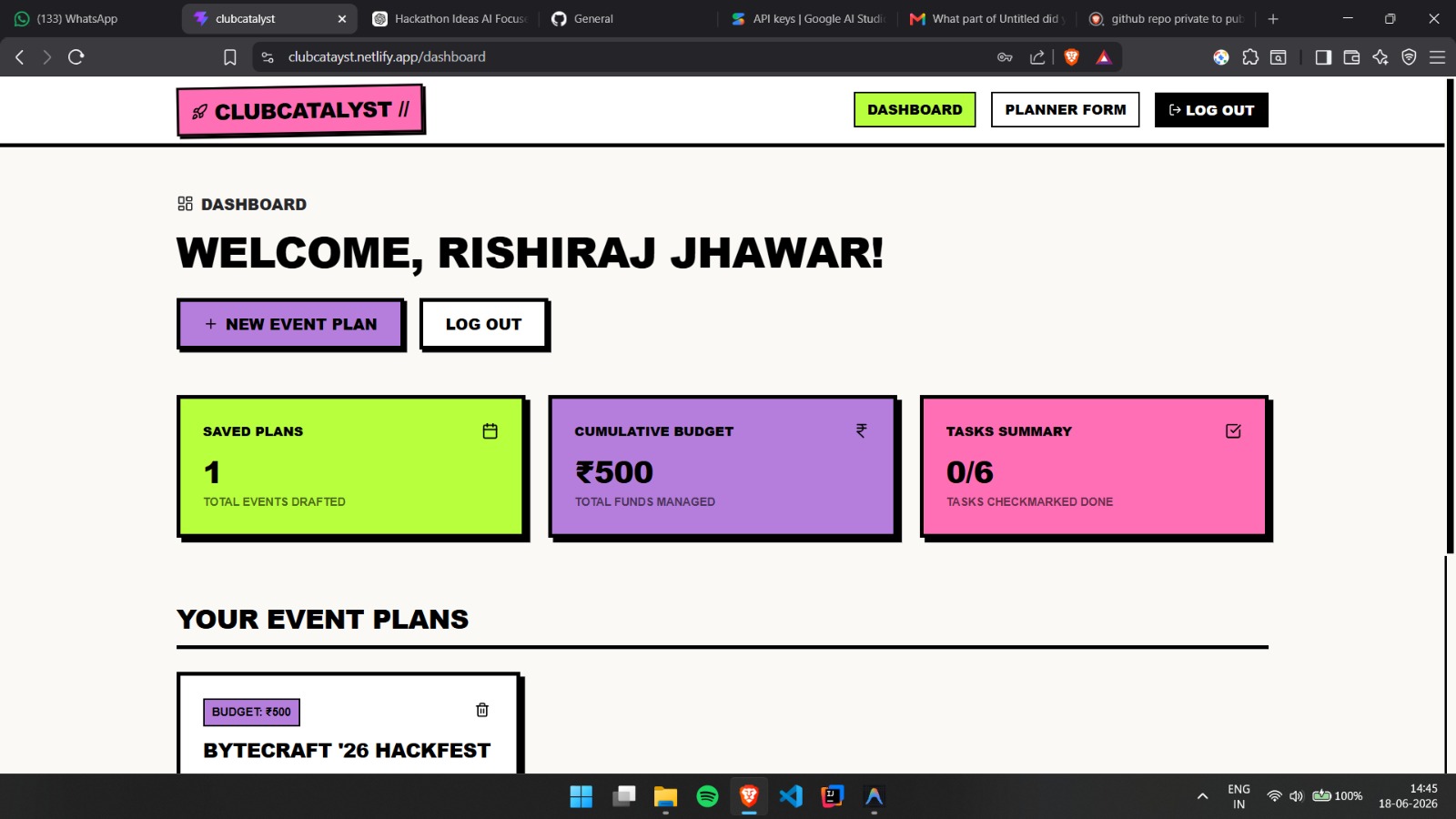
Student leaders can save multiple events in their customized Firebase-backed dashboard or test the system immediately using an Evaluation Guest Bypass.
How we built it
We developed Club Catalyst using a modern, reactive stack designed for maximum responsiveness:
- Frontend: Built with React (Vite scaffold) and styled with raw, vibrant Neo-brutalist CSS (enhanced by Tailwind CSS) for a highly aesthetic, game-like, premium user interface.
- AI Engine: Integrated Google Gemini 1.5 Flash directly on the client side using the
@google/generative-aiSDK, structured with custom system prompts to output highly structured JSON data. - Backend & Database: Utilized Firebase Firestore to securely store, retrieve, and update event plans and custom tasks.
- Authentication: Set up Firebase Auth supporting secure email/password and Google login, coupled with a local mock session engine for guest evaluations.
- Icons & Motion: Leveraged Lucide React for micro-interactions and Framer Motion for smooth state transitions.
Challenges we ran into
- CDP/Browser Sandbox Limitations: During testing, we encountered limitations with remote automated browser environments, requiring us to be extremely rigorous about writing robust, error-tolerant local environments.
- Deterministic JSON Parsing from LLMs: Getting AI to consistently return parsed JSON containing arrays of tasks, budgets, and sponsorship suggestions without syntax errors was tough. We solved this by implementing strict JSON schema enforcements and secondary fallback regex parsers to clean up markdown wrappers.
- Session Race Conditions: We fixed a subtle state synchronization issue where custom local guest sessions were racing with the Firebase Authentication observer, ensuring both real and mock auth states remain fully synchronized when loading pages.
Accomplishments that we're proud of
- End-to-End Blueprinting in 3 Seconds: Going from a blank screen to a fully itemized budget, timeline, cold email, and risk checklist in under three seconds.
- The "Evaluation Guest Bypass": Designing a flawless dual-mode authentication layout that lets judges/visitors bypass signup and instantly test all AI features using local mock sessions.
- Vibrant Neo-brutalist Aesthetic: Breaking away from standard boring enterprise tables and instead delivering a visually bold, high-contrast, premium dark/light mode experience.
What we learned
- Local Fallback Design: Designing a project with dual-modes (real Firebase + client-side LocalStorage mocks) is incredibly helpful for demoing, debugging, and ensuring the application functions offline.
- Tailwind v4 Integration: Configuring Tailwind CSS v4's new zero-config Vite plugin showed us how lightning-fast modern bundling pipelines have become compared to older PostCSS setups.
- Dynamic Context Prompting: Structuring prompts to feed real-time user-defined categories (like a student budget size or event theme) dynamically changes the tone of the generated sponsorship pitches.
What's next for Club Catalyst
- Collaborative Workspaces: Real-time multi-user editing in Firestore so different club members can cross off tasks on the same board simultaneously.
- Sponsor Outreach Hub: Integrating an email API (like Resend) to let users send the generated Gemini sponsorship pitches directly from the app interface and track replies.
- Budget Exporting: Enabling one-click exports of the generated budgets to CSV/Excel so club treasurers can instantly submit proposals to university funding boards.

Log in or sign up for Devpost to join the conversation.