💡 Inspiration
Cloud bills are unpredictable. Companies waste thousands of dollars every month on idle VMs, oversized servers, and storage nobody uses — and they don't even know it's happening.
We wanted to build something that acts like an intelligent cost watchdog — one that doesn't just show a dashboard but actually tells you what's wrong and what to do about it.
The idea of applying real Machine Learning to a real business problem — not just a toy dataset — is what drove us to build CloudOptix.
🤖 What it does
CloudOptix is an AI-powered cloud cost optimization platform that:
- 📊 Monitors cloud resource usage across AWS, GCP, and Azure
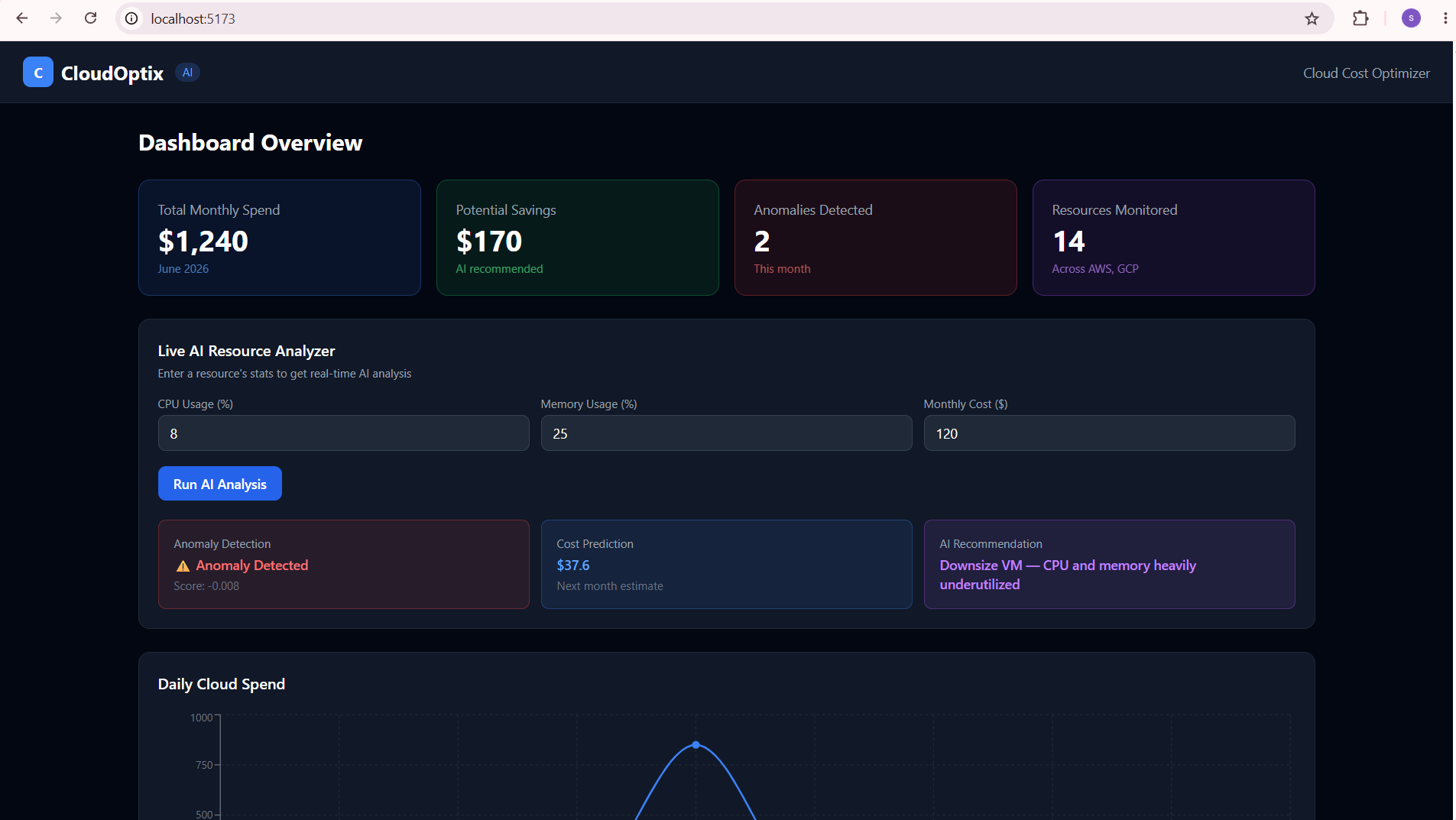
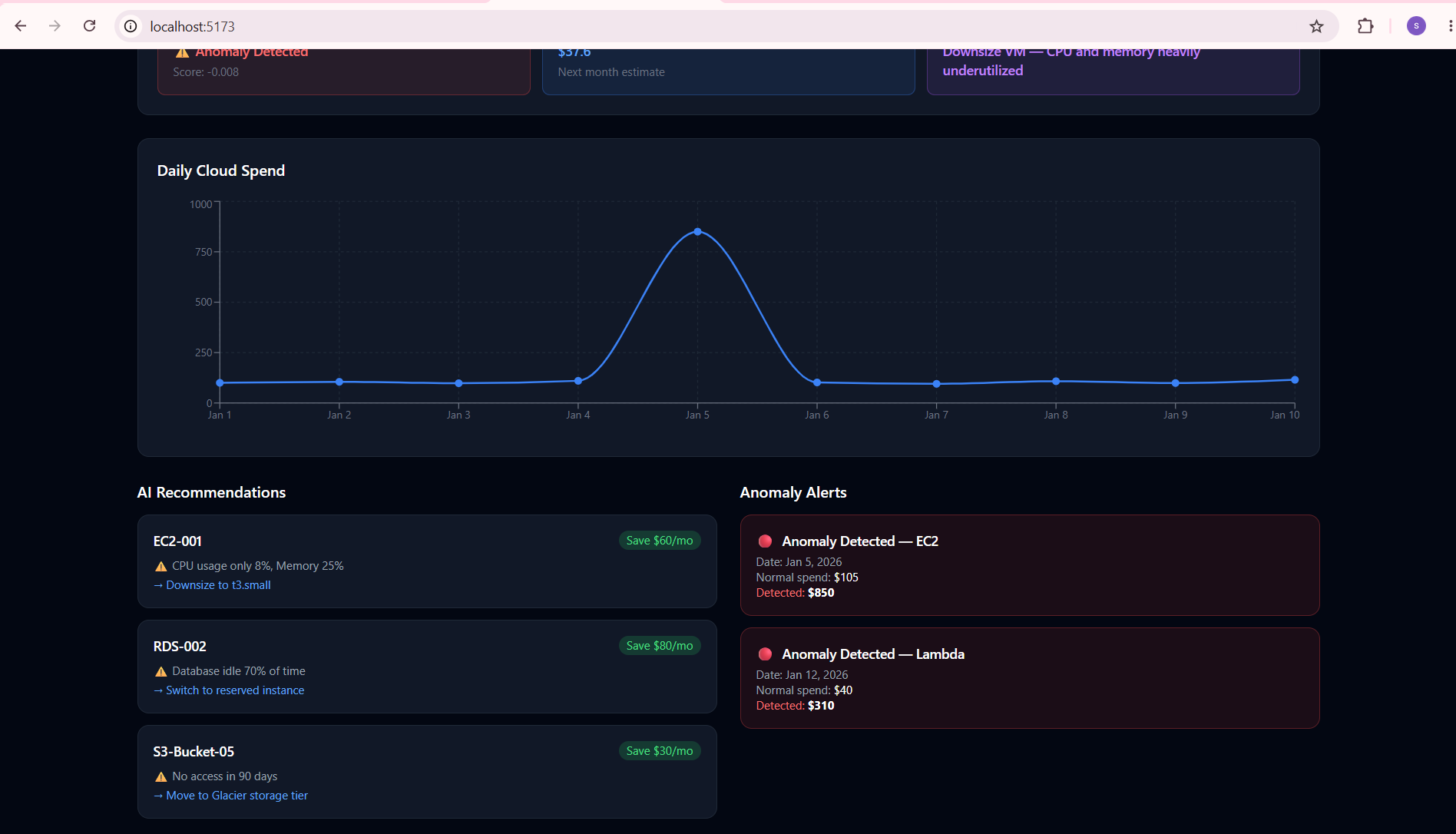
- 🔴 Detects unusual spending spikes using Isolation Forest anomaly detection
- 📈 Predicts next month's cloud bill using Linear Regression
- 💡 Gives actionable recommendations like "Downsize this VM — save $60/month"
- ⚡ Provides a Live AI Analyzer — enter any resource stats and get real-time AI analysis instantly
🛠️ How we built it
We built CloudOptix as a three-layer full-stack system:
| Layer | Tech |
|---|---|
| Frontend | React + Vite + Tailwind CSS + Recharts |
| Backend | Node.js + Express REST APIs |
| AI Engine | Python + FastAPI + Scikit-learn |
AI Models
Anomaly Detection using Isolation Forest:
$$\text{anomaly score} = -\mathbb{E}[h(x)] / c(n)$$
where $h(x)$ is the path length and $c(n)$ is the average path length of unsuccessful searches in a Binary Search Tree.
Cost Prediction using Linear Regression:
$$\hat{y} = \beta_0 + \beta_1 x_1 + \beta_2 x_2 + \beta_3 x_3 + \beta_4 x_4$$
where $x_1$ = CPU usage, $x_2$ = memory usage, $x_3$ = storage GB, $x_4$ = network GB.
We generated a synthetic dataset of 1000 cloud billing records with 30 injected anomalies to train and test our models.
The three layers communicate in real time:
🚧 Challenges we ran into
- Getting three servers to communicate reliably across Render and Netlify — CORS policies, environment variables, and cold start delays caused unexpected failures
- Setting up Python virtual environment on Windows with Git Bash caused multiple dependency and path conflicts
- Tuning the Isolation Forest contamination parameter to correctly identify anomalies without overfitting
- Managing pip package hash mismatch errors on a restricted network
- Ensuring
.envvariables on Render override local config correctly
🏆 Accomplishments that we're proud of
- ✅ Built a genuine ML pipeline running in production — not a hardcoded demo
- ✅ Isolation Forest correctly detects cost spikes with real anomaly scores
- ✅ Linear Regression predicts monthly costs from resource usage features
- ✅ Full stack deployed live — Python on Render, Node on Render, React on Netlify
- ✅ Live AI Analyzer returns real-time predictions in under 2 seconds
- ✅ End-to-end system built and deployed in under 3 days
📚 What we learned
- How to architect and deploy a multi-service system where JavaScript and Python communicate in production
- How Isolation Forest contamination rate affects anomaly sensitivity
- How Linear Regression performs on synthetic time-series cost data
- The importance of environment configuration when moving from localhost to cloud deployment
- How to handle CORS, cold starts, and port binding in multi-cloud deployments
🚀 What's next for CloudOptix-AI
- 🔌 Connect to real cloud APIs — AWS Cost Explorer, GCP Billing API, Azure Cost Management
- 🗄️ Add MongoDB to store historical analysis and track savings over time
- 🔐 User authentication for multi-account team management
- 📊 Upgrade anomaly detection to LSTM for time-series forecasting:
$$h_t = \sigma(W_h \cdot [h_{t-1}, x_t] + b_h)$$
- 🔔 Slack and email alerts for real-time anomaly notifications
- ☁️ Multi-cloud cost comparison dashboard
Built With
- axios
- css
- express.js
- fastapi
- git
- mongodb
- netlify
- node.js
- numpy
- pandas
- python
- react
- recharts
- render
- scikit-learn
- tailwind
- uvicorn
- vite

Log in or sign up for Devpost to join the conversation.