-
-
Reroute
-
architecture
-
chat agent
-
mission
-
generate plan
-
session
Inspiration
I've watched people lose entire days at big conferences to one small, repeating chore: rebuilding their schedule. AWS re:Invent is the extreme version ~1,500 sessions across six Las Vegas venues, popular ones fill in minutes, and rooms can be a 20-minute walk apart. You arrive with a real goal ("get production-ready with AI agents") and spend the week reshuffling instead of learning. That's exactly the "Agents for Humans" problem: a routine, judgment-heavy task that quietly drains your time. I wanted an agent that does the busywork and only interrupts me when there's a genuine decision to make.
What it does
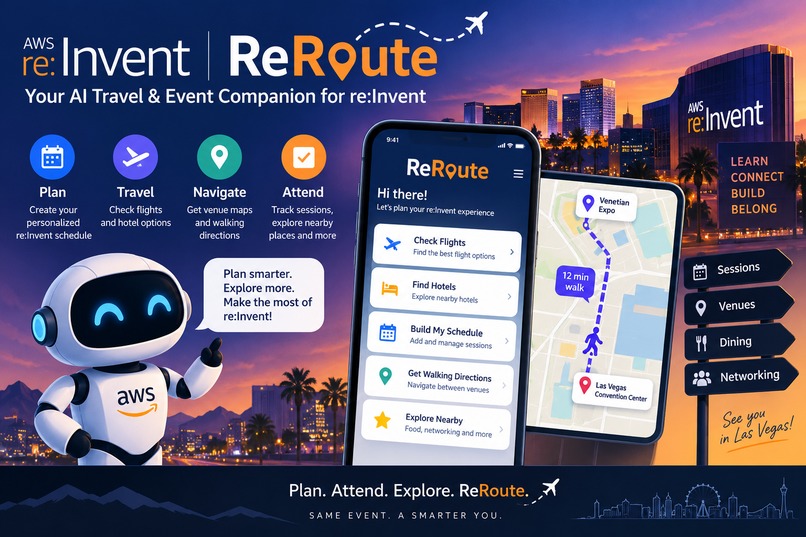
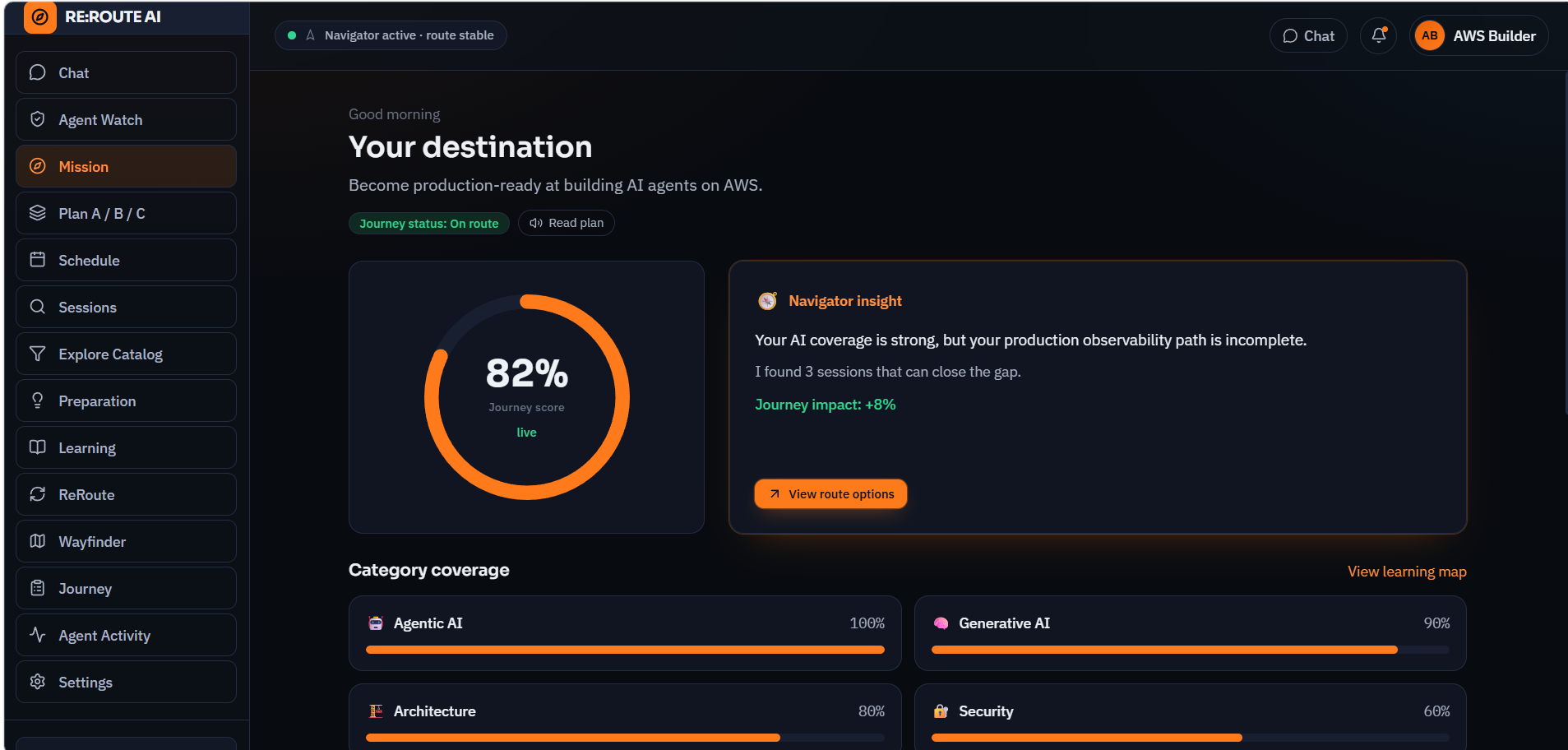
Re:Route AI turns a plain-language learning goal into a realistic, walkable re:Invent route, then keeps that route alive in the background.
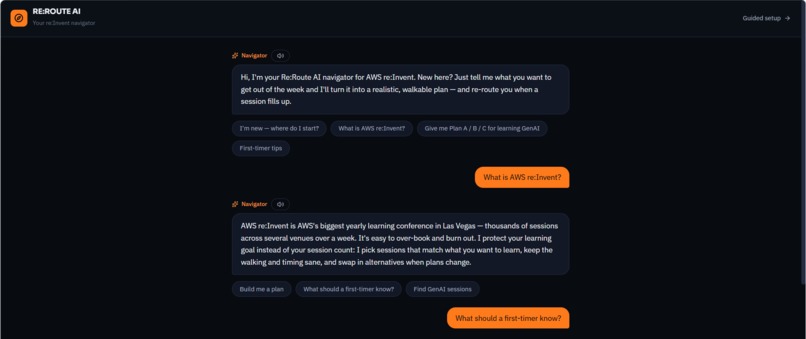
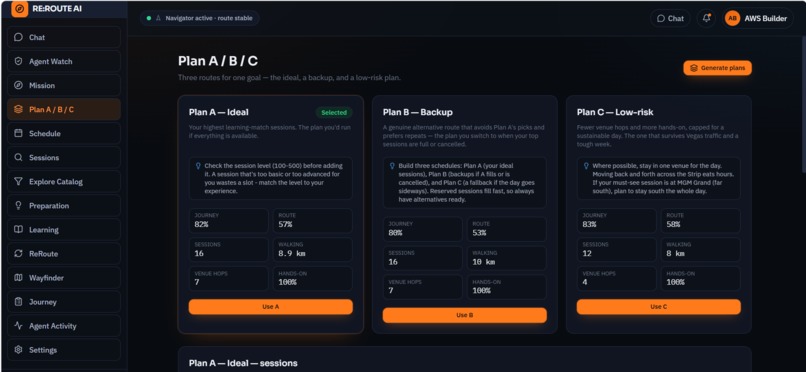
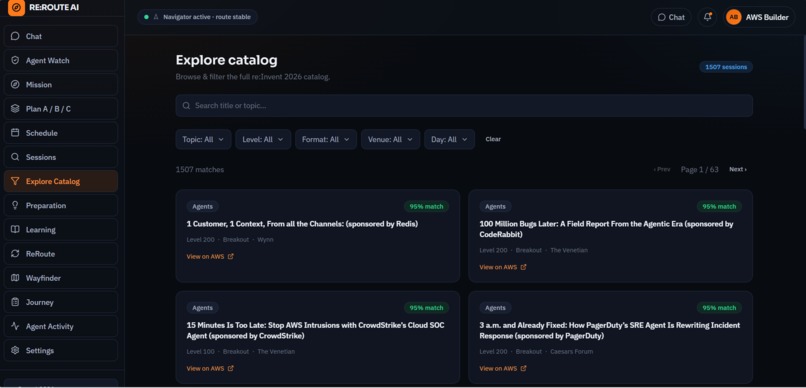
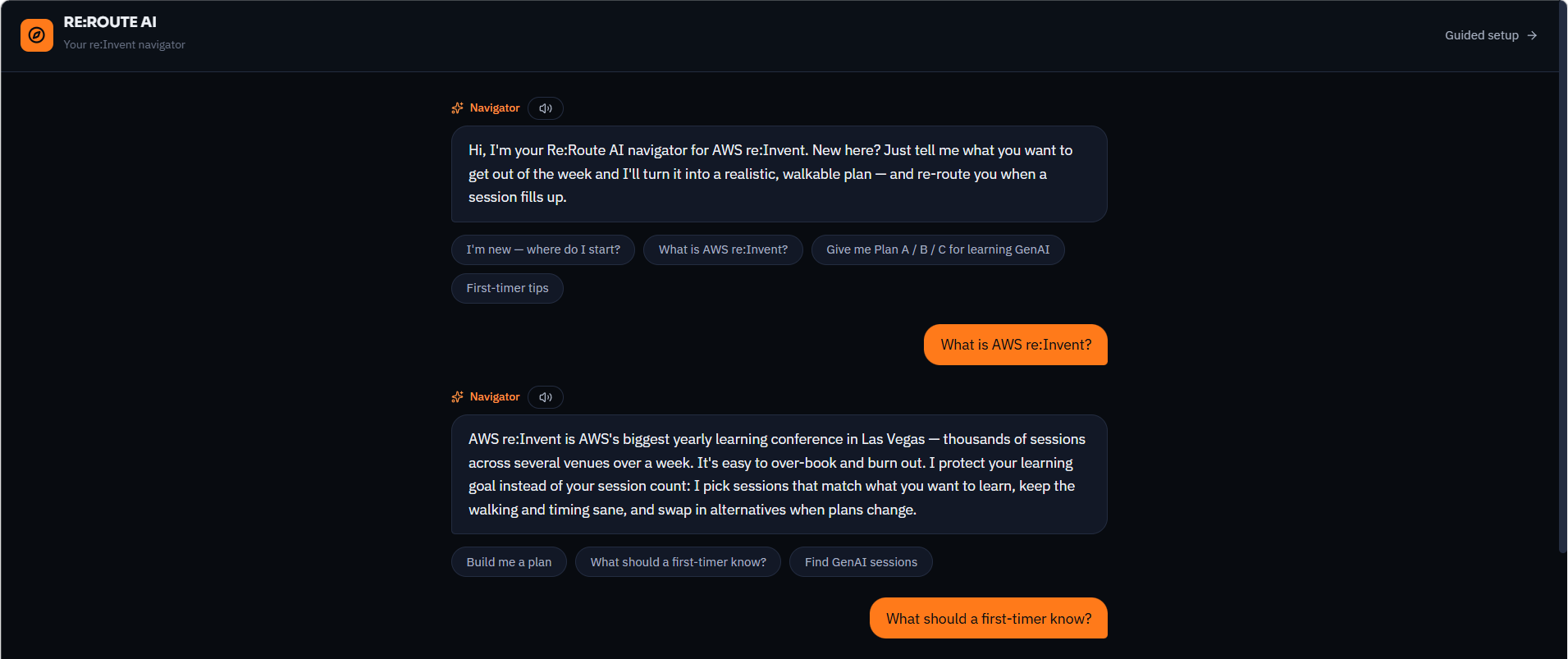
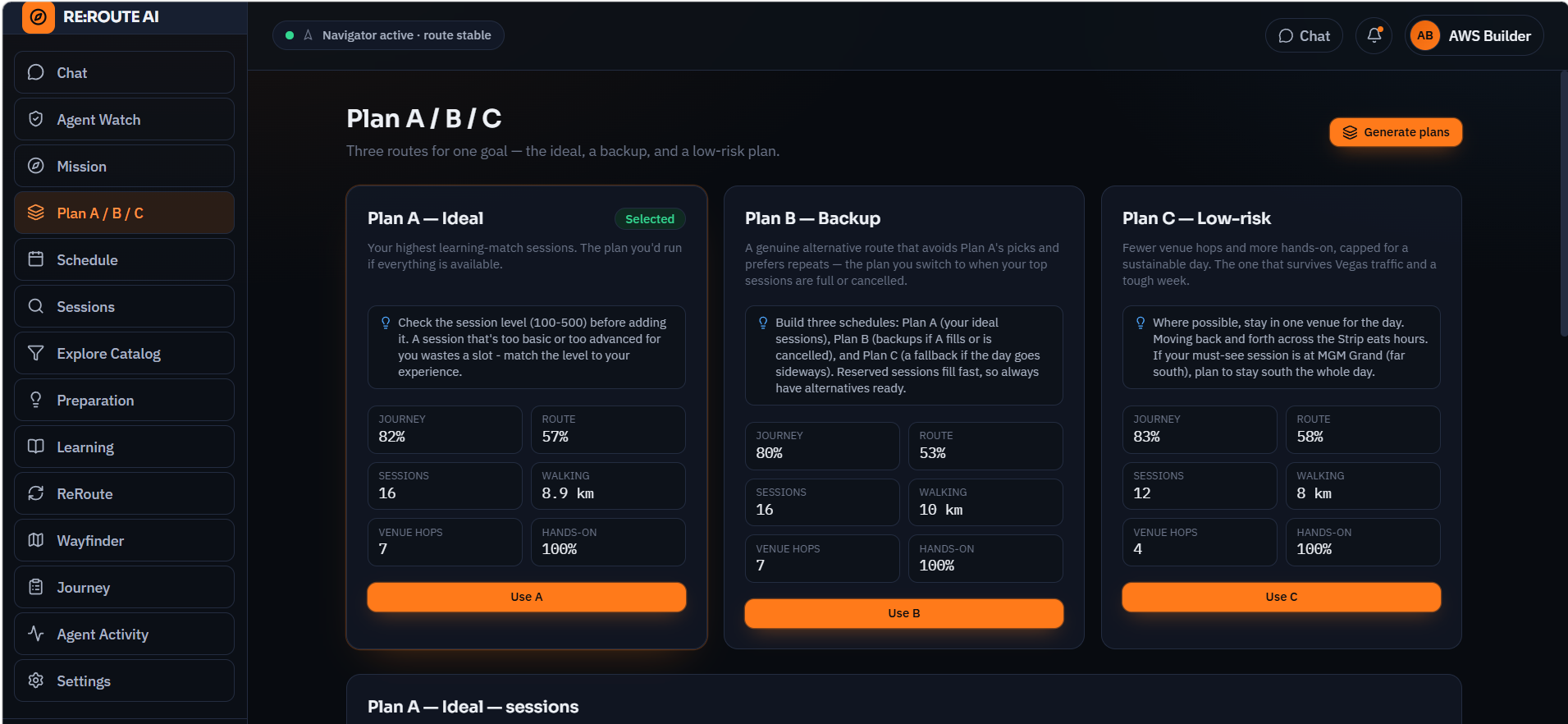
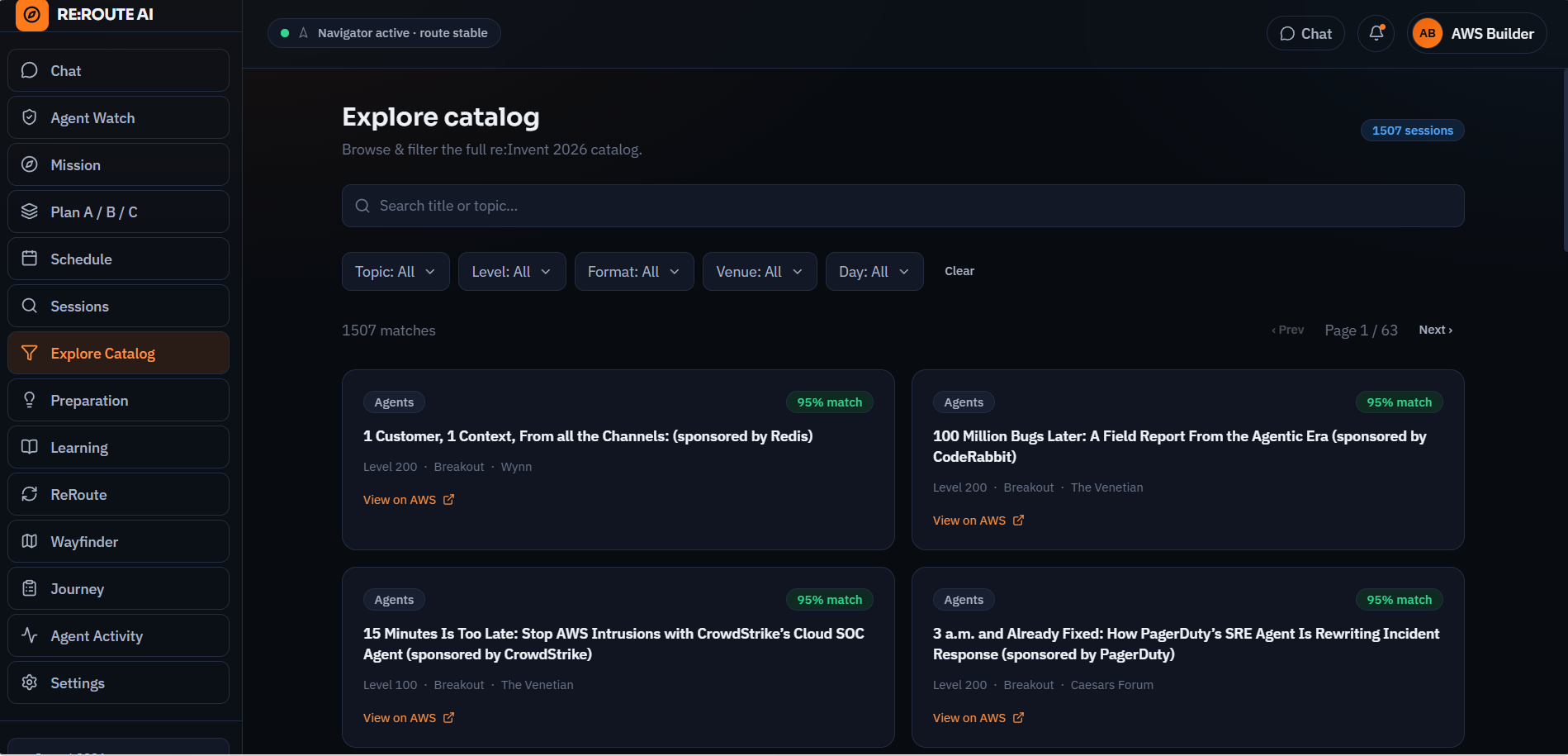
- Talk to it. You type a goal ("I'm new build me a plan for learning GenAI") and the agent explains, finds matching sessions from the real 1,500+ catalog, gives prep advice grounded in real attendee tips (RAG), and builds a conflict-free daily schedule or three ranked options: Plan A (ideal) / B (backup) / C (low-risk).
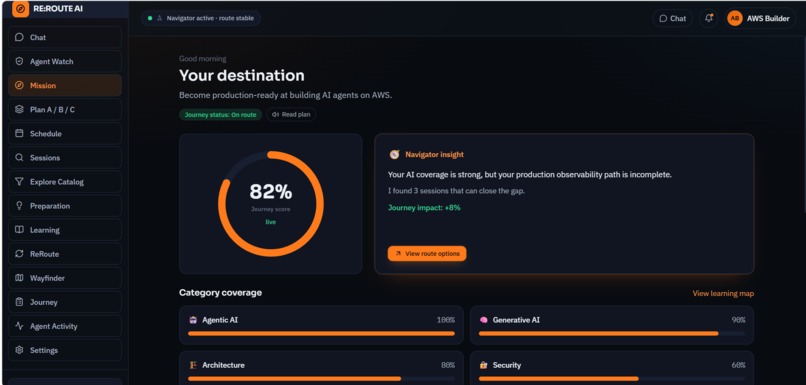
- Agent Watch - the heart of it. Once your plan exists, the agent stops being an app you babysit. It runs on a schedule, re-checking your route against changing conditions. It stays quiet while everything's healthy, and only surfaces when something changes a session fills up, a transition becomes infeasible arriving with the fix already worked out (ranked replacement sessions). You just approve or dismiss.
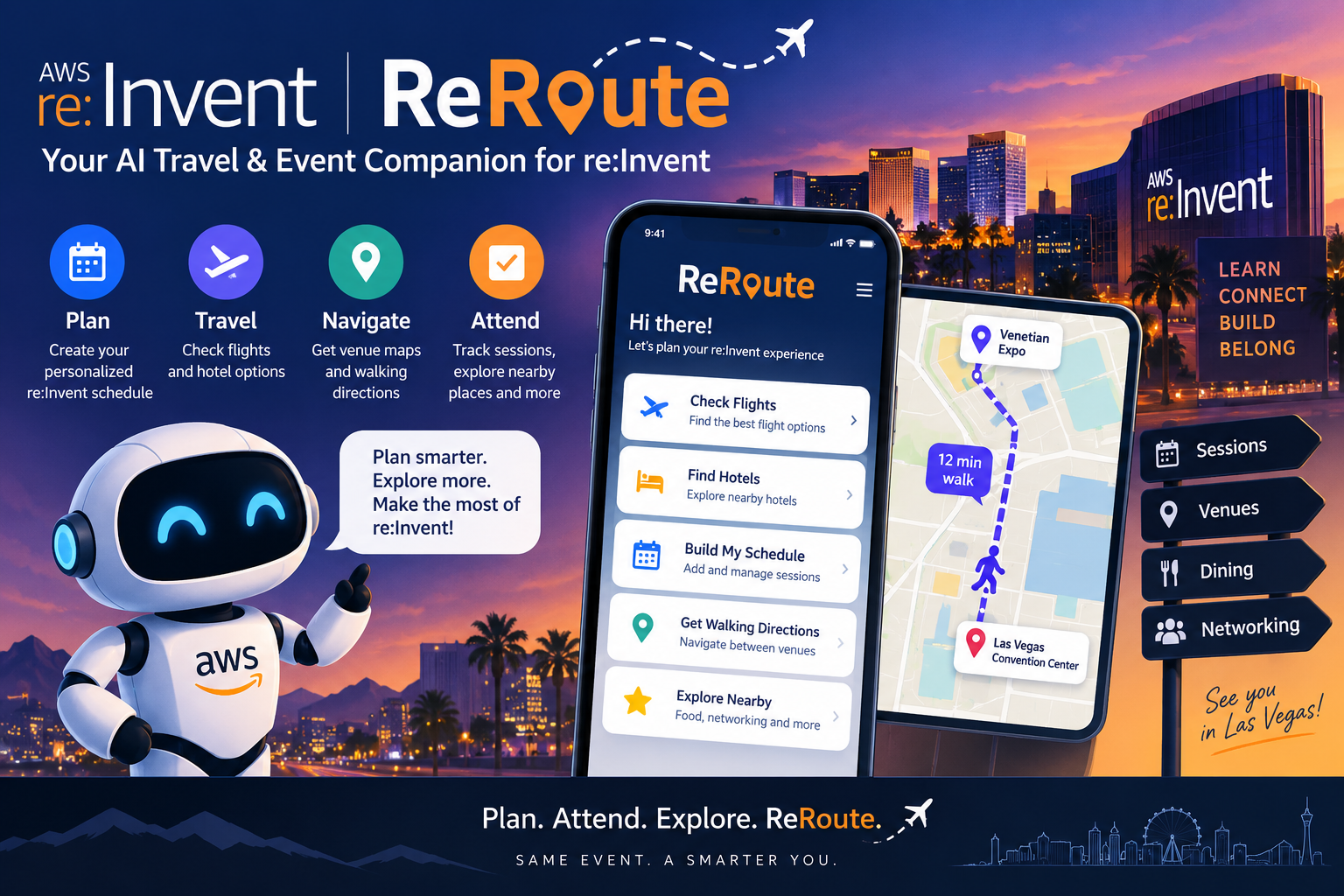
- Extras: real Google Maps walking directions between venues (Wayfinder), and "Read aloud" using Amazon Polly.
How we built it
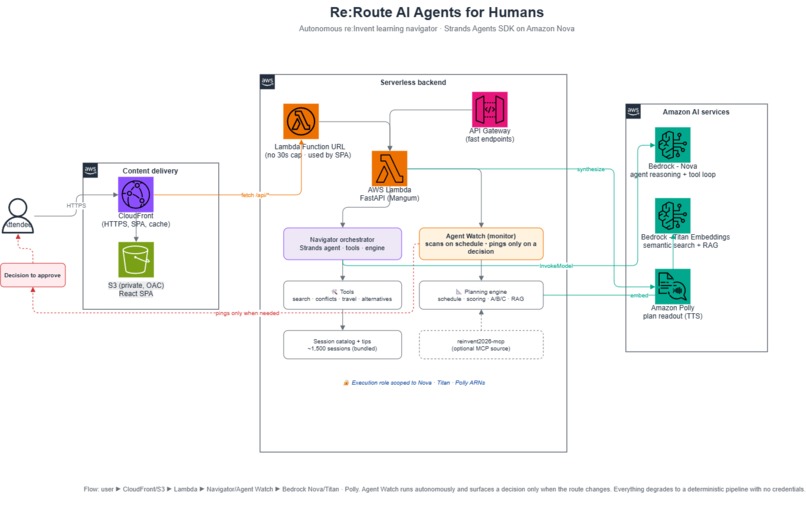
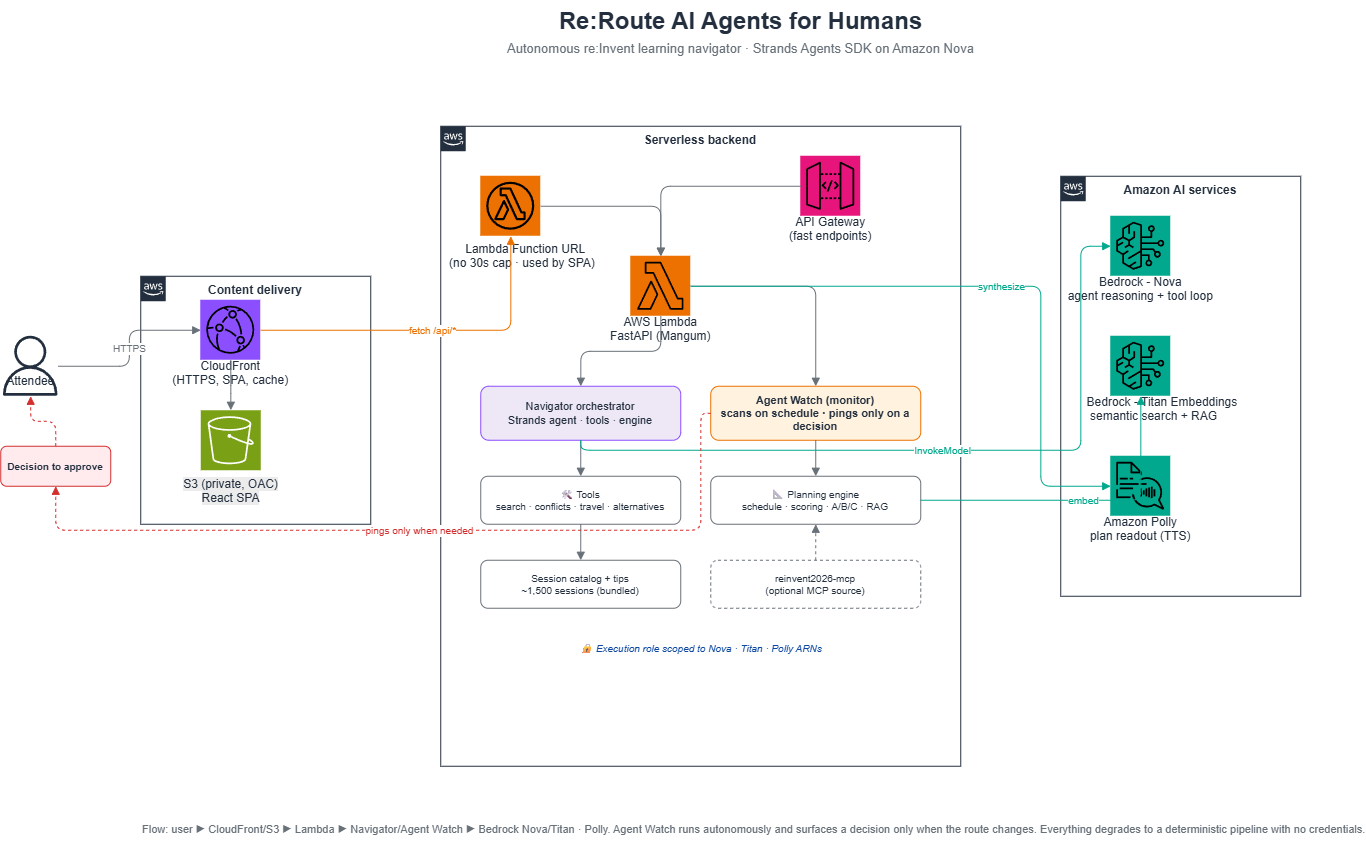
- Agent: a real
strands.Agent(Strands Agents SDK) backed by aBedrockModel, driving a tool-calling loop over@toolfunctions (search sessions, check conflicts, estimate travel, recommend alternatives) and returning typed Pydantic models viastructured_output. - AWS: Amazon Bedrock Nova for reasoning, Titan embeddings for semantic search + a RAG knowledge base, Amazon Polly for voice.
- Backend: FastAPI on AWS Lambda (via Mangum) behind both a Function URL (no 30s cap, for the agent loop) and an API Gateway HTTP API.
- Frontend: React 19 + TypeScript + Vite + Tailwind, hosted on S3 + CloudFront.
- Deployed with AWS SAM, with a least-privilege IAM role scoped to just the Nova/Titan/Polly ARNs. Everything degrades gracefully: with no credentials, the same tools run in a deterministic pipeline, so the app always works.
Challenges we ran into
- The empty-plan trap: the model sometimes returned a well-formed but empty structured plan — no error, just a blank UI. Fix: validate the content, not just the shape, and fall back to the deterministic pipeline.
- The 30-second cliff: API Gateway's 30s cap killed the Nova tool loop mid-plan. Added a Lambda Function URL (no cap) for the agent path.
- A CORS ghost: the Function URL's CORS and FastAPI's CORS both set the header, producing a duplicated, invalid one the browser rejected. Made FastAPI the single source on Lambda.
- Reframing for the theme: my first version was a great planner you drove which isn't the brief. Adding Agent Watch (with a baseline snapshot so it pings on changes, not pre-existing conditions) is what turned it into a true background agent.
Accomplishments that we're proud of
- A genuine Strands + Nova agent that does real end-to-end work, not a chatbot demo — and it's live on AWS.
- Agent Watch: an autonomous monitor that stays quiet and surfaces a pre-analyzed decision only when a human choice is truly needed. That's the "Agents for Humans" idea made real.
- It never breaks: deterministic fallback, honest
/api/healthreporting which path is live, and it works with zero credentials. - Real data (the actual re:Invent catalog), real maps, and real voice.
What we learned
- With structured LLM output, validate the content, not just the schema.
- The "surface only on a real decision" pattern is what separates a background agent from another app to manage and the trick is snapshotting a baseline so you alert on change, not on the current state.
- Serverless choices matter: Function URL vs. API Gateway wasn't cosmetic it decided whether the agent could finish at all.
- Designing for graceful degradation makes an agent demo-proof.
What's next for Re:Route AI
- Per-user persistence for the monitor and a real Amazon EventBridge schedule for the background scan tick.
- Explore Amazon Bedrock AgentCore for the agent runtime.
- Generalize the monitor pattern beyond conferences the "plan once → watch for change → surface a pre-analyzed decision" loop fits bill-pay, care scheduling, and volunteer logistics.


Log in or sign up for Devpost to join the conversation.