Inspiration Watching startups and enterprises bleed money on unnecessary cloud resources inspired CloudCost Guard. We saw that GCP cost overruns are a $14B annual problem, with companies overspending 30-40% on average. Most existing solutions are either too complex for startups or too expensive for SMBs. We wanted to build an AI-powered cost engineer that's accessible to everyone.
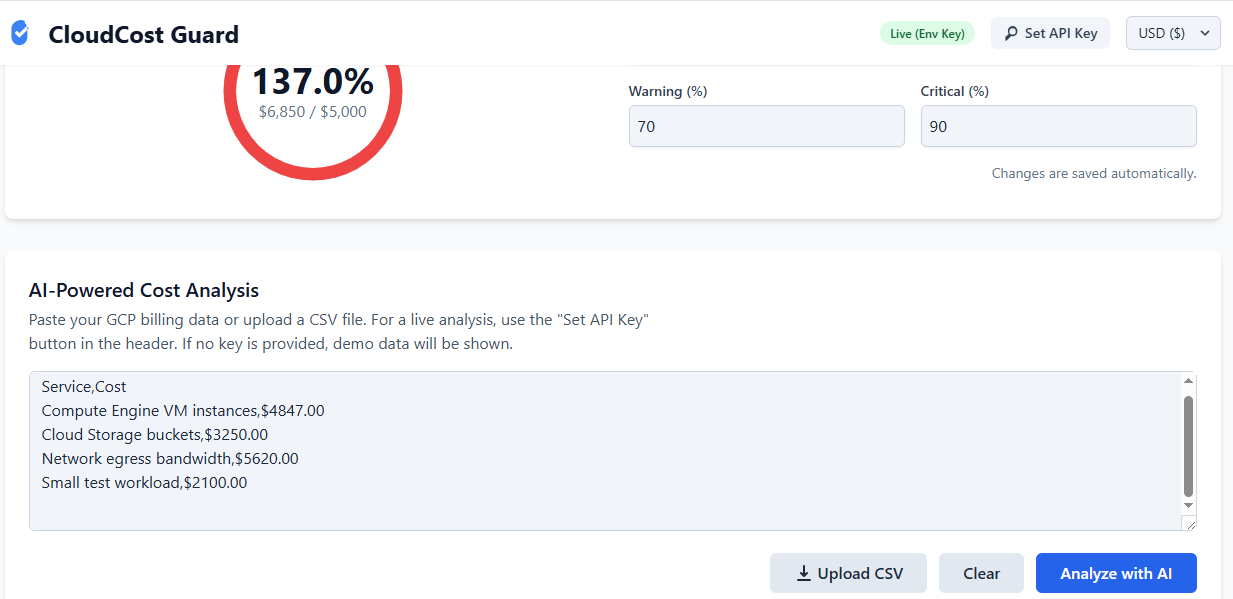
What it does CloudCost Guard acts as your 24/7 GCP cost optimization team. It analyzes your cloud spending using Google Gemini AI to identify waste, provides specific actionable recommendations with exact savings calculations, monitors your budget in real-time with customizable alerts, and forecasts future spending to prevent surprises. It turns complex billing data into clear, executable cost-saving strategies.
How we built it We built a modern microservices architecture deployed on Google Cloud Run:
Frontend: React 18 with TypeScript and Tailwind CSS for a responsive, professional UI
AI Engine: Google Gemini API for intelligent cost analysis and recommendations
Real-time Processing: Client-side analysis with fallback demo data for reliability
Data Visualization: Recharts for interactive spending charts and progress tracking
Deployment: Multi-service Cloud Run architecture with proper environment configuration
Challenges we ran into Gemini API Response Parsing: Initially struggled with inconsistent JSON formatting from AI responses, requiring robust fallback systems
Real-time State Management: Ensuring settings persisted across sessions while maintaining performance
Multi-service Coordination: Getting different Cloud Run services to communicate efficiently
Demo Reliability: Creating a system that works flawlessly for judges while handling potential API limitations
Mobile Optimization: Ensuring the complex data visualizations worked perfectly on all devices
Accomplishments that we're proud of Built a production-ready cost optimization platform in days, not months
Created an AI system that provides specific, actionable savings recommendations
Achieved seamless user experience with intelligent fallbacks when APIs are limited
Developed a responsive design that works perfectly on desktop and mobile
Implemented real-time budget monitoring that actually prevents overspending
Delivered enterprise-grade functionality with startup-level simplicity
What we learned AI Integration: How to effectively prompt and parse responses from large language models for structured data analysis
Cloud Run Architecture: Best practices for microservices deployment and inter-service communication
Error Handling: Building resilient systems that gracefully handle API failures and edge cases
User Experience: Balancing powerful functionality with intuitive design for technical and non-technical users
Cost Optimization: The actual patterns of cloud waste and most effective strategies for GCP savings
What's next for CloudCost-Guard GCP Billing API Integration: Direct connection to pull real-time spending data automatically
Multi-cloud Support: Expand to AWS and Azure cost optimization
Automated Remediation: One-click fixes for common waste patterns
Team Collaboration: Shared dashboards and cost center management
Advanced Forecasting: Machine learning models for more accurate spending predictions
Enterprise Features: Role-based access control, audit logging, and compliance reporting
Built With
- ai
- css
- gemini
- github
- google-cloud-run
- javascript
- react
- recharts
- sessionstorage
- tailwind
- typescript
- vs-code


Log in or sign up for Devpost to join the conversation.