Inspiration
Professional esports coaches spend hours before each match manually preparing scouting reports — reviewing VODs, tracking picks, identifying patterns, and summarizing tendencies.
This process is:
- time-consuming,
- repetitive,
- and difficult to scale across multiple opponents and games.
The inspiration for Cloud9 AI Scouting Assistant came from a simple question:
Why are coaches still doing manually what structured data and AI can handle automatically?
With access to official GRID esports data, we saw an opportunity to transform raw match history into actionable, coach-ready intelligence — delivered in seconds instead of hours.
What it does
Cloud9 AI Scouting Assistant is an automated scouting report generator for Valorant and League of Legends.
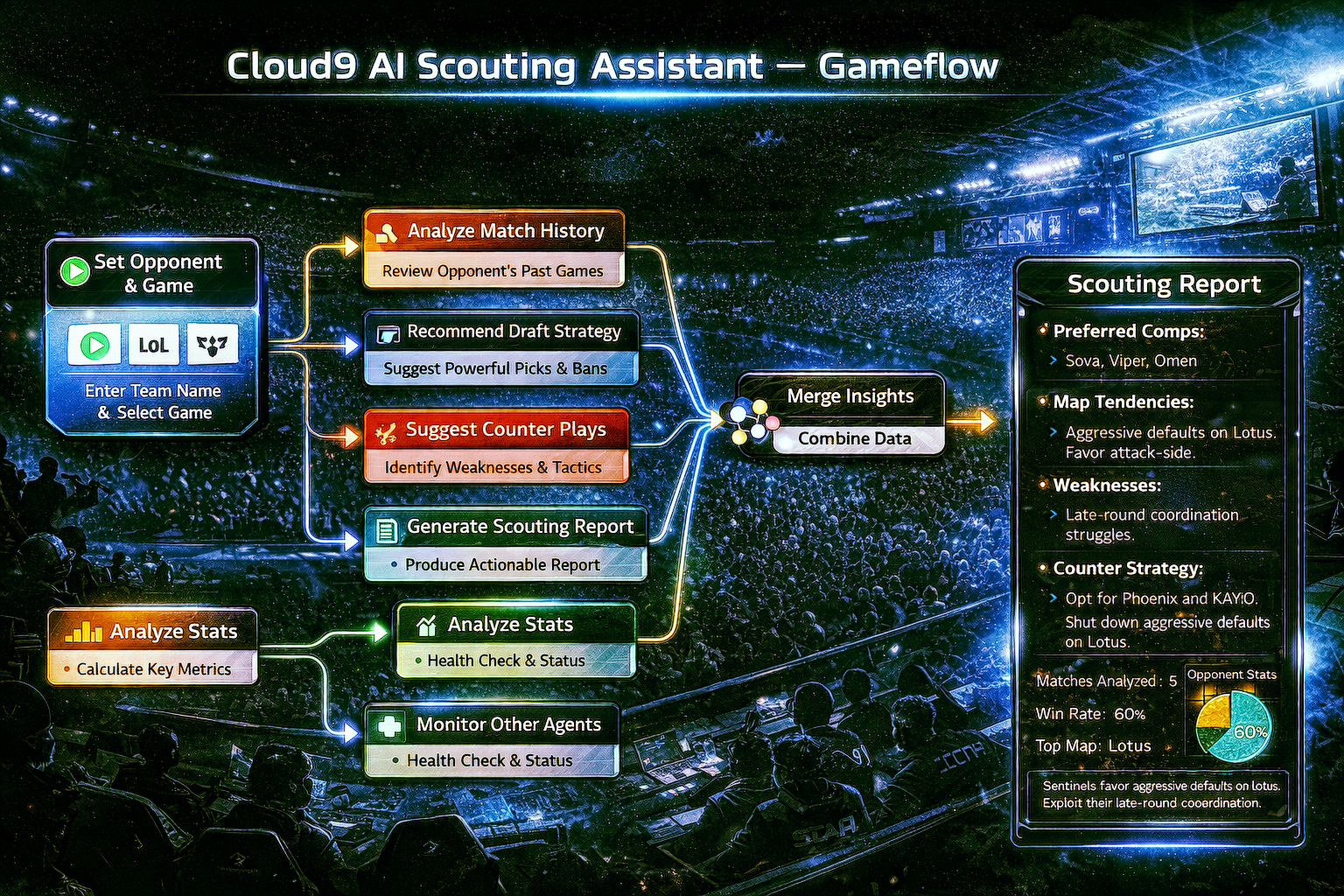
Given an upcoming opponent, the system:
- fetches recent match data from the GRID Esports API
- analyzes team strategies, compositions, and trends
- highlights player tendencies and weaknesses
- generates a concise, professional scouting report for coaches
The output focuses on what actually matters before a match:
- common strategies and patterns
- preferred compositions
- exploitable weaknesses
- draft and counter-play insights
How we built it
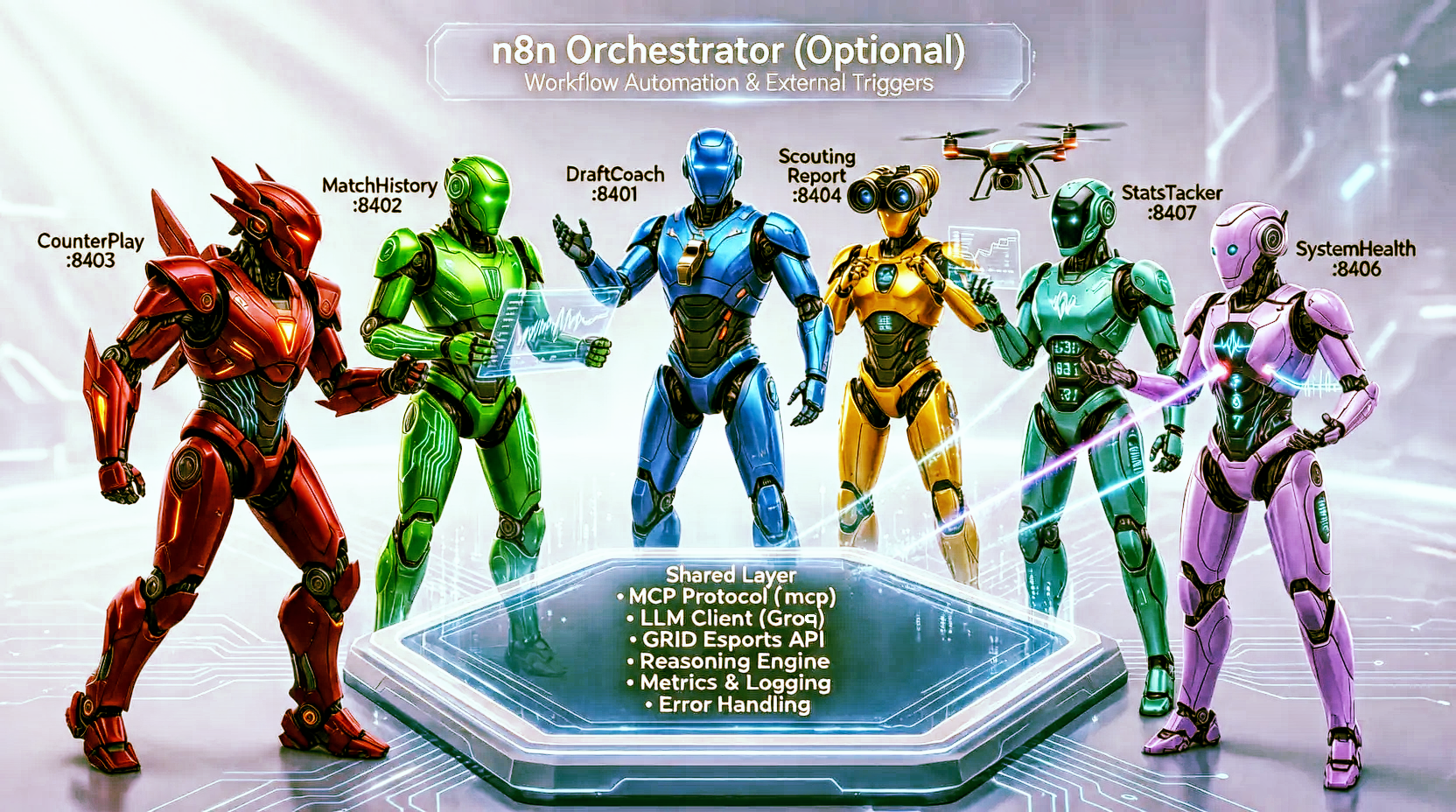
The system is built as a production-ready multi-agent architecture.
Each agent is a dedicated FastAPI microservice, running in Docker:
- MatchHistory Agent — evaluates recent form, trends, and consistency
- StatsTracker Agent — analyzes player and team statistics
- CounterPlay Agent — identifies exploitable patterns and counter-strategies
- DraftCoach Agent — provides draft and pick/ban recommendations
- ScoutingReport Agent — aggregates all insights into a final report
- SystemHealth Agent — continuously monitors system reliability
Agents communicate via a structured MCP protocol, enabling parallel analysis and clean data exchange.
Tech stack:
- GRID Esports API (GraphQL) for real match data
- Groq Llama 3.3 70B for ultra-fast LLM inference
- n8n for orchestration and demo workflows
- Docker Compose for reproducible setup
A demo mode ensures the project works end-to-end even without API keys, while preserving identical production behavior.
Challenges we ran into
Designing a scalable scouting format
Turning raw match data into actionable insights — not just statistics — required careful structuring of agent outputs.Balancing real data and demo reliability
Hackathon projects must be easy to run, so we built a seamless fallback system that switches between real GRID data and realistic mock data.Agent orchestration and consistency
Ensuring multiple agents return structured, compatible outputs required a strict MCP contract and aggregation layer.Keeping reports concise
Coaches need clarity, not noise. A major challenge was keeping reports short, focused, and decision-oriented.
Accomplishments that we're proud of
- Fully automated scouting reports using real GRID esports data
- Production-grade multi-agent architecture
- Sub-second report generation with Groq
- Clean demo experience: one Docker command to run everything
- Coach-friendly, readable reports — not just raw analytics
- Works for both Valorant and League of Legends
What we learned
- Structured esports data unlocks far more value when paired with specialized agents, not a single monolithic model.
- Fast inference is critical — real-time coaching tools demand instant feedback.
- Judges and users value reproducibility and clarity as much as raw technical depth.
- Multi-agent systems shine when each agent has a clear, narrow responsibility.
What's next for Cloud9 AI Scouting Assistant
Future improvements include:
- live draft-phase recommendations
- VOD timestamps linked directly to scouting insights
- team dashboards and Discord integrations
- deeper player-level trend analysis
- expansion to additional esports titles
Our long-term vision is a real-time coaching intelligence platform that supports teams throughout the entire competitive lifecycle — before, during, and after matches.

Log in or sign up for Devpost to join the conversation.