
About the project Cloud Pilot AI was inspired by the way modern teams constantly jump between separate tools for CRM, projects, HR, billing, and now AI assistants. Instead of forcing teams to glue everything together manually, the idea was to build one modular “operating system” where everyday workflows and advanced AI reasoning live in the same place.
The project was built as a full‑stack, Odoo‑inspired SaaS dashboard with a TypeScript‑based frontend and a modular architecture for core business modules and AI services. The interface brings together CRM & Sales pipelines, inventory and invoicing, Kanban‑style project management, and an employee directory for HR, all inside a single, consistent UI. On top of this, specialized AI tools handle solution architecture, cloud‑migration reasoning, market intelligence from external sources, multimodal document/image/video analysis, and creative content like speech and visuals.
During the build, a lot was learned about designing opinionated but flexible module boundaries, structuring a clean component and services layer in TypeScript, and thinking about how AI features can augment—not replace—classic ERP flows. Challenges included keeping the interface simple while exposing many capabilities, planning for future AI agents without over‑engineering today’s features, and making sure the platform still feels approachable for non‑technical business users.
Inspiration CloudPilot AI was inspired by how modern teams constantly juggle too many disconnected tools for CRM, projects, HR, billing, and AI assistants.
Seeing this fragmentation, the goal was to imagine an “enterprise operating system” where everyday workflows and advanced AI reasoning live in one clean, modular dashboard instead of ten separate tabs.
What it does CloudPilot AI unifies core business operations and advanced AI tools into one modular web dashboard.
It lets teams manage CRM and sales pipelines, inventory and invoicing, projects and HR, while also running AI‑powered architecture reasoning, market intelligence, multimodal analysis, and creative generation from the same interface.
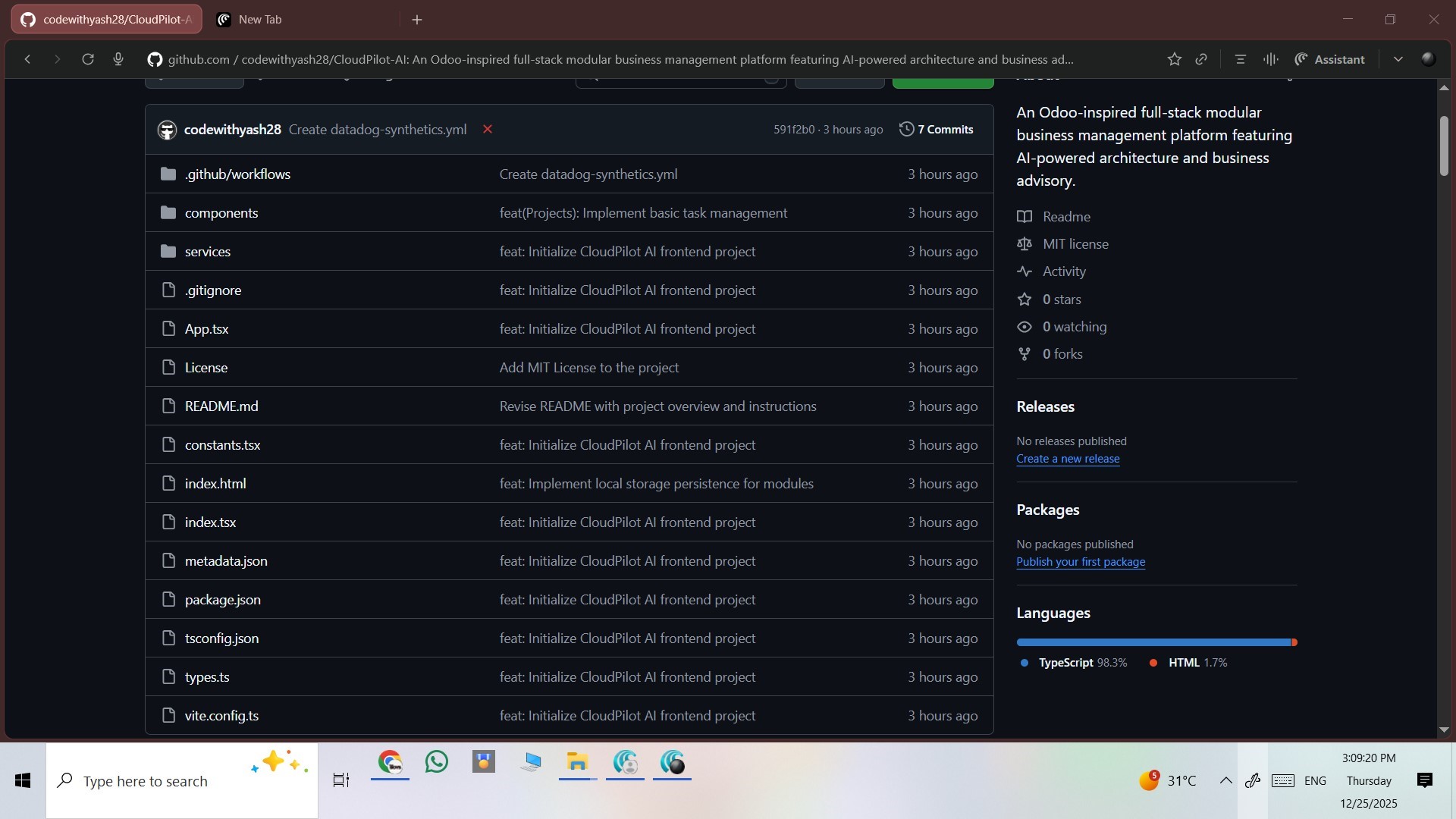
How we built it CloudPilot AI was built as a modular TypeScript + React frontend, scaffolded with Vite and organized into feature‑based components and services.
The project is version‑controlled on GitHub, deployed on Vercel as a live SaaS‑style dashboard, and wired to AI/LLM services for architecture reasoning, market intelligence, multimodal analysis, and creative generation. Challenges we ran into Balancing many modules—CRM, inventory, projects, HR, and multiple AI workspaces—inside one clean UI was difficult, and required several redesigns to avoid a cluttered “control panel” feeling. Defining clear boundaries in the TypeScript codebase so each module stayed modular but still felt like one unified operating system also took multiple architecture iterations.
Accomplishments that we're proud of We are proud that CloudPilot AI runs as a real, deployed SaaS‑style dashboard, not just slides or mockups, with a clean GitHub codebase and a working Vercel deployment. We’re also proud that the AI features—architecture reasoning, market intel, multimodal analysis, and creative tools—are tied to real business workflows instead of being isolated demos.
What we learned We learned how important it is to design feature modules and shared services up front so the app can grow without becoming unmanageable as more business domains and AI tools are added. We also learned that AI feels most valuable when it is deeply integrated into everyday flows (like sales, projects, and strategy) rather than being a separate “lab” screen users rarely visit.
What’s next for CloudPilot AI Next, we want to add AI agents that continuously watch business data, automatically flag risks or opportunities, and suggest actions such as follow‑ups, inventory fixes, or new architecture options. We also plan to strengthen the platform with richer analytics, role‑based access control, better collaboration features, and a more production‑ready backend so businesses can adopt it beyond the hackathon.
Built With
- css
- html
- llm
- react
- typescript
- vite


Log in or sign up for Devpost to join the conversation.