Inspiration
Teachers spend hours creating, marking and reviewing assessments, yet the final marks often answer only one question: how did the class perform? They do not automatically tell the teacher what to teach next, which misconceptions may be developing or how to respond differently to learners who need support and those who are ready to extend.
Cloud Grader Classroom Intelligence was created during the Build with Gemini XPRIZE to close that gap while keeping the teacher in control.
What it does
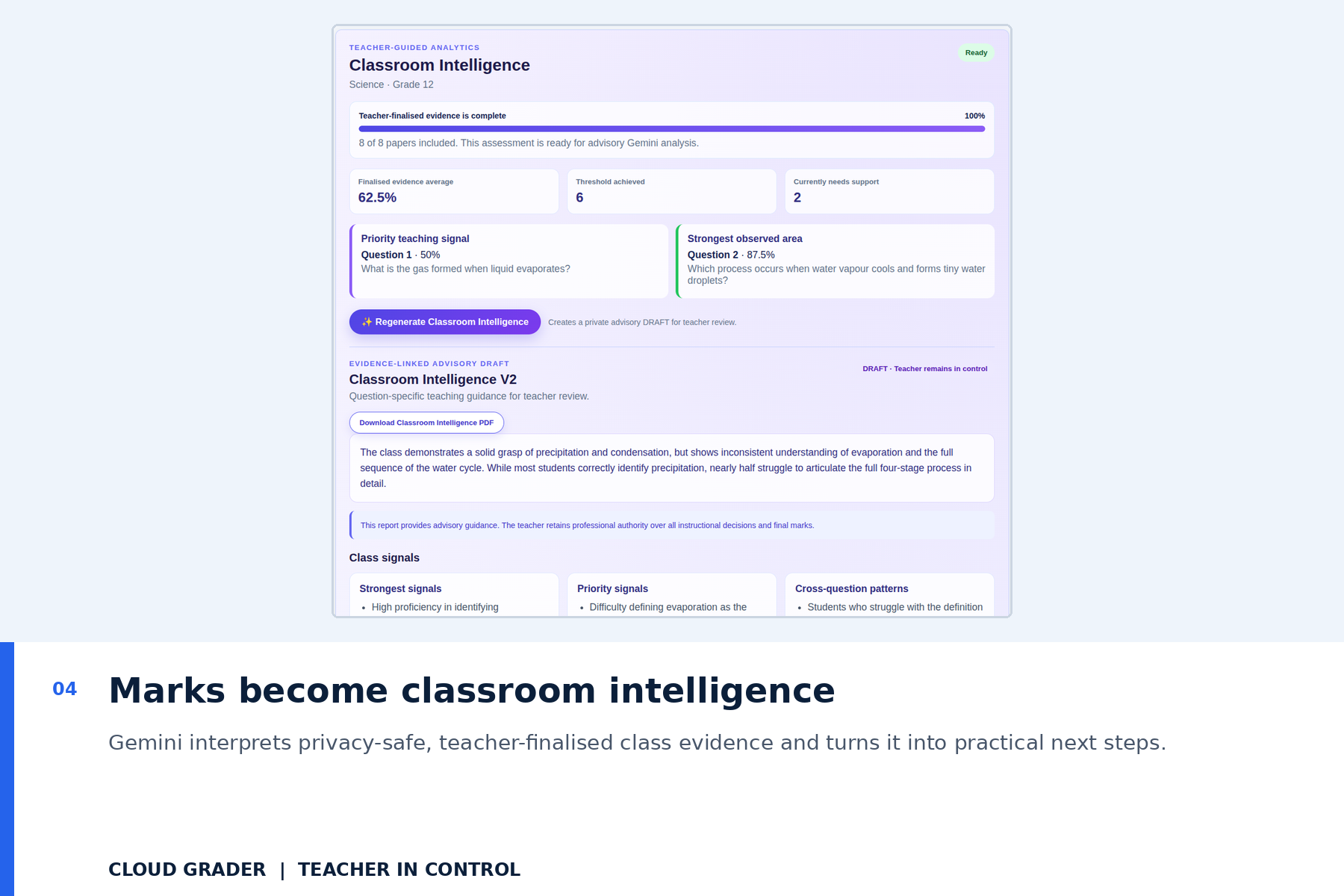
Classroom Intelligence transforms completed, teacher-finalised assessment evidence into structured, question-specific educational guidance.
The product uses AI at two deliberate stages. Google Cloud Vision converts completed assessment pages into machine-readable text. After marking is complete and the teacher has finalised the papers, Cloud Grader builds a privacy-safe aggregate evidence contract. That contract excludes learner names, learner identifiers, Service Tags, raw scans and raw OCR. Small response groups are suppressed before the approved evidence reaches Gemini.
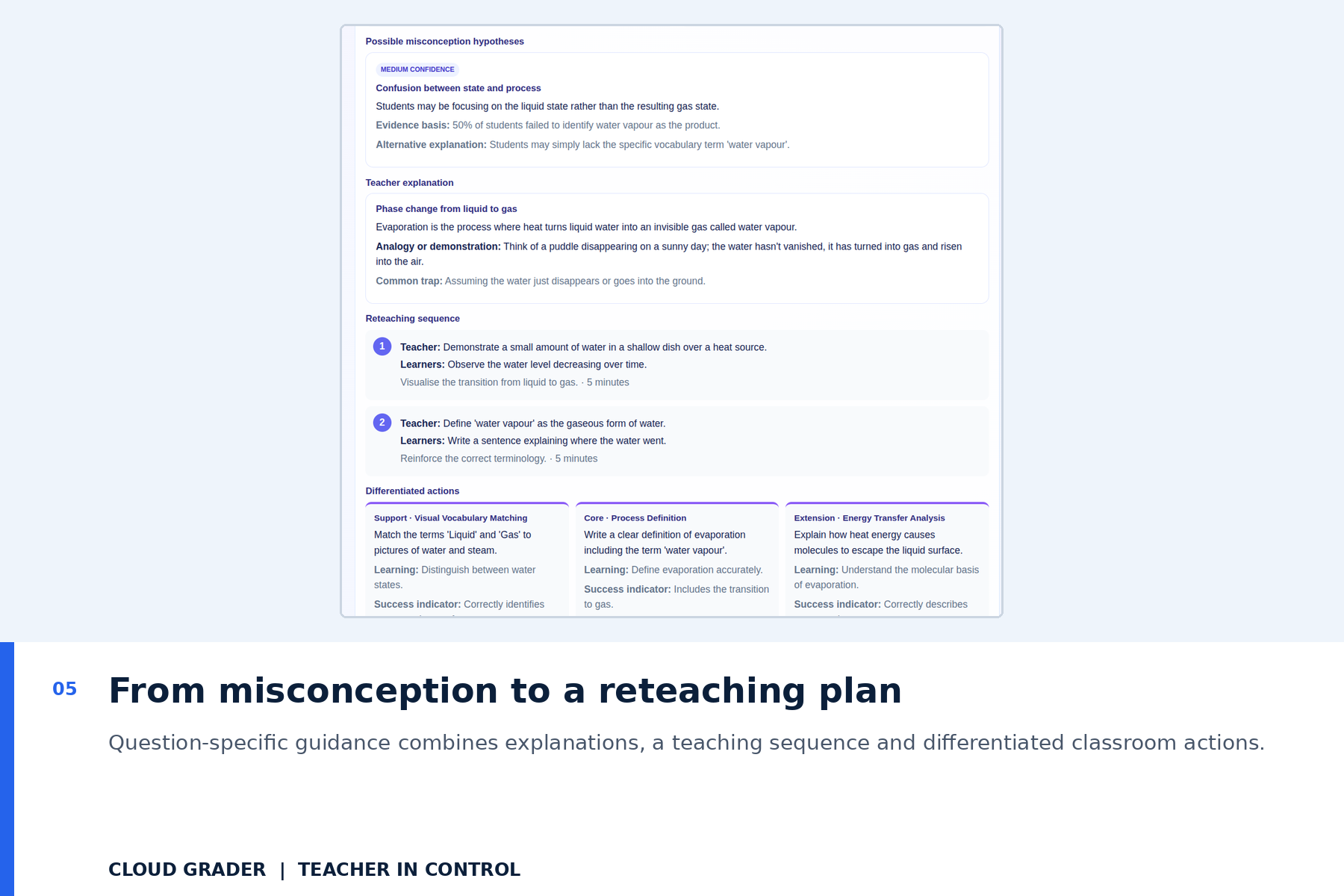
Gemini interprets the aggregate evidence and proposes question-by-question teaching guidance: what the evidence shows, a teacher explanation, a reteaching sequence, differentiated actions and a quick formative check. It also produces whole-class next steps and explicit teacher decision points.
This is not a decorative chatbot added to an existing report. Classroom Intelligence depends on Gemini for bounded educational reasoning over changing class evidence. Without that reasoning stage, the question-specific instructional report does not exist.
How we built it
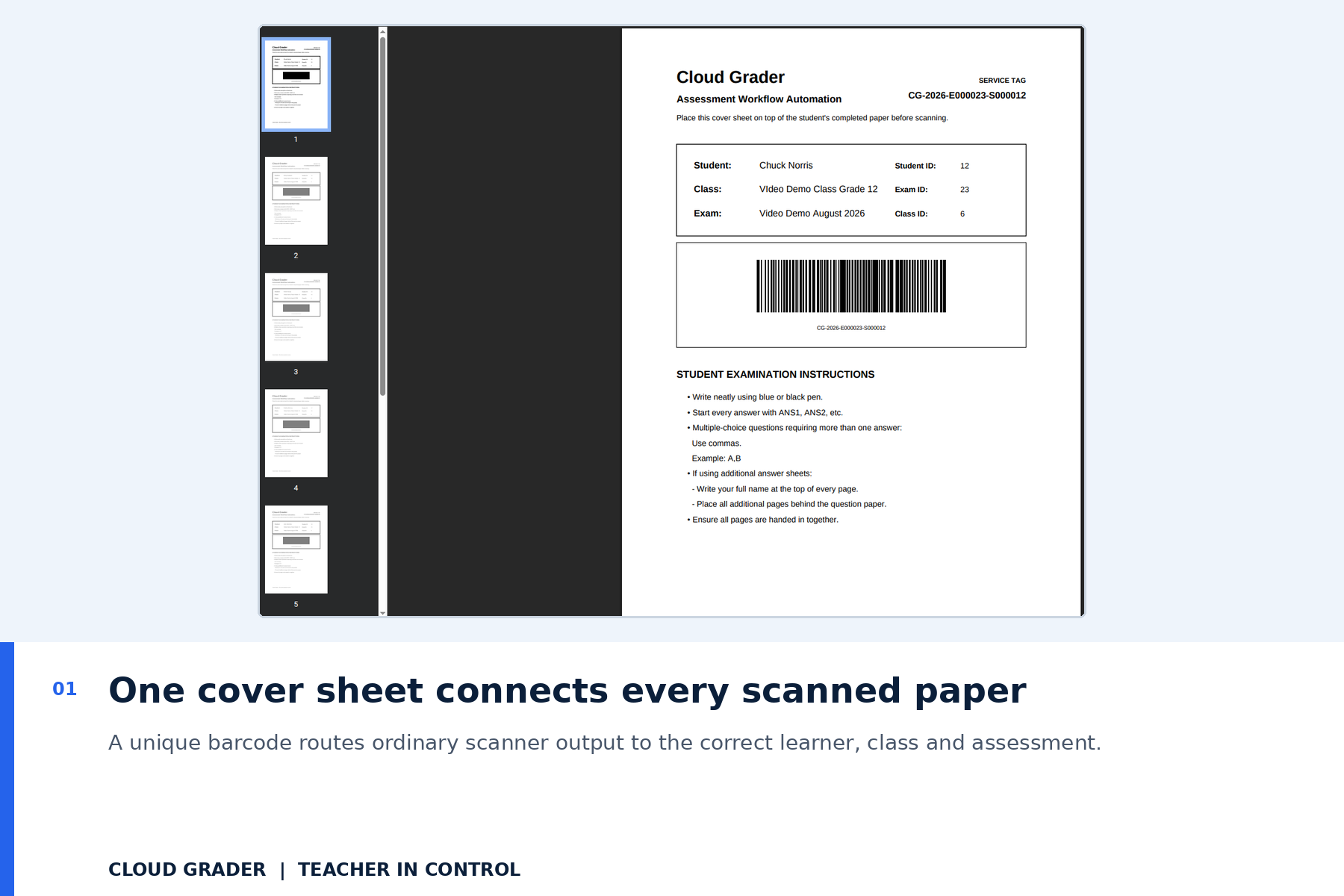
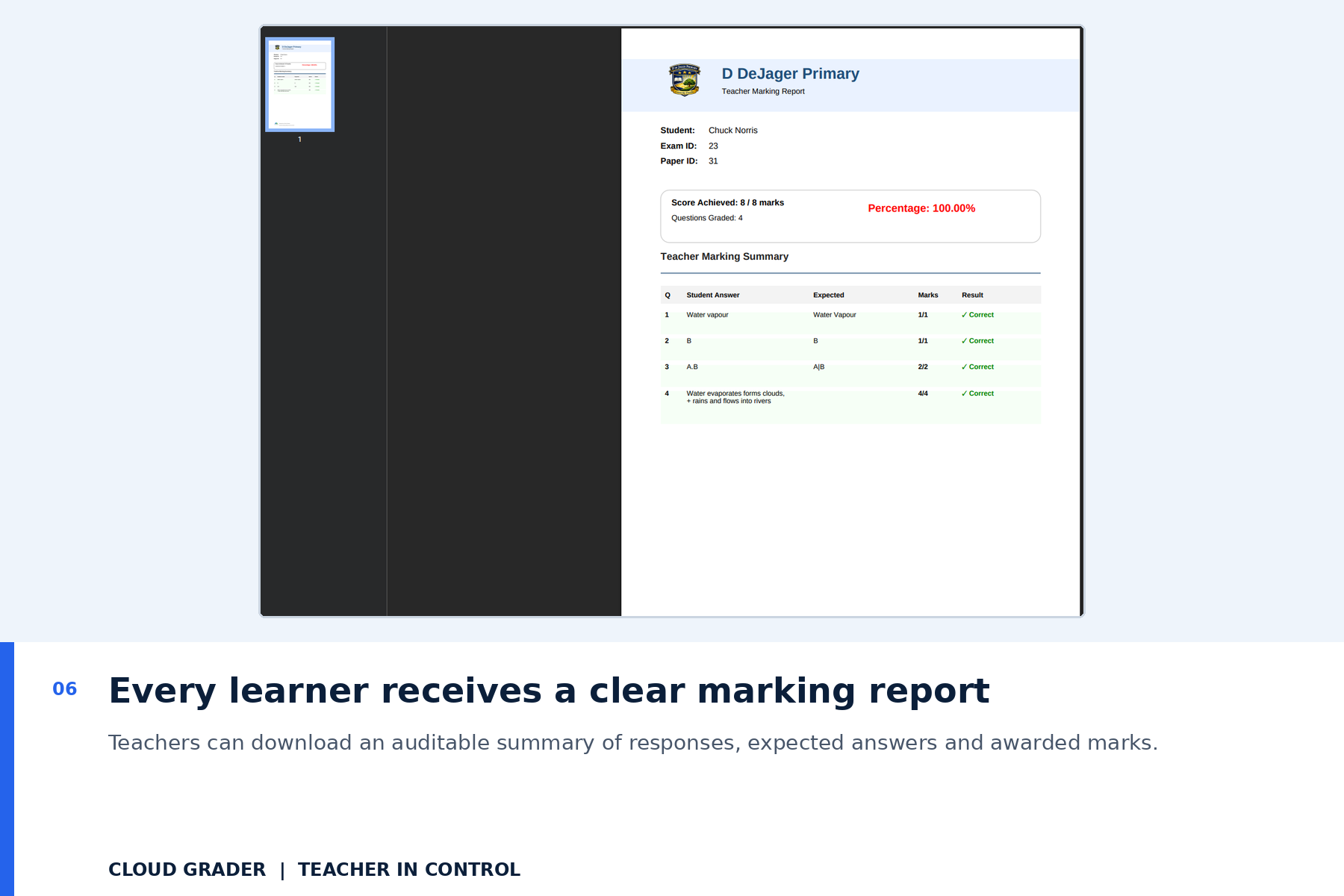
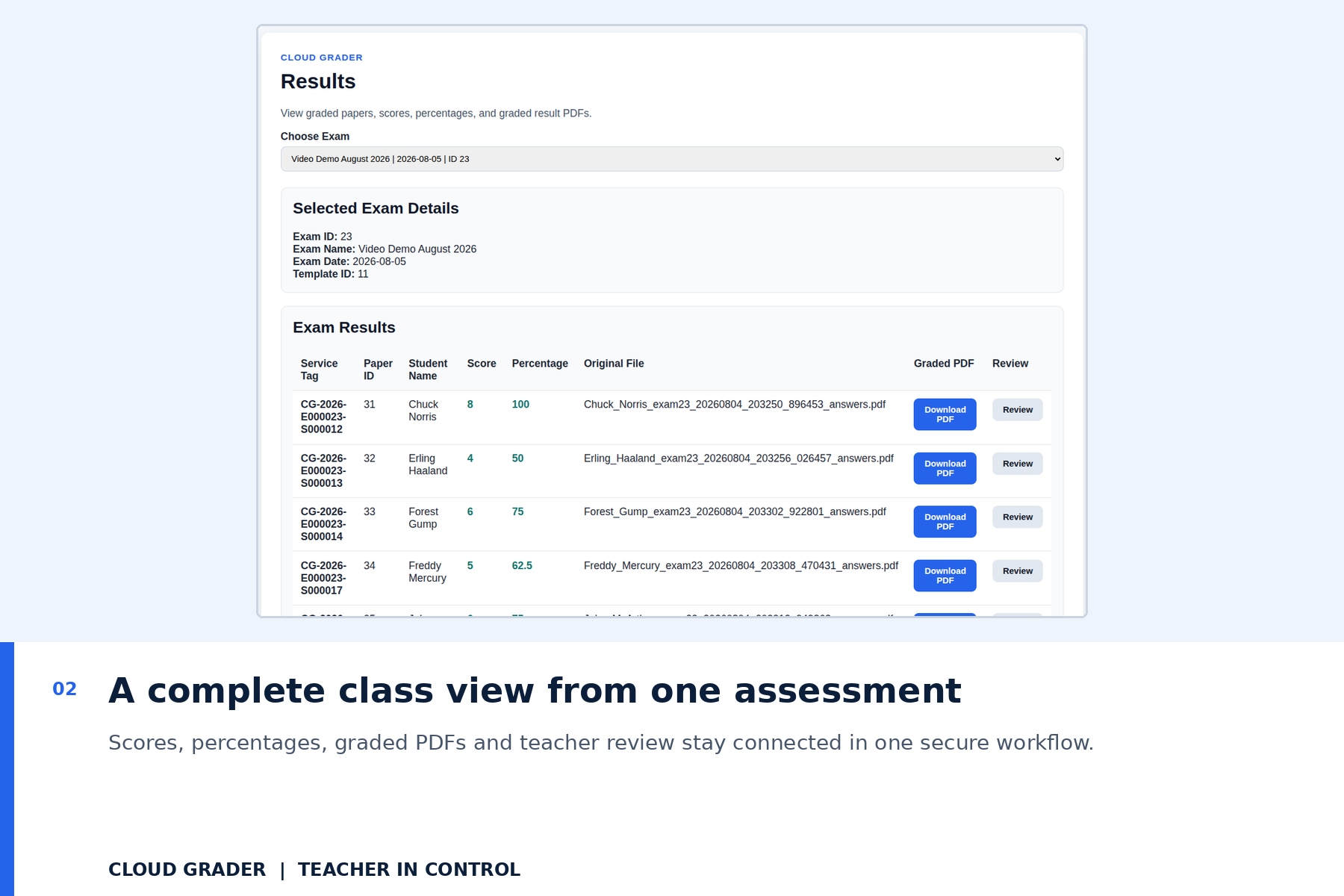
Cloud Grader had an assessment-processing foundation before the competition. That foundation could create assessments, separate scanned papers, use Google Cloud Vision for OCR, assist with marking and produce results.
During the competition period, we created a distinct new Gemini-powered product and commercial offering: Classroom Intelligence. The repository preserves a formal pre-Gemini baseline and a dated development history so reviewers can see exactly what existed before the competition and what was built during it.
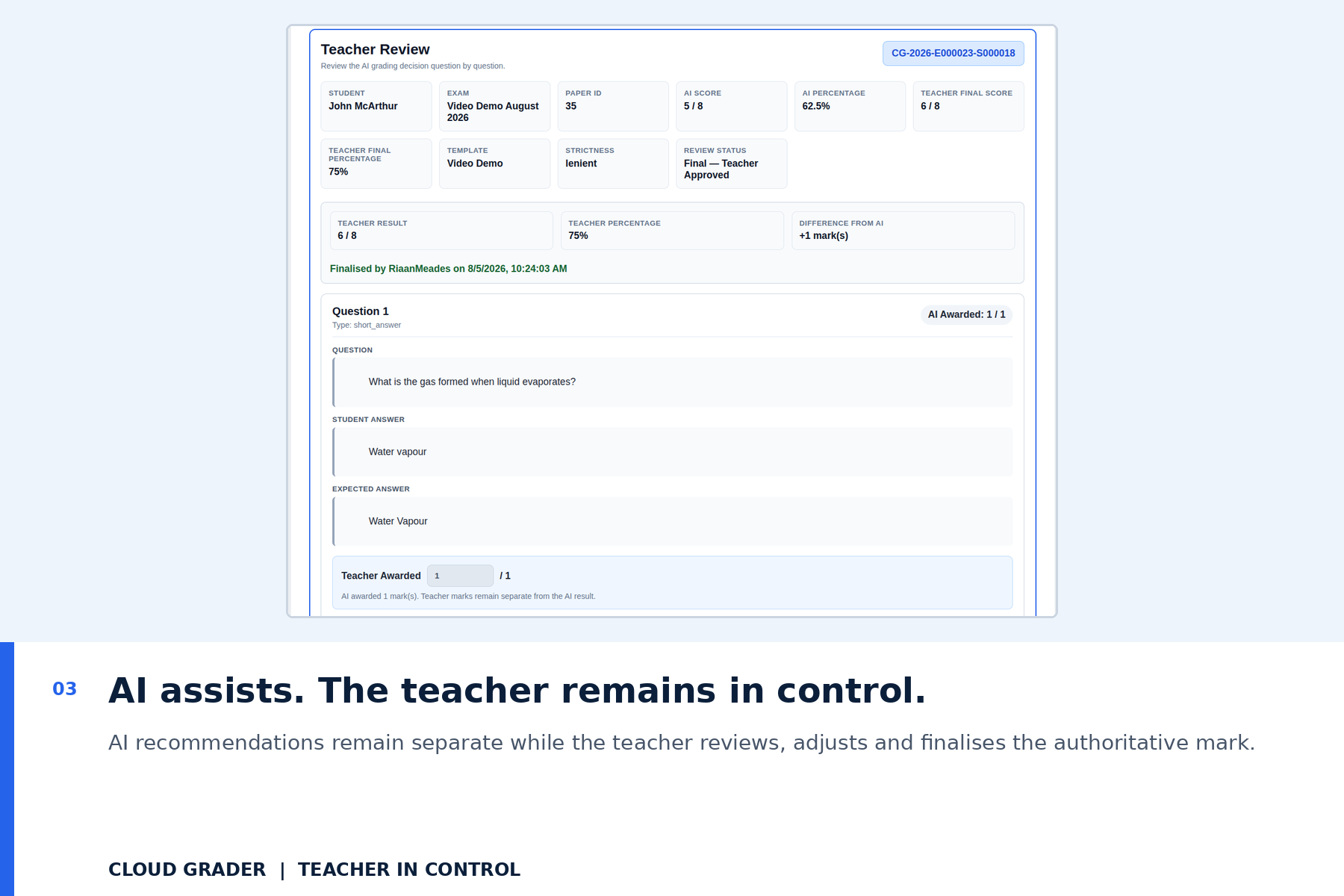
Cloud Grader does not hand control of the assessment to the model. The application owns authentication, school isolation, evidence selection, privacy filtering, calculated performance bands, deterministic performance facts, validation, audit integrity and presentation. Gemini cannot change exams, papers, marks, scans, OCR or finalisation state. Its output starts in DRAFT status and remains advisory.
Every Gemini response must satisfy a strict structured contract. Cloud Grader rejects missing questions, unsupported percentages, incorrect performance bands, unknown fields, learner-level claims and educational content that is not grounded in the approved evidence. One bounded correction attempt is permitted. Raw attempts, validated output and evidence are stored separately with independent SHA-256 hashes. The browser receives only the validated teacher-facing report, never the private raw-attempt audit material.
I am the sole founder and remain responsible for product direction, customer promises, security decisions, financial decisions and every final release. AI assists throughout the daily workflow: Google Cloud Vision performs OCR, Gemini creates the educational interpretation, and GPT-assisted development helps accelerate architecture review, test design, documentation and implementation. Human judgement sets the requirements, verifies the evidence and decides what enters the product.
Challenges we ran into
The central challenge was using AI for meaningful educational reasoning without allowing it to overstep the teacher’s authority or expose learner information.
This required a carefully enforced boundary between deterministic application-owned facts and model-generated advice. It also required privacy filtering, suppression of small response groups, strict validation, tamper-evident audit records and access controls that preserve separation between schools.
Another challenge was proving what had genuinely been built during the competition. We addressed this by preserving a formal pre-Gemini baseline, maintaining a dated development history and documenting the distinction between the original assessment-processing foundation and the new Classroom Intelligence product.
Commercial validation required the same discipline. Interest, proposals and future opportunities could not be represented as achieved adoption or revenue. The first school demonstration produced useful feedback, but no sale, payment or formal pilot agreement resulted from it. Qualifying project revenue therefore remains R0.
Accomplishments that we're proud of
This way of building has allowed one founder to create and validate a product that would normally require a much larger early engineering and educational analysis team.
The repository includes automated contract tests for the privacy boundary, deterministic ownership, audit integrity, tamper rejection and access-control ordering. Controlled live verification has produced audited reports, a rich browser presentation and a branded thirteen-page PDF without altering the underlying assessment evidence.
The product is now deployed in production. Its first production Classroom Intelligence report was generated successfully with Gemini and passed independent database-integrity, audit-hash and learner-name exclusion checks. The privacy and authority boundaries are enforced, the audit trail is verifiable and the teacher-facing result is working.
Cloud Grader has also completed its first external school demonstration. Educators provided practical feedback and supplied a sample assessment for further product development. The demonstration identified real needs, including support for image-based questions and the importance of customer references.
What we learned
The opportunity extends beyond saving marking time. Classroom Intelligence can help a teacher identify where the class struggled, explain the underlying knowledge or skill, plan a focused reteaching sequence, differentiate the next lesson and verify understanding quickly. This is particularly valuable in schools where teachers manage large classes and have limited time for manual data analysis.
We learned that useful classroom AI needs strong boundaries. The model should interpret approved evidence and suggest actions, while the application protects learner privacy, preserves verified facts and leaves every educational decision with the teacher.
We also learned that technical validation and commercial validation are different. A functioning, audited product is an important achievement, but genuine adoption requires listening to schools, incorporating practical feedback, earning trust and converting interest into paid use without overstating the evidence.
What's next for Cloud Grader
The immediate priority is to continue learning from real schools, add support for image-based questions and convert genuine interest into paid use.
Cloud Grader uses a subscription model with options for individual teachers and schools. Schools receive pooled page capacity so usage can move between teachers according to real assessment demand. The model is designed to support recurring software revenue while accounting for OCR usage costs.
Successful adoption could create work in school onboarding, teacher support, sales, local distribution, implementation and scanner setup. Cloud Grader can also help schools use existing scanning equipment more effectively; where new equipment is required, installation and technical support create additional local service opportunities. These are potential opportunities and are not represented as jobs already created.
Cloud Grader’s principle is simple: AI should help the teacher understand more without taking authority away from the teacher. Google Cloud Vision helps digitise the completed assessment. Gemini transforms approved aggregate evidence into practical educational guidance. Cloud Grader protects the trust boundary around both.
The teacher remains in control.


Log in or sign up for Devpost to join the conversation.