CloudForge
Inspiration
Cloud infrastructure design is still fragmented across multiple tools. Architects often sketch diagrams in one application, write Infrastructure as Code (IaC) in another, validate configurations elsewhere, and then manually maintain documentation. This process is time-consuming, error-prone, and difficult for teams to collaborate on.
We wanted to create a platform where cloud architects, developers, DevOps engineers, and students could visually design infrastructure, validate best practices, generate deployable code, and receive intelligent architectural guidance—all from a single workspace.
CloudForge was inspired by the idea of making cloud architecture as intuitive as designing a flowchart while still producing production-ready infrastructure artifacts.
What it does
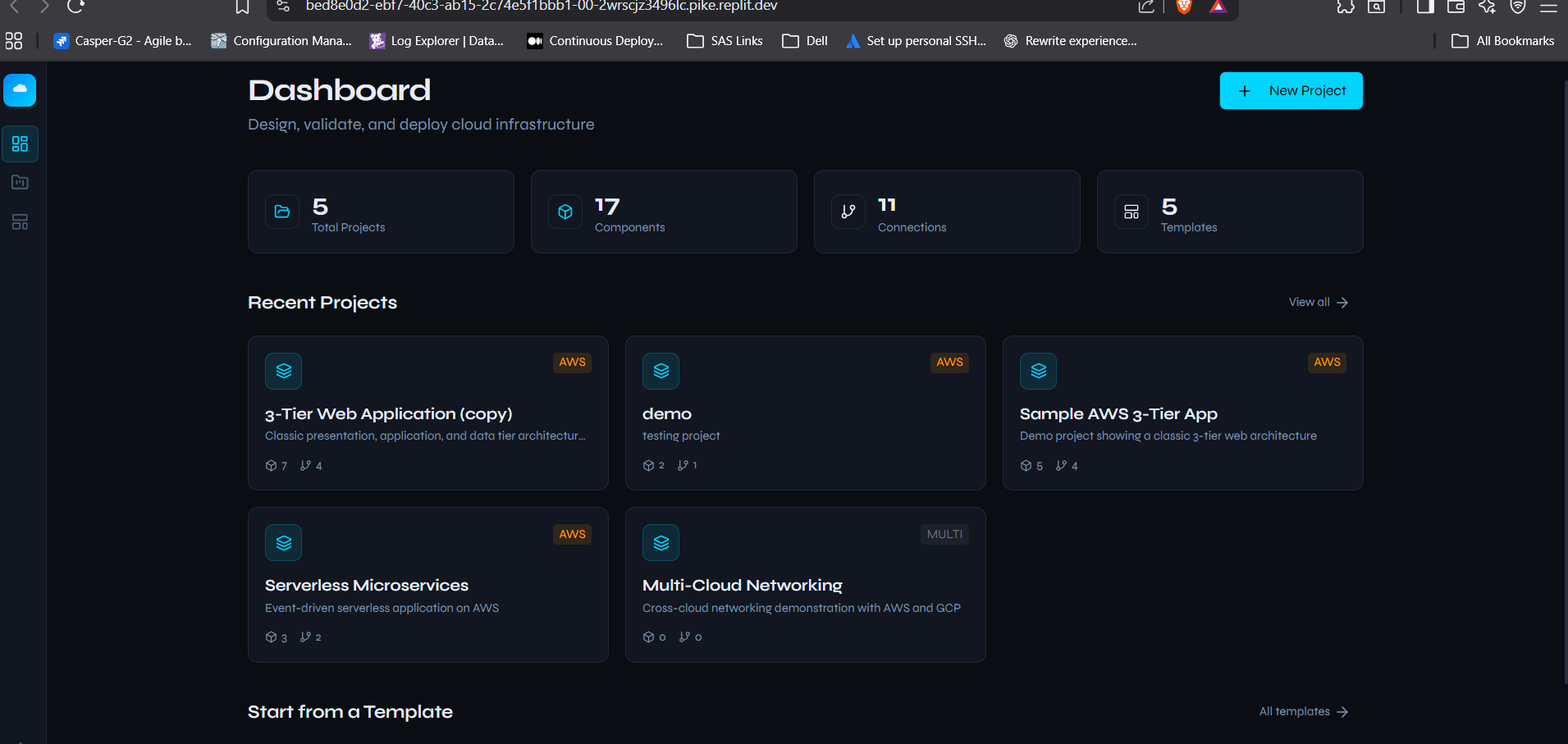
CloudForge is a visual cloud infrastructure design platform that enables users to:
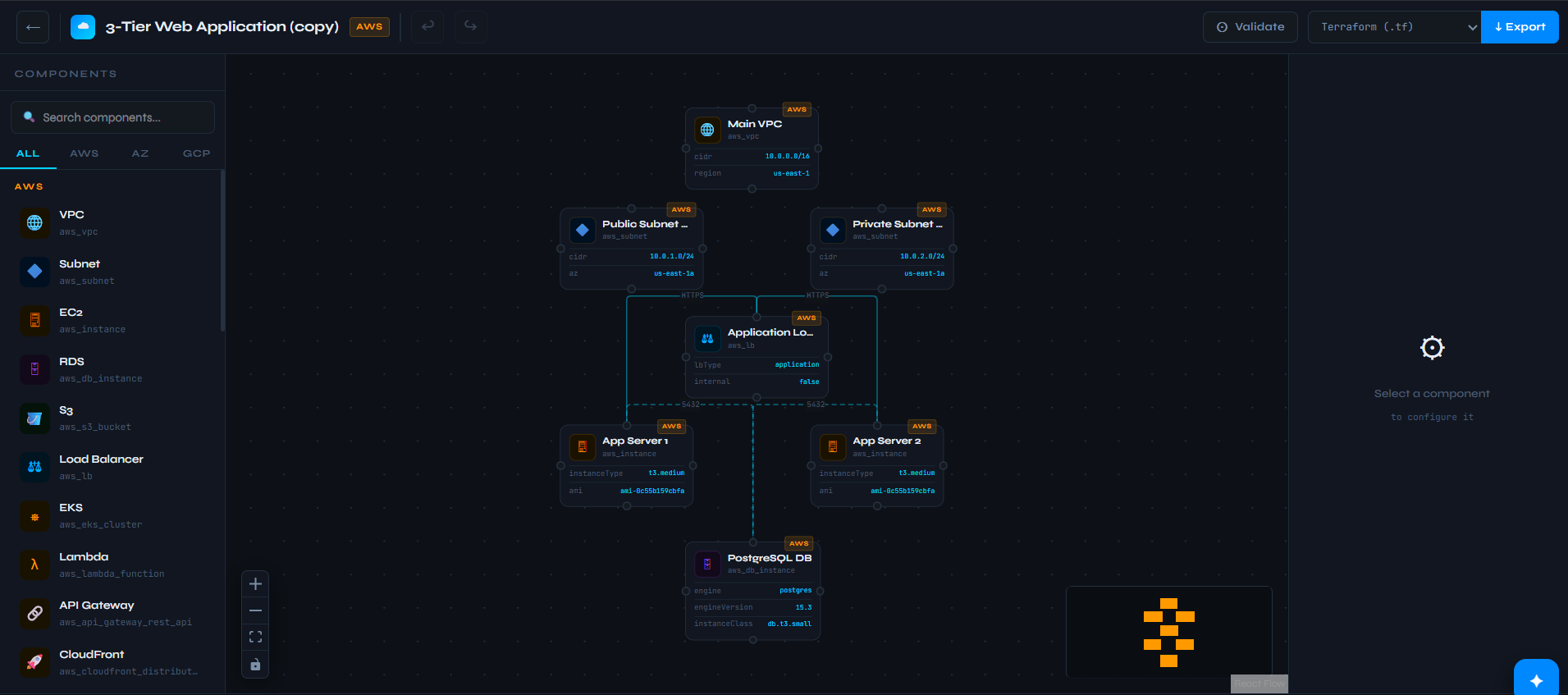
- Drag and drop AWS, Azure, and GCP services onto a canvas
- Create infrastructure diagrams through visual connections
- Configure resources directly within the editor
- Import existing Terraform files and automatically generate architecture diagrams
Export infrastructure as:
- Terraform HCL
- CloudFormation templates
- Kubernetes manifests
- YAML configurations
Run validation checks to identify security issues and architectural misconfigurations
Start from pre-built architecture templates
Use an AI-powered architecture assistant that understands the current project context
Access projects from both web and mobile applications
The result is a complete cloud architecture lifecycle platform—from design to deployment-ready code.
How we built it
CloudForge was developed as a full-stack monorepo application.
Frontend
- React + Vite
- Tailwind CSS v4
- ReactFlow (@xyflow/react) for the visual infrastructure canvas
- TypeScript 5.9
Backend
- Express 5 API server
- Node.js 24
- PostgreSQL database
- Drizzle ORM
Developer Experience
- OpenAPI-driven API design
- Orval for automatic React Query hook generation
- Zod for runtime validation and schema safety
- npm workspaces for monorepo management
AI Layer
The architecture assistant uses GPT-powered contextual reasoning. It analyzes the current project's components, connections, and configurations to provide architecture recommendations that are specific to the user's actual design rather than generic cloud advice.
Mobile
- Expo React Native application
- iOS and Android support
- Project browsing and management on the go
Infrastructure Features
We built:
- Multi-cloud component library (AWS, Azure, GCP)
- Terraform parser and importer
- Infrastructure code generators
- Validation engine for architecture best practices
- Template management system
- Context-aware AI assistant
- Cross-platform web and mobile experience
Challenges we ran into
Terraform Reverse Engineering
One of the most difficult challenges was converting Terraform files into visual diagrams. Infrastructure code can be highly modular, contain variables, and define implicit relationships that are not immediately visible.
We had to:
- Parse infrastructure resources
- Detect dependencies
- Infer relationships
- Automatically position components on the canvas
Multi-Cloud Abstraction
AWS, Azure, and GCP all have different resource models and naming conventions. Designing a unified component system while preserving provider-specific capabilities required careful abstraction.
Real-Time Canvas Synchronization
Managing node positioning, connections, configurations, and state updates across a large visual canvas introduced complex state management challenges.
Code Generation
Generating valid Terraform, CloudFormation, Kubernetes manifests, and YAML from a single visual model required building a provider-agnostic architecture representation that could be translated into multiple output formats.
Context-Aware AI
Providing AI recommendations that genuinely understand the user's architecture instead of producing generic responses required supplying structured project context and building effective prompt orchestration.
Accomplishments that we're proud of
- Built a complete visual cloud architecture platform from scratch
- Successfully support AWS, Azure, and GCP in a single interface
- Implemented Terraform import with automatic diagram generation
- Created multi-format export capabilities
- Developed a context-aware AI architecture assistant
- Added validation capabilities for security and architecture best practices
- Delivered both web and mobile experiences
- Maintained end-to-end type safety using TypeScript, OpenAPI, Zod, and generated clients
Most importantly, we transformed infrastructure design from a code-heavy workflow into an intuitive visual experience without sacrificing deployment readiness.
What we learned
Building CloudForge reinforced several important lessons:
Visual Modeling Is Powerful
Many infrastructure concepts become significantly easier to understand when represented visually rather than as hundreds of lines of code.
AI Works Best With Context
Generic AI recommendations have limited value. The quality of architectural guidance improved dramatically when the model was provided with actual project components and relationships.
Strong Type Systems Scale
Using TypeScript, OpenAPI specifications, generated clients, and Zod validation greatly reduced integration bugs and accelerated development.
Infrastructure Is More Than Deployment
Modern infrastructure workflows involve design, collaboration, validation, governance, and documentation—not just provisioning resources.
Multi-Cloud Is Increasingly Important
Teams want flexibility. Supporting multiple cloud providers from a unified platform creates significant value for architects and organizations.
What's next for CloudForge
We have an ambitious roadmap for CloudForge.
AI-Powered Architecture Intelligence
- Automated architecture reviews
- Cost optimization recommendations
- Security hardening suggestions
- High-availability and resiliency analysis
- Architecture scoring and health reports
Advanced Collaboration
- Real-time multi-user editing
- Team workspaces
- Architecture reviews and approvals
- Commenting and annotations
Expanded Cloud Support
- Additional AWS, Azure, and GCP services
- Kubernetes-native design experiences
- Hybrid cloud and on-premise components
Deployment Automation
- One-click deployment pipelines
- GitHub Actions integration
- GitOps workflows
- Infrastructure drift detection
Enterprise Features
- Role-based access control
- Compliance validation
- Audit logging
- Policy-as-code integration
Architecture Marketplace
- Community-contributed templates
- Reusable infrastructure blueprints
- Best-practice reference architectures
Our vision is to make CloudForge the operating system for cloud architecture design—where teams can design, validate, collaborate, optimize, and deploy infrastructure from a single intelligent platform.
Built With
- amazon-web-services
- azure
- cloudformation
- drizzleorm
- esbuild
- expo.io
- express.js
- gcp
- github
- gpt-4
- kubernetes
- node.js
- openai
- openapi
- orval
- postgresql
- react
- reactflow
- reactnative
- reactquery
- tailwindcss
- terraform
- typescript
- vite
- yaml
- zod

Log in or sign up for Devpost to join the conversation.