-
-
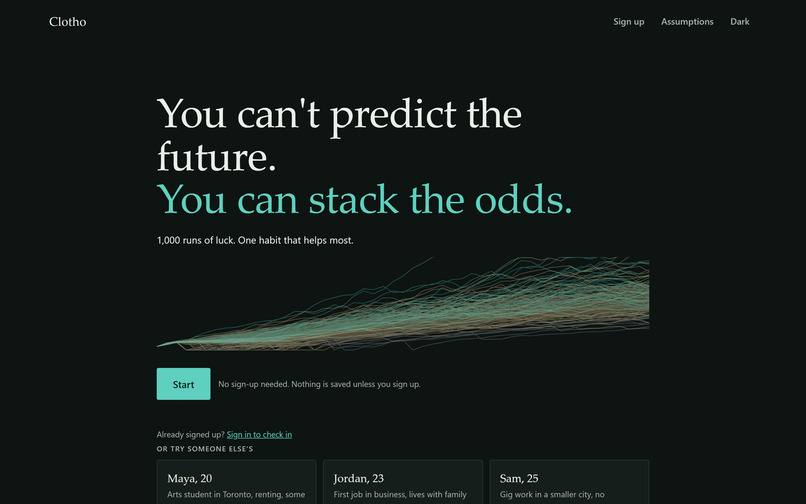
Landing page
-
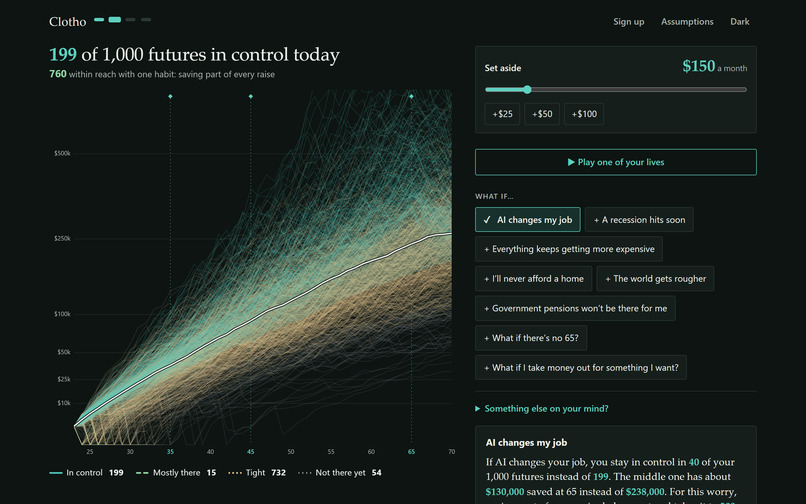
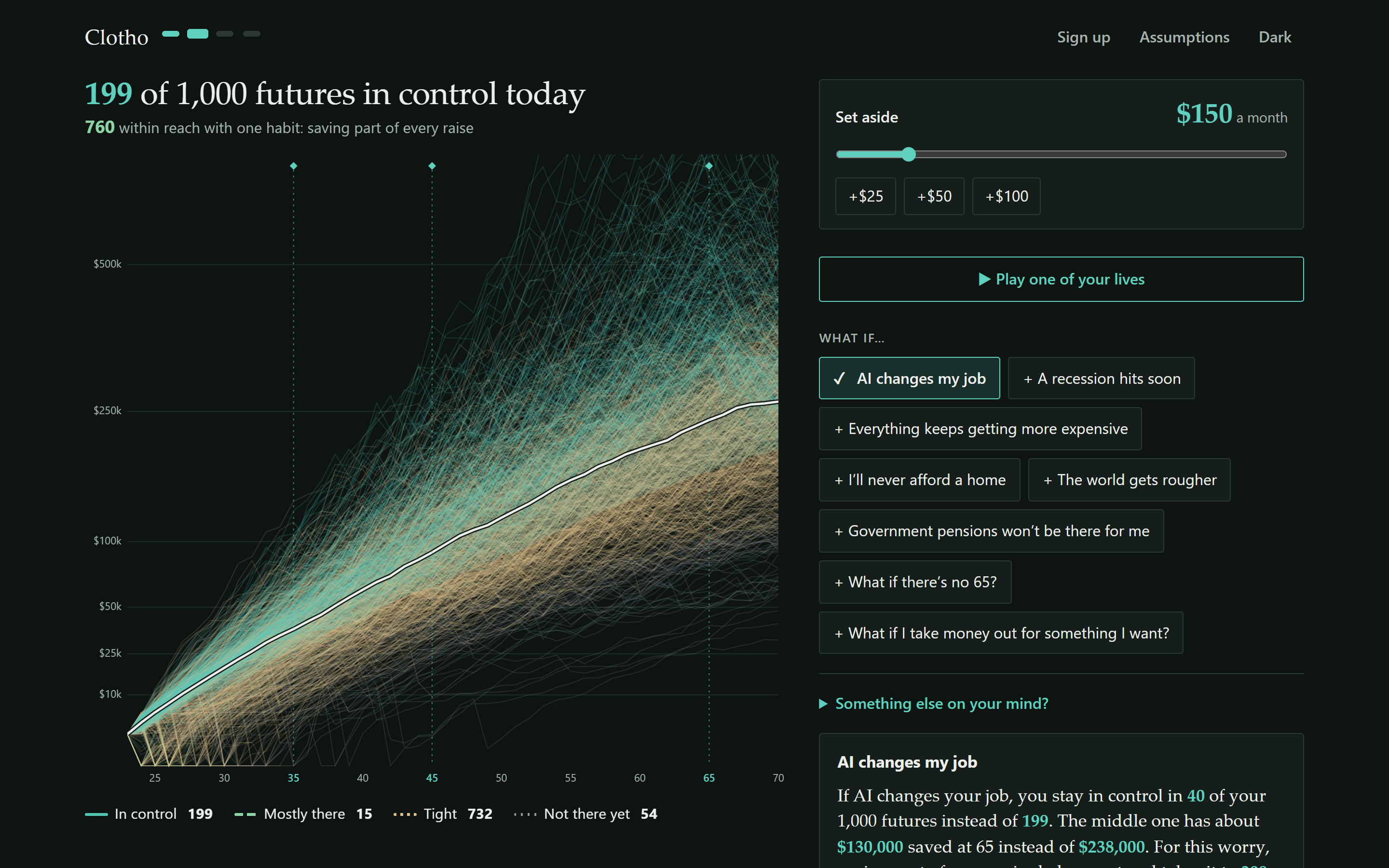
Chart of 1000 futures
-
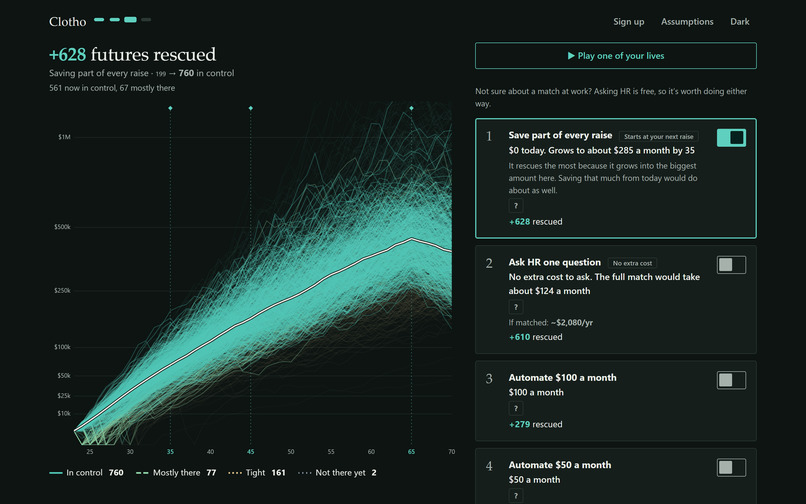
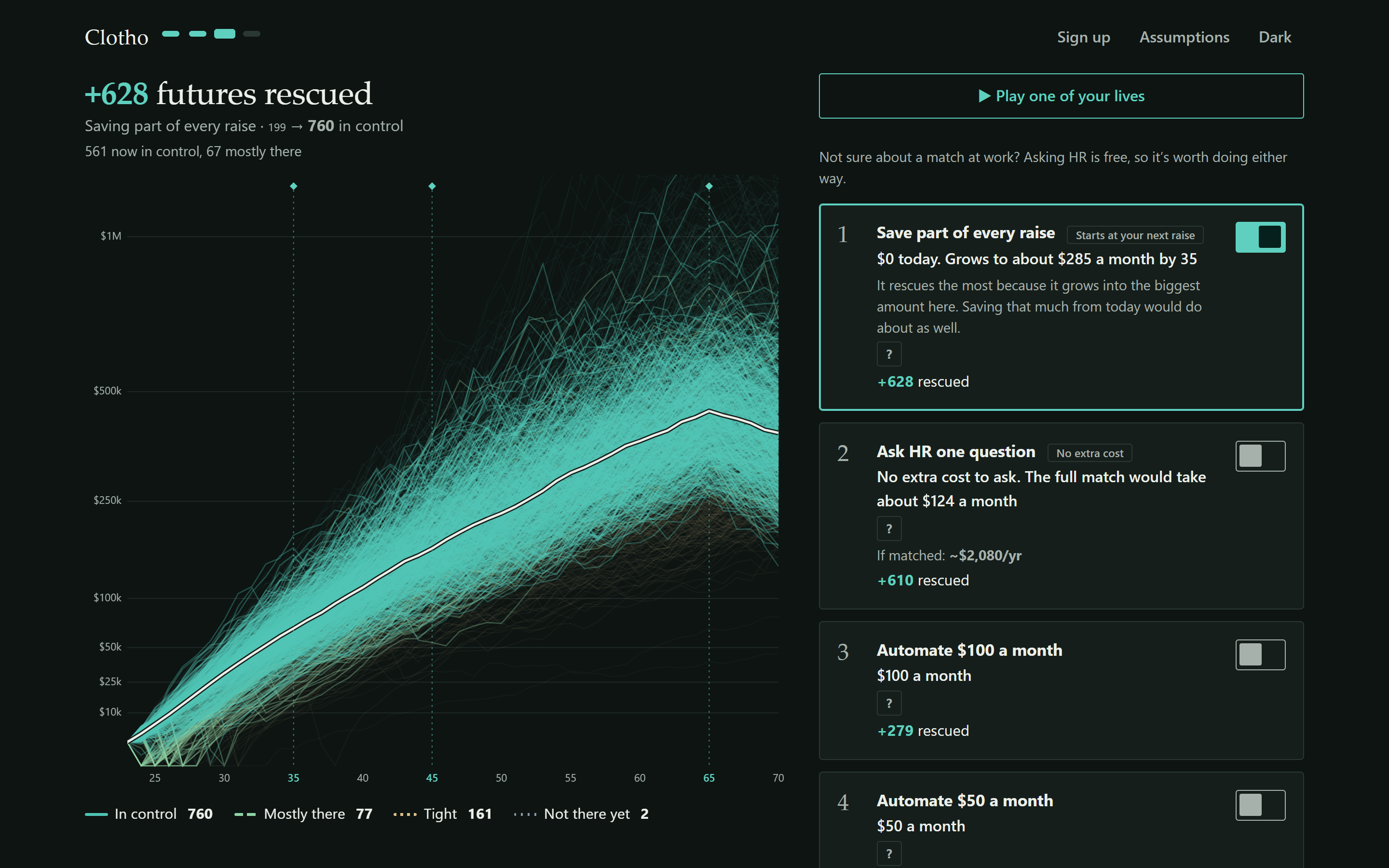
Chart of rescued futures
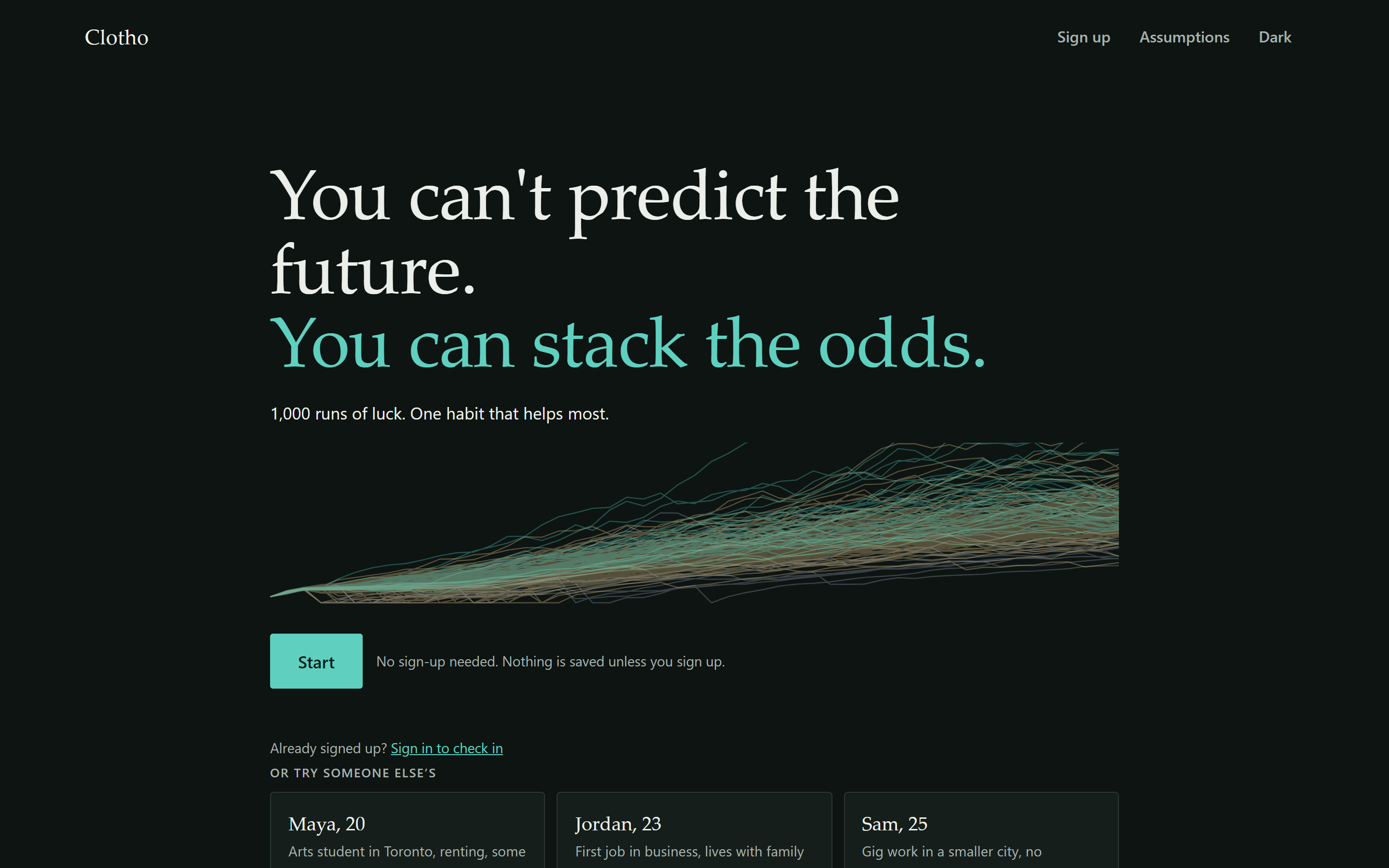
Inspiration
Most retirement calculators ask for your age and salary and give you one number for when you're 65. If you're 21, that number is either terrifying or meaningless, and either way you close the tab.
Canada Life's Gen Z research described something we recognized in ourselves and our friends. You worry about the world, so you doomscroll, you feel helpless, and you put off the boring things that would actually help, like turning on automatic savings. The research also found that messages of "doom" make it worse.
So we tried to build the opposite of a scary calculator. Start with what you're actually worried about, show how much it really changes, and end with one thing you can do today.
Clotho is the Fate who spins the thread of your life. Hack Western's theme was "Discover the unknown," and your own future is about as unknown as it gets.
What it does
You answer a few questions about yourself and Clotho runs 1,000 versions of your life from now until 70. Your choices are the same in every one. However, the luck is different, affecting layoffs, raises, market crashes, and surprise bills.
You see all 1,000 as lines on one chart, with a sentence on top like "185 of 1,000 futures in control today." A future is in control if it gets through the bad years, has savings to move with at 35 and 45, and makes work optional by 65. You can tap any line to read that life as a story, or press play and watch one happen.
Your worry is tested on those same 1,000 lives. For Maya, our example user, "AI changes my job" drops her from 185 to 25. Clotho then shows which habit helps most against it, like automating $25 or $100 a month, taking the full employer match, building a cushion first, saving part of every raise. Switch one on and the same lines move up. There are free ones too, like asking for a raise or paying lower fees, and pointers to the TFSA, FHSA and other accounts when they fit your situation.
Finally you pick one habit. You get the exact steps (or an email ready to send to HR), a calendar reminder, and the "how do you feel?" question again. If you sign in with Google, you can come back for a 30-second check-in each month: did you do it, and where is that pointing now. Signing in is optional, and if you skip it nothing is saved.
How we built it
The simulation is TypeScript running in a Web Worker, so the page never freezes. Each life steps through the years one at a time: pay and career changes, job loss, market returns and crashes, inflation, a cash cushion, TFSA, FHSA, RRSP and workplace plans with matching, student debt, and emergency withdrawals.
The part that makes the whole thing work is that every life draws all of its luck up front from a seed. Life #412 gets the same layoff and the same crash whether or not you switch on a habit. That's what lets us honestly say "this habit rescued 648 futures," and it's also why the lines can glide from their old shape to their new one instead of reshuffling.
The chart is drawn by hand on a Canvas so it can animate all 1,000 lines at once. The rest is React, Vite, Zustand and plain CSS, with light and dark themes and a phone layout.
Gemini only writes words. It can turn a life into a short story, soften the wording of a worry's answer, and sort answers people type in their own words. It never does math: we check every reply, and if it contains a number our engine didn't compute, we throw it away and use our own wording.
Sign-in uses Firebase with Google, and each person gets one private record that only they can read. There are 162 automated tests, and every assumption the model makes is listed in the app with where it came from.
Challenges we ran into
Tone was the hardest part. Some honest results are grim. An early version of "everything keeps getting more expensive" left almost no futures standing for someone saving a little, and it felt awful to look at. We didn't want to hide that, so we switched to counts instead of percentages, took out every bit of red, and made sure every bad number comes with the thing that helps.
Our favourite bug: the model treated a student's first full-time salary as a raise and automatically saved part of it. So a student putting away $50 a month looked safer than someone who'd been working for years. We only caught it by running very different people through the app and asking whether the answer made sense.
Language models love doing arithmetic, which is a problem in a money tool. Rejecting any reply with a number the engine didn't produce was the simplest rule we could trust.
We also wanted people to come back without making them create an account, so sign-in is optional and nothing is kept for people who skip it.
Accomplishments that we're proud of
The moment you switch on a habit and the same thousand lines lift. That's the thing we're proudest of. We also like that a vague fear like "AI will take my job" turns into a number and a next step, and that we finished the whole loop, from worry to action to coming back next month.
What we learned
"185 of 1,000" lands in a way "18.5%" doesn't. The wording matters as much as the code: "work becomes optional" starts a very different conversation than "retirement." And small assumptions can flip the whole result, so we ended up spending as much time testing different kinds of people as testing the code.
What's next for Clotho
We want to put it in front of more Gen Z users and see whether they actually take their step. We'd like an actuary to check our assumptions. After that, we'd like to try it inside a workplace benefits plan, where employers only see anonymous totals, and add things like partners, inheritances and moving between provinces.
Built With
- canvas
- cloud-firestore
- express.js
- firebase
- firebase-authentication
- gemini
- github
- node.js
- react
- typescript
- vite
- vitest
- web-workers
- zustand

