-
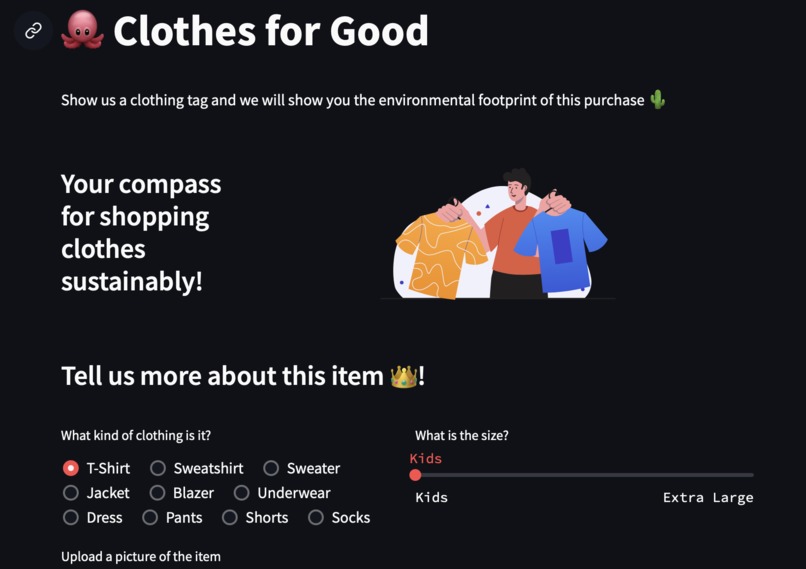
The Web App cover
-
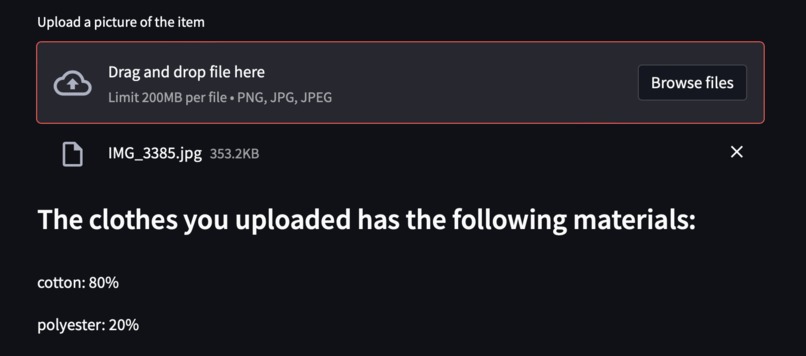
How to use the App
-
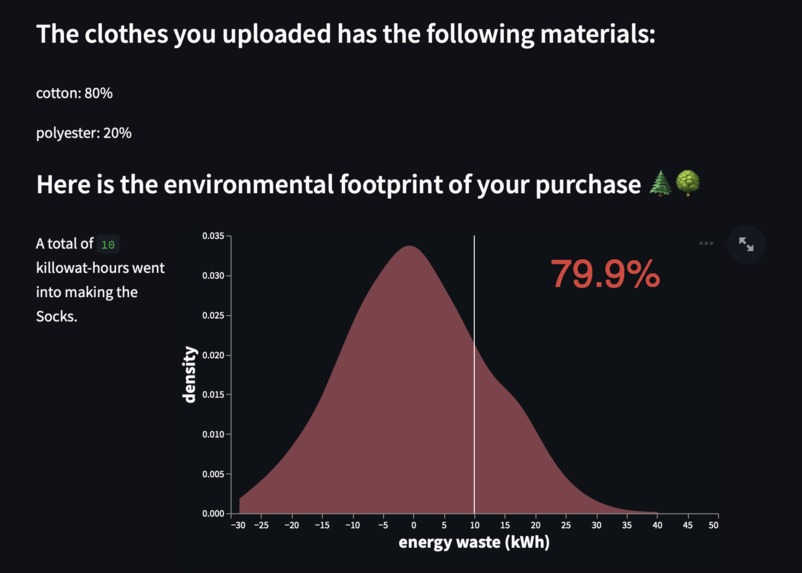
The report automatically generated by our Clothes4Good application!
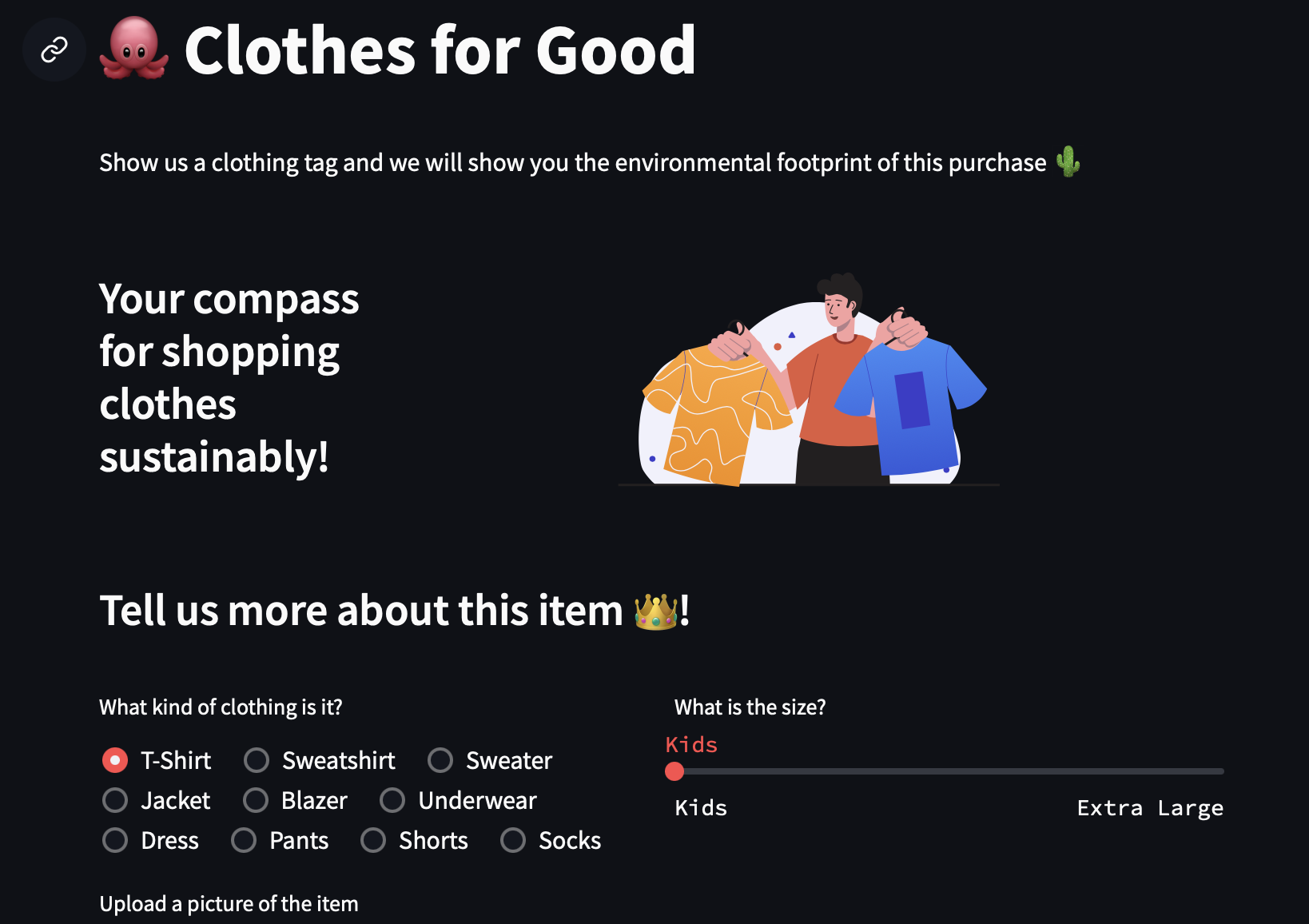

Environment Track
Clothes For Good
Inspiration
Textile production industries produce an outrageous amounts of water waste, producing one kilogram of cotton shirts require the use of more than 2,700 liters of water. The industry burns through trillions of kilowatt-hours of electricity, and account for 10% of global carbon emissions. This project, dubbed clothes for good, provides a pathway allowing customer to be conscious about how much energy waste goes into the purchase of a garment.
What it does
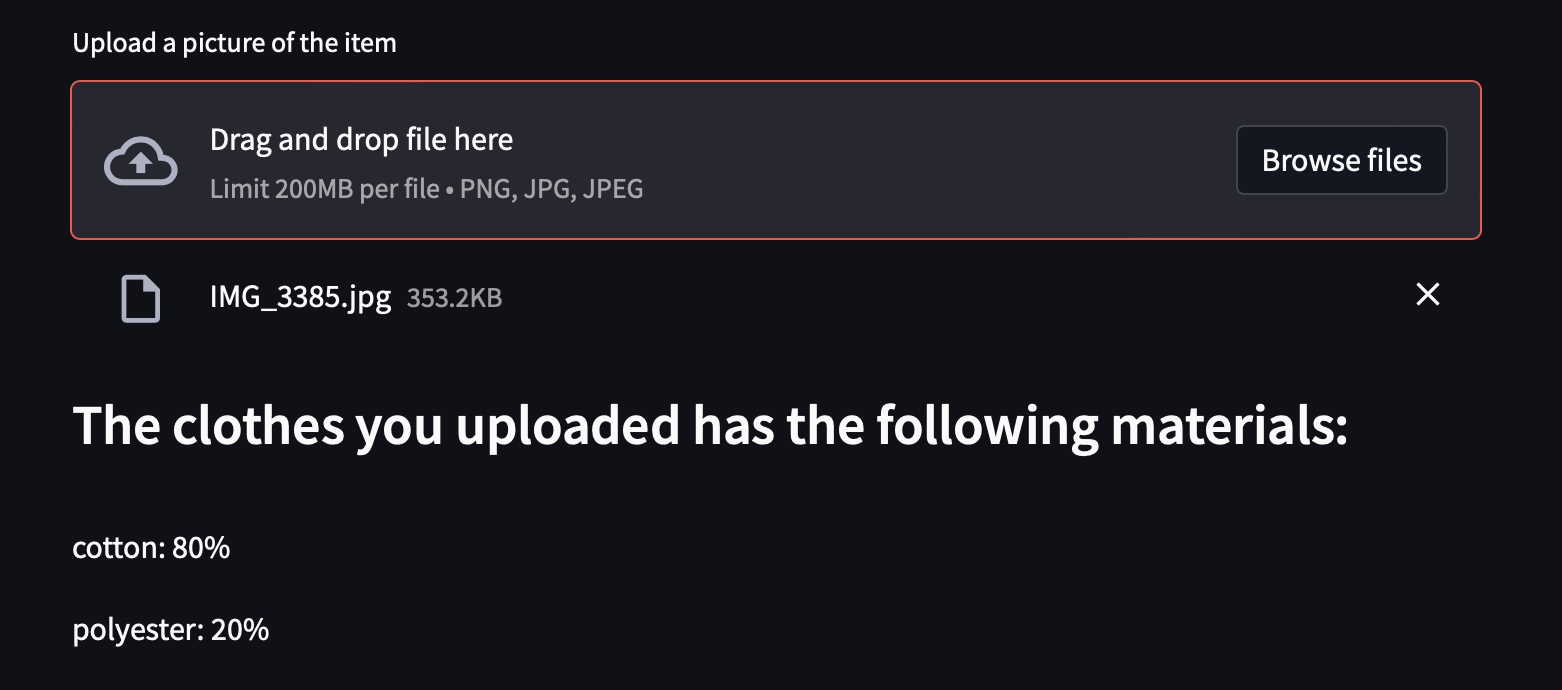
The web app gives users information about potential environmental costs that went into the making of that garment. Users scan a clothing tag with the material compositions at the store, enters the type of clothing and its size and receives clear and actionable insights on exactly how much electricity and water was used to produce the garment and how much greenhouse gas was emitted in the process. The app is user-facing and is designed to inspire conversations and build communities around sustainable fashion: users can see how their clothes’ environmental costs fall in the distribution of all other users combined.
How we built it
We used Google’s state-of-the-art image-to-text generation model to identify the composition of the clothes’ materials from the tag. Through external research, we build a matrix of data on the average electricity use, water waste and CO2 emission that went with each type of material. We fed the image into the model to get a list of all the materials in the clothes and their respective percentages, which we then use to calculate the estimated environmental footprint of that garment.
Challenges we ran into
First of all, even though we spent huge amount of time doing research (both webiste resources and academic research), the dataset isn’t comprehensive. Thus, most dataset might not be as accurate as reflected in the reality. Second, given that we are using the text-to-image package “tesseract”, which is developed by Google, in general, it is working accurately, while when it comes to lable with unclear characters, it might not detect the texts as expected, which is something we should fix after the HackDuke. Third, we use “Heruko” as the deployment tool for our web application, however for a third-party web service like it, some additional packages are not loaded as expected, which took us some time to test-and-error. (Thankfully, it is working!!)
Accomplishments that we’re proud of
First, all the members in our group are awareness of environmental issue. We have a common goal to achieve, which is to help raise awareness toward environmental protection and energy saving. We develop a practical, while interesting application that can really be deployed in our daily life. we can apply the web app tool (streamlit) and web service tool (heruko) to launch the application in the way we want.
What we learned
We learn that sometimes with “big” idea isn’t enough, we have to not only know the technical skills but also have practical project management and have a good flow of building it step by step. We also learned that DO NOT GIVE UP till the last minute.
What’s next
After the HackDuke event, we will keep working on the project in order to make the datasets more accurate reflected and make the Application more user-friendly. Furthermore, we aim to increase our user base and hopefully make the application widely applied. Meanwhile, we welcome people from fashion field or experts knowing the details of the textiles knowledge to work with us and together optimize the application.


Log in or sign up for Devpost to join the conversation.