Inspiration
Clothing waste rarely begins at the trash bin. It often begins earlier when someone sees a post, follows a trend, buys a cheaper copy, and replaces clothing that still has years of use left.
Cloth-ee originally started as a virtual fitting room. While building it, we realized that placing a digital shirt over someone did not answer the more meaningful question:
Why do people buy, replace, and discard clothing, and what could change that behavior?
That realization transformed Cloth-ee into a transparent fashion behavior simulation. Instead of claiming that we can predict a real shopper, we created a synthetic town where assumptions are visible, decisions are traceable, and interventions can be tested.
What it does
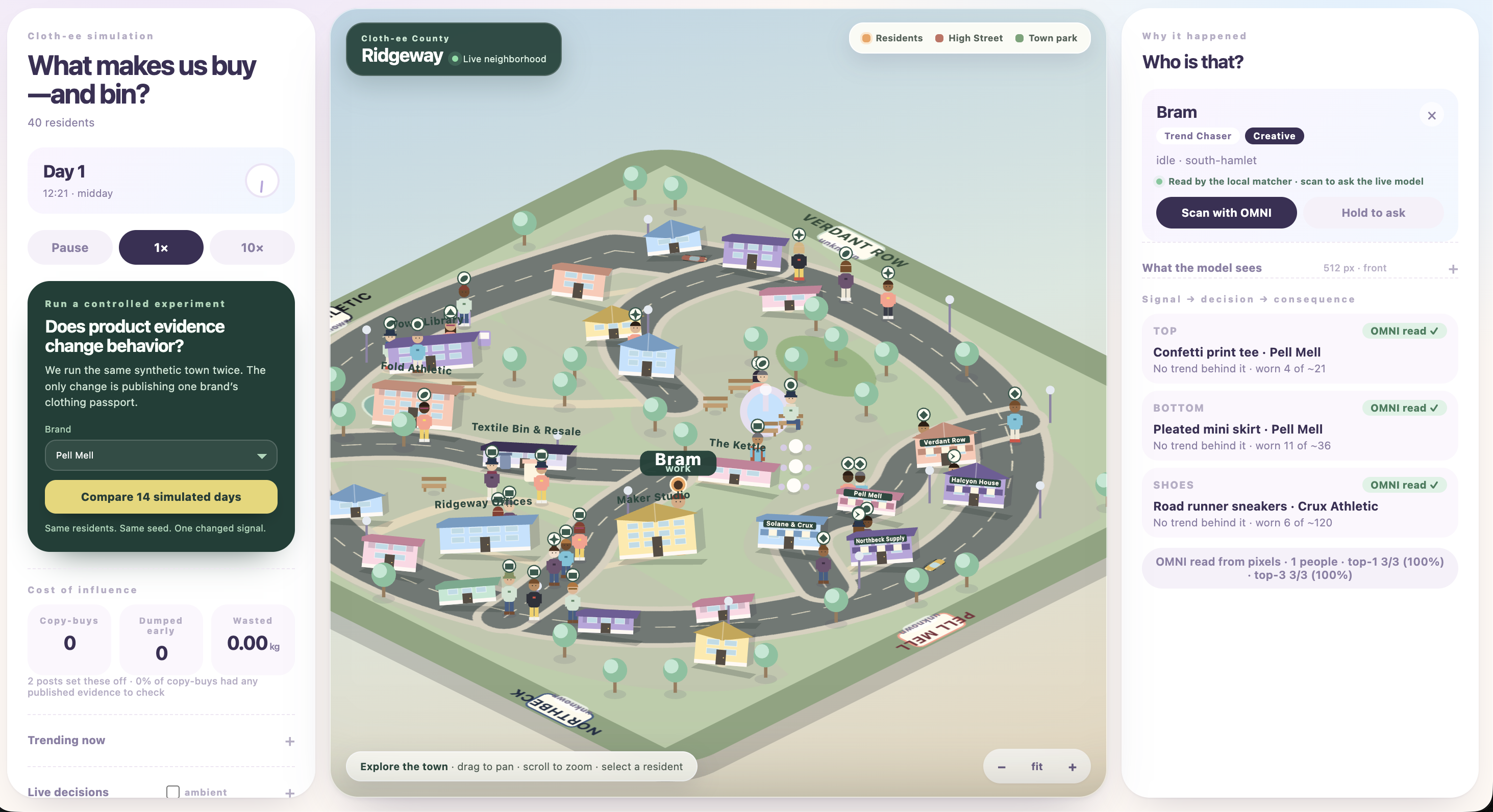
Cloth-ee simulates a town of 40 residents with different:
- Budgets and incomes
- Fashion preferences
- Jobs and routines
- Social connections
- Brand loyalties
- Sensitivity to trends
- Interest in sustainability evidence
- Disposal habits
Residents move through town, visit stores, purchase garments, wear them, influence each other, and eventually resell, donate, or discard clothing.
Every decision follows inspectable rules. When a trend causes a purchase, Cloth-ee can trace the complete chain:
Social signal → purchase → displaced garment → unused wears → disposal
Users can select a resident to understand what they are wearing, why they bought it, and whether another garment was replaced prematurely.
Cloth-ee also runs controlled experiments. It creates two copies of the same seeded town and changes one signal, such as whether a brand publishes a clothing product passport.
It then compares:
- Total purchases
- Purchases from the selected brand
- Items sent to the bin
- Prematurely discarded garments
- Potential wears lost
- Resale and donation rates
- Trend related textile waste
- Differences between shopper personas
The same seed and settings always reproduce the same result. This means the changed signal, rather than unrelated randomness, causes the difference between the two runs.
Cloth-ee presents these outcomes as synthetic scenario results, not predictions about real people.
How we built it
Cloth-ee is a browser based simulation built with JavaScript, HTML, CSS, Canvas, and a Node.js backend.
The shared simulation engine models:
- Resident schedules and movement
- Shopping decisions
- Product prices and availability
- Social posts and conversations
- Trend growth and decay
- Brand awareness
- Garment durability
- Wardrobe wear counts
- Premature replacement
- Resale, donation, and disposal
- Product passport availability
Each resident gives a garment a purchase score:
$$ \text{Purchase Score} = (\text{Style Fit} \times \text{Style Priority})
- (\text{Evidence} \times \text{Evidence Priority})
- \text{Need}
- \text{Trend Influence}
- \text{Social Awareness}
- (\text{Price Pressure} \times \text{Price Sensitivity}) $$
Different residents assign different importance to these signals.
A Conscious Buyer responds strongly to product evidence. A Trend Chaser responds more strongly to style and social momentum. A Bargain Hunter is more sensitive to price. A Minimalist has less interest in shopping and keeps garments longer.
The interface renders a living town and displays purchases, posts, conversations, wardrobe changes, and disposal events as they happen.
We also built:
- A deterministic baseline versus intervention runner
- Product passports with explicit unknown fields
- Material based lifecycle calculations with stated boundaries
- A Shopify Storefront adapter for products, variants, carts, and checkout
- An OMNI multimodal adapter for visible garment inspection and spoken questions
- A local visual matcher that can be evaluated against simulation ground truth
- Automated tests for determinism, evidence handling, catalog matching, sessions, and API behavior
The language model does not control resident behavior. Resident decisions remain rule based, reproducible, and testable. OMNI is used on demand to inspect rendered pixels and explain information conversationally.
Challenges we ran into
Finding the real product
Our first concept focused heavily on virtual try-on. We experimented with body landmarks, garment overlays, sizing profiles, and augmented reality interfaces.
We learned that reliable virtual try-on requires more than recognizing a person. It requires garment specific assets, body measurements, depth, segmentation, occlusion, cloth deformation, and validated fit models.
Presenting a rough overlay as accurate fitting would have weakened the project. The more interesting system was underneath it: behavioral signals, clothing lifecycles, social influence, and the consequences of replacing garments too early.
That led us to make the simulation the core product.
Making behavior understandable
It was easy to generate purchases and disposal events. It was much harder to explain why they happened.
We added causal records connecting social posts, trends, purchases, displaced garments, remaining wears, and disposal routes. This transformed the town from an animation into an inspectable experiment.
Avoiding misleading sustainability claims
Lifecycle information is incomplete and often uses incompatible system boundaries. A cradle-to-gate carbon estimate cannot be compared directly with a complete lifecycle assessment.
Cloth-ee separates information into three categories:
- Events observed inside the simulation
- Estimates calculated from sourced factors
- Unknown or unsupported information
If a required factor or source is missing, Cloth-ee shows it as unknown instead of asking a model to invent a number.
Comparing scenarios fairly
Two simulations can produce different results simply because of randomness.
To isolate an intervention, both scenarios use the same residents, schedules, social graph, products, and random seed. The intervention is the only changed signal.
Managing scope
The project evolved through virtual fitting, commerce, multimodal AI, product passports, lifecycle analysis, and behavior simulation.
Our biggest challenge was deciding which story these systems genuinely supported.
The final answer was to use the town to make clothing behavior visible, use controlled experiments to test interventions, and keep every claim honest.
Accomplishments that we're proud of
- Built a living simulation with 40 synthetic residents
- Created deterministic and repeatable scenario comparisons
- Traced trends from social posts to purchases and premature disposal
- Modeled garments through purchase, wear, resale, donation, and disposal
- Made resident decisions inspectable instead of hiding them inside an AI model
- Kept missing environmental and ethical information explicitly unknown
- Allowed OMNI to inspect rendered pixels without receiving hidden outfit data
- Created top-1 and top-3 garment matching evaluation
- Connected product passport visibility to evidence sensitive behavior
- Built an interactive town that works without external API keys
- Added Shopify product, variant, cart, and checkout support
- Reached 22 passing automated tests
We are especially proud that Cloth-ee does not force every intervention to look successful. An intervention can improve one metric while making another worse. The application reports that tradeoff instead of manufacturing a positive result.
What we learned
The most important lesson was that simulation and prediction are not the same thing.
Cloth-ee does not prove how real consumers will behave. It helps formalize assumptions, expose possible mechanisms, and identify ideas worth testing with real data.
We also learned that:
- Sustainability evidence matters most when it appears during a decision.
- A traceable story can communicate more than an isolated carbon score.
- A garment discarded with 40 possible wears remaining makes waste understandable.
- Deterministic systems are easier to test, explain, and challenge.
- Language models are more useful when grounded in observable information.
- Missing data is meaningful information.
- A smaller honest claim creates a stronger product than an impressive but unreliable one.
- Product development sometimes requires abandoning the original interface while preserving the strongest underlying idea.
What's next for Cloth-ee
Our next step is calibrating the simulation with real-world evidence.
We want to:
- Calibrate personas using consumer surveys and anonymized purchasing data
- Compare simulation outcomes with merchant conversion and return data
- Add repair, rental, return, and secondhand interventions
- Model washing, care, repair, and end-of-life pathways
- Import live Shopify catalogs into simulation scenarios
- Add merchant controls for price, durability, disclosure, and take-back programs
- Run experiments across multiple seeds and report outcome distributions
- Add confidence ranges instead of showing only one result
- Partner with researchers to validate behavioral assumptions
- Run controlled real-world trials based on hypotheses discovered in Cloth-ee
Our goal is not to claim that Cloth-ee knows what people will do.
It is to help researchers, merchants, and consumers ask a better question:
Which signals might change clothing behavior, for whom, and what should we test next?


Log in or sign up for Devpost to join the conversation.