Inspiration
Shopping for a dress online is endless scrolling. Filters don't know your taste, and a dress that looks perfect on the model often looks wrong on you, so it goes back. Meanwhile, every pause, like and skip is a signal about what you actually want, and none of it is ever turned into anything useful.
Dating apps solved a similar problem with one gesture: swipe right if you like it, left if you don't. We asked: what if a stylist learned from those swipes the way a good friend would, and could show you how a dress looks on you before you buy it?
You might not find your perfect date, but with Closet Cupid you can find your perfect dress.
What it does
- Tell Cupid about yourself. Pick the occasion and your vibe, and add a selfie. YouCam Skin Tone Analysis reads your undertone, so Cupid judges colours for you.
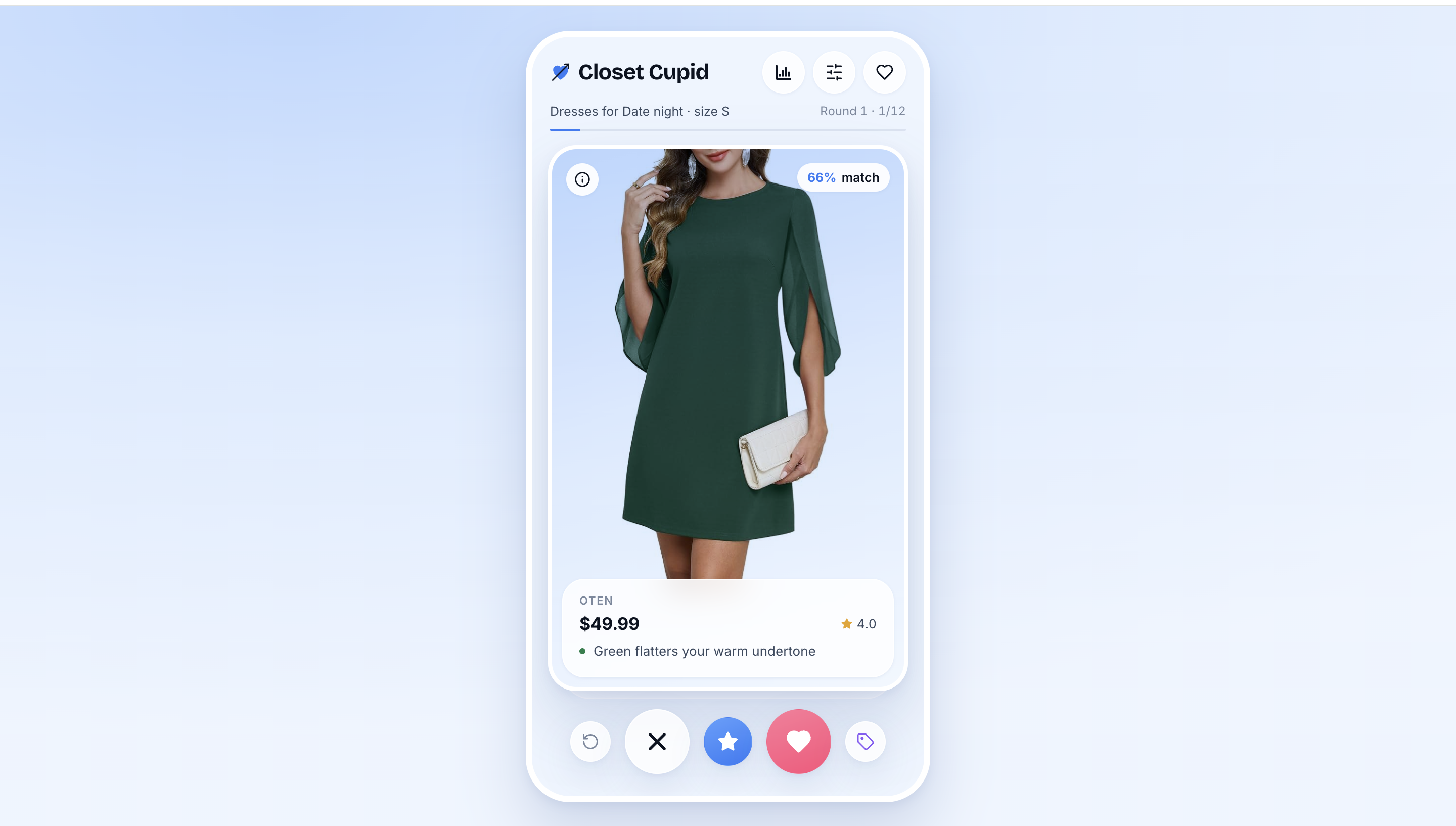
- Swipe. Right if you like it, left if you don't, up to super like. After every swipe, Cupid, a self-learning stylist agent built on Claude, rewrites its profile of your taste and picks your next dress for a reason: "Best bet", "Testing long sleeves", "Something new".
- Try it on. A super like sends the dress and your photo to YouCam Clothes Try-On. Claude then looks at the try-on itself (colour against your skin, fit, length) and gives honest green and red flags. Your Love it on me or Not on me teaches Cupid something a swipe can't.
- Love one, see its look-alike. Like a dress and the next card is its closest look-alike, found by a fashion vision model. Like that too and Cupid leans in. Pass, and it backs off.
- Cupid asks when it's unsure. Every 12 swipes it tells you what it learned in one line. Then it asks this or that: two real dresses, alike except for the one thing it can't work out (sleeveless or long sleeve?). One tap changes your next round.
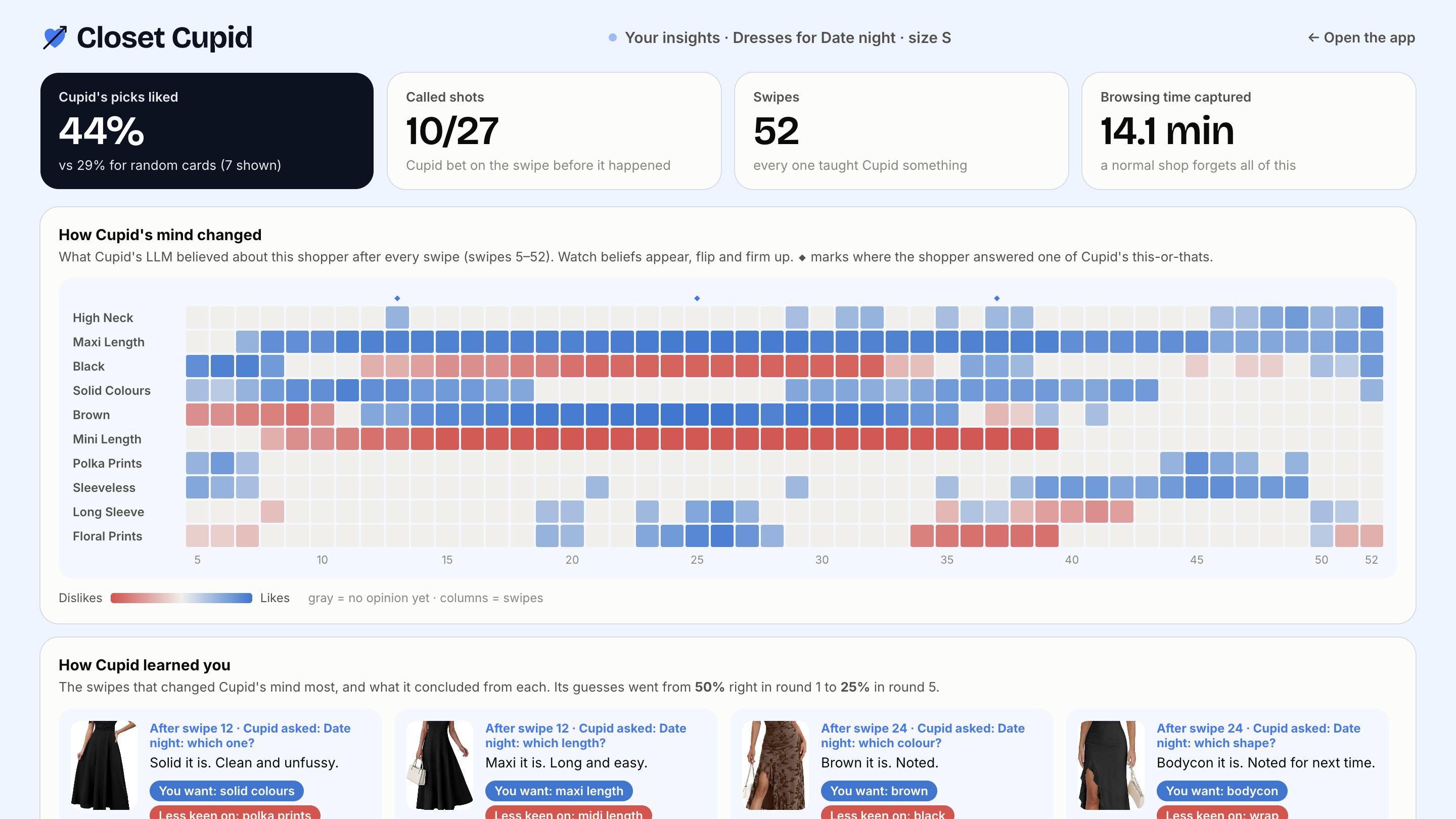
- Insights. Your scrolling becomes a picture of your taste:
- a heatmap of how Cupid's beliefs about you formed and flipped, swipe by swipe
- the turning points that changed its mind
- the experiments it ran on your taste
- the searches it went shopping with
How we built it
Frontend: React 19 + TypeScript + Vite, with framer-motion for the swipe physics and a sky-blue glassmorphism UI.
Backend: Python, FastAPI and SQLite, deployed as one Docker service on Render.
YouCam APIs: Skin Tone Analysis (onboarding) and Clothes Virtual Try-On (cloth-v4, super likes).
The catalogue: about 2,000 real dresses from US online stores, fetched through SerpAPI and cached. Each one is fingerprinted and tagged by Marqo-FashionSigLIP (Hugging Face), which gives image embeddings and zero-shot style tags such as boho, minimal and edgy.
The learning: every dress gets a match score from four layers:
$$ p(\text{like}) = \sigma\Big(b + \sum_{f \in \text{dress}} \big(w_f + t\,s_f + \beta_f + \tau_f\big) + \gamma\, k(x)\Big) $$
- \( w_f \): online logistic weights for each attribute (colour, cut, neckline, sleeve, length, fabric, vibe). They update on every swipe, with recent swipes counting more.
- \( s_f \): what you told it at the start. It fades as evidence grows, with \( t = \tfrac{1}{1 + n/10} \).
- \( \beta_f \): Claude's beliefs, taken from the written profile it rewrites after every swipe, using structured JSON outputs.
- \( \tau_f \): your this-or-that answers. These are your own word, so they don't fade.
- \( k(x) \): a look-alike score, a nearest-neighbour vote over the FashionSigLIP embeddings of dresses you liked and passed on.
The agent: Claude Haiku 5.5 does more than learn. It plans the next cards from a shortlist, labels why each was chosen, keeps a list of experiments about your taste (testing, confirmed, rejected), writes its own product searches from real store filters, and writes the this-or-that questions. The app then picks the actual pair of dresses: the most similar-looking pair that differs only in the attribute being tested.
Keeping it honest: about 15% of cards are random control cards, so we can measure whether Cupid's picks beat chance. With simulated shoppers of known taste, its picks are liked 13–15 percentage points more often than a random feed.
Challenges we ran into
- LLM latency vs. a fast thumb. People swipe every second or two, but a Claude call takes 3–8 seconds. All learning and planning runs in a background queue, so the swipe never waits. The end-of-round summary was getting stuck behind that queue, so it now runs on its own thread and is ready about 0.6 s after the round ends.
- Every vibe got the same feed. Picking "boho" or "minimal" barely changed the first cards, because the occasion's search results were mostly one style. We had FashionSigLIP rank the catalogue for each chosen vibe and rewrote the vibe prompts so the model could tell them apart. Dresses tagged minimal went from 12 to 306.
- Making an LLM ask good questions. Our first yes/no questions were vague or contradicted the summary. Switching to this or that, with Claude limited to real attributes (enum-constrained structured outputs) and the app choosing real dress pairs, made every answer specific and immediately useful.
- Spending responsibly. It's a public link on paid APIs, so it has hard daily limits on SerpAPI calls, Claude sessions, try-ons and photo analyses. Claude costs about \$0.001 per swipe, roughly 3–4 cents per shopping session.
- A flaky test. Our "Cupid beats random" test occasionally failed because Python's hash randomisation changed the simulated data between runs. Averaging over more simulated shoppers made it hold every time, without lowering the bar.
Accomplishments that we're proud of
- An agent that visibly learns: you can watch its beliefs about you form, flip and firm up on the insights heatmap.
- Try-on that teaches the stylist, not just a gimmick: "loved the style, not on me" is a signal no swipe can give.
- Questions that feel like a stylist, not a form: two real dresses, one tap.
What we learned
- The best use of an LLM here wasn't recommending. It was explaining and deciding what to test next, combined with fast numeric models for ranking.
- Asking at the right moment beats guessing: one this-or-that answer settles what ten swipes leave unclear.
- Seeing a dress on you changes decisions more than any product photo.
What's next
- Insights for brands, pooled across shoppers: dresses loved on the model but rejected on real people, colour preferences by skin undertone, and why shoppers pass.
- More categories beyond dresses, and complete-the-look suggestions with more YouCam APIs.
- A real user study to measure fewer returns.
