-
-
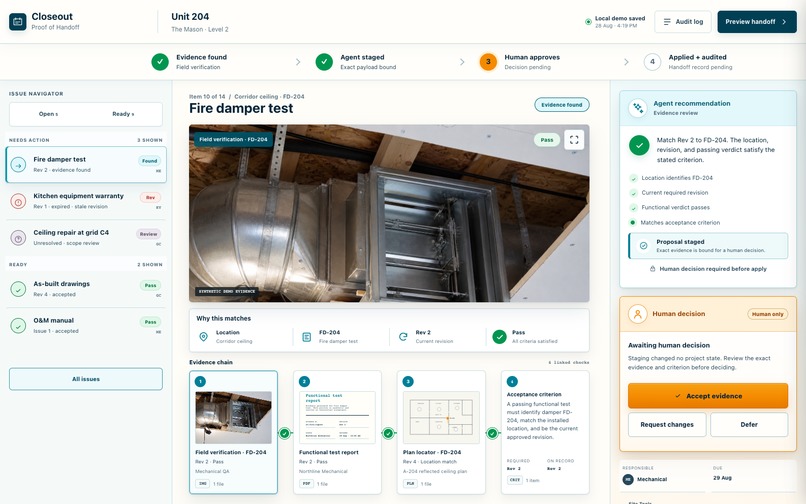
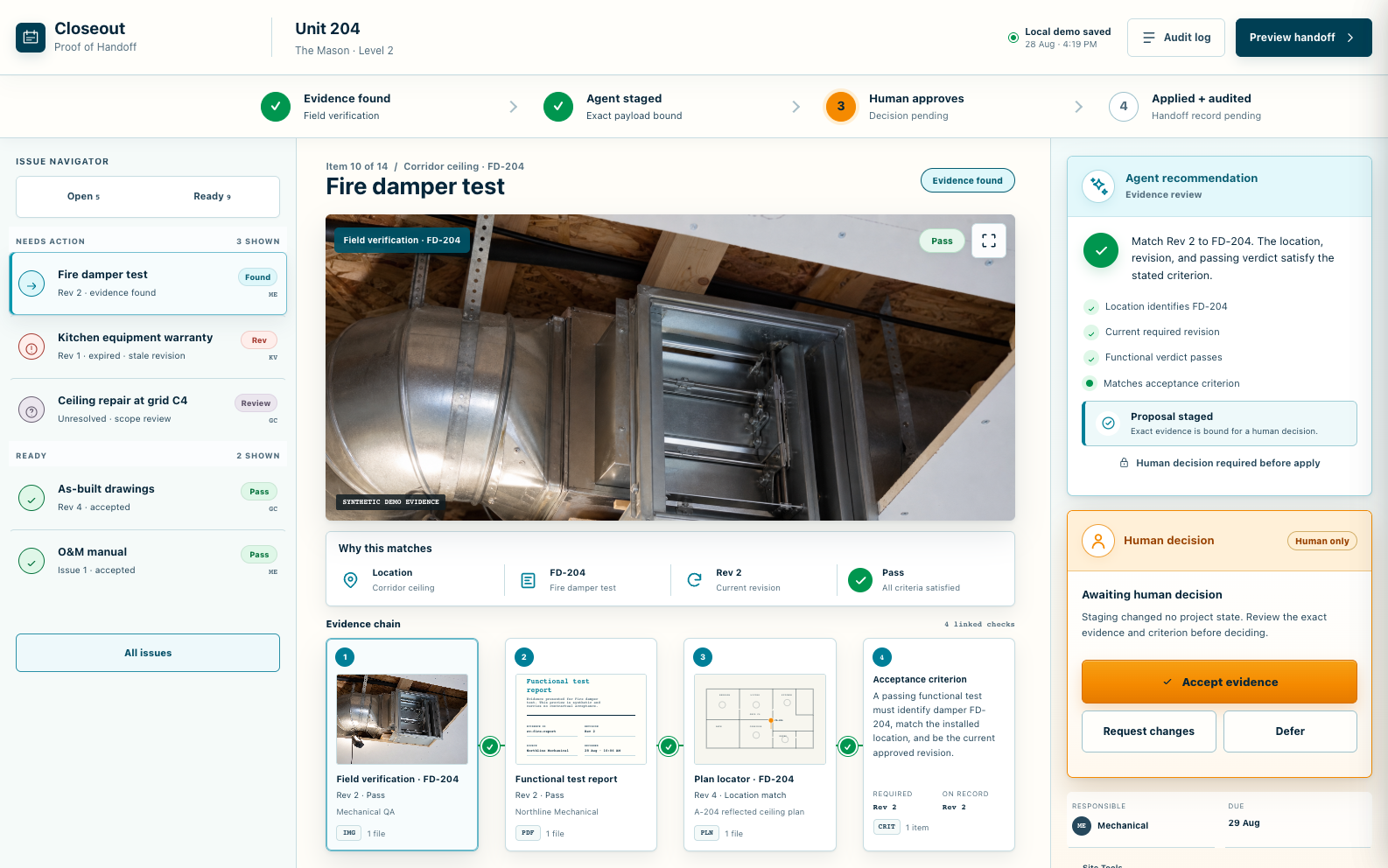
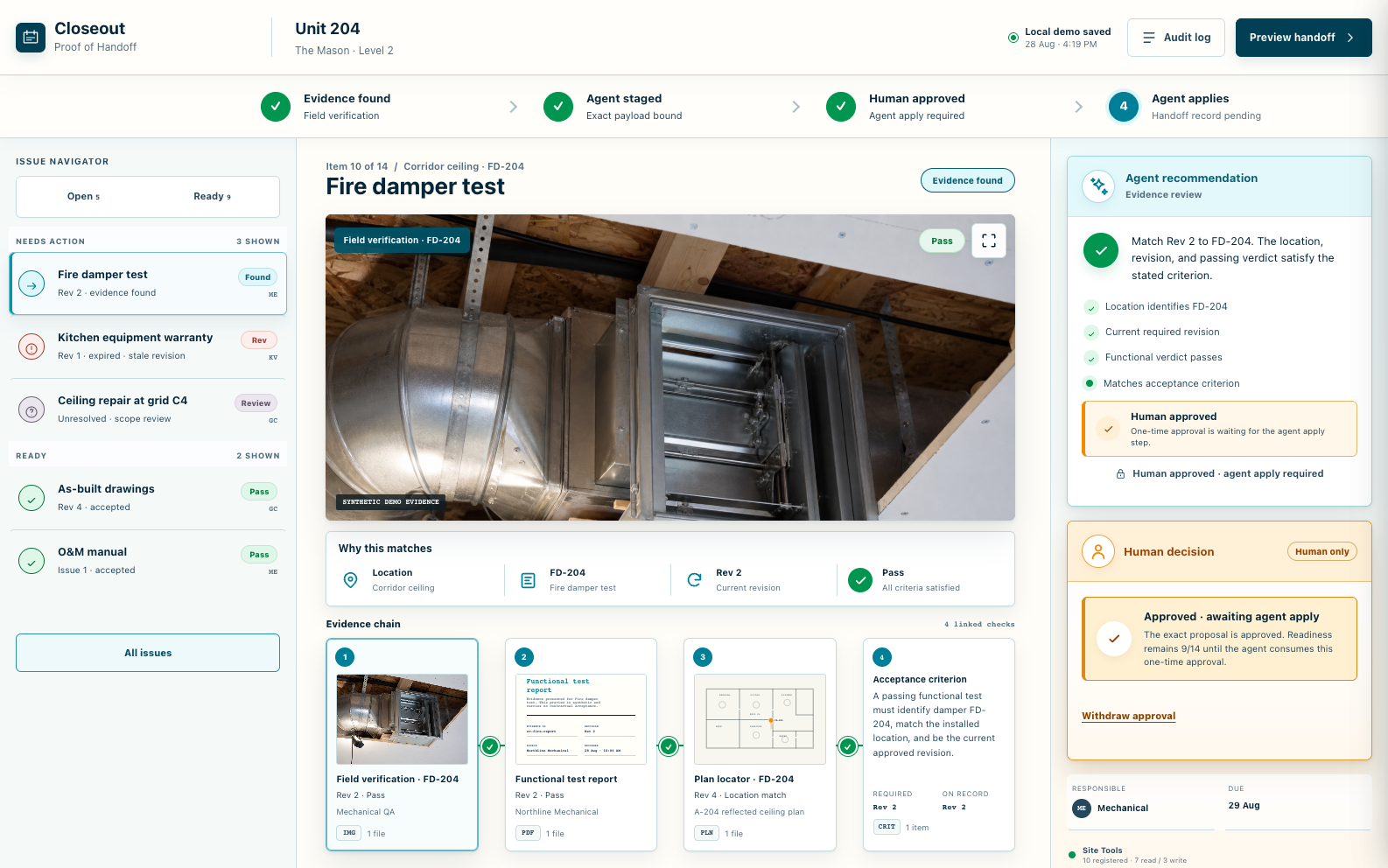
Desktop: human decision staged and ready for approval
-
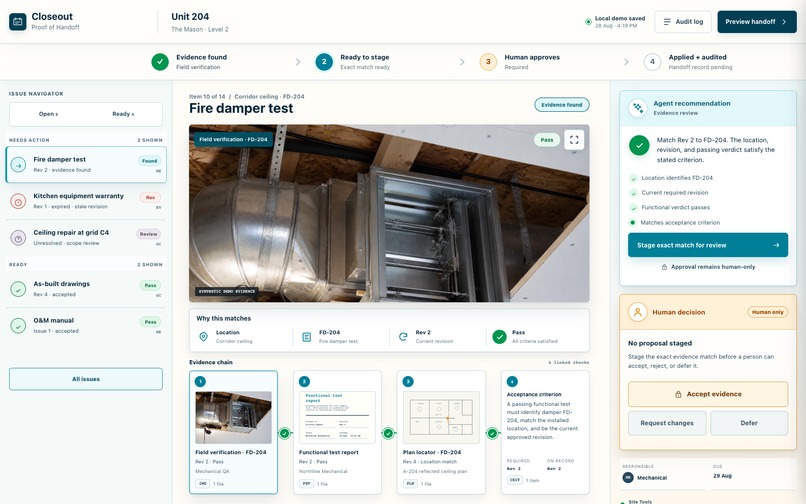
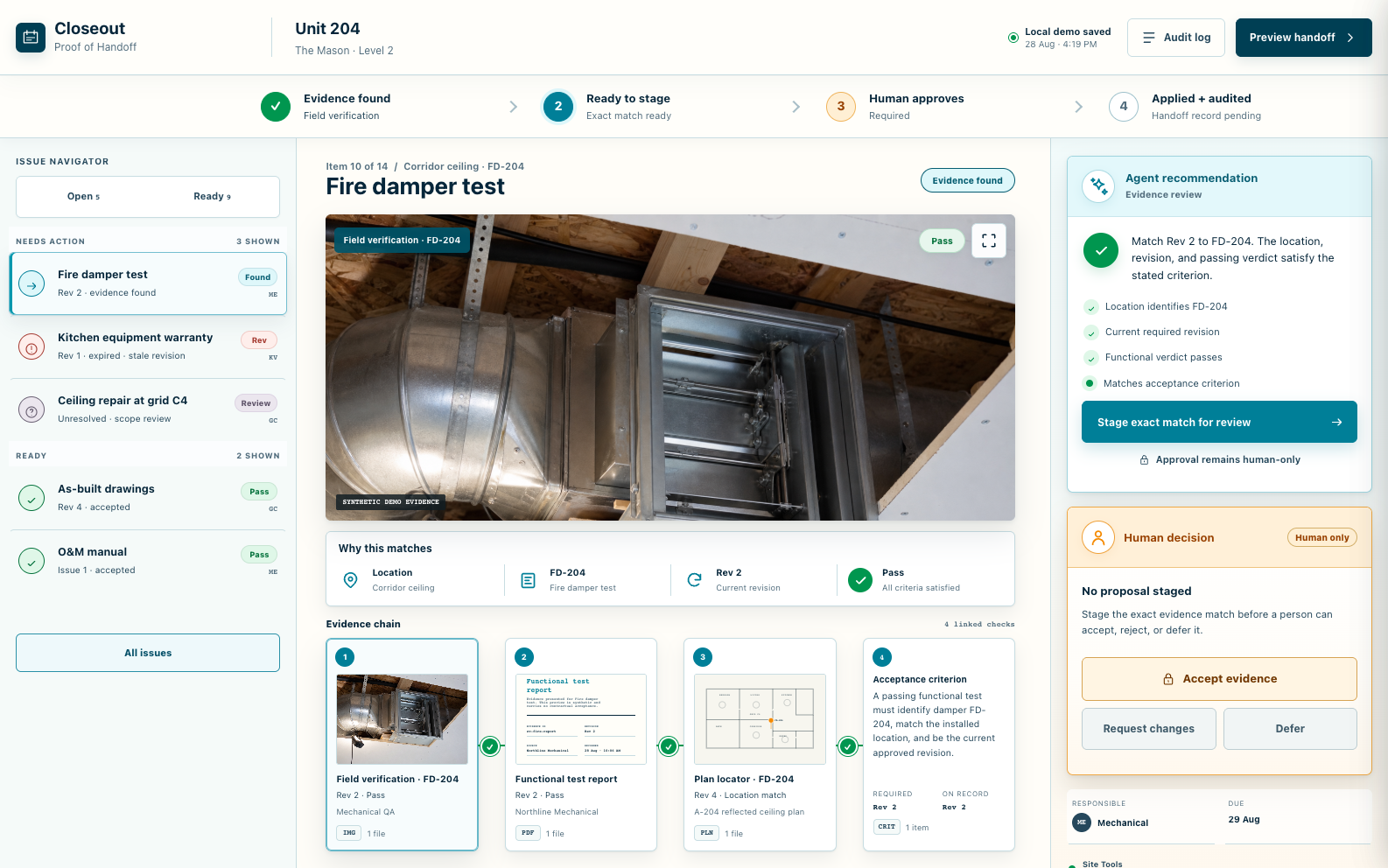
Desktop: proposal locked until agent staging
-
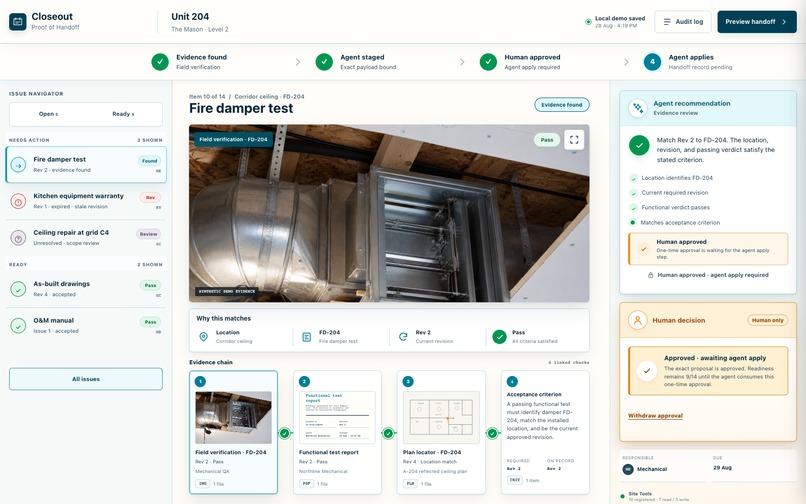
Desktop: approval recorded and withdrawable before apply
-
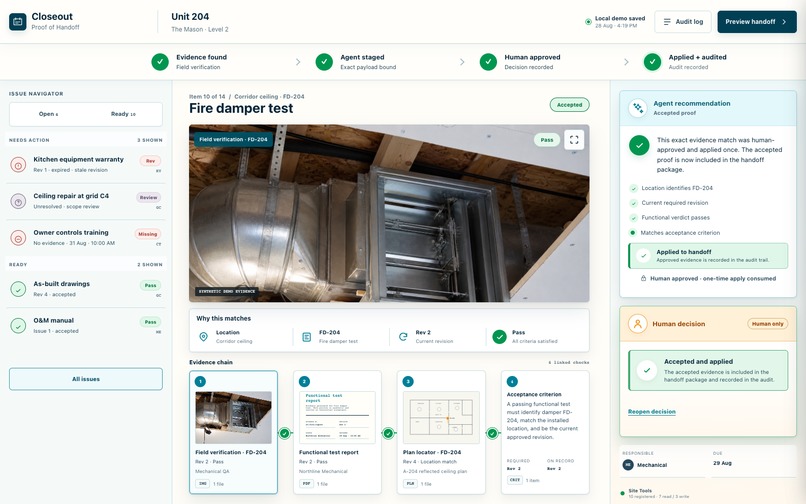
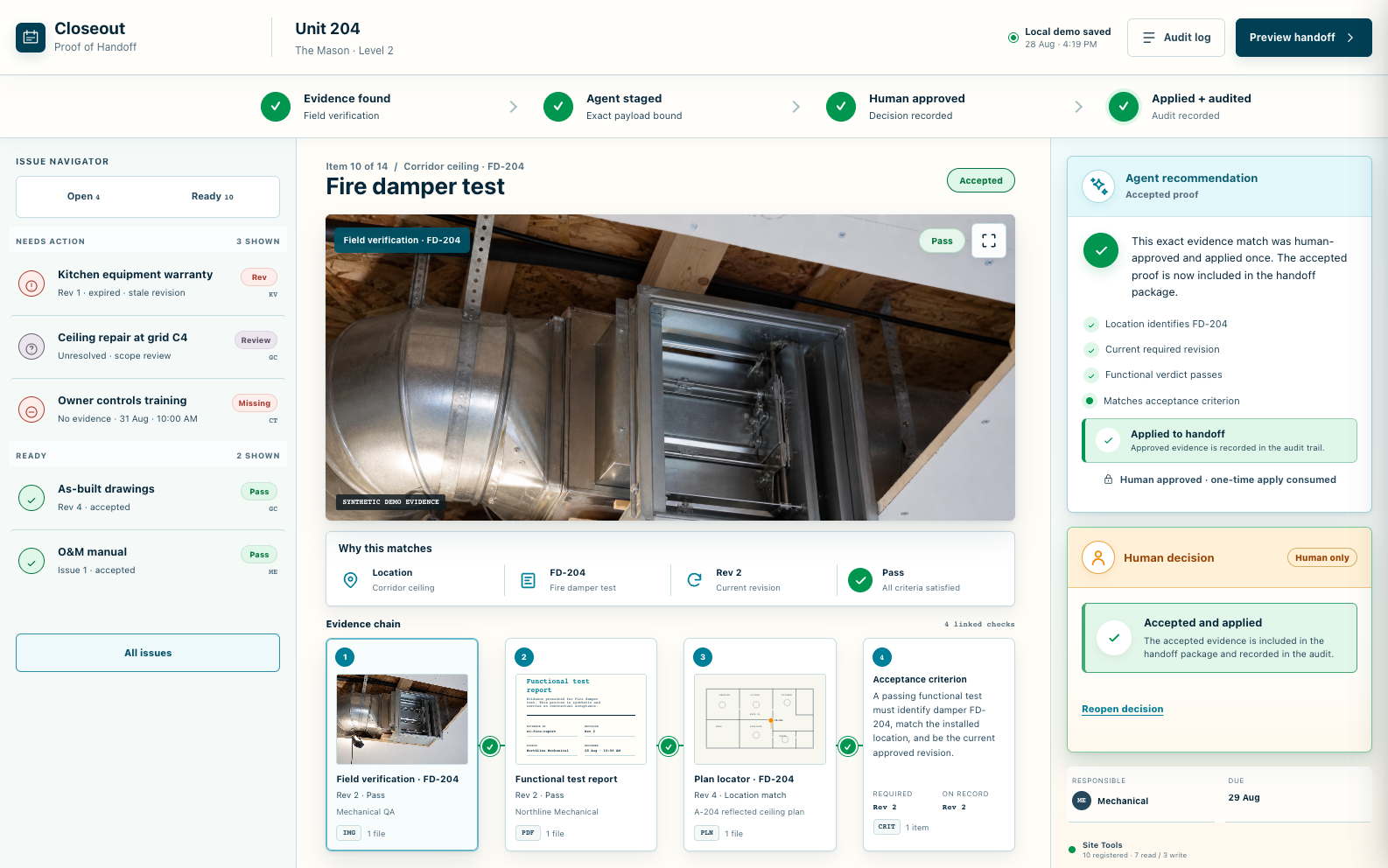
Desktop: approved evidence applied with audit-ready completion
-
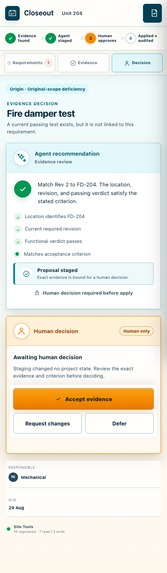
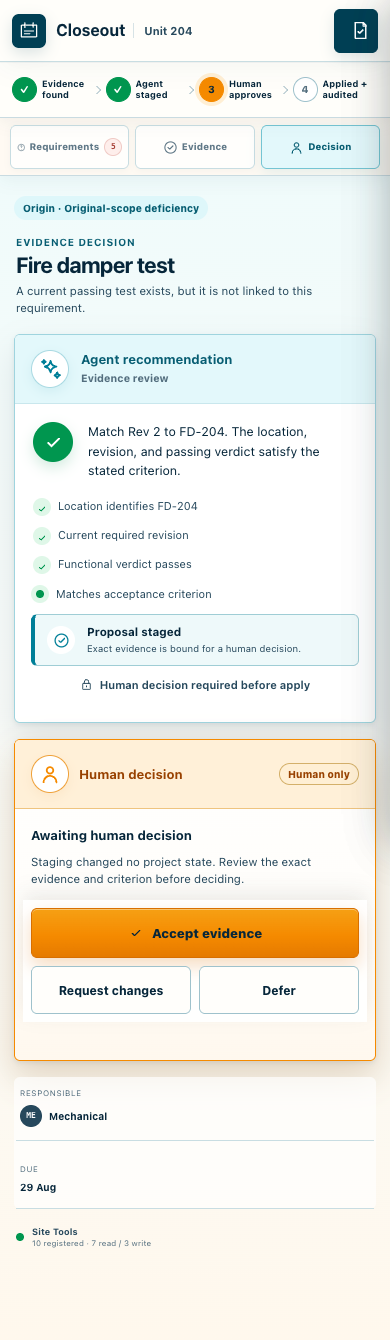
Mobile: staged human-decision controls
-
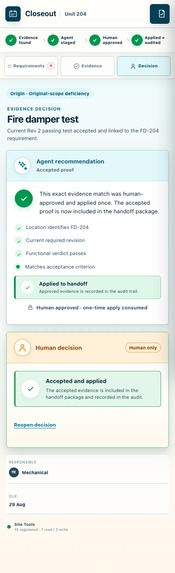
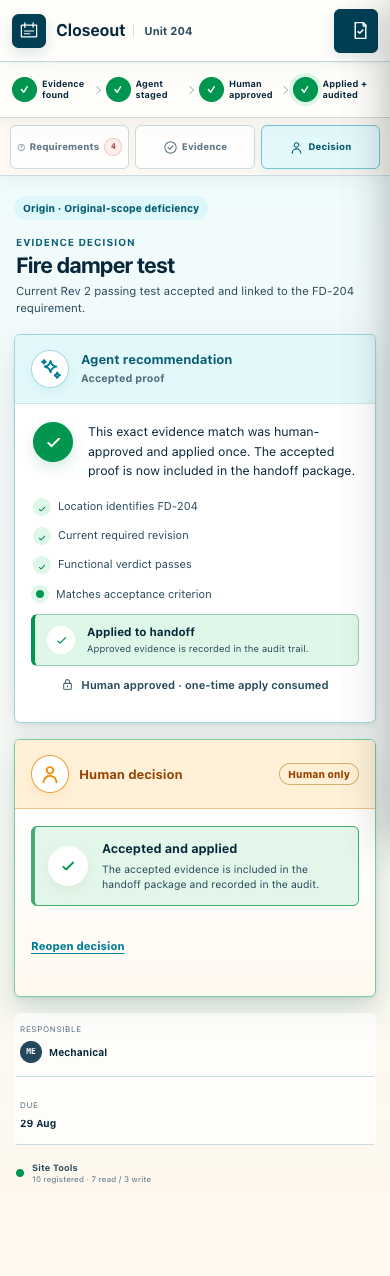
Mobile: applied state and completion confirmation
Who it is for
For general contractors, owner representatives, closeout coordinators, and commissioning teams, Closeout catches stale, missing, or mislinked proof while keeping scope questions from becoming false completion.
Judge in 60 seconds
- Open
https://closeout-proof-of-handoff.vercel.app/in a supported ChatGPT or Chrome WebMCP testing surface. An ordinary browser intentionally shows preview mode. - Call
closeout_read_stateandcloseout_identify_blockers: the clean seed is9/14with five explicit blockers. - Stage
fire-testwithev-fire-photo; readiness must remain9/14. - Use the visible Accept evidence control on the page.
- Apply the returned token once; readiness moves to
10/14. - Retry the same token and observe
APPROVAL_CONSUMED. - Preview the handoff: it remains
not_ready_to_issuewith four named exceptions.
Use closeout_reset_demo afterward if you want to restore the clean seed in
that browser context.
Inspiration
Construction closeout often fails at the last mile. The work may look finished while the proof needed for handoff is missing, stale, attached to the wrong revision, waiting on an owner decision, or mixed with a possible change order. A generic checklist hides those distinctions. Closeout turns them into one visible evidence-to-criterion workflow.
What it does
The demo opens one synthetic Unit 204 package at 9 of 14 requirements ready. Five exceptions represent different closeout failure modes:
- A current passing fire-damper test exists but is not linked.
- A kitchen warranty is one revision behind and expired.
- A ceiling repair may belong to a possible change order.
- The owner controls-training record is missing.
- Paint touch-up evidence still awaits owner acceptance.
ChatGPT can use seven read Site Tools to inspect the structured state, criteria, revisions, evidence chain, blockers, recovery plan, pending decision, audit, and handoff result. It can use two bounded write tools to stage the one eligible FD-204 match or Paint Photo 12 owner-review record and apply it only after the same payload is approved through the visible human-only page control. A third destructive tool resets only the synthetic in-memory demo for judging.
The successful path moves readiness from 9/14 to 10/14, records the exact
actor/payload/decision/application chain, rejects replay of the consumed token,
and keeps the handoff package at not_ready_to_issue with four explicit
exceptions.
Why WebMCP improves the experience
Without WebMCP, an agent would have to infer meaning from cards and click a UI that was designed for people. The page instead provides narrow domain contracts for requirements, evidence, revisions, scope lanes, approval state, and audit results. The agent and person operate the same live page and can both verify the visible outcome.
This is not a button-replacement demo. The useful collaboration depends on the split between structured agent operations and human judgment:
Structured blockers → digest-bound proposal → visible human decision → exact one-time application → replay rejection → truthful blocked handoff.
- The agent may inspect, reconcile, explain, and stage.
- A person alone may accept, reject with a reason, defer, or reopen.
- The agent may apply only the exact approved payload once.
- Neither side can silently convert unresolved exceptions into completion.
How it was built
- Dependency-light HTML, CSS, and JavaScript with an evidence-centered responsive construction UI.
- Ten top-level imperative Site Tools registered sequentially with awaited
document.modelContext.registerToolcalls. - Narrow JSON input schemas and accurate read/write/destructive annotations.
- SHA-256 project-state, payload, approval, decision, and result digests.
- Generation-bound one-time approval tokens with a random per-page nonce.
- Exact criterion, revision, evidence fingerprint, payload, approval, and expected-state checks before mutation.
- A visible actor audit and exception-aware handoff preview.
- Restrictive CSP, no network sinks, safe DOM construction, and entirely synthetic local data and imagery.
- A Playwright regression harness that captures the real registered handlers and exercises visible human controls.
Challenges
The first internal prototype discovered Site Tools but did not reliably invoke them because registration was not awaited and the test procedure reused stale session state. We isolated the problem with an official OpenAI control and a one-tool awaited local control, then registered the production tools sequentially and tested in a fresh supported ChatGPT session.
The harder design problem was preventing “approval” from becoming a decorative button. The final workflow binds the exact criterion, revisions, evidence, state, payload, person-visible decision, token, and generation. Reset and replay paths fail closed, and the handoff package never claims that unresolved work is complete.
Accomplishments
- Genuine production Site Tool discovery and invocation in ChatGPT desktop build 7303 with Recently Used/Sources evidence.
- A complete read → stage without mutation → preapproval block → visible human approval → exact apply once → replay rejection → audit → handoff flow.
- A second owner-acceptance flow for Paint Photo 12 that applies only after the visible decision and reopens back to the exact unresolved seed state.
- Ten consecutive complete automated production flows with zero unauthorized mutations, plus concurrent reset/apply, cross-generation replay, decision, keyboard, and untrusted-input coverage.
- A polished desktop/mobile evidence workspace that is separate from the frozen internal validation prototype.
- The final-fidelity main branch is deployed to the public Vercel origin with matching runtime assets, restrictive headers, excluded internal paths, and fresh desktop/mobile QA.
- Public-origin ChatGPT Terra/Sources returned the exact
9/14seed and all five blockers, then passed the guarded stage → human approval → exact apply → replay rejection → audit → truthful handoff → reset → stale-generation sequence. That first public checkpoint finished at the clean generation-2 seed; the later same-generation demo capture reset cleanly to generation 3. Isolated Chrome native WebMCP independently passed read-only discovery and invocation.
What we learned
WebMCP is strongest when the page offers a domain contract instead of a second copy of its buttons. The agent needs structured operations and enough result data to verify the effect; the person needs the same state rendered clearly, with consequential judgment kept in the ordinary interface.
What is next
A production version would integrate authenticated project records and durable storage while keeping the same evidence, scope, approval, audit, and exception boundaries. This challenge entry intentionally avoids external systems and real project data so the judge path remains deterministic and safe.
Built with
WebMCP / OpenAI Site Tools, HTML, CSS, JavaScript, Web Crypto, Playwright, and original synthetic evidence imagery.
Built With
- css3
- html5
- javascript
- openai
- playwright
- vercel
- webmcp

Log in or sign up for Devpost to join the conversation.