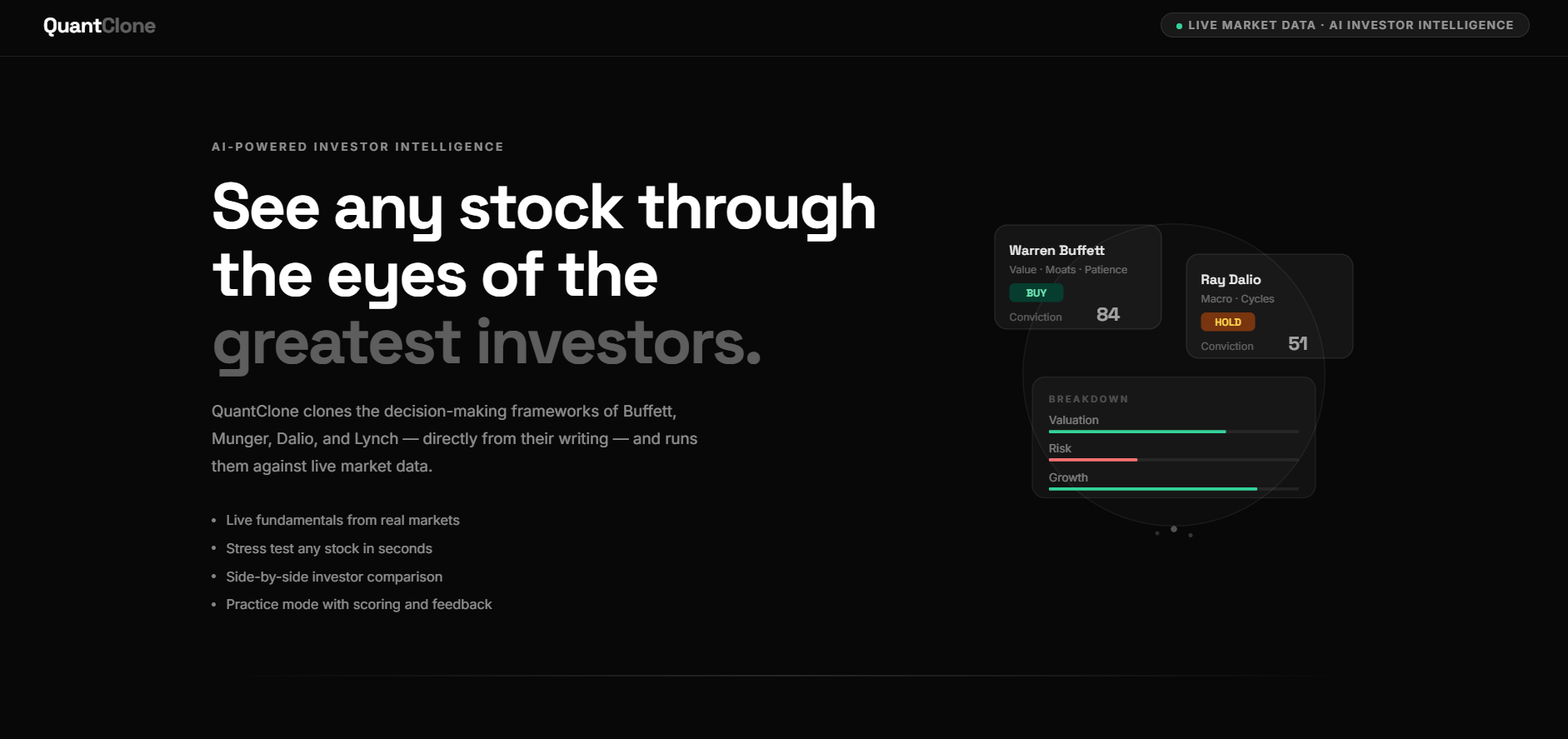
QuantClone was inspired by a simple idea: most investing tools give you data, but not the thinking process behind great decisions. We wanted to simulate how investors like Warren Buffett and Ray Dalio would evaluate a stock, basically making a "clone" of the top investors. This is something no one has ever done before; people have made AI's that give generic advice or built something to give the most trending stock today, but no one built a webstite before that not only gives results based off of the mindsets of investors, but also let's you compare between investors to give you the best stock options.
One of the biggest challenges was stopping the outputs from feeling generic. Early on Buffett and Dalio sounded too similar, scores were clustering around 50, and the reasoning made no sense. So we went back to a piece of paper, researched each investor and how they looked at stocks, and then used that to build a scoring model that makes each clone respond differently with accurate results. Then, we started having issues with our API keys; They stopeed working. We then switched to groq and results were much better. Once the logic was working we moved onto to the UI because we knew our very complex backend needed a simple frontend. We planned out the layout first on canva, then built the visuals, which took the most time as we had to learn various HTML techniques that we never used before. After that we added the portfolio feature so users can track and plan their positions all in one place.
One thing we focused on a lot is the impact we could give to people all around the world. This is why we made the UI/UX so easy to use. Many students blindly trust AI machines who tell them to buy a stock for the first time, so we made it so that they can learn from the best, so that next time, they won't have to use the first AI they find to buy a stock. We also added the portfolio option to let people know how diverse your portfolio shouldbe and why the top investors believe in spreading out your stocks. Finally, we added 3d effects all around the website to further enhance the user's experience with a modern touch.
What we learnt is that we should always plan out our ideas before just making them. Once we put our ideas on a piece of paper and canva, we were able to visualize what we were doing much more effectively. We also learnt that live data changes everything. Once we started using real-time data for our project, everytrhing suddenly became much more personalized and responses were not repetitive at all.


Log in or sign up for Devpost to join the conversation.