-
-
Highlight
-
Strategy Guide
-
Settings Guide
Inspiration
Clockbound started with a simple idea: what if time was not just part of the story, but a resource the player needs to survive?
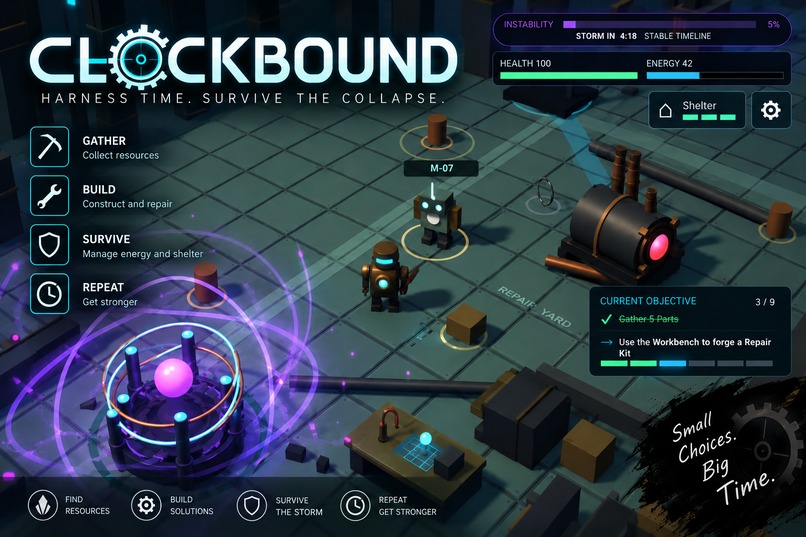
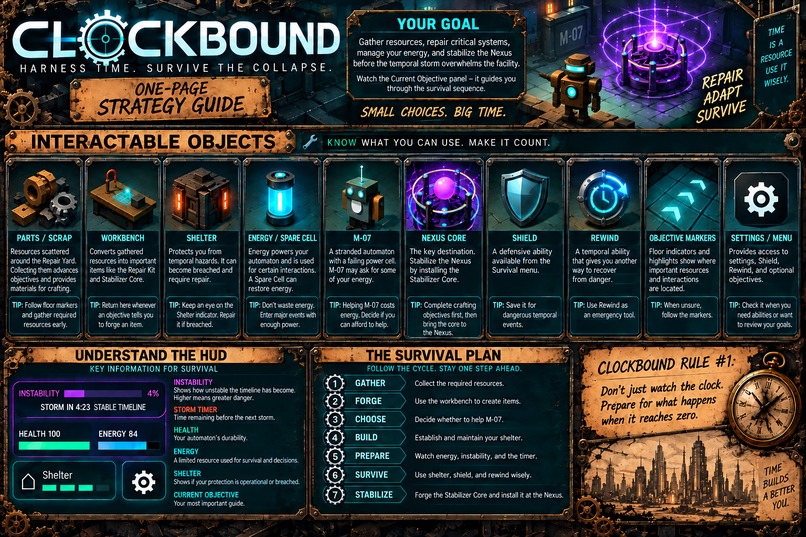
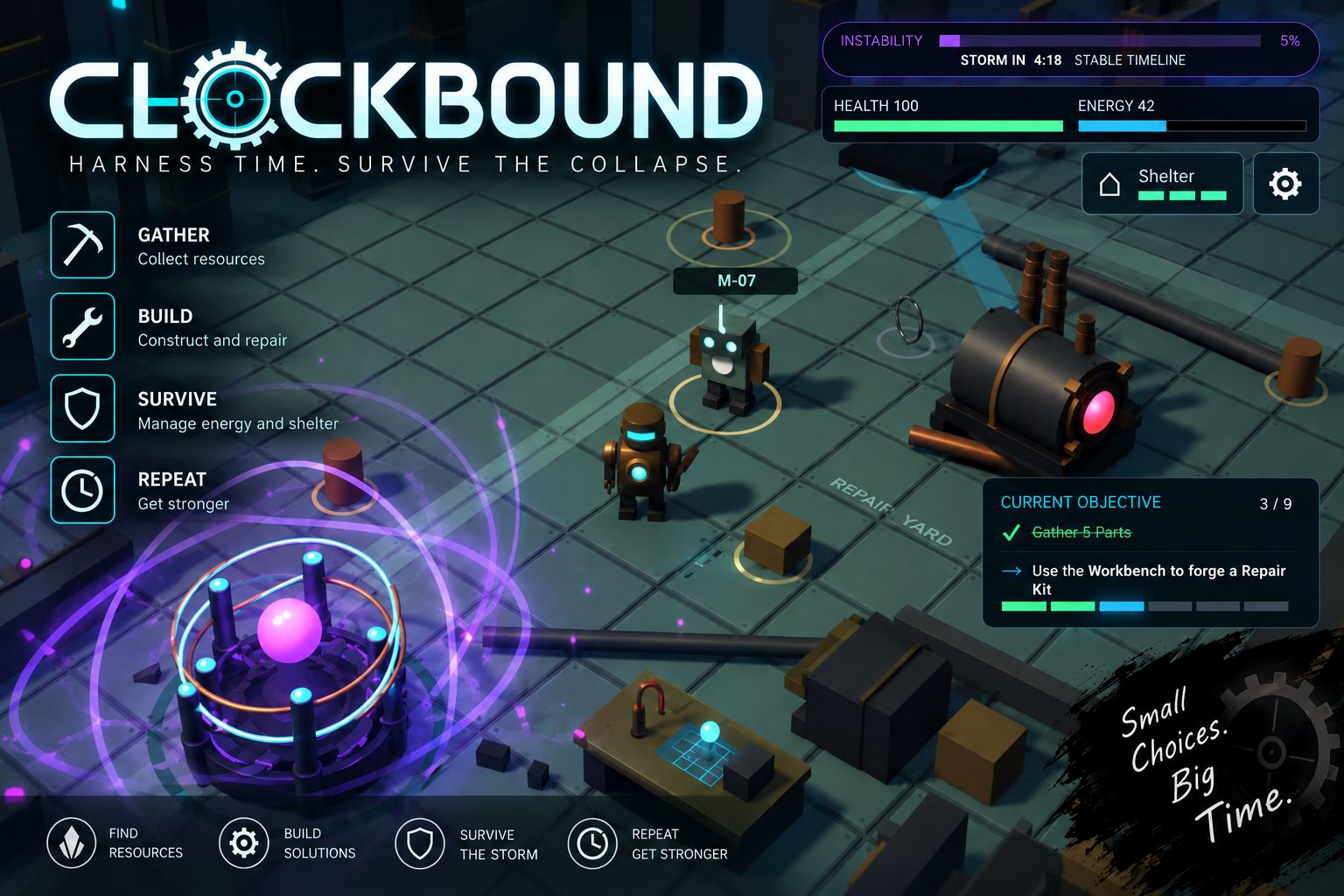
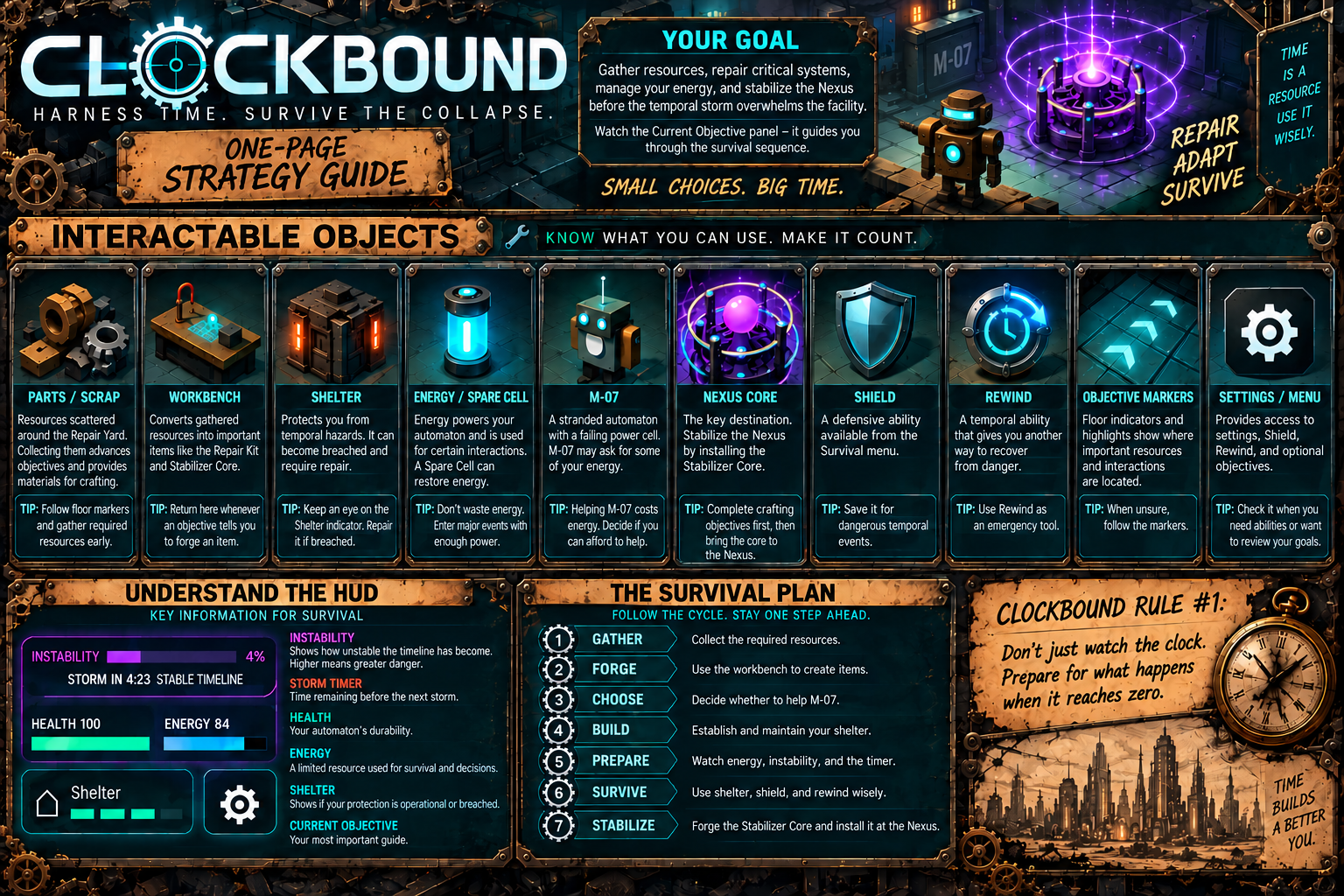
The game focuses on resource scarcity, energy management, shelter, forging, and temporal storms. Every decision costs something, including whether to spend valuable energy helping another automaton like M-07.
What it does
Clockbound: The First Storm is a short survival and resource-management vertical slice.
The player explores an industrial facility, gather parts, forges broken items, manages health and energy, builds shelter, interacts with M-07, and prepares for an approaching temporal storm by exploring the environment for resources.
The main gameplay loop is:
Explore → Gather → Forge → Build → Prepare → Survive
How we built it
The prototype was built as a mobile-first browser experience using HTML5, JavaScript, and Three.js.
We focused on one complete survival cycle instead of trying to build the full game. The prototype combines resource gathering, forging, energy management, shelter, objectives, instability, and storm systems into one connected gameplay loop.
Codex was used as an AI-assisted development tool to help implement, test, and refine systems while the overall gameplay design and direction remained developer-driven.
Challenges we ran into
The biggest challenge was scope. Clockbound has ideas for additional biomes, automation, advanced forging, resource progression, and larger world systems, but the competition version needed to stay focused.
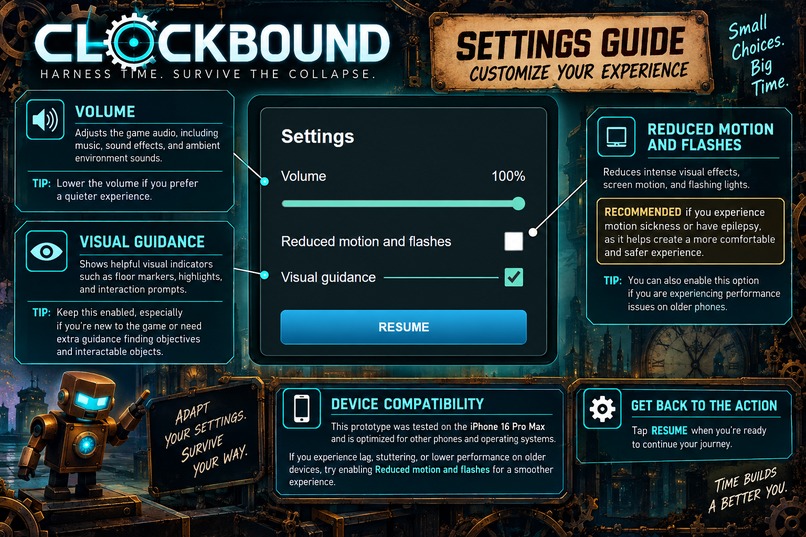
Another challenge was presenting Health, Energy, Instability, Shelter, objectives, and storm information clearly on a portrait mobile screen without overwhelming the player.
Balancing the storm, recovery windows, shelter damage, and resource decisions also required several iterations.
Accomplishments that we're proud of
We are proud that Clockbound became a complete playable vertical slice instead of just a collection of mechanics.
Gathering, forging, energy, shelter, M-07, the Nexus Core, and the temporal storm all contribute to the same survival loop.
We are also proud of the game's visual identity, combining teal industrial environments, copper machinery, cyan interfaces, and purple temporal energy.
What we learned
The biggest lesson was that a small, complete experience is more valuable than a large unfinished one.
We also learned that survival games depend heavily on clear feedback. Players need to immediately understand when energy changes, shelter is damaged, instability increases, or an objective is completed.
Using Codex also reinforced that AI-assisted development works best when the design, requirements, and systems are clearly defined first.
What's next for Clockbound Game Prototype
Next, we want to expand the systems introduced in the vertical slice.
Future development includes deeper crafting, more resources, additional temporal hazards, expanded shelter mechanics, more interactions with M-07 and other automatons, upgrades, new environments, automation systems, and more meaningful long-term choices.
Our plans include moving from prototype to MVP phase where we would replace our primitive 3D models with higher detailed and optimized .glb 3D models.
The goal is to keep building around the central question:
What are you willing to sacrifice now to buy yourself more time later?



Log in or sign up for Devpost to join the conversation.