Inspiration
Turning long recordings into short clips is only half the creator workflow. Paying for the work and tracking delivery usually happen somewhere else. ClipPay brings AI-assisted clip selection and PayPal payment state into one open-source pipeline.
What it does
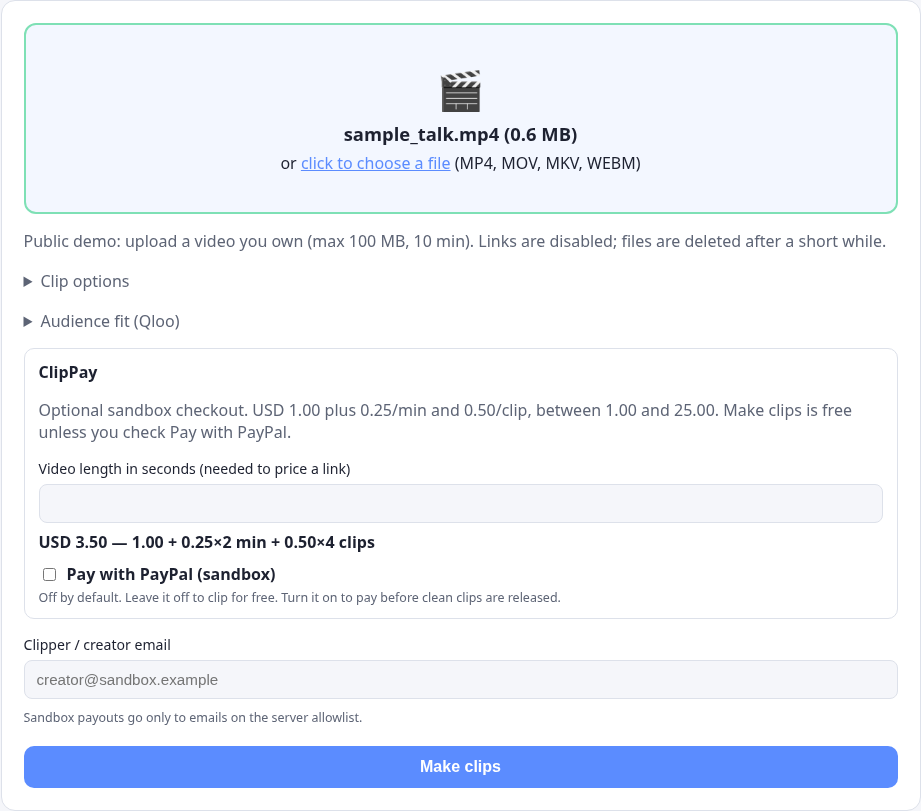
Upload a recording you own. The pipeline transcribes it, selects standalone moments, and renders captioned clips with per-platform title, description, and hashtag sidecars.
Clipping is free by default. For the payment demonstration, explicitly select Pay with PayPal (sandbox) before creating the job. That path creates a quote and a PayPal Orders v2 checkout. A watermarked preview can be delivered before payment; clean files remain locked until a signed PayPal webhook passes verification and matches the job's order and quoted amount. The browser return alone is not proof of payment.
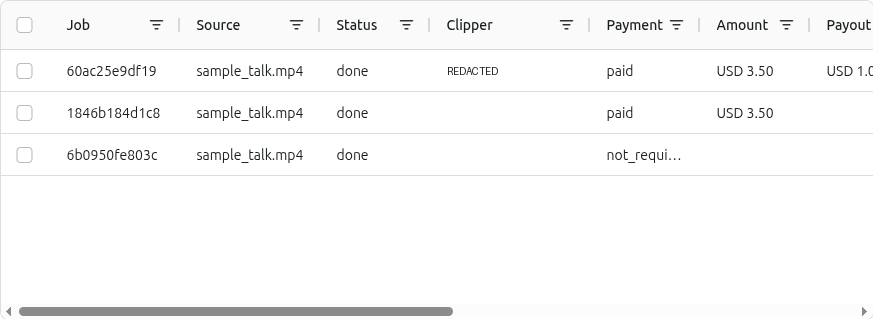
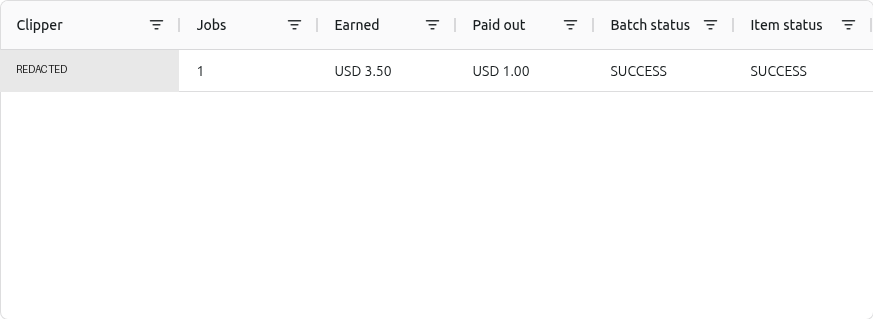
The Jobs & payments dashboard uses AG Grid Community to sort, filter, and inspect jobs and payment states. Earnings groups jobs by clipper. Pay clippers sends sandbox PayPal Payouts to allowlisted receivers and tracks batch/item state; the public demo caps payouts at $1 per job. No real money moves.
How we built it
Python and Flask handle the workflow, faster-whisper transcribes, and ffmpeg cuts and captions the clips. An OpenAI-compatible AI provider chooses moments; the hosted deployment currently reports the single-pass GLM-compatible provider route. The repository also supports optional propose/critique selection and other providers, but those are not required for this demo.
The PayPal integration includes Orders v2 create/capture, signed webhook verification, refunds, and Payouts. The clean-download gate checks the signature, order and amount. The implementation includes a refund path if rendering fails after verified payment; that failure path is not claimed as a live demo result. AG Grid Community provides the job/payment table. The service is deployed on Railway and the public source is MIT licensed on GitLab.
Challenges we ran into
The difficult boundary was distinguishing a successful browser return from a verified payment event. ClipPay uses server-side webhook verification rather than trusting the redirect. Payouts are asynchronous, so the UI stores both batch and individual item status instead of treating the initial API response as completion.
Accomplishments that we're proud of
The hosted app currently retains completed free and paid jobs. One completed paid job records payout batch GSXUDESSP45ZG and item Q5ETQQKNUXC5Q with item status SUCCESS. The app's health endpoint reports clipping and payouts enabled in public-demo mode. This is sandbox integration evidence, not a production payment claim.
What we learned
Payment approval, verified delivery, and payout completion are different states. Keeping them explicit makes a creator workflow easier to inspect and prevents a redirect from becoming an accidental authorization mechanism.
What's next for ClipPay
Configurable creator/clipper revenue splits, richer earnings filters, and multi-tenant isolation. Production payments would require a separate security and operational review; this build deliberately stays sandbox-only.
Significant updates during the submission period
The original local clipper predates this hackathon. After October 1, 2026, it gained the OpenAI-compatible/Nebius/Qloo provider work (fc411be, October 11), ClipPay checkout and verified-webhook gating (bef8a92, October 12), Pay clippers payouts and earnings grid (ba0b90a, October 13), opt-in checkout (067b8e3, October 13), and worker/trim fixes. The November 7 README updates point judges to the public GitLab source and hosted sandbox testing instructions (current local tip 62869cb). These changes add the payment lifecycle rather than merely renaming the pre-existing clipper.
Video scope
The review video combines six seconds of actual software recording with readable still captures of the real application. It shows a sample selected and quoted, existing clip output, existing paid jobs and retained earnings/payout SUCCESS states. It does not demonstrate a fresh end-to-end checkout or newly verify a webhook.
