Inspiration
Educators and small education businesses need polished learning resources every week, but they rarely have the production team that large publishers have. A tutor may need a worksheet, slides, answer key, quiz, parent note, and differentiated version by tomorrow. A microschool may need a full unit pack that looks professional enough to share with families. ClioMake was created to compress that repetitive but high-skill production workflow into an AI-operated business.
What it does
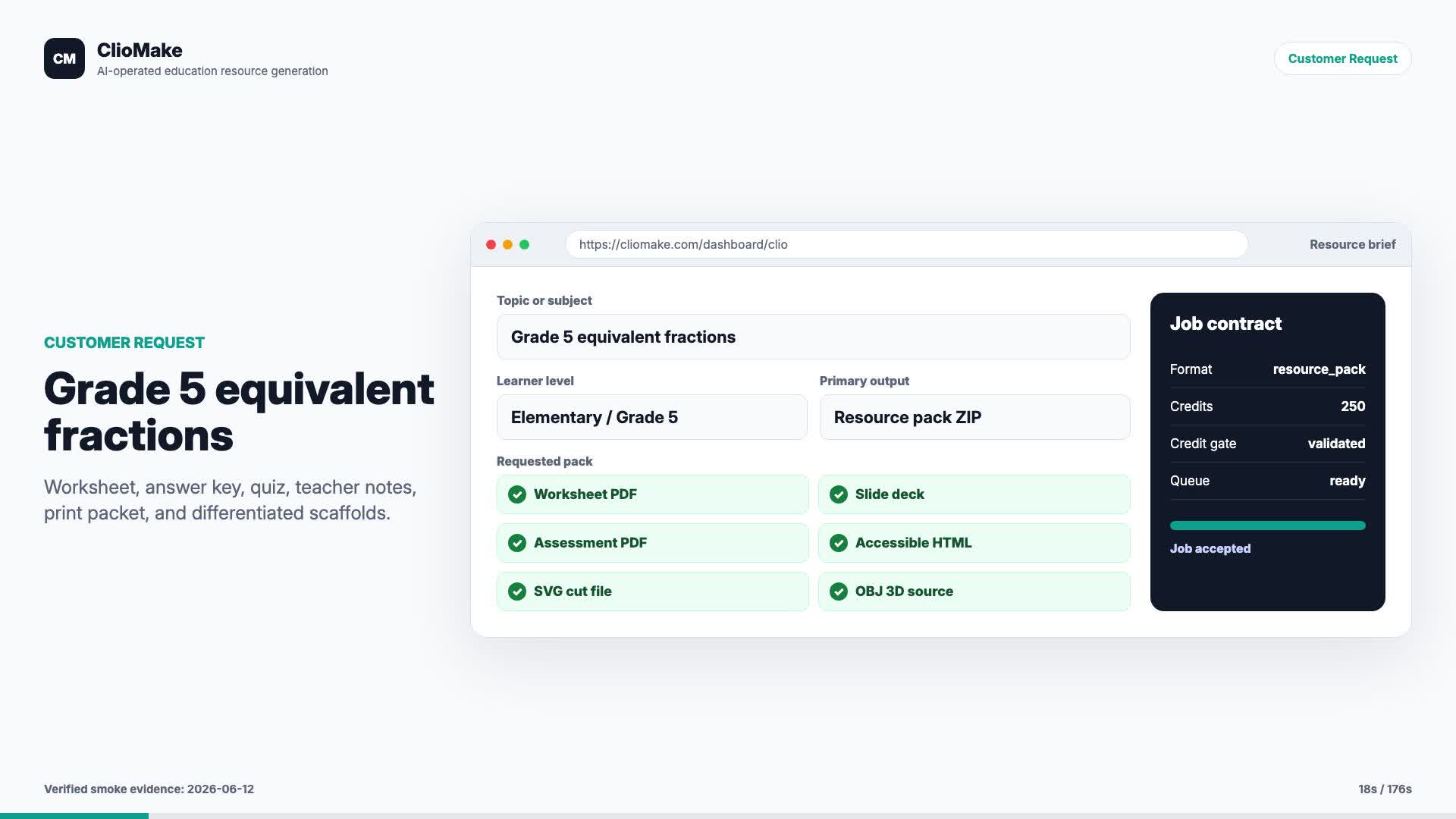
ClioMake turns one teaching brief into reviewable classroom-ready resource packs. A user provides a topic, learner level, classroom context, output format, language, differentiation needs, accessibility needs, and constraints. The system plans the learning flow, generates a structured pack specification, compiles downloadable files, runs quality checks, and returns artifacts that educators can inspect before classroom or paid use.
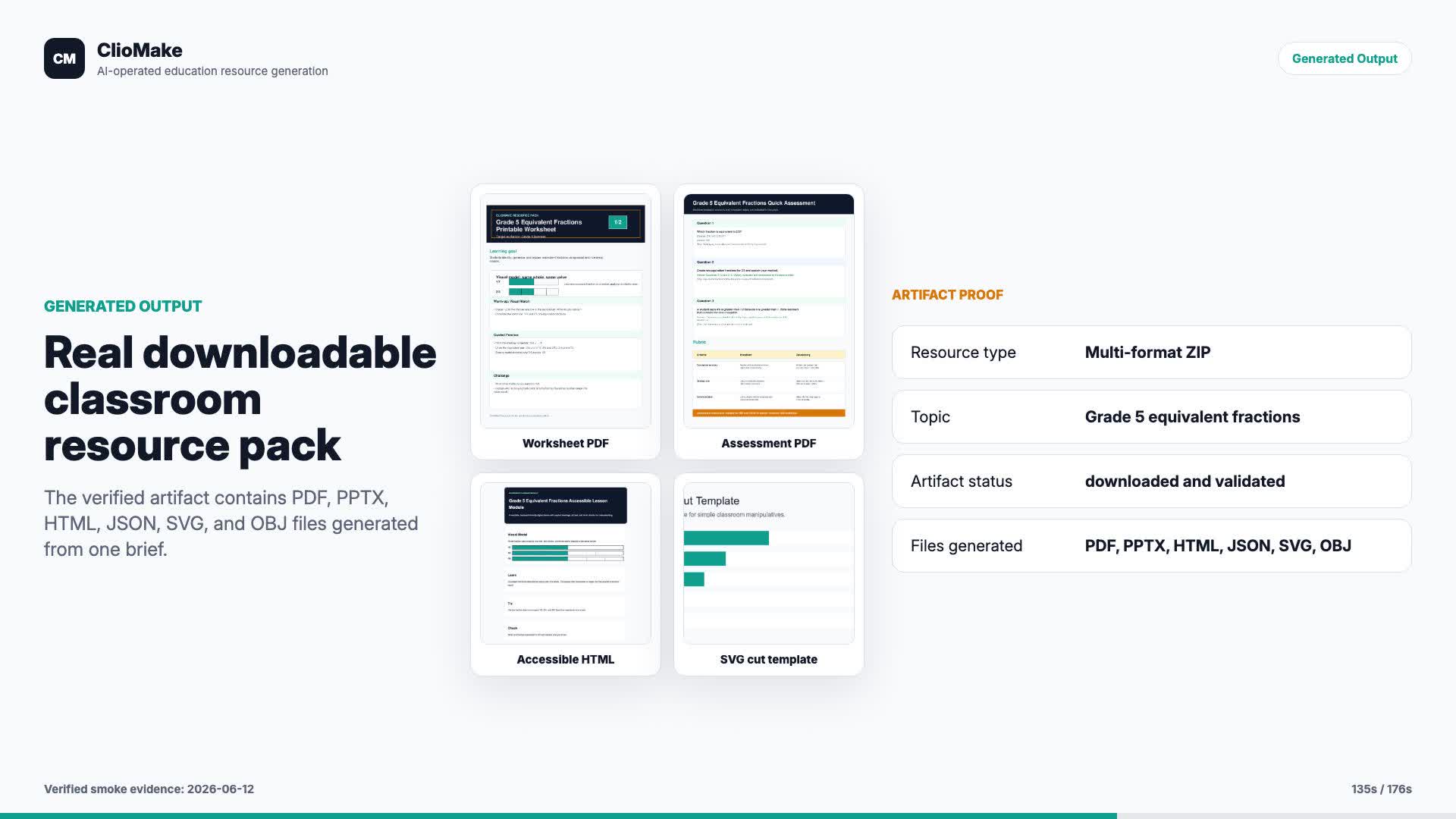
The current production workflow supports worksheets, answer keys, quizzes, rubrics, slide decks, teacher briefs, accessible HTML lessons, study guides, chapters, standards maps, quality reports, manifest files, QTI/LMS export files, SVG cut templates, simple 3D source files, and full ZIP packs.
How AI operates the business
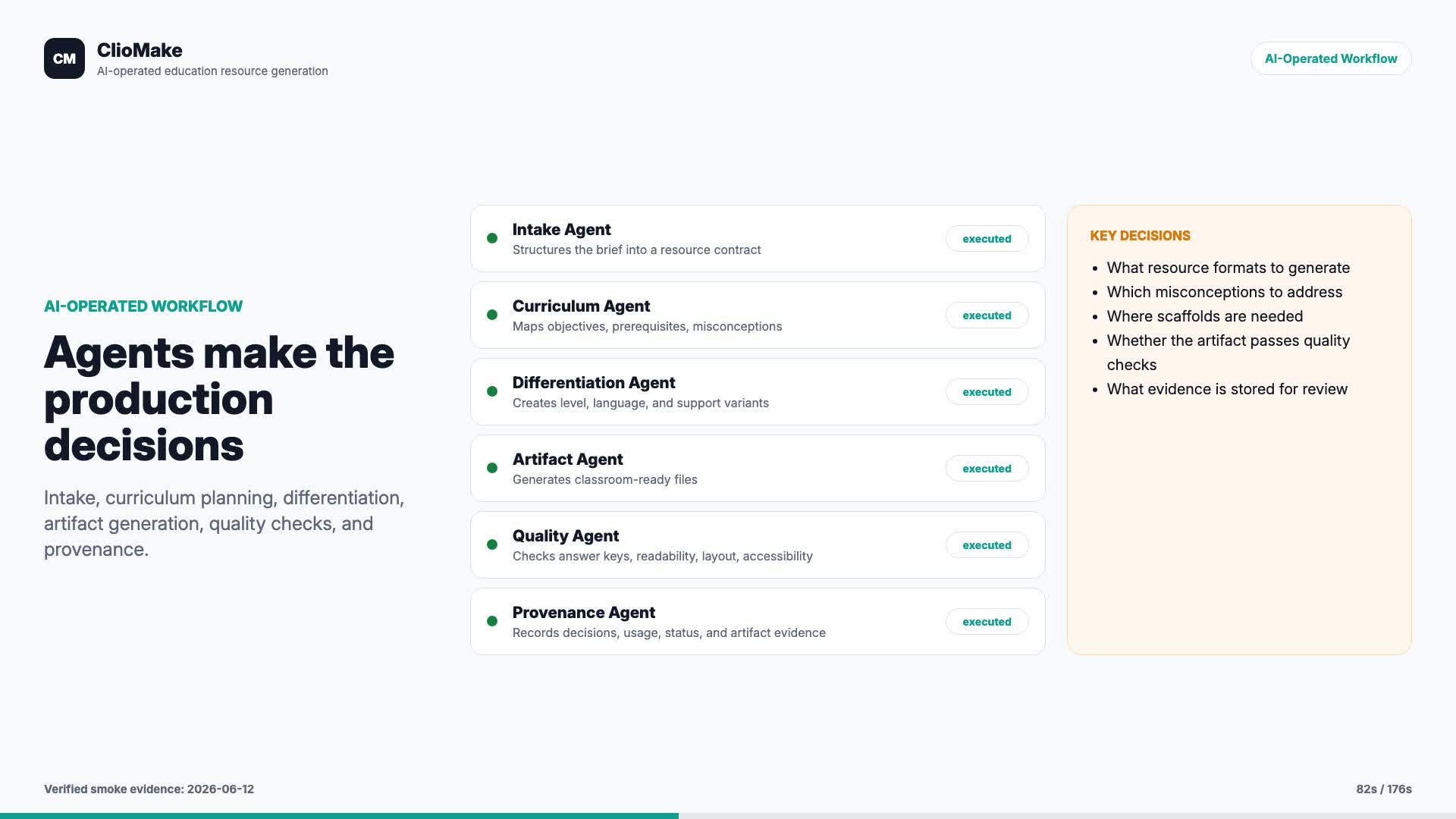
AI is not only a writing feature in ClioMake. It operates the production workflow. The Intake Agent structures customer requests into resource contracts. The Curriculum Agent maps objectives, prerequisites, misconceptions, and assessment targets. The Differentiation Agent creates variants by level, language, accommodation, and time available. The Design Agent plans page rhythm, slide variety, and classroom print constraints. The Artifact Agent generates the resource content. The Quality Agent checks pedagogy, answer-key consistency, accessibility, standards alignment, design readiness, export integrity, and hallucination risk. The Provenance Agent records decisions, usage, and quality evidence.
How we built it
ClioMake is implemented as a standalone educational resource-generation platform with authenticated users, credits, queued jobs, agent-status logs, staged resource generation, deterministic artifact compilers, review-state scoring, and downloadable evidence. The deployed application runs as an isolated production service with managed hosting, secret management, managed database access, object-storage-compatible artifact paths, and a dedicated AI runtime.
Latest production evidence
On June 19, 2026, ClioMake production was redeployed and verified after the AI-native resource-engine upgrade. The live app now includes workflow surfaces for LMS export, in-platform review/editing, unit building, creator-marketplace packaging, and AI operations evidence.
A production QA account generated a complete Unit Builder pack through the live authenticated app. Parent job clio_6a34cd2237201_c4aa9b31 completed Green with quality score 100 and 19 artifacts. The resulting ZIP passed archive and file-level validation and included PDF, PPTX, DOCX, HTML, SVG, QTI/XML, OBJ/3D source, manifest, standards map, and quality-report assets.
We also tested selective regeneration in production. Child job clio_6a34d4f2bef98_50b52206 regenerated the worksheet path while recompiling a fresh internally consistent full pack. It completed Green with quality score 100 and passed the same ZIP and file-level checks. Desktop and 390px mobile browser QA passed across the advanced workflow pages with no horizontal overflow.
Watch the current production demo here: https://cliomake.com/xprize-demo.html Direct MP4: https://cliomake.com/public/storage/clio/cliomake-devpost-demo-2026-06-14.mp4 Public sample packs: https://cliomake.com/samples.html
Challenges we ran into
The biggest challenge was making the workflow real enough for judging rather than just a landing page. The system needed authenticated users, credits, queued jobs, agent status logs, generated artifacts, quality receipts, neutral public positioning, and a repeatable evidence trail. We also had to separate creative AI decisions from deterministic file compilation so exported resources are inspectable, reproducible, and not just text pasted into a document.
Accomplishments that we're proud of
ClioMake now has a private GitHub submission repo, public website, paid-pilot path, contact mailbox, evidence registers, staging and production deployments, live checkout validation, authenticated generation proof, advanced workflow pages, selective regeneration, and verified multi-format resource packs. The product now shows the core business loop: a customer can buy access, log in, spend credits, generate resources, inspect quality evidence, and download files.
What we learned
The strongest product is not a generic content generator. Educators need reviewable resources with answer keys, differentiation, accessibility notes, standards evidence, editable handoff files, and export formats that fit real classrooms and institutions. The competition also rewards business viability, so we built pricing, checkout, outreach evidence, revenue/expense tracking, and a path from small paid pilots to team and institutional plans.
What's next for ClioMake
Next steps are to close arms-length paid pilots through the live pricing page, collect consented customer testimonials, export production usage and agent logs, improve the in-platform editor, add deeper LMS integrations, and prepare updated revenue, expense, and customer evidence for final judging. The production site now has live checkout links for the Pilot Pack, individual subscriptions, team subscriptions, Center Pilot, and Institution Sprint offers.
Built With
- artificial-intelligence
- css
- education
- html
- javascript
- mysql
- php

Log in or sign up for Devpost to join the conversation.