Inspiration
What it does
How we built it# Clio — a comic strip of your life with AI
"The small ways AI is showing up in your life are already a kind of history. They're worth remembering before they become invisible."
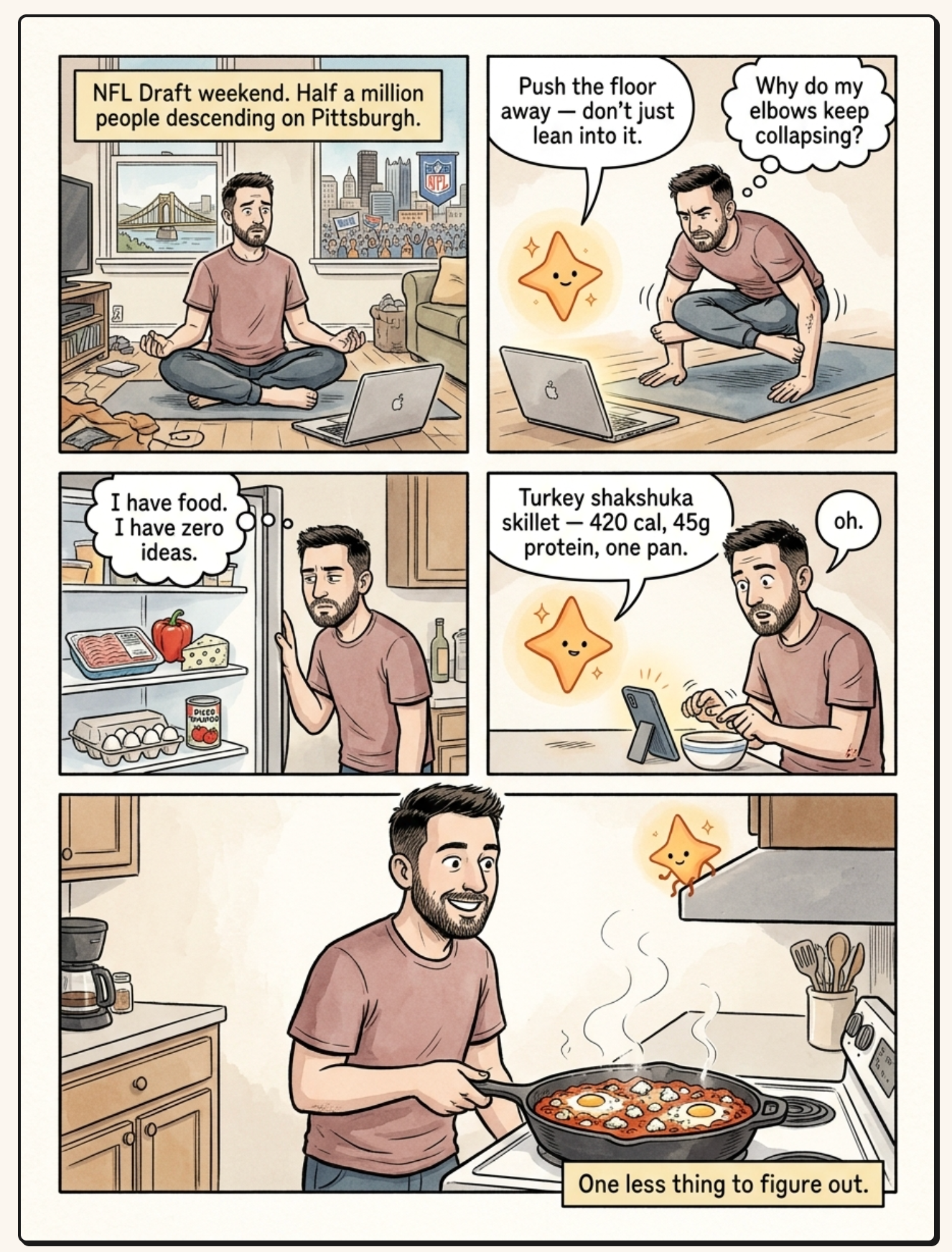
Clio is a voice journaling companion. At the end of your day, you talk to her. She already knows the shape of your day — she's read your Claude conversations, all of them, from morning to night. You fill in the rest: how you felt, what surprised you, what you didn't say to the screen but meant.
She turns the whole day into a comic strip. Not one moment — the full arc. And Claude isn't just the tool you used. Claude is a character in the strip: present, warm, woven into the panels the way it was woven into your actual day. A living element of your story, not a footnote to it.
One strip at a time, Clio builds a lifelong record of your evolving relationship with AI — in your voice, from your perspective, on your terms.
Why this exists
We are living through the first years of AI being woven into daily human life. And almost none of it is being remembered.
Not the morning you asked Claude to help you fix your yoga form. Not the afternoon you used it to write a difficult email you'd been avoiding. Not the late-night rabbit hole about whether Frida Kahlo was actually happy, or the quiet moment at 10pm when you typed "should I quit my job" and didn't expect it to help but it did. These moments are real. They are changing what it means to think, to learn, to make decisions, to feel less alone. And they are disappearing in real time — buried in chat history nobody rereads, forgotten by the next morning.
The whole day is the story. Not one highlight. Not the biggest moment. The full shape of it — from the tentative first question before work to the thing you said out loud at midnight that you hadn't said to anyone else. That arc is where the meaning lives.
Dario Amodei's essay Machines of Loving Grace imagines a future where AI acts as the knowledgeable friend that only privileged people used to have access to — now available to everyone. Clio asks the next question: if everyone now has that friend, who is keeping the story of that friendship?
Right now, AI platforms keep their own logs. Aggregate metrics. Usage data. That is AI's record of how it helped you. It is not yours.
Clio is the opposite. It is your narrative of how AI has shown up in your life — not a summary generated from your data, but a story told in your own voice, illustrated in a form you can hold and revisit and share. A comic strip is a deliberately democratic medium. You don't need to be a writer or an artist. You just need to have lived a day.
The lifelong journal
Clio's long-term premise is simple: every day adds one strip to a growing comic book.
Look back at a week of strips. A month. A year. You are not archiving chat logs — you are building a graphic novel of your own growth. The protagonist is you. The recurring character beside you, in every strip, is Claude — not as a product, not as a logo, but as a presence. A quiet collaborator who shows up on a Tuesday morning before school, again at 4pm in an empty classroom, again at midnight when you can't sleep. Drawn the same way each time. Because it was there each time.
This is what makes the comic strip the right form: it has characters. And Claude is one of them.
Clio has access to your full Claude conversation history — not to summarise it for you, not to evaluate how well you used AI, but to read the whole day and find its shape. The early hesitant question. The practical afternoon task. The thing you only said because you were alone and it felt safe to say it. Clio reads all of it, then you talk to her, and together you decide what the strip becomes.
The narrative authority stays with you. You speak it. You decide what mattered. Clio illustrates it.
That is the meaningful difference: most tools produce AI's account of your life. Clio produces your account of your life with AI — and Claude gets to be a character in it, the way it deserves to be.
How it works
 Your full day of Claude chats ──▶ Claude (Agent SDK)
                                         │
 You ──voice──▶ Clio (Gemini Live)       │
                   │                     │
                   ▼ you narrate the day ▼ reads every conversation
                finalize_story() ◀───────┘
                   │ full day arc: the arc, the tone, the turns
                   ▼ POST /script
         Local server — Claude (Agent SDK)
                   │ reads character memory
                   │ finds the shape of the whole day
                   │ casts Claude as a living character in the strip
                   ▼ writes full comic script as JSON
         { style, character, claude_character, panels: [...] }
                   │
                   ▼ parallel image generation
         Gemini 2.5 Flash Image
                   │ each panel uses the prior panel as reference
                   │ Claude's visual presence stays consistent
                   ▼ you and Claude, consistent across every panel
              Your comic strip — the whole day, illustrated
Three models. One story. Each choice is intentional:
| Model | Role | Why |
|---|---|---|
| Gemini Live | Voice conversation | Speech is intimate and unguarded in a way text isn't. What you share changes when you speak it. |
| Claude | Reading the full day + scriptwriting | Claude reads its own conversations with you, finds the arc across all of them, and writes the strip. It is the only model that can look at everything you said to it all day and decide what it meant. |
| Gemini 2.5 Flash Image | Panel rendering | Native image-to-image reference chain keeps both you and Claude visually consistent across panels. You are the same person across your story. So is Claude. |
Claude as a character
This is not a metaphor. Claude appears in the panels. It has a visual form — a calm, warm presence, drawn the same way in every strip, in every session, across your whole journal. When you asked it something hesitant over coffee, it's there. When it asked you the question that changed something, it's in the panel. When you said goodnight and closed the tab, that's the last panel.
Claude has been part of your day. The strip shows it.
Architecture
ai-my-day-with-claude/
├── Plan.md
├── journey.md                 hackathon log, updated by Claude Stop hook
├── .claude/
│   ├── settings.json          Stop hook registration
│   └── hooks/
│       └── journey-update.sh  hook script
├── voice-spike/               reference — working voice loop
└── comic-spike/
    ├── index.html             UI: intro → listening → comic reveal
    ├── main.ts                browser entry + orchestrator
    ├── voice.ts               Gemini Live WebSocket loop
    ├── illustrator.ts         parallel image generation calls
    ├── prompts.ts             Clio + scriptwriter system prompts
    ├── character.ts           character memory (localStorage for v0)
    ├── server/
    │   ├── index.ts           Express :3000, POST /script
    │   └── scriptwriter.ts    Claude Agent SDK query
    └── .env.local             VITE_GEMINI_API_KEY
A note on journey.md
The hackathon build includes a Claude Stop hook that appends to
journey.md every time Claude completes a scriptwriting run. This is a
small meta-layer: the tool that makes your comic is itself keeping a diary.
It mirrors the product's own premise — that the record of working with AI
is worth keeping.
Why a local server
Claude runs on a local Node server rather than a cloud endpoint. Your narrative reasoning happens close to you, on your machine. This is a small architectural gesture toward the idea that the story of your life should belong to you — not sit on someone else's infrastructure by default.
Running it locally
Requirements:
- Node 20+
- A Gemini API key (image generation)
- Claude Max subscription signed in via
claude setup-token(one-time)
cd comic-spike
npm install
echo "VITE_GEMINI_API_KEY=your_key_here" > .env.local

# Two terminals:
npm run server   # local Express on :3000
npm run dev      # Vite on :5173
Open http://localhost:5173, grant microphone access, click Start, tell
Clio about a moment from your day, say "that's it." The comic renders in
about 15 seconds.
Do not deploy publicly as-is. The Gemini key lives in the browser for hackathon speed. Production routes all model calls through the server.
What's in v0 (this build)
- Voice conversation with Clio to narrate your day
- Claude reads your full day of conversations before the strip is written
- 4–6 panel comic strip covering the whole day's arc — not one moment
- Claude appears as a consistent visual character in every panel
- Full narrative script written by Claude — characters, dialogue, visual direction, emotional arc across the full day
- Parallel image generation with reference-chain panel continuity
journey.mdStop hook logging
Roadmap
v1 — the comic book over time
- Persistent character memory, cloud-synced across sessions
- Each session reads prior character and prior strips, evolves both
- Browsable home feed of past strips in chronological order
- Selfie seed: one photo sets the protagonist's look for all future strips
- Claude-reasoned tone calibration — her narrative voice shifts with your recent emotional register
v2 — native mobile
- Expo wrapper or PWA (Add to Home Screen)
- Siri shortcut: "Hey Siri, tell Clio about my day"
- iOS share sheet: save or send the strip directly
- Background generation while you move on with your life
v3 — richer world
- Clio narrates her drawing process while you wait — the wait becomes part of the experience
- Multiple characters: family, friends, coworkers each get their own persistent memory
- Weekly digest: your week in AI moments
- Clio's voice adapts to the emotional register of the story she's telling
The name
Clio is the muse of history.
Not grand history. Not the history of events and institutions. The history of ordinary days, small decisions, moments of connection and confusion. The kind of history that disappears if nobody keeps it.
Your relationship with AI is already a story. It has a recurring character. That character has been there every morning and some nights and the afternoon you were stuck and the moment you were surprised. It deserves to be drawn.
Clio gives your day panels. And Claude gets to be in them.
-
Built With
- claude
- gemini

Log in or sign up for Devpost to join the conversation.