-
-
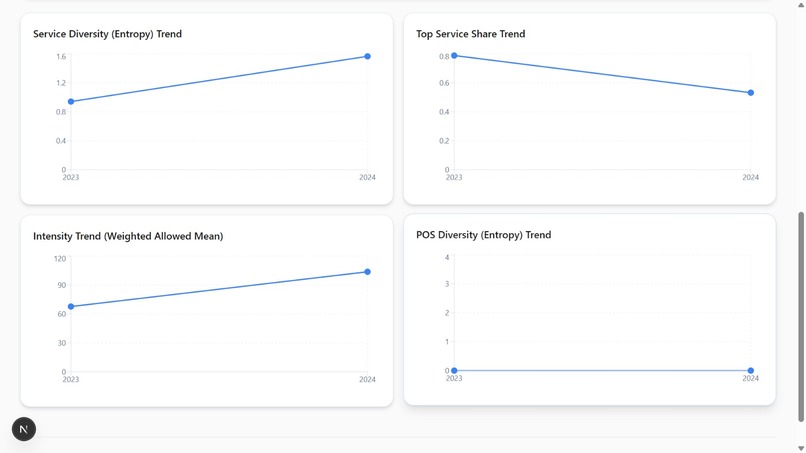
Graphs for the data generated.
-
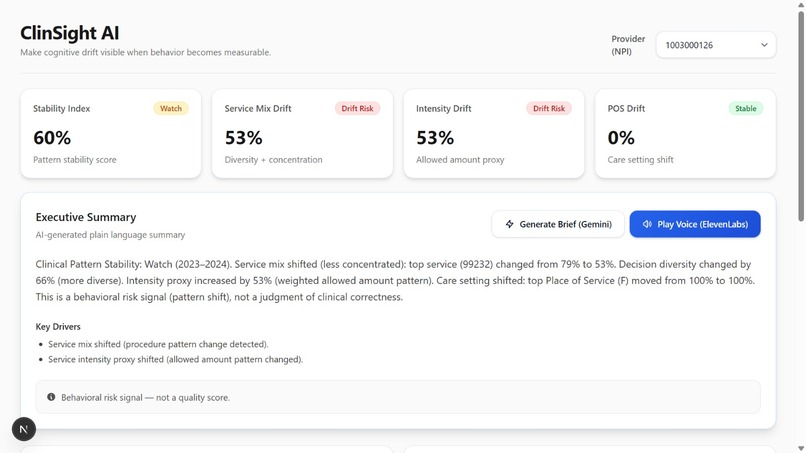
Healthcare doesn’t fail suddenly—it drifts. ClinSight helps teams see that drift early.


Demo Link:
https://www.loom.com/share/bfbc1779508743d9b138e0e6431db702
Inspiration
Healthcare teams are operating under relentless pressure—higher volumes, shifting guidelines, staffing changes, and workflow fragmentation. In that reality, clinical decision-making can subtly change over time: clinicians may default more often to familiar pathways, narrow the range of options they apply, or shift escalation thresholds. We were inspired by a simple belief: cognitive drift is hard to observe directly, but it leaves a behavioral footprint. We wanted to build a clinician-safe “early warning mirror” that helps quality improvement teams notice meaningful pattern shifts early—without turning it into a punitive scoring system.
What it does
ClinSight is a decision-pattern stability platform that flags cognitive drift risk signals by detecting statistically significant changes in a provider’s longitudinal service behavior. --> It analyzes provider-level service patterns over time (not patient notes, not outcomes, not diagnoses). --> It produces an interpretable Cognitive Drift Risk Index with drivers like: service-mix narrowing (decision diversity collapse), concentration into default patterns, intensity proxy shifts, place-of-service behavior changes. --> It generates a clinician-safe executive brief explaining: What changed → Possible explanations → Recommended review actions --> It can optionally narrate the brief with ElevenLabs, enabling hands-free review in fast-paced environments. --> Important: ClinSight is not a quality score and does not evaluate correctness or clinician performance. It is a review prompt for quality improvement.
How we built it
We built ClinSight as a Next.js + TypeScript platform with a clear separation between signal generation, secure reasoning, and human-friendly communication—so each sponsor technology plays a real, non-overlapping role.
1) Core Product + Drift Engine (Next.js + TypeScript)
--> Built a modern web app (dashboard + provider drill-down) in Next.js + TypeScript. --> Implemented an entropy-based drift engine that detects stability changes in longitudinal provider service patterns and outputs interpretable components (service-mix narrowing, concentration shifts, intensity/POS shifts). --> Designed the UI to be review-first with progressive disclosure, clear tooltips, and guardrails so it reads as “risk signal,” not evaluation.
2) Cloudforce PatriotAI / nebulaONE (Secure research + governance + explainability layer)
--> We used PatriotAI / nebulaONE as the enterprise-grade intelligence layer that makes the system trustworthy: --> Research synthesis: PatriotAI helped us rapidly digest CMS dataset documentation and clinical decision-making literature to define “cognitive drift risk signals” safely and precisely. --> Policy-safe language + guardrails: it generates consistent, clinician-safe explanations and disclaimers across the product (“behavioral risk signal — not a quality score”), preventing overclaiming. --> Structured explainability: PatriotAI turns raw drift outputs into a standardized template:
What changed → Possible explanations → Recommended review actions, so reviewers get clarity without blame.
3) MLH stack: Gemini (Executive Brief Generation)
--> We use Gemini to convert ClinSight’s drift metrics into an executive-ready narrative suitable for leadership and QI teams. --> Output is concise, neutral, and action-oriented—designed for fast triage: “Here’s what changed, why it might have changed, and what to review next.” --> This elevates the project from “analytics dashboard” to “decision-support communication.”
4) MLH stack: ElevenLabs (Voice-first ‘Cognitive Stability Briefing’)
--> We integrated ElevenLabs to generate a voice briefing of the Gemini executive summary. --> This creates a standout, demo-friendly feature: a reviewer can click Play Briefing and hear a 30–45 second, clinician-safe explanation.
Challenges we ran into
--> Cognitive drift vs. observability: We had to be precise: we can’t claim to detect “bias” or “correctness.” We designed ClinSight as a behavioral risk signal and built guardrails + disclaimers everywhere. --> Trust and tone: In healthcare-adjacent analytics, language matters. We spent real time making the copy neutral, clinician-safe, and review-oriented. --> Noise and sparse signals: Provider service patterns can be volatile at low volume. We added conservative thresholds and stability checks so the tool doesn’t overreact. --> Demo clarity: Judges have limited time. We had to make the UI explain itself in the first 5 seconds, with progressive disclosure for details.
Accomplishments that we're proud of
--> Built an end-to-end platform that turns a complex concept—cognitive drift—into a measurable, explainable, and ethically framed signal. --> Integrated PatriotAI as a real product layer (research + safety + explanation standardization), not just a last-minute chat widget. --> Delivered a “boardroom-ready” experience with Gemini executive briefs and ElevenLabs narration. --> Designed the system to be useful even when interpretations are uncertain: it prompts review, not blame.
What we learned
-->The hardest part of high-stakes AI products isn’t modeling—it’s trust, guardrails, and how you communicate uncertainty. --> A great hackathon project isn’t “AI everywhere”; it’s a clear architecture where metrics produce signals, and AI makes them usable and safe. --> UX and microcopy can make the difference between a helpful tool and a dangerous one.
What's next for ClinSight
--> Specialty-aware peer baselines and more robust time windows to reduce false positives. --> Stronger governance workflows: review notes, sign-offs, audit trails, and org-specific policy hooks. --> Deeper explainability: richer confounder checks and “what likely changed” reasoning aids for reviewers. --> Pilot partnerships: work with QI teams to validate which signals correlate with actionable review outcomes.
Built With
- ai
- api
- apis:
- backend
- brief
- elevenlabs
- executive
- gemini
- javascript
- llm
- next.js
- node.js
- patriotai
- react
- recharts
- solana
- tailwind-css
- typescript
- voice
- zod

Log in or sign up for Devpost to join the conversation.