Inspiration
In healthcare, some of the most important questions happen when there is the least amount of time to answer them. Clinicians may need to search through research, guidelines, and other resources while already managing a demanding workflow.
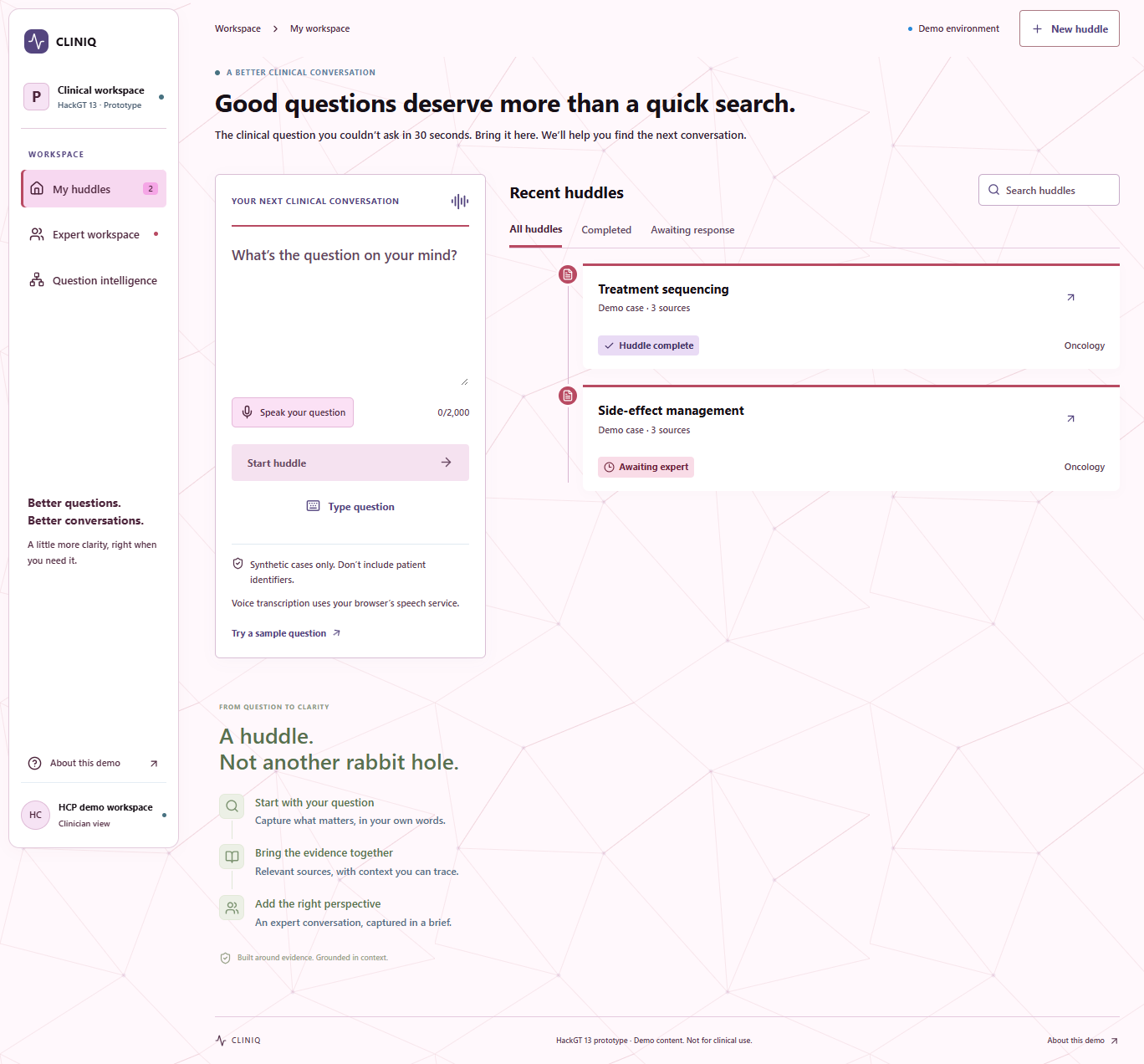
That inspired us to create CLINIQ — “the clinical question you couldn’t ask in 30 seconds.”
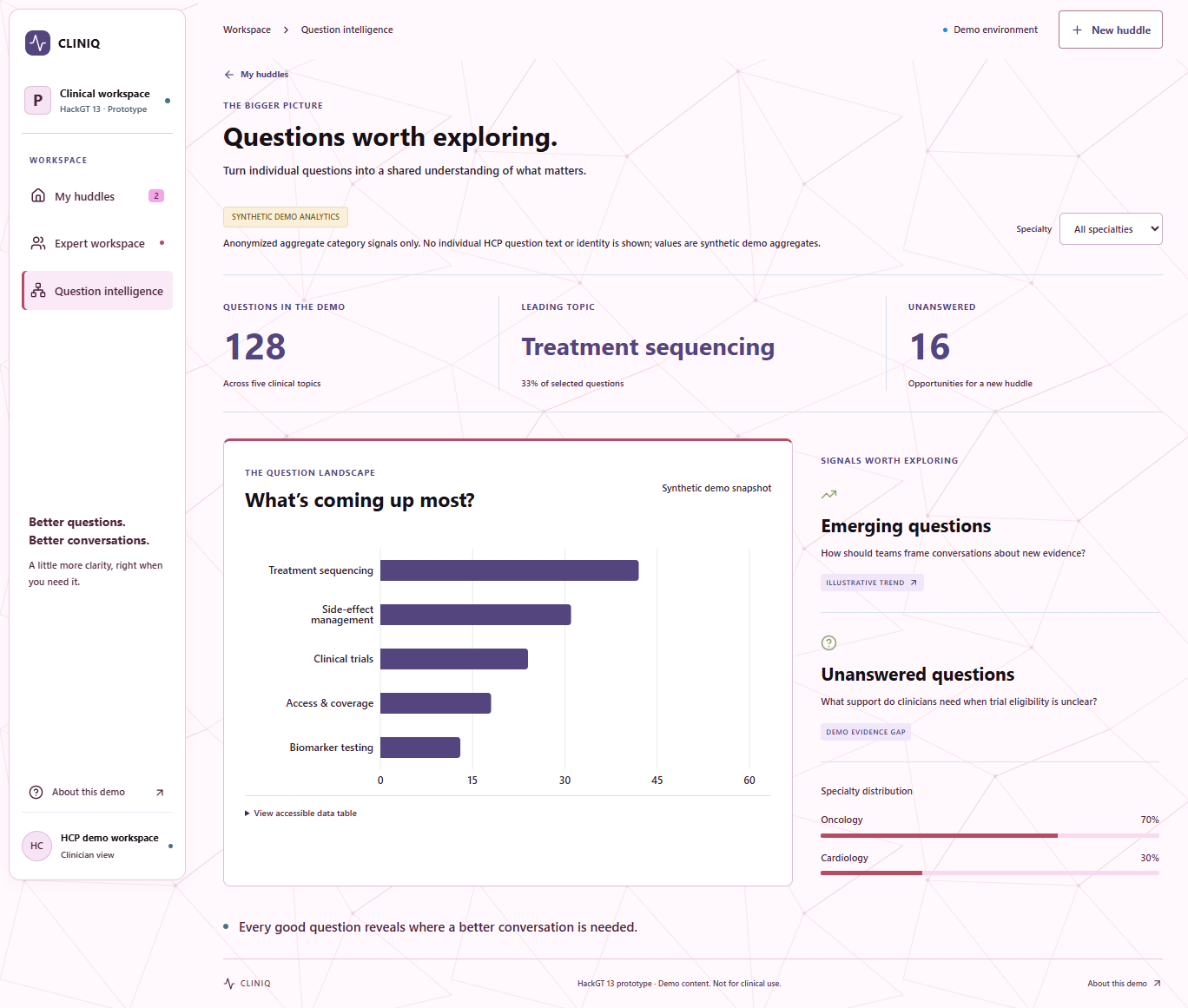
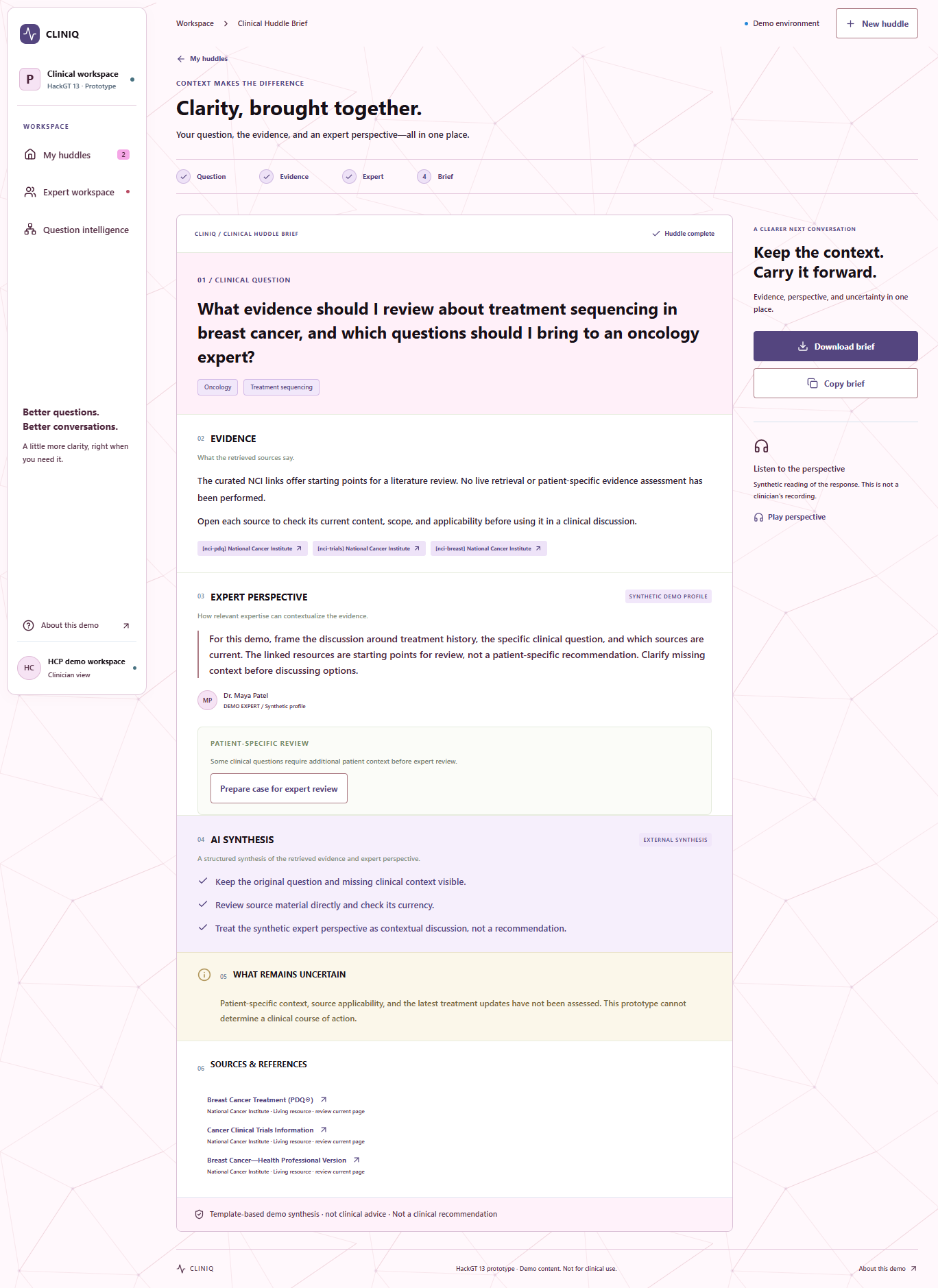
We wanted to explore what would happen if AI didn't try to replace clinical judgment, but instead helped clinicians reach the evidence and expertise behind a question faster. CLINIQ is designed to turn a clinical question into a structured brief that clearly distinguishes between evidence, expert opinion, and AI synthesis.
What It Does
A clinician can submit a clinical question to CLINIQ, which then:
- Retrieves relevant evidence and sources.
- Matches the question with a relevant expert profile.
- Creates a collaborative “huddle” around the question.
- Combines the available evidence and expert perspective into a concise AI-generated brief.
- Clearly displays citations, uncertainty, and where each piece of information originated.
Rather than presenting AI output as unquestionable truth, CLINIQ is designed around transparency and human decision-making.
How We Built It
We built CLINIQ as a full-stack application with a Next.js, TypeScript, and Tailwind CSS frontend and a FastAPI/Python backend.
Our backend uses SQLite for data storage and BM25 information retrieval to find relevant evidence for a submitted question. We built APIs that handle the full workflow from question submission and evidence retrieval to expert matching, huddles, responses, synthesis, and analytics.
For the AI layer, we designed a retrieval-augmented workflow that grounds synthesis in the evidence and expert responses supplied to it. We also added validation rules intended to prevent the system from introducing unsupported clinical claims or citations.
For our HackGT prototype, we use synthetic/de-identified demonstration data and fictional expert profiles rather than real patient information.
Challenges We Faced
One of our biggest challenges was deciding how AI should fit into a high-stakes environment like healthcare.
Simply generating an answer wasn't enough. We needed to think about where that answer came from, how uncertainty should be communicated, and how users could distinguish retrieved evidence from expert perspective and AI synthesis.
Integrating all of our components was another challenge. Our frontend, backend, retrieval system, expert-matching workflow, and AI synthesis pipeline all needed to work together as one experience within the limited timeframe of a hackathon.
We also had to balance ambition with reliability. Instead of attempting to build an AI “doctor,” we focused on creating a system that supports the people already making clinical decisions.
What We Learned
Building CLINIQ taught us that creating an effective AI product is about much more than connecting an interface to a language model.
We learned about retrieval-augmented generation, BM25 search, API design, full-stack development, structured AI outputs, data modeling, and safety-focused validation. More importantly, we learned how important it is to design AI systems so users can understand the distinction between retrieved information and generated content.
Working under hackathon constraints also taught us how to divide a large idea into smaller systems, integrate work across a team, and prioritize the features that best demonstrate our core vision.
What's Next for CLINIQ
Our prototype demonstrates what we believe could become a much larger idea: a collaborative intelligence layer for clinical questions.
Future versions could integrate verified medical literature and institutional knowledge, improve semantic retrieval and expert matching, support real clinician collaboration, and provide stronger privacy and security infrastructure for healthcare environments.
Ultimately, we envision CLINIQ as a way to make asking a difficult clinical question almost as fast as having the thought itself — while keeping evidence, expertise, transparency, and human judgment at the center.
Built With
- ai
- api
- bm25
- css
- fastapi
- github
- llm
- machine-learning
- natural-language-processing
- next.js
- python
- rag
- react
- rest
- sqlite
- tailwind
- typescript

Log in or sign up for Devpost to join the conversation.