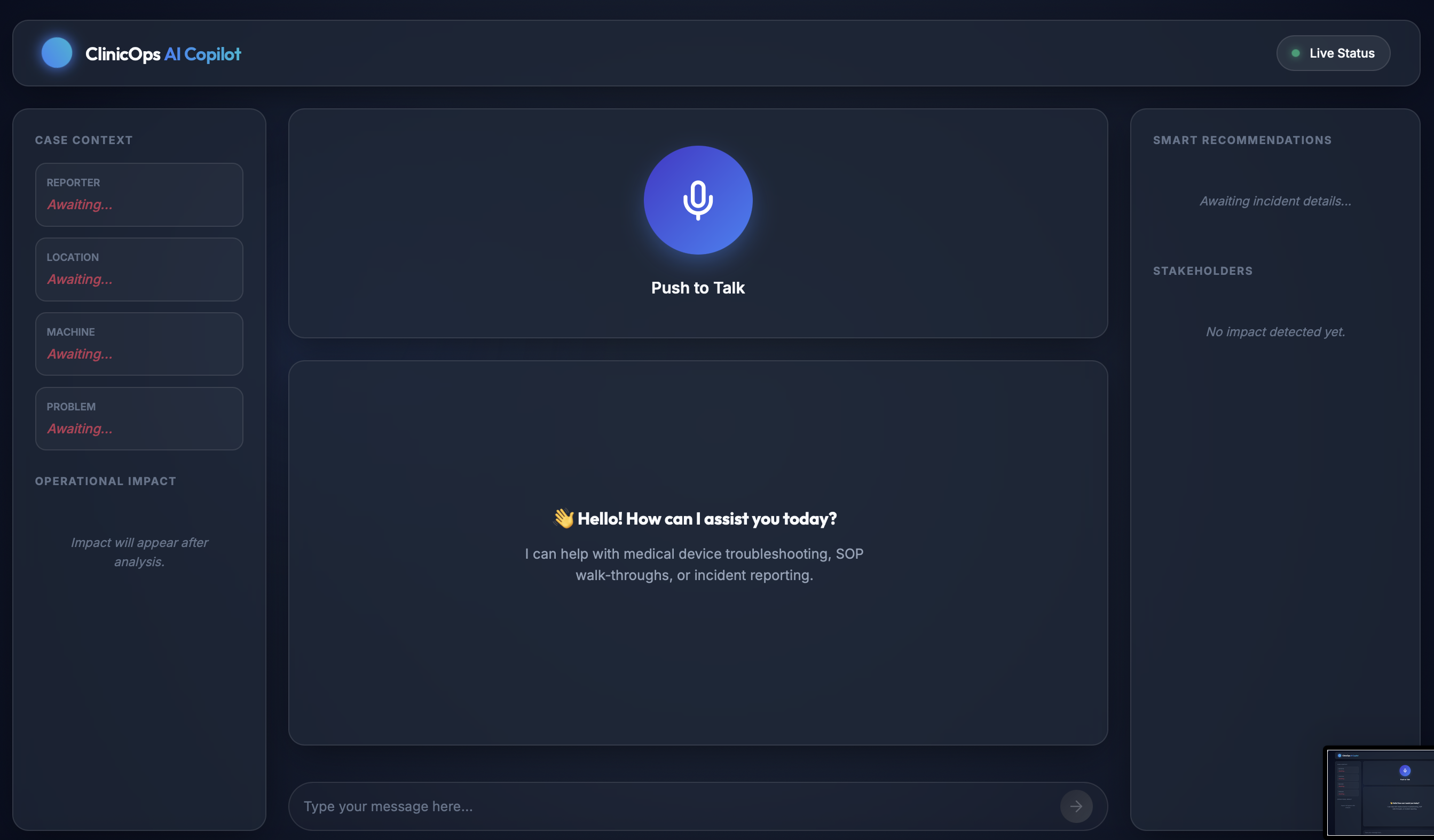
ClinicOps-Copilot
Inspiration
What happens when a critical clinic machine stops working in the middle of a busy day — and the solution is buried inside a 200-page manual?
In modern clinics, nurses and technicians rely on dozens of specialized machines. When equipment fails, staff often lose valuable time searching through dense SOPs or waiting for technical support.
In high-pressure clinical environments, even small delays can impact patient care.
We built ClinicOps-Copilot to solve this problem: an AI operational assistant that helps clinic staff troubleshoot equipment issues instantly using their own SOPs and operational manuals.
Instead of digging through documentation, staff can simply describe the issue using voice or chat and receive clear step-by-step guidance immediately.
What It Does
ClinicOps-Copilot is an AI operations assistant designed for healthcare clinics.
When staff encounter an equipment issue, they can report it through voice or chat. The assistant then runs a short troubleshooting conversation to collect key context such as:
- staff role
- machine involved
- clinic room or department
- description of the issue
Once enough context is gathered, the system retrieves relevant SOPs and equipment manuals and generates concise, actionable troubleshooting steps.
Instead of returning long document excerpts, ClinicOps-Copilot interprets operational procedures and converts them into practical instructions that staff can follow instantly.
Key Capabilities
- 🎤 Voice-first troubleshooting for hands-free operation
- 💬 Conversational issue reporting through chat
- 📄 Retrieval of clinic SOPs and manuals using RAG
- 🧠 AI reasoning that converts manuals into actionable steps
- 👩⚕️ Role-aware operational guidance tailored to clinic staff
- ⚡ Short, step-by-step troubleshooting instructions
- 📊 Incident logging for operational dashboards
The result: faster issue resolution and reduced equipment downtime in clinics.
How We Built It
ClinicOps-Copilot combines Retrieval Augmented Generation (RAG) with reasoning to transform dense operational documentation into practical troubleshooting guidance.
1. Document Ingestion
Clinic SOPs and equipment manuals are uploaded and processed.
Documents are:
- chunked into smaller sections
- converted into embeddings using Amazon Nova Embeddings
- stored in a vector database for semantic retrieval
2. Context Collection
When a staff member reports an issue, the assistant gathers structured context through conversation:
- user role
- equipment involved
- clinic location
- issue description
This helps the system understand the operational scenario before generating guidance.
3. Semantic Retrieval
Using vector search, the system retrieves the most relevant SOP sections and troubleshooting procedures.
This ensures responses remain grounded in clinic-approved documentation.
4. Reasoning with Amazon Nova
The retrieved context is passed to Amazon Nova Lite, which:
- interprets operational procedures
- reasons through troubleshooting steps
- generates clear step-by-step instructions
Instead of returning raw documentation, Nova converts technical manuals into usable operational guidance.
5. Voice Interaction
Using Amazon Nova Sonic, the system supports real-time voice interaction so clinic staff can report issues hands-free while operating equipment.
Challenges We Ran Into
Avoiding Information Overload
Medical equipment manuals are extremely long and technical. Simply retrieving document sections often produced too much information for staff to use quickly.
We solved this by adding a reasoning layer that converts retrieved SOP content into short, actionable troubleshooting instructions.
Designing Fast Conversations
Clinic staff operate in fast-paced environments. We needed a conversational flow that gathers the right information without slowing down workflows.
Structured questioning helped dramatically improve troubleshooting accuracy while keeping interactions short.
What We Learned
Through building ClinicOps-Copilot, we learned that operational AI systems must prioritize:
- speed
- clarity
- actionable responses
Retrieval alone does not solve operational problems. The real value comes from combining retrieval with AI reasoning that converts documentation into decisions.
We also learned that structured conversational questioning significantly improves troubleshooting accuracy.
What's Next
ClinicOps-Copilot is designed to scale across clinics and medical specialties.
Future improvements include:
- multi-clinic deployment with role-based authorization
- automated escalation for critical incidents
- operational dashboards for recurring issues
- support for additional specialties such as dermatology, neurology, and ENT
- predictive insights based on historical troubleshooting patterns
Our Vision
Clinics should not lose valuable time searching through manuals when equipment fails.
Our vision is to build an AI operational co-pilot for healthcare clinics that:
- reduces equipment downtime
- improves staff efficiency
- supports faster patient care
ClinicOps-Copilot brings the right operational knowledge to the right staff member at exactly the moment they need it.
Built With
- amazon-bedrock
- amazon-nova
- fastapi
- healthcare-ai
- javascript
- nova-embeddings
- python
- rag
- react
- semantic-search
- speech-to-text
- vector-database
- voice-ai
- webaudioapi

Log in or sign up for Devpost to join the conversation.