Inspiration
Medical students spend years learning how to diagnose disease, but they get far fewer chances to practise what to say when a patient is anxious, frustrated, or reluctant to open up. A review of 43 studies (Gössi et al.) found that around 53% of patients' emotional cues and concerns go without an empathic response. How a doctor reacts directly shapes what the patient is willing to share, and acknowledging fear or embarrassment often brings out the one detail that changes the working diagnosis.
Simulated patient actors make these conversations feel real, yet sessions are expensive, scarce, and impossible to schedule at 11 pm before an exam. Text quizzes do not train conversational pacing or active listening. We built Clinico for the Avelios VIP challenge so students and doctors can practise emotionally challenging, voice-first consultations on demand, tracking their progress across cases the way a language app builds fluency through repetition.
What it does
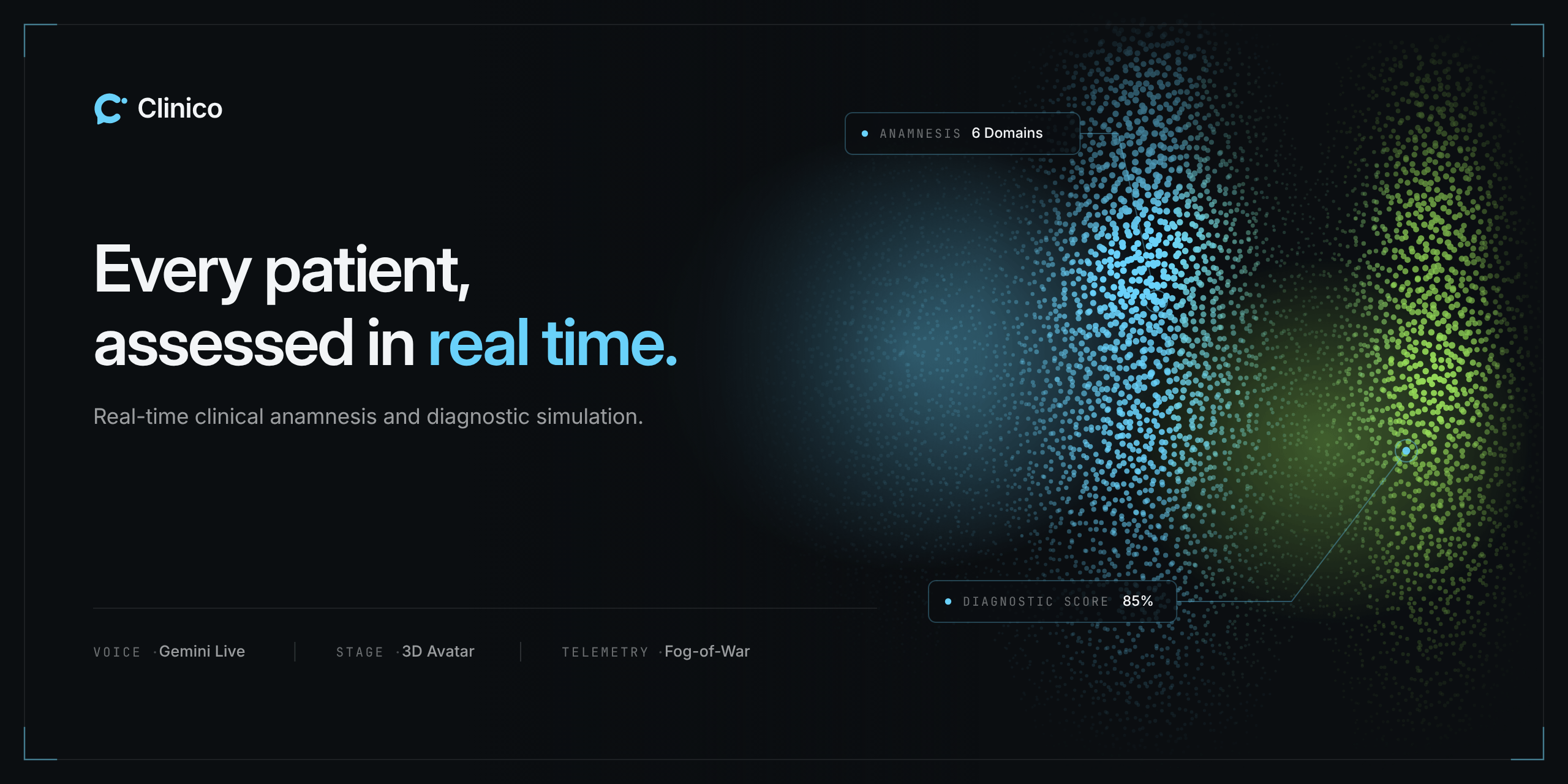
Clinico lets learners run full clinical interviews with a 3D virtual patient directly in the browser. You start by picking a medical specialty and a difficulty level from 1 to 10, choosing a prebuilt conflict scenario, or generating a new patient on the fly.
During the consultation, you speak naturally through your microphone (or switch to text chat at any point) with an English-speaking 3D avatar. Each patient has a consistent medical backstory, a distinct personality, and lay-language answers, holding back key symptoms until you ask the right follow-up questions or de-escalate tension.
Alongside the conversation, a live patient chart separates check-in data and existing ICD-10 diagnoses (complete with reference links to read up on each condition) from new clinical findings, which only appear in the chart once the patient has actually mentioned them. If you get stuck, you can ask for a context-aware coach hint that nudges your reasoning without giving away the answer. When you wrap up and submit your working diagnosis and disposition plan, Clinico scores your clinical coverage, red-flag screening, and empathy from 0 to 100 and tracks your active practice days over time.
How we built it
Clinico is a full-stack web application built with Next.js, TypeScript, and React, backed by PostgreSQL and Drizzle ORM for user accounts, session history, and progress tracking.
Live voice sessions stream audio to Gemini Live with automatic failover to OpenAI Realtime. To keep conversations usable in a noisy room, we built a 3-second ambient noise calibration step, echo suppression, English-only transcript filtering, natural interruption handling, and mobile audio routing. TalkingHead and Three.js drive the 3D avatar's lip-sync and facial expressions directly from the live audio stream.
Behind the scenes, DeepSeek and Gemini generate structured patient cases validated against a strict JSON schema with AJV. Each case separates fixed clinical ground truth from the patient persona so two students can take completely different conversational paths through the same case. A parallel extraction pipeline checks every turn against the transcript to unlock verified findings in the chart, while a multi-tier evaluation pipeline grades the finished consultation, backed by 745 automated tests.
Team contributions
- Colin Ziegler (
czett): Built the full-stack architecture, database and user authentication, the real-time voice pipeline (Gemini Live and OpenAI Realtime failover, ambient noise calibration, echo suppression, English-only filtering, and mobile audio handling), live semantic fact extraction, coach hints, post-session evaluation and progress tracking, voice-to-avatar lip-sync and emotion integration, and the redesigned clinical UI. - Jue Li (
Jue): Built the initial frontend foundation for the consultation, dashboard, profile, and results views, and collaborated with Colin on the component and layout structure for the UI redesign. - Randa Kamal (
randakamal237): Built the patient case schema and validation layer, the LLM provider abstraction and DeepSeek/Gemini case generation pipeline, the conversational patient prompt engine for selective disclosure, and prebuilt conflict scenarios, alongside early avatar exploration. - Vega Buchrieser (
star7-web): Integrated the 3D TalkingHead avatar foundation including age-group variants, outfits, consultation room backdrop, and facial expressions, and owned the pitch narrative, demo video production, and presentation.
Challenges we ran into
Building a voice-first clinical simulator for a live hackathon floor brought three main hurdles:
- Keeping voice latency low in a loud room: Standard voice detection triggers constantly on background chatter or speaker echo, so getting natural barge-in and clean turn-taking required ambient noise calibration, echo guarding, and reliable provider failover.
- Keeping the patient in character: Language models naturally want to be helpful and summarize everything in medical terms. Preventing the patient from leaking their diagnosis or dumping their whole history in one turn took strict separation between clinical data and persona rules.
- Synchronizing speech, emotion, and live extraction: Testing live microphone sessions showed how quickly a delayed reply, mismatched lip movement, or lingering facial expression breaks the illusion, and how carefully live chart extraction must stick to actual patient quotes so it never unlocks facts the student did not ask about.
Accomplishments that we're proud of
We shipped a live, full-stack clinical training app that works across desktop and mobile browsers, handles noisy environments through automatic voice failover and text fallback, synchronizes a 3D avatar's lip-sync and expressions to live speech, unlocks verified clinical findings in real time, and passes 745 automated tests.
What we learned
Believable patient interviews depend heavily on conversational timing and body language. A half-second audio hiccup or an expression that stays on screen too long immediately pulls the learner out of the scenario. Separating the fixed medical ground truth from the patient's emotional state also proved essential: it lets the patient react naturally to how the student communicates while keeping clinical grading objective.
What's next for Clinico
Next, we want to test Clinico directly with medical students and practising doctors to see which difficult conversations they feel least prepared for and refine our feedback rubrics. We also plan to expand the case library with de-identified clinical scenarios and explore deeper integration with Avelios workflows so learners can practise with realistic hospital charts and ICD-10 coding.
Try the live deployment at clinico.study.
Built With
- deepseek
- node.js
- react
- tailwind
- talkinghead
- typescript
