The Problem
Clinical trials
For a novel drug to gain approval and become available to patients, it has to undergo three phases of clinical trials. Each phase requires dozens to thousands of participants to determine the appropriate dosage, effectiveness, and safety of the drug. However, there is a significant need to improve communication between potential participants and researchers.
Participants' experiences
The protocols and study plans accessible to potential participants are often filled with technical jargon, making it difficult for patients to understand what to expect from the trial. This confusion can lead to participants unknowingly accepting risks or being discouraged from participating due to misunderstandings. A notable example is the BIA 10-2474 trial, which resulted in one participant being declared brain dead and four others suffering irreversible brain damage (Kaur, R., 2016). This tragic outcome highlights the gap between what patients understand and the risks they take.
Researchers' experiences
The current communication between potential participants and researchers is also not beneficial for researchers. This one-sided approach relies on patients to seek out information, often resulting in insufficient recruitment—approximately 80% of clinical trials close due to low enrollment (Clinical Trials Arena, 2022). Our team proposes ClinicalConsent as a solution to facilitate communication between potential participants and researchers, fostering a safer and more engaging interaction throughout the clinical trial process.
Our Solution
ClinicalConsent
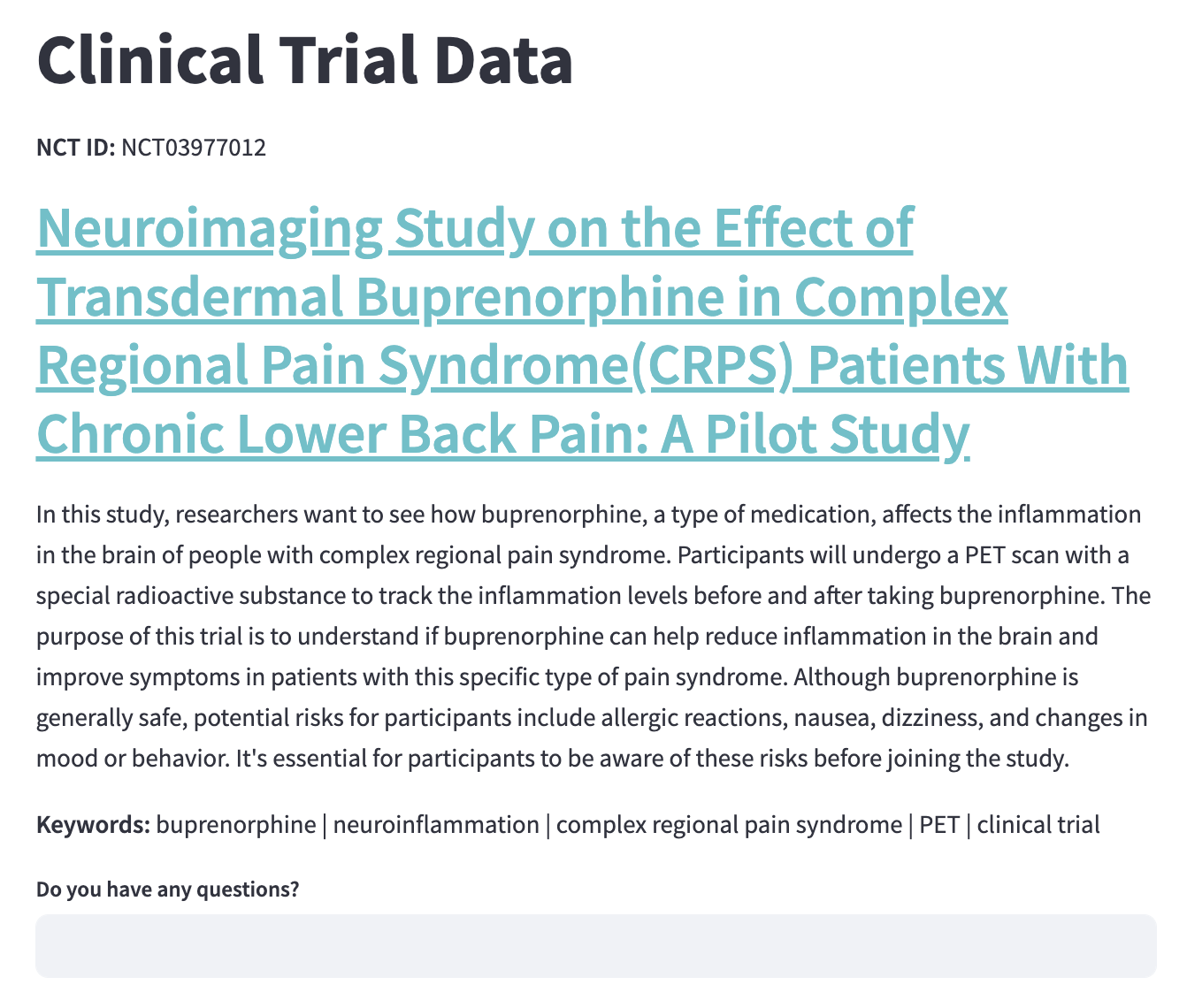
By utilizing the GPT API, ClinicalConsent simplifies complex study plans and protocols into clear, easily understandable information for participants. This approach reduces barriers to engagement in clinical trials. Additionally, our platform includes a recommendation system that matches potential participants with suitable clinical trials based on their profiles. Ultimately, we aim to enhance the clinical trial process and improve safety outcomes.
How we built it
Our team retrieved and processed existing clinical trial datasets from the ClinicalTrials.gov APIgenerating clear and concise summaries for each trial using the OpenAI API to make protocol descriptions easily understandable for non-experts. We also developed a real-time chatbot with the OpenAI assistant API to support users with any questions or gaps in understanding. To streamline the application’s functionality, we utilized Firebase DB to store data on participants, researchers, and clinical trials, which we later incorporated into a filtering system to provide optimal matches between participants and trials. The entire application is hosted on Streamlit.
Challenges we ran into
Our main challenges came from our first-time use of Firebase DB and the ClinicalTrials.gov API. Setting up four separate databases in Firebase for participants, researchers, clinical trials, and studies was a big challenge we managed to get through. We also hit Firebase's rate limit when attempting to process 67,000 records, which led us to upgrade our account. Additionally, understanding the data structure of the ClinicalTrials.gov API was challenging and took extra time, which slowed down our data import process. The retrieved data had many missing values and was unclean, requiring us to clean it for the filter function to work properly in our matching recommendation system.
Accomplishments we are proud of
One of our key accomplishments is adding over 67,000 clinical studies to ClinicalConsent, with the capacity to include more. We also optimized and implemented an assistance API to generate clear, concise summaries for each clinical trial. This resulted in over 200,000 API requests processed throughout the project. To handle the high volume of requests, we utilized UNC’s Research Computing Cluster, LongLeaf, and implemented batch processing for efficiency. For a smoother user experience, we created a dummy page in Streamlit, allowing the app to transition seamlessly between pages.
What's Next for ClinicalConsent
Currently, the data we retrieve from ClinicalTrials.gov does not categorize participant eligibility into high, medium, and low; instead, it either matches participants to a study or excludes it from the participant view if they do not meet eligibility criteria. In the future, if we convert this data into a categorized format or if researchers upload trials through our platform, we can utilize them to provide more optimal matches due to the more granular options we offer. Furthermore, our system can be expanded to enable researchers to automate outreach to potential participants who are optimal matches taking the burden off of researchers recruiting human subjects for their work and allowing more time to be spent on research.


Log in or sign up for Devpost to join the conversation.