Inspiration
Finding a clinical trial is only the first step. The harder question is: Is this trial actually suitable for this patient, and why?
Clinical trial eligibility criteria are long and complex, while the information needed to evaluate them is scattered across diagnoses, biomarkers, treatments, laboratory results, and clinical notes.
We built TrialBridge to turn clinical trial discovery into a transparent, evidence-based eligibility workflow for both humans and AI agents.
What it does
TrialBridge helps users discover cancer clinical trials and evaluate eligibility at the individual criterion level.
Instead of generating a single match score, TrialBridge breaks eligibility criteria into structured checks and classifies each one as:
- Matched
- Unmatched
- Missing information
- Requires clinical review
Every assessment is linked to the original trial criterion and the corresponding patient evidence, making the reasoning independently reviewable.
TrialBridge also identifies actionable eligibility gaps. A patient may need a biomarker test, updated laboratory result, completion of a treatment washout period, or clinician confirmation.
This means TrialBridge can distinguish between:
Not eligible now ≠ Not enough information ≠ Potentially eligible later
How we built it
We designed TrialBridge as a structured eligibility engine rather than a conventional semantic-search system.
Trial criteria are decomposed into individual inclusion and exclusion requirements. Patient information is normalized into structured clinical facts including diagnosis, stage, biomarkers, treatment history, laboratory values, performance status, and relevant dates.
AI helps interpret unstructured clinical language, while deterministic rules evaluate conditions such as numerical thresholds, dates, treatment history, washout periods, and explicit exclusions.
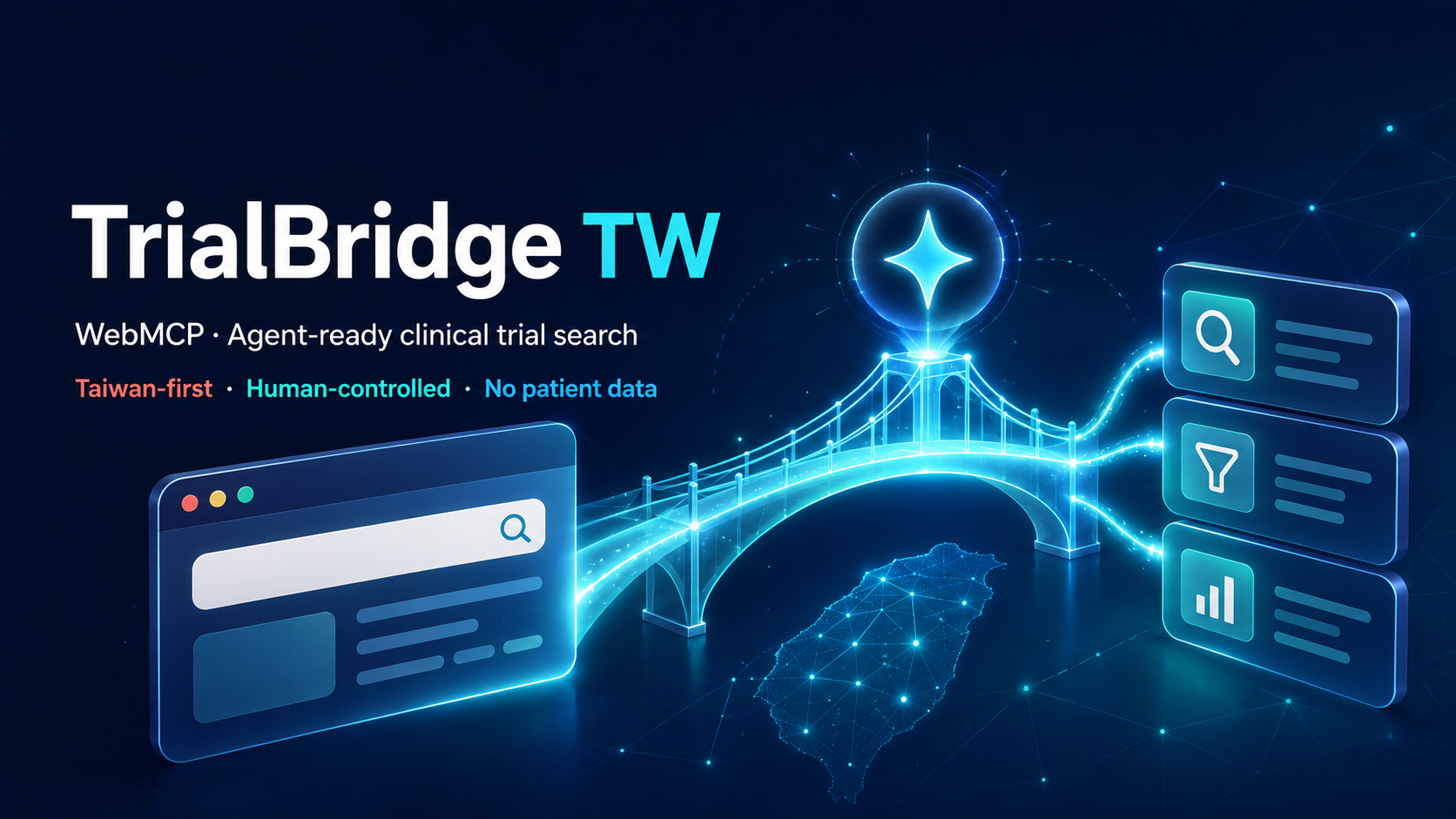
We also implemented WebMCP, allowing compatible browser agents to discover and invoke TrialBridge capabilities directly from the website.
Public trial-search tools can be discovered through the browser's model context. Patient-context tools are dynamically exposed only after explicit permission, allowing the available agent capabilities to change with the application's state.
This makes TrialBridge not just an AI-powered website, but an agent-ready clinical trial workspace.
Challenges we ran into
The biggest challenge was uncertainty.
Clinical eligibility criteria contain ambiguous language, temporal conditions, nested logic, and requirements that ultimately depend on clinical judgment. Patient information may also be missing, outdated, or conflicting.
A naive matching system can easily mistake missing information for either eligibility or ineligibility.
We therefore created explicit uncertainty states and separated AI-assisted interpretation from deterministic eligibility checks.
We also needed a safe way for AI agents to interact with clinical workflows. Instead of exposing every capability by default, our WebMCP implementation makes tool availability dependent on explicit user permission and application state.
Accomplishments that we're proud of
We built a working prototype that connects:
Trial discovery → Criterion-level matching → Evidence → Eligibility gaps → Agent interaction
TrialBridge does more than rank trials. It explains why a patient may qualify, which evidence supports the assessment, what information is missing, and what could make the patient eligible later.
We are especially proud of:
- Criterion-level explainability with traceable patient evidence
- Explicit uncertainty handling instead of forcing binary decisions
- Future eligibility reasoning for potentially resolvable barriers
- Actionable missing-data identification
- WebMCP-native tools that browser agents can discover and execute
- Permission-aware tool exposure for patient-context workflows
These features transform TrialBridge from a trial search engine into an explainable, agent-ready clinical trial eligibility workspace.
What we learned
We learned that clinical trial matching is not simply a search or ranking problem.
Reliable matching requires structured clinical facts, temporal reasoning, uncertainty management, deterministic validation, and human oversight.
We also learned that explainability must be built into the architecture. A clinically useful system should not only answer:
“Which trial matches?”
It should also answer:
“Why?” — “Based on what evidence?” — “What is missing?” — “What happens next?”
Building TrialBridge with WebMCP also showed us a new way for AI agents to interact with clinical software: instead of giving an agent unrestricted access, the application itself can control which tools are discoverable based on user permission and context.
What's next for TrialBridge
Next, we plan to expand TrialBridge from a working prototype toward prospective clinical validation.
We plan to integrate real-time trial registry data, improve automated eligibility parsing, and connect with structured EHR data through standards such as FHIR.
We also want to add:
- Site-level recruitment verification
- Multilingual patient-friendly explanations
- Automated missing-data checklists
- More advanced temporal eligibility reasoning
- Prospective evaluation with clinical trial coordinators
- Expanded WebMCP workflows for agent-assisted screening
Our long-term goal is for TrialBridge to become the bridge between patients, clinical evidence, trial teams, and AI agents—while keeping final eligibility and enrollment decisions with the responsible clinical trial team.
Built With
- chrome
- clinicaltrials.gov-api
- docker
- fastapi
- libsql
- netlify
- next.js
- ollama
- python
- react
- turso
- typescript


Log in or sign up for Devpost to join the conversation.